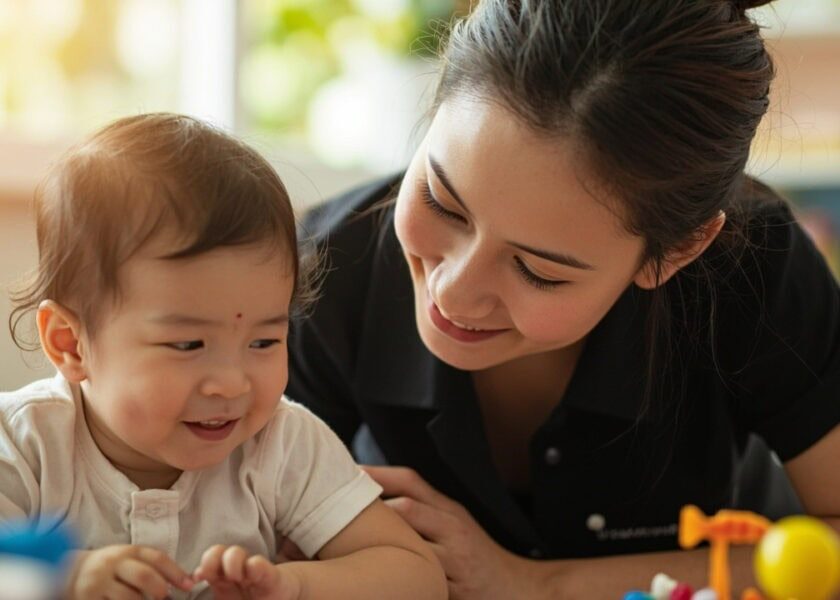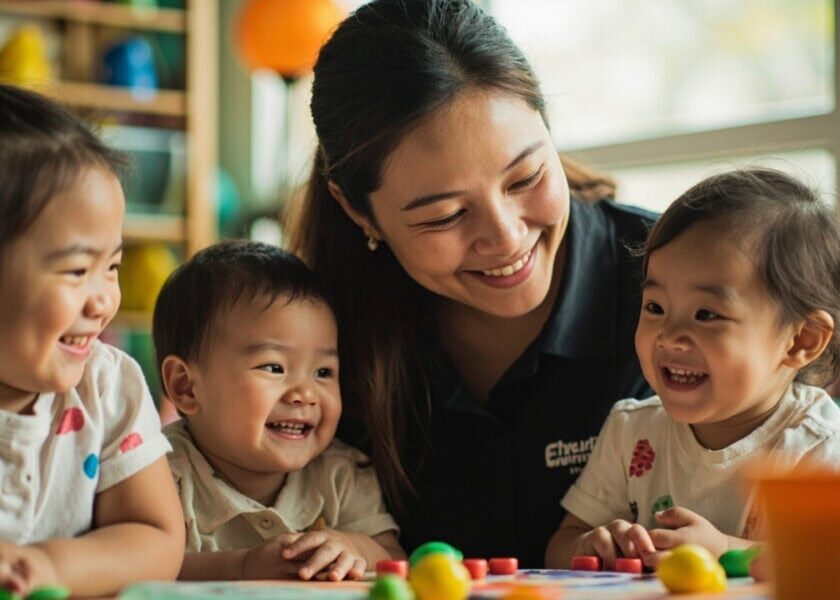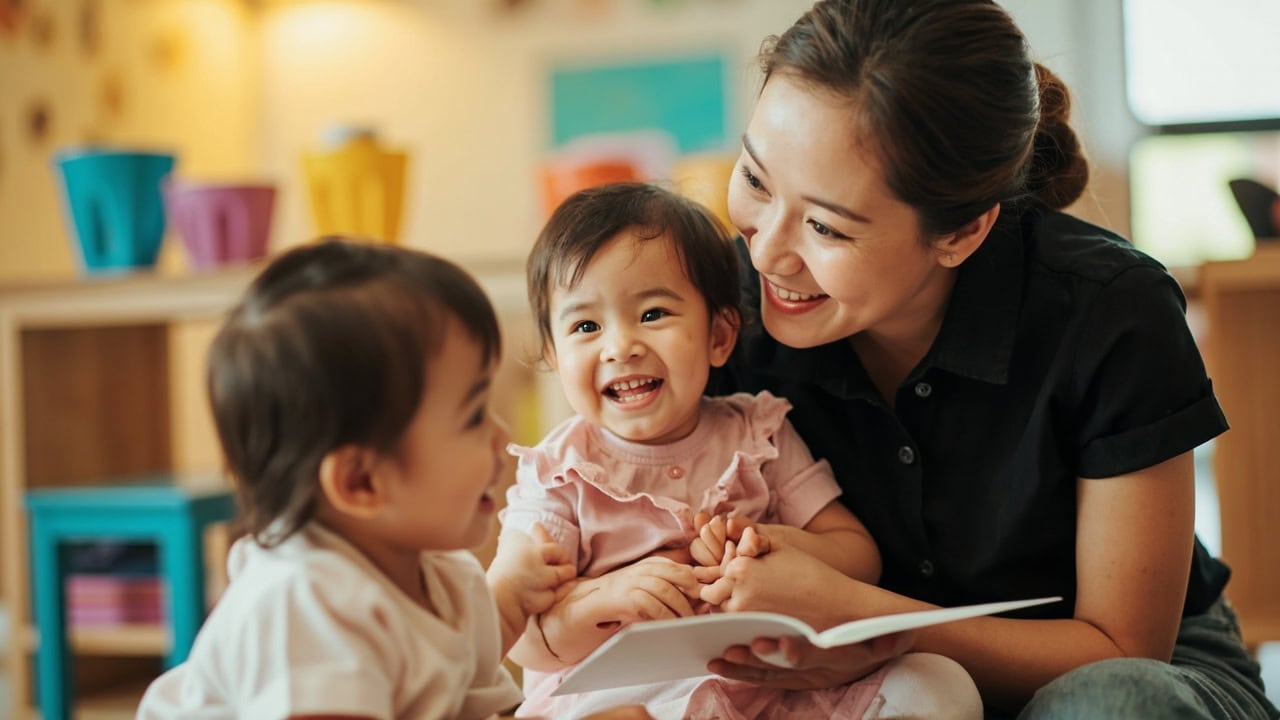
Five Signs Your Child Is Developing Beyond Just Being Watched
What Is My Child Actually Becoming in There?
There is a moment, every single day, that every parent in Singapore knows. It happens at pickup. The door opens. Your child looks up. And in the space between the smile and the wave, between the backpack and the transition, there is a question you carry in your chest before you even realize it’s there.
Not was my child safe today. That question has already been answered by the fact that she is standing in front of you, whole and happy.
The question underneath the question — the one you may not even say aloud to yourself — is something different:
What is my child becoming in there?
Not what did she eat. Not who she played with. Not whether she napped. But what is growing inside her during all those hours when you are not in the room. What neural pathways are being built. What capacity is taking shape. What version of herself is quietly, invisibly, emerging.
That question is not a worry. It is a love letter. And it is the question that this article was written to help you answer — not in theory, but in the daily, observable reality of what happens when a child’s development is held by people who understand exactly what they are holding.
The Gap Between What You’re Told and What You Need to Know
Most parents in Singapore are navigating something extraordinary and largely unspoken. You are raising children in one of the most demanding urban environments in the world. You are balancing professional ambitions with the deepest personal responsibility you will ever carry.
You are making decisions about your child’s earliest years — years that neuroscientists now understand carry more developmental weight than any decade that follows — while managing work commitments, financial planning, extended family expectations, and the quiet, constant undertow of wondering whether you are doing enough.
The conversation around childcare in Singapore has, for too long, focused on the wrong things. It has focused on safety. On supervision. On logistics. On whether a centre is clean enough, whether ratios are compliant, whether the fee structure fits the budget.
These things matter. But they are the floor, not the ceiling. They are the minimum standard, not the measure of what your child deserves.
What you actually need — what you are searching for in every search bar and every school tour and every conversation with other parents — is a place that will shape your child. That will see your child. That will understand the extraordinary, fragile, magnificent work of human development happening inside that small body and will tend to it with the same care and intentionality you bring to it yourself.
The Science Behind Early Development
Here is what research tells us: The first years of life are not a warm-up for the real business of growing up. They are the real business.
By the time a child reaches three, their brain has formed more than one thousand trillion neural connections — more than it will ever form again. This is not a metaphor. This is measurement.
The speed at which the human brain develops in the first thousand days is greater than at any other point in the lifespan. Synaptic pruning, myelination, the architecture of emotional regulation, the foundations of language, the patterns of social engagement — these are not waiting for primary school. They are being built right now, in every interaction, every response to a need, every moment of being held or spoken to or challenged just slightly beyond current capacity.
Developmental scientists call these sensitive periods: windows of opportunity that open, flourish, and eventually close. A child’s brain is extraordinarily plastic in these early years — it is building itself based on experience. Every sensory input, every caregiver response, every moment of secure attachment or unresolved stress leaves a fingerprint on the architecture that will define how this child thinks, feels, learns, and connects for the rest of their life.
You may not have known this when you became a parent. But now, watching your child, you are beginning to understand it in your bones.
- A word your eighteen-month-old said that you do not remember teaching
- The way your two-year-old navigated a conflict with another child — with a kind of social awareness that was not there last month
- The way your infant reaches for you differently now — more deliberately, more confidently
You have started to see growth. But you are also wondering whether what you are seeing is real, whether it is enough, and whether the place your child spends most of their waking hours has anything to do with it.
That wondering is not doubt. It is the beginning of seeing.
Maintenance vs. Shaping: The Crucial Distinction
There is a difference, and it is important, between childcare that maintains children and childcare that shapes them.
Maintenance childcare is not a moral failing. It is simply a different level of intention. A maintained child is fed, changed, supervised, kept safe, entertained. A maintained child gets through the day. In a city like Singapore, where the cost of living is real and the need for dual incomes is often unavoidable, maintenance childcare serves an essential function for many families.
But it is not what your child deserves at the level of their developing brain. And it is not what you are actually looking for, even if you do not yet have the language for it.
Shaping childcare is the deliberate, informed, observationally precise work of supporting a child’s development across every domain:
- Language and communication
- Social and emotional regulation
- Gross and fine motor development
- Cognitive exploration
- Self-concept and confidence
It is the difference between a caregiver who sees a child crying and thinks I need to stop this crying and a caregiver who sees the same child crying and thinks:
- What is this child trying to tell me?
- What skill are they practicing right now?
- What do they need to move from dysregulation to co-regulation?
- How do I support that process in a way that builds rather than suppresses?
That second set of questions takes training. It takes time. It takes ratios that allow a caregiver to actually observe rather than merely supervise. And it takes a culture in which every caregiver understands that their role is not to entertain children but to be the architect of their growth.
What Quality Care Produces: Five Areas of Observable Growth
Here is what this looks like in concrete terms — the actual developmental outcomes you can watch emerge in your own child.
1. Language Growth That Is Not Accidental
In quality, development-focused care, language growth is supported through the caregiver’s own vocabulary and response patterns. Consider what happens when a caregiver:
- Narrates a child’s actions back to them in real time
- Expands their single words into full sentences (“Ball! Yes, you found the red ball!”)
- Reads books not as a time-filler but as an intentional language-building exercise
- Responds to a child’s vocalizations as though they are real communication
Children in language-rich care environments enter preschool with measurably larger vocabularies — not because they are inherently smarter, but because their brains received the right kind of input at the right time during sensitive developmental windows.
What you might notice at home: Your child begins using two-word combinations unexpectedly. They start naming things in the environment. Their comprehension seems to leap ahead of their speech.
2. Emotional Regulation That Is Taught, Not Assumed
In quality care, emotional regulation is not left to chance. It is taught, gently and consistently, through co-regulation — the process by which a calm, attuned caregiver helps a distressed child move back to a regulated state.
This is not permissive. It is the precise, skilled work of naming emotions, holding boundaries, and teaching a child that big feelings are survivable and that help is available.
Children who experience consistent co-regulation in their early years develop stronger prefrontal cortex function — the part of the brain responsible for impulse control, decision-making, and emotional intelligence. This is not a soft skill. It is neurological development.
What you might notice at home: Your child recovers from meltdowns more quickly. They begin to name their own emotions. They look to trusted adults for help when upset rather than escalating.
3. Social Confidence That Is Scaffolded
In quality care, social curiosity is cultivated through structured and unstructured opportunities to be with other children — under the close, trained observation of caregivers who understand group dynamics, who model conflict resolution, who know when to intervene and when to let children practice.
Social development does not happen naturally on its own. It needs scaffolding. It needs safe social laboratories in which children can experiment with sharing, with turn-taking, with the full, overwhelming experience of another child who wants the same toy.
What you might notice at home: Your child shows interest in other children. They attempt to engage in parallel play or cooperative play. They begin to notice and respond to other children’s emotions.
4. Motor Development That Is Intentional
In quality care, motor development is supported through intentional environments — the kind of space design that invites crawling, climbing, and balance-challenging movement. The kind of fine motor activities that build hand strength and dexterity, which will later enable a child to hold a pencil, to write, to manipulate objects with precision.
Gross motor development builds core strength and coordination. These are not luxuries. They are the physical foundation of everything else.
What you might notice at home: Your child masters a new physical skill — stacking blocks higher, climbing the playground structure independently, showing more precision in their hand movements.
5. A Sense of Self That Is Being Built
Something harder to measure but profoundly important happens in quality care: a child’s sense of self is developing. You can see it in:
- The way they hold their bodies around other children
- The confidence with which they explore a new environment
- The security with which they separate from a parent at drop-off because they have internalized that departures are followed by returns
This happens when a child is consistently seen, consistently responded to, consistently held in mind by caregivers who understand that every interaction is either building or undermining that fundamental sense of I am capable, I am valued, I am safe.
What you might notice at home: Your child separates more easily. They assert preferences. They show curiosity and confidence in new situations. They refer to themselves and their abilities with increasing certainty.
Seeing the Evidence: Building Developmental Trust
Here is something important that quality childminding services understand: parents are not passive observers of this process. You are co-creators of your child’s development, and your capacity to see what is happening — to recognize meaningful growth when it occurs — is one of the most powerful forces in their development.
When you know what to look for, and when you see it, something shifts. The daily anxiety — the low-grade, background hum of is this working, am I making the right choice — begins to quiet. Not because the uncertainty disappears entirely, but because it is replaced by evidence.
This is what we call developmental trust — and it is different from blind trust. It is not the trust that says I hope this is good enough. It is the trust that says I can see that this is working. It is earned through observation, through transparency, through communication that actually shows you what is happening — not just what was on the schedule.
Common Questions, Answered Honestly
If you are researching infant care and childminding in Singapore, you likely have specific concerns. Here are the most common ones.
“Is home-based care as quality as centre-based?”
What matters is not the setting but the intentionality, training, and ratios within that setting. A home environment can offer extraordinary developmental advantages — familiarity, smaller ratios, a domestic setting that supports language and exploration. What matters is whether the caregiver is trained, whether the ratios allow for attunement, and whether the programme is grounded in developmental science rather than mere supervision.
“How do I know if my child is actually developing well?”
You are already noticing more than you realize. The word that appeared overnight. The way your child handled frustration. The confidence in their separation. These are real developmental indicators. Quality care programmes that prioritize communication and documentation can help you understand what you are looking at.
“What if my child doesn’t adjust well?”
Adjustment takes time, and quality caregivers understand this. Separation is hard — for children and for parents. But the difference between a child who is being maintained and one who is being shaped often becomes visible in how they begin to settle over time. A child in quality care typically moves from anxiety to security, from uncertainty to confidence.
What Quality Childminding Looks Like in Singapore
Singapore has taken thoughtful steps to recognize and elevate the role of professional childminding within the early childhood ecosystem. The ECDA Childminding Pilot represents an understanding, at a policy level, that the early years matter. That the people who tend to children in these years are not babysitters. That quality childminding, when done well, can provide something extraordinary for a child’s development.
Within development-focused programmes like EduNanny Singapore, there are generally two pathways available to families:
- Home-based childminding: A trained, vetted caregiver comes to your home and provides development-focused care within your child’s own environment
- Community and centre-based options: Caregivers operate within structured, quality-assured settings
Both pathways are grounded in the same developmental philosophy. The environment changes. The intentionality does not.
Ratio That Allows for Attunement
With smaller ratios — up to one to three infants in a home-based setting — your child is not one of many. Your child is seen. Every response, every milestone, every moment of growth is noticed by a caregiver who has the time and the training to notice it. This ratio is the difference between supervision and attunement.
Trained, Intentional Caregivers
Quality childminding is built around caregivers who understand developmental science, who can read a child’s cues, who know how to support growth rather than simply manage it. This training matters — not as credentials alone, but as the foundation of every interaction.
Transparent Communication
Parents deserve to see what is happening in their child’s day — not through surveillance, but through genuine observation documentation and updates that help you understand the developmental narrative unfolding. This transforms childcare from a black box into a partnership.
Responsive Rather Than Scheduled
A curriculum that is a responsive map of developmental progression, not simply a schedule of activities. The best days in quality care rarely look the same, because they are built around the children’s actual needs and interests, not predetermined routines.
Questions to Ask When Evaluating Care Options
| Area | Questions to Ask |
|---|---|
| Language and Communication | How does the caregiver interact with children during routine activities? Is conversation encouraged throughout the day, not just during designated “learning” time? |
| Emotional Support | What happens when a child is upset? How does the caregiver approach emotional regulation? Is co-regulation part of their training? |
| Social Development | How are opportunities for social interaction structured? Are caregivers trained to observe and scaffold peer interactions? |
| Motor Environment | Is the space designed to support physical exploration? Are fine motor activities part of the daily routine? |
| Communication with Parents | How will you know what happened in your child’s day? What kind of documentation or updates can you expect? |
| Caregiver Training | What training do caregivers have in child development? Is ongoing professional development part of the programme? |
The answers to these questions will tell you whether you are looking at maintenance childcare or shaping childcare — and that distinction matters more than any marketing claim.
At Pickup, When Your Child Looks Up
Every child who spends their earliest years in quality, development-focused care is building something that will last a lifetime.
- The language they are acquiring right now will be the foundation of their literacy.
- The emotional regulation they are learning right now will shape their relationships for decades.
- The social confidence they are developing right now will influence how they lead, how they collaborate, how they love.
- The motor skills they are honing right now are building the physical capacity they will carry into every physical act of their lives.
This is not sentiment. This is the science of human development, applied.
And every parent who has the courage to trust a part of this work to someone else — whether through home-based childminding, through a community setting, through a centre — is not outsourcing their child’s development. You are choosing a partner. You are extending your village. You are making a decision that reflects not a lack of commitment but a profound understanding of what your child needs — which is not just you, but a trained, caring, developmentally informed team that sees your child the way you see your child, and acts on that sight every single day.
Let us return to that moment.
At pickup, your child looks up. And in that moment, before you have said a word, your child is telling you something. They are telling you whether those hours were filled with responsiveness or mere watching. Whether the people who cared for them were present or just present. Whether they spent the day being maintained or being shaped.
You may not yet have the language to read everything your child is showing you. But you are learning. You are noticing the vocabulary that appeared overnight. The way they handled frustration with something that looked almost like skill. The way they walked into the room — not with the tentative uncertainty of a new visitor, but with the quiet confidence of a child who belongs there.
That is what quality care looks like from the inside. It looks like your child, visibly, measurably, becoming more themselves than they were yesterday.
That is what quality childminding is here for. To be the place your child is becoming in. To give you, every single day, the evidence you deserve — that your child is not just being watched, they are being grown.
And to give you, in the process, something invaluable: the quiet, profound relief of watching your child and knowing — not hoping, not trusting blindly, but knowing — that you chose this. That it is working. That the question you have always carried at pickup — what is my child becoming — is one you no longer have to carry alone.
You can see the answer for yourself. And it is extraordinary.
If you are looking for childcare that sees your child — not just watches them — EduNanny Singapore offers development-focused childminding programmes designed around the science of early childhood. Learn more about our approach or connect with our team to find the right fit for your family.