Singapore Families Are Designing Their Villages on Purpose
The Quiet Question Every Singapore Parent Carries
There is a question that lives in the pause before answering well-meaning relatives. It surfaces in the hesitation when grandparents offer with such generous intention. It emerges in late-night conversations between partners who want to honor their roots while building something that actually fits their lives.
The question is this: How do we care for our children in a way that feels true to who we are, true to where we came from, and right for the family we are becoming?
This is not a question about quality checklists or credential comparisons. It is a question about identity. About authorship. About the kind of family you are choosing to be.
In Singapore, we have long spoken about the village it takes to raise a child. This metaphor has served us well. It acknowledges that childcare has never been the work of one person alone, that families are embedded in communities, and that raising the next generation requires a network of care.
But we have outgrown one assumption embedded in that metaphor. The village, as we inherited it, was something you received. You were born into it, or you married into it, or you simply accepted it as the arrangement that had always existed. The village arrived. You did not design it.
What is happening now, quietly and with considerable courage, is that Singapore families are beginning to build their villages on purpose.
The Evolution of the Singapore Village: From Received to Designed
For generations, the village that raised Singapore children operated on clear, unspoken assumptions. Grandparents would help. Extended family would step in. The community would provide. These arrangements were not chosen so much as inherited—they simply were, the way things had always been done.
This is not wrong. These traditions emerged from genuine wisdom: children thrive when surrounded by loving family. Intergenerational bonds carry irreplaceable value. The knowledge passed down through generations contains deep truths about nurturing young lives.
But something has shifted. Singapore families today navigate realities that previous generations did not face in the same way. Careers that demand presence during hours when grandparents may not be available. Homes spread across the island, not clustered in kampongs. Lifestyles built around dual incomes and professional identities that did not exist for many parents thirty years ago.
The result is a growing gap between the village families inherited and the village they actually need.
What “Building on Purpose” Actually Means
Building your village on purpose does not mean dismantling what came before. It means something more thoughtful: taking what works from tradition, honoring what has meaning, and adding what is needed.
Consider what this looks like in practice. A grandmother who spent decades raising her own children wants nothing more than to help with her grandchildren. Her offer comes from a place of love, of legacy, of a deep belief that family should care for family. It is beautiful.
But alongside that offer is a daughter who has built a career she values, who has her own understanding of child development, who may live across the island and navigate a commute that leaves no room for the flexibility a grandparent arrangement assumes. She does not want to refuse her mother’s love. She also does not want to inherit an arrangement that will quietly erode her sense of agency, or compromise the quality of care she believes her child deserves, or leave her in a position where she is always negotiating, always compromising, always feeling that she has disappointed someone she loves.
The answer is not to choose between them. The answer is to build something that holds both.
The Three Roles of a Modern Family Village
When you design your village intentionally, three distinct roles emerge—each valuable, each in its rightful place:
- Grandparents as grandparents: Present, loving, connected to legacy and tradition. Free to enjoy grandchildren without bearing the weight of being the primary or only option.
- Parents as parents: Confident in their choices, present in their own way, supported by systems that allow them to parent from a place of strength rather than exhaustion.
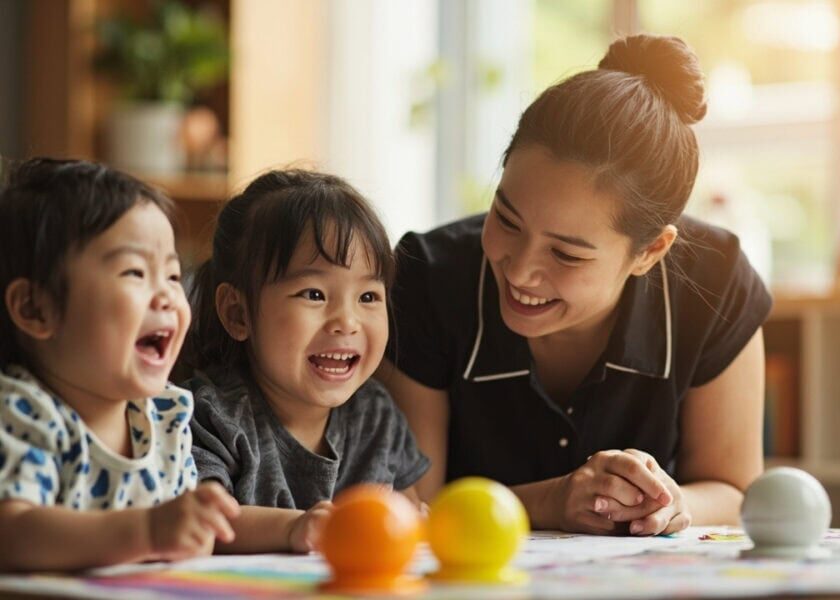
- Professional partners as professional partners: Bringing trained expertise, consistent quality, and the kind of attention that comes from manageable ratios and genuine professional commitment.
None of these roles diminishes the others. In fact, when each role operates from its proper foundation, the whole system functions better. Grandparents enjoy their grandchildren. Parents show up with energy. Children receive consistent, quality attention.
The Question That Gets Asked
There is a question that sits at the heart of what many Singapore families are wrestling with. It often goes unasked in polite conversation, but it surfaces in the quiet moments when parents make decisions about childcare.
The question is whether choosing professional care is somehow a lesser form of love. Whether it means you are delegating what should belong to family. Whether the presence of a trained caregiver diminishes the role of parents or grandparents.
This question deserves a direct answer.
Love is not measured by who is in the room. It is measured by the quality of thought you bring to the decisions you make for your children.
Love is choosing the care that helps your child thrive, even when it requires having difficult conversations. Love is building the support system your family actually needs rather than the one you were handed. Love is recognizing that your parents gave you everything they had, and that honoring that gift sometimes means doing things differently—not repeating them exactly, but carrying their intention forward in ways that fit your life.
The families who seek professional care partnerships are not looking for someone else to raise their children. They are looking for a partner who will care for their children with the same intentionality they would bring themselves. They are looking for transparency, for communication, for the kind of professional rigor that allows them to trust what they cannot always see.
That is not delegation. That is stewardship.
What Quality Childminding Actually Means
For professional care to feel like a true partnership rather than a compromise, certain elements must be present. These are not luxuries—they are the foundations that allow parents to trust, children to thrive, and families to function well.
What to look for:
- Trained caregivers: Professional development matters. Caregivers who understand child development, safety protocols, and responsive caregiving are better equipped to support your child’s early years.
- Appropriate ratios: In infant care, smaller ratios mean genuine attention rather than mere supervision. When one caregiver is responsible for fewer children, each child receives the responsiveness they need.
- Home-based environments: Children cared for in familiar, warm home settings often experience less disruption and stress. The continuity of environment matters for young children who are still developing security and attachment.
- Communication systems: Regular updates, open lines of communication, and transparency about daily routines help parents stay connected to their child’s experiences even when they are apart.
- Consistent presence: A familiar caregiver relationship, rather than rotating staff, allows children to form secure attachments and gives parents continuity of trust.
The ECDA Childminding Pilot
In Singapore, the Early Childhood Development Agency (ECDA) Childminding Pilot represents an important recognition: home-based care, when it meets rigorous standards, can be one of the most powerful expressions of what modern family support can be. It acknowledges that families need options beyond center-based care—options that can fit the texture of actual Singapore family life.
Organizations participating in this pilot have committed to standards that make professional home-based care a genuine partnership with families, not simply an arrangement.
The Freedom of Designing Rather Than Defaulting
There is a particular kind of freedom that comes when a family stops trying to make an inherited arrangement work and starts building the one they actually need.
It is not a freedom from responsibility. It is a freedom from pretense. It is the freedom of saying, this is what we have, this is what we need, and we are choosing accordingly.
This freedom shows up in different ways for different family members:
- For grandparents: The freedom to enjoy grandchildren without the weight of being the only option. The freedom to be present as family, not as unpaid childcare labor.
- For parents: The freedom to return to work without guilt because they know their child is not just cared for but cherished. The freedom to trust their care arrangements and show up fully present when they are home.
- For children: The freedom that comes from consistent, quality care. The freedom to explore, to grow, to become secure in the knowledge that their needs will be met.
- For the whole family: The freedom of functioning as a family rather than a childcare arrangement held together by obligation and silence.
This freedom is not selfish. It is generative. It creates the conditions for everyone in the family ecosystem to show up as their best self.
EduNanny’s Approach: Partnership in Practice
EduNanny was built with the reality of modern Singapore families in mind. Not as a service that steps in where family leaves off, but as a partner that works alongside family—bringing professional quality, genuine warmth, and the kind of intentionality that transforms childcare from an arrangement into an architecture.
When families choose EduNanny, they gain access to caregivers who are trained, vetted, and supported by an organization that holds itself to standards worthy of the trust families place in them.
Philosophy without logistics is just sentiment. EduNanny’s participation in the ECDA Childminding Pilot reflects a commitment to practical realities Singapore families face:
- Availability: Care during the hours when work demands presence, Monday to Friday
- Affordability: Fee structures that feel sustainable, not structures that require choosing between quality and financial sanity
- Accessibility: Acceptance of payment mechanisms families have planned around, including government subsidies where applicable
- Infant care focus: Ratios that allow for genuine nurturing rather than mere supervision, recognizing that the first years require more than attendance
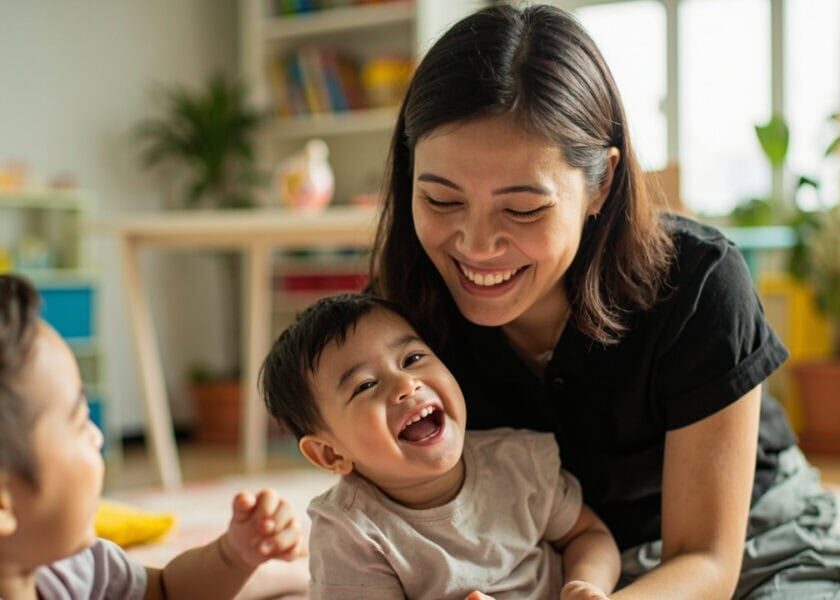
A child cared for in their own home, in a familiar environment, by a trained professional, with a ratio that allows for genuine attention—this is not a child missing a village. This is a child living inside one that was designed for them.
The Family You Are Building
Here is what is true: the family you are building is not a lesser version of the families that came before. It is not a departure from tradition. It is tradition continuing, evolving, expressing itself through the particular circumstances of your life, your values, your children.
The village your children will inherit from you will not be the village you inherited. It will be better, because it will be designed. It will reflect who you actually are, rather than who someone else assumed you would be.
That is not a loss. That is the whole point.
Singapore parents are not looking for permission. You do not need to be told that your choices are valid or that you should not feel guilty. You are adults who have thought carefully about your lives, who love your children deeply, and who are doing your best to build something that works.
What you are looking for is support. Partnership. A village that works on purpose.
EduNanny exists to be that partner. Not to replace the village, but to help build it. To bring professional quality to the heart of the family. To stand alongside parents as you navigate the conversations you need to have, make the decisions that feel true, and build the relationships that will sustain your family across generations.
Welcome to the village being built, not received. Welcome to the future of family.
If you are exploring infant care or childminding options in Singapore, EduNanny welcomes the opportunity to learn about your family’s needs. Whether you are navigating conversations with extended family, seeking clarity on your options, or ready to find a care partner who aligns with your values, we are here to listen.
Your family deserves support that feels true to who you are. Start the conversation today.