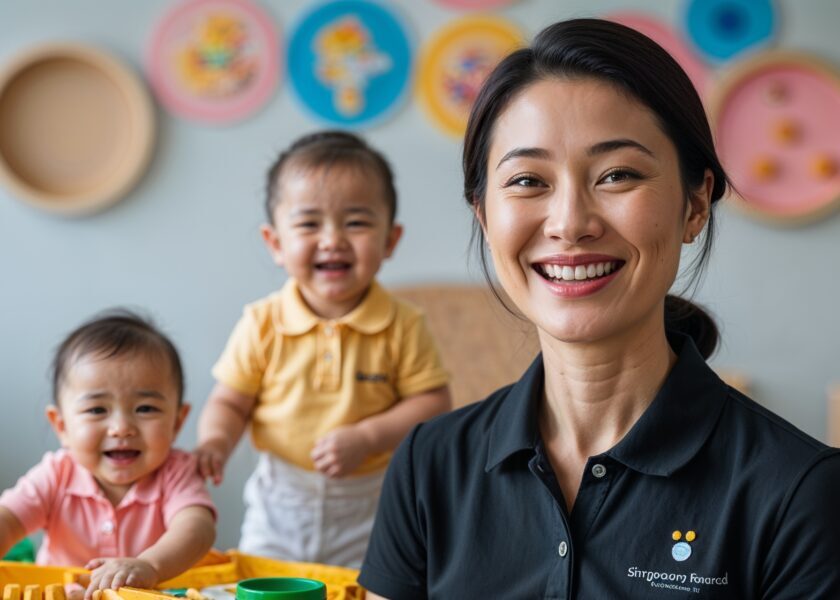
Who Singapore Parents Become When They Choose Quality Childcare
The Question You Almost Never Ask
There is a version of every parent in Singapore who, somewhere between the midnight feeds and the morning rush, pauses and asks a question they almost never say out loud. The question is not only about their child. It is about themselves.
They ask it in the quiet of the nursery, in the back seat of a Grab while heading to a meeting they almost cancelled, in the moment before the door closes behind them at the childcare centre. The question goes something like this:
Who am I becoming in all of this?
And then, almost immediately, they set the question aside. Because the world around them has made it very clear what they are supposed to feel. They are supposed to feel guilty for needing support. They are supposed to feel that asking for help is an admission of something lacking. They are supposed to frame every childcare decision entirely around the child, as if the parent is simply a vessel for logistics and guilt — and not a human being whose own growth, capacity, and identity are being quietly forged in these early years.
But what if that assumption is incomplete? What if the childcare decision you are making right now is not just about finding the best environment for your child, but also about choosing who you want to become?
Redefining What Quality Childcare Means
The decision to choose quality childcare is not a compromise. It is not a lesser option. It is not a concession made by parents who care less or love less or sacrifice less.
When a parent in Singapore makes the deliberate, thoughtful choice to find the right care for their child, they are not stepping back from parenting. They are stepping forward into a more sustainable, more intentional, more whole version of themselves as parents.
Here is what happens when a parent finds care that genuinely meets their child’s needs. When they trust the hands holding their baby. When they know that their child is safe and learning and loved during the hours they are not together:
Something shifts. The guilt does not disappear entirely — Singapore parents are too thoughtful for that. But it loses its grip. It becomes smaller. Because what takes its place is something far more powerful: the knowledge that their child is thriving and so are they.
What You Get Back When Your Child Is Well-Cared For
- Presence. When you are not operating from a baseline of anxiety about your child’s welfare, you are able to be truly present. You are able to listen. You are able to respond with patience instead of reacting from depletion.
- Attention. You become the parent who sits on the floor and plays without glancing at your phone. The parent who notices the small things — the new word, the funny expression, the moment of wonder.
- Clarity. You can leave work at a reasonable hour without the cloud of guilt that has become so familiar it almost feels like background noise. You can think clearly. You can make good decisions.
- Capacity. You have room to breathe, to think, to be something more than a logistics coordinator for your child’s schedule.
The First Thousand Days: Yours and Theirs
You have probably heard of the first thousand days — the extraordinary window of development from conception to approximately two years of age. It is often described as the period when the child’s brain forms connections at a rate that will never be repeated, when the architecture of future learning and emotional regulation is being laid down.
But those thousand days are not only your child’s thousand days. They are also yours.
They are the thousand days in which your identity as a parent is being formed. They are the days in which you are discovering, often through trial and error and exhaustion and unexpected moments of profound joy, who you are in this new role.
You are not the same person at the end of those thousand days that you were at the beginning. Neither is your child. Both of you are growing. Both of you are becoming.
The question is not whether this transformation will happen. It will. The question is whether you will have the support to experience it with your capacity intact — whether you will have the infrastructure that allows you to grow alongside your child instead of simply surviving alongside them.
What Quality Childcare Actually Looks Like
EduNanny is part of the ECDA Childminding Pilot, and that matters for a reason you may not immediately see. The pilot represents a recognition at the policy level that families need options that are flexible, accessible, and genuinely supportive of both child development and parental well-being.
For families navigating those early years, this means:
- Options. Home-based care pathways, where your child can be cared for in an intimate, familiar environment with low ratios and high attention. Centre-based pathways where applicable, depending on what fits your family best.
- Accessibility. Care arrangements designed with the realities of Singapore working life in mind — Monday to Friday blocks, affordable structures within the pilot framework.
- Support. The ability to use instruments like the Child Development Account and Baby Bonus where applicable. Singapore-wide relevance, because the need for quality care does not stop at any particular district or postcode.
The Foundations of Trustworthy Care
Quality care rests on practical foundations that give parents real confidence:
- Communication and transparency. Parents need to know what is happening with their child during the hours they are apart. That is not anxiety; that is love translated into the need for information.
- Accountability. Where CCTV measures are deployed, they are deployed not as surveillance but as a layer of accountability that gives parents the confidence to breathe.
- Attention. Caregiver ratios — up to one to three for infants — reflect the belief that quality cannot exist without attention, and that every child deserves to be known, not just managed.
These are not marketing points. These are the practical foundations on which trust is built. And trust is what allows a parent to let go of the background anxiety that steals their capacity and focus.
The Role of the Childminder
We believe in the role of the childminder. Not as a euphemism, not as a lesser version of other forms of care, but as a profession and a calling that deserves dignity and recognition.
The childminders in our ecosystem are trained, supported, and valued. They are not interchangeable. They are the hands that hold your child when you cannot. They are the voices that soothe, the eyes that watch, the presence that your child learns to trust in your absence.
They are part of your village, even when that village is chosen rather than inherited.
When we speak about quality care, we are speaking ultimately about the quality of those human relationships. The ratios matter because relationships require time and attention. The training matters because sensitive responsiveness is a skill that can be developed. The communication matters because the relationship between caregiver and parent is a partnership, not a transaction.
Emotional Capacity as Infrastructure
Emotional capacity is infrastructure.
When we talk about infrastructure in Singapore, we think of MRT lines and expressways, broadband networks and water systems. We think of the systems that allow a society to function, the underlying platforms on which everything else is built. They are easy to take for granted until they fail. And when they fail, everything else stops.
Emotional capacity works the same way. When a parent is running on empty — when they have no reserves, no margin, no space to breathe — the effects are not contained. They show up in the quality of attention the parent gives to their child. They show up in the patience, or lack of it, that the parent brings to the difficult moments. They show up in the ability to think clearly, to make good decisions, to respond rather than react.
Quality childcare is not a luxury. For families who need it — and that is most families in Singapore, in one form or another — it is infrastructure. It is the system that restores the parent’s emotional reserves so that they can be present, available, and responsive. It is the platform on which the rest of parenting is built.
What This Means for Your Family
- When the childcare arrangement is solid, the family functions better.
- When the parent has the support they need, they parent better.
- Not perfectly — there is no such thing. But better. More. Differently.
- From a place of strength instead of scarcity.
Addressing Common Concerns
If you are thinking carefully about childcare, you probably have questions. That is not weakness. That is care.
“Am I less of a parent for needing help?”
No. The fact that you are thinking carefully about this means you are already becoming the parent you intend to be. The act of searching, of researching, of asking questions and weighing options and caring so deeply about getting it right — this is not a distraction from your parenting. This is your parenting. This is you doing the work.
“What if the care arrangement is not right for my child?”
This concern comes from love, and it deserves a thoughtful answer. Quality care is not about finding a perfect replacement for your presence. It is about finding a trustworthy partner who complements your care. When you have confidence in your childcare arrangement — built on transparency, communication, and evidence — the anxiety that comes from uncertainty softens. You learn to trust the process, and that trust frees you to be present in the hours you do have together.
“How do I know what kind of care my family actually needs?”
There is no universal answer. Some families need the intimacy of home-based care. Some need the structure of a centre. Some need flexibility that adapts as their child grows. What matters is that the arrangement fits your family’s rhythms, your child’s temperament, and your own capacity as a parent. This is worth exploring with care and without rush.
“How do I know if I am ready for childcare?”
Perhaps a better question is: What would it mean to be ready?
Readiness is not a feeling. It is not the absence of doubt or the presence of certainty. Readiness is a structure. It is the childcare arrangement that gives you the confidence to leave your child in someone else’s care. It is the trust built on evidence, not hope. It is the knowledge that while you are apart, your child is safe, nurtured, and loved.
You may never feel completely ready. But you can build the conditions that make readiness possible.
Practical Guidance for Choosing Infant Care in Singapore
If you are beginning to explore your options, here are some questions worth asking:
- What are the caregiver ratios? For infants, lower ratios mean more individual attention. Ask specifically about the number of caregivers per child.
- How is communication handled? Will you receive regular updates? Photos? Notes about your child’s day? How do caregivers share information about feeding, sleeping, and milestones?
- What is the environment like? Is it clean, calm, and age-appropriate? Is there space for your child to explore safely? Are there opportunities for both structured activity and free play?
- What is the caregiver’s approach to responsiveness? How do they respond to crying? How do they support sleep and feeding routines? Do they follow the family’s preferences or impose their own?
- What happens if my child is unwell? What are the policies around illness, and how are sick children managed?
- How does the arrangement support your family specifically? Are the hours flexible? Is the location practical for your commute? Are there options if your work situation changes?
Questions Worth Sitting With
Beyond logistics, there are questions that only you can answer:
- What kind of parent do I want to be at the end of the day — when I pick my child up?
- What version of myself am I working toward, and does this childcare arrangement support that growth?
- What would it feel like to leave my child in someone else’s care and actually be present at work?
Who Are You Becoming?
Whoever you are, wherever you are in this journey — perhaps still pregnant, researching, preparing. Perhaps in the early months, sleep-deprived, figuring out how to return to work. Perhaps further along, wondering whether the arrangement you have is serving your family as well as it could — I want to tell you something.
You are not choosing between your ambition and your child. You are integrating them. You are building a life in which both can thrive. You are refusing the false choice between the professional you are and the parent you are becoming.
You are doing what parents in Singapore have always done — finding creative, thoughtful, resilient ways to make it all work.
The question I want to leave you with is not whether you need childcare. I suspect you already know the answer to that.
The question I want to leave you with is this:
What kind of parent do you want to become?
Not who do you want your child to become — that question matters too, and it is being answered every day in the choices you make. But who do you want to become? What version of yourself is waiting for you, on the other side of enough support, enough sleep, enough space to breathe?
What would you do with your capacity restored? What would you build? What would you contribute? What kind of presence would you be at home, at work, in the world?
EduNanny Singapore cannot give you that version of yourself. Only you can become it. But we can give you the room to get there. We can give you the infrastructure, the partnership, the trust. We can give you the confidence that your child is safe, nurtured, loved, and learning while you are building the life you want for your family.
When you walk out of a childcare centre and into your day, and the background hum of worry is just slightly quieter than it was before — know that you have made a choice that serves both your child and yourself.
When you come home at the end of the day and your child runs to you, and you are actually present enough to enjoy it — know that this is what quality care makes possible.
When you think about who you were before children, and who you are becoming now, and you feel something that is not just exhaustion but also growth — know that this is the thousand-day journey. Yours and theirs. Happening at the same time.
Choose well. Choose with intention. Choose with the knowledge that you are not less of a parent for needing support.
You are a wiser parent for building it.
EduNanny Singapore. For your child. For you. For the family you are building together.
Learn more about EduNanny · Get in touch