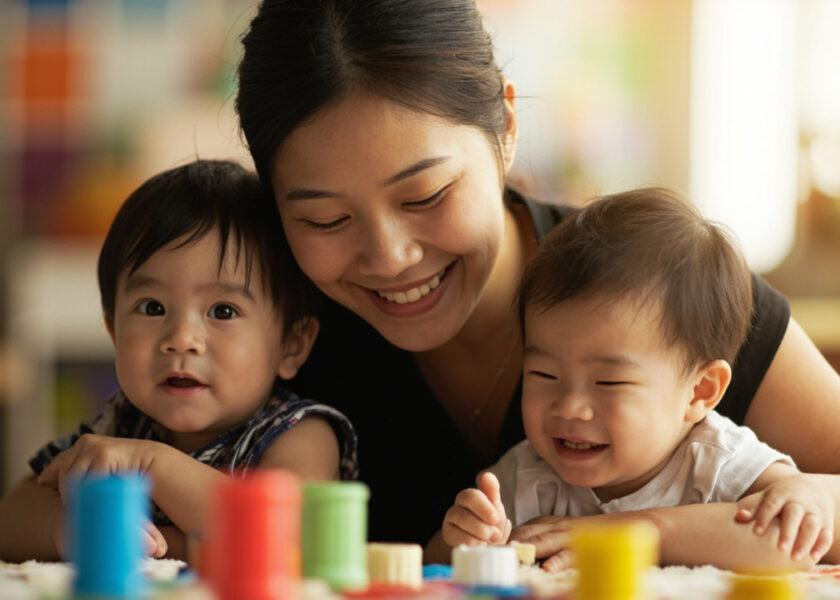
What Your Child’s Evening Behavior Is Telling You
The Language Your Child Has Been Speaking All Day
Not with what happens inside the classroom, because you cannot always see inside the classroom. Not with the curriculum or the schedule, because those are important but they are not the whole story.
We want to begin with you. With what you already know how to do. With the quiet, attentive work you are already performing every single afternoon when you meet your child at the gate and try to read the day in their body.
Because here is what years of working alongside families in Singapore have taught us: your child has been communicating all day. They have been speaking a language older than words, more sophisticated than any sentence they know how to form.
And if we can help you learn to hear what they are saying, something remarkable happens. The invisible becomes visible. The gap between your uncertainty and your confidence begins to close. And the most important relationship in your child’s life, the one between the two of you, becomes even more attuned.
What Reunions Reveal: The Science of Attachment at Pickup
Return with us to that pickup moment. Because what you see in your child in those first minutes after the childcare door closes behind them is not random. It is not merely the expression of a tired toddler or a hungry preschooler, though those things are real too.
It is a window. And what you are looking at, if you know how to look, is evidence of what your child experienced, how safe they felt, whether they were engaged and supported, whether they encountered the kind of early care that shapes the architecture of a developing brain.
These are called reunion behaviors, and in child development science, they are among the most revealing moments in a young child’s day.
What Secure Reunion Looks Like
When a child has spent time in an environment where they felt genuinely secure, where their caregiver was attuned to their needs, where the ratio of children to adults allowed for real responsiveness, something specific happens at reunion.
The child has a secure base to return from. They have been away from you, in another world, and they have navigated that world successfully. When they see you again, they do not collapse. They do not fall apart. They use your return as a platform from which to communicate what they have been doing, thinking, feeling.
Consider these reunion behaviors you might observe:
- The child who runs to you with open arms, who melts into your body with a particular looseness that signals genuine release rather than desperate clinging
- The child who walks toward you with calm but deliberate steps, who makes brief eye contact and then looks around the familiar space with the confidence of someone who knows exactly where they are
- The child who buries their face in your neck for exactly ninety seconds before lifting their head and announcing that they want to show you something they made
These children are telling you something profound about the quality of the hours they just spent in care.
When the Message Is Different
This is different from the child who cannot settle. The child who cries at pickup and cannot be comforted. The child who seems dysregulated, who cannot integrate the transition between the childcare world and the home world, who seems to be holding too much inside themselves to process.
That child is also communicating. The message is just different.
Both children are telling the truth. Both children are being heard by their bodies, expressing in movement and posture and energy what their words cannot yet capture. The question is not whether your child is communicating. They always are. The question is what you are equipped to hear.
The Evening Window: What Play and Wind-Down Tell You
The hours after pickup are, in many ways, the most informative part of your day as a parent of a young child in childcare. This is when the child’s nervous system is processing the entire day’s experience. This is when you can observe, if you know what to look for, the markers of how deeply they were engaged, how well they were supported, and whether the care they received is producing the kind of healthy development you enrolled them hoping for.
Reading the Quality of Play
Watch the quality of their play in that first hour after you get home. A child who has been in a stimulating, responsive environment often arrives home with a particular kind of creative energy. They want to build. They want to draw. They want to role-play with you, recreating scenes from their day in ways that reveal what mattered to them. They are processing, integrating, and sharing all at once.
This is the play of a child whose brain has been well-used, whose curiosity has been engaged, whose emotional containers did not overflow during the day.
Reading the Quality of Wind-Down
Watch how they wind down. All children get tired. But the quality of the winding down tells you something.
Does the child move through the evening with a gradual, natural descent toward sleep, supported by the routines you have established? Or does the evening feel like a series of triggers and eruptions that seem disproportionate to the moment?
Evening dysregulation can be a signal of an overwhelmed nervous system, a child who spent the day managing too much stimulation without enough co-regulation from a calm adult presence. When the external structure of the childcare day falls away, the child’s true state has nowhere left to hide.
What Quality Care Looks Like: A Framework for Parents
This is not about perfection. No child thrives every single day. No childcare arrangement is without its difficult moments. What we are talking about is a pattern. A consistent story that emerges over weeks and months.
Here is what quality care produces in your child, observable in the hours after pickup:
- The child who consistently arrives home with a quality of ease that tells you they were well-held
- The child who consistently uses the evening to play with the kind of imagination and energy that signals genuine cognitive engagement during the day
- The child whose attachment behaviors at reunion tell you that you remain their secure base, even after a full day away
- The child whose sleep comes more peacefully, knowing they were genuinely cared for during the hours apart
These are not feelings you are inventing. These are not anxieties you should learn to dismiss. These are real observations, grounded in your child’s body and behavior, and they are telling you something important.
The Difference Between Adequate and Quality Care
It is not just what happens inside the room. It is the partnership that extends beyond the room.
- It is the caregiver who notices that your child arrived home differently today, who mentions it to you not as a report but as a conversation, who helps you understand what the behavior might mean
- It is the caregiver who sees your child as a whole person with a whole story, and who wants to help you understand that story more deeply
- It is low ratios so that every child can be truly seen and responded to
- It is caregivers trained not just in safety and scheduling, but in the science of early attachment and child development
- It is communication that treats parents as partners rather than customers
At EduNanny, our caregivers are trained to read children this way. Not just as professionals implementing a curriculum, but as attentive observers who understand that every behavior is communication, every cue is data, and every parent is doing the most important work of their life when they try to understand their own child.
This is why the ECDA Childminding Pilot has mattered so much to us. Not just because it represents recognition of a model that we believe in, but because it has allowed us to bring this quality of care to more families across Singapore. Whether we are serving families through home-based childminding or through our community pathways, whether a family walks with us through the centre-based route or the more intimate home setting, the principles remain the same.
The Question Every Parent Carries
There is a question we hear often from parents in those early days of enrollment. It is not always asked out loud. Sometimes it lives in the body more than in words. But it is there, in the way a parent lingers at the gate, in the way a parent asks the same question three different ways, in the way a parent studies their child’s face in the rearview mirror on the drive home.
The question is this: Are they really okay? Is this actually good for them?
We want to answer that question not with promises but with evidence. With the daily, observable, beautiful evidence of a child who is developing well. A child who uses you as their secure base. A child who plays with imagination and joy. A child who sleeps more peacefully knowing they were genuinely cared for during the hours apart.
A child who comes home. And comes home to you.
Choosing Infant Care in Singapore: What to Look For
If you are researching infant care or childminding for your child, here are the observable markers that tell you whether the care is likely producing the healthy development you want:
- Observe the reunion: When you pick up your child, watch how they respond. Do they have a secure base to return from? Do they use your arrival as a platform to share, or do they seem dysregulated and unable to settle?
- Watch the evening: Does your child come home with creative energy for play? Do they wind down naturally, or is every evening a battle of triggers and eruptions?
- Notice the pattern over weeks: One difficult day happens everywhere. What matters is the consistent story across weeks and months.
- Ask about ratios: Low ratios of children to adults mean every child can be truly seen and responded to.
- Look for partnership communication: Do caregivers talk with you about what they observe in your child, helping you understand rather than just reporting?
- Trust your fluency: You have been your child’s translator since birth. If something feels off, pay attention. If something feels right, trust that too.
Affordability and Transparency
We know that affordability matters. Singapore families are navigating real pressures, and childcare costs are a significant part of that calculation. That is why our pilot fee structures have been designed to be accessible, and why we work with families to make use of available support through CDA and Baby Bonus wherever applicable.
The access to quality care should not belong only to families with unlimited resources. Every child deserves caregivers who know how to read them. Every parent deserves to feel confident in what they are seeing at pickup.
We also know that transparency matters. We offer communication and monitoring measures that help you stay connected to your child’s day. But more than that, we want the invisible to become visible not because we will show you footage of every moment, but because you, as your child’s parent, deserve to feel confident in what you are seeing.
The most powerful thing we can give you is not our observation of your child. It is your own ability to read them.
The Invisible Is Not Invisible Anymore
This is what quality care looks like. Not in the brochure. Not in the curriculum document. Not in the inspection report. It looks like your child at the end of the day. It looks like your child in your arms. It looks like the language of their behavior telling you a story you are finally fluent enough to hear.
Every parent, given the right framework, already has what they need to understand their child more deeply than they realized. Your child’s body has been keeping score all day. Their behavior has been recording data. Their energy, their play, their mood in the evening hours, the way they drift toward sleep or fight it with unusual intensity.
These are not mysteries to be solved by experts alone. These are clues that are yours to read, with the right support, the right framework, and the confidence that comes from knowing you already love your child enough to pay this kind of attention.
We are here to help you read them. Not to take that role from you. Not to become the interpreters your child needs. But to stand alongside you as you develop the fluency you already have the capacity for.
To notice with you. To wonder with you. To celebrate with you when your child’s behavior at pickup tells you what you most hoped to hear: that they are safe, that they are learning, that they are held, that they are whole.
All you have to do is listen.
At EduNanny, we believe every family deserves to feel confident in the care their child receives. Learn more about our approach to development-oriented childminding in Singapore, or reach out to schedule a conversation about your family’s needs.