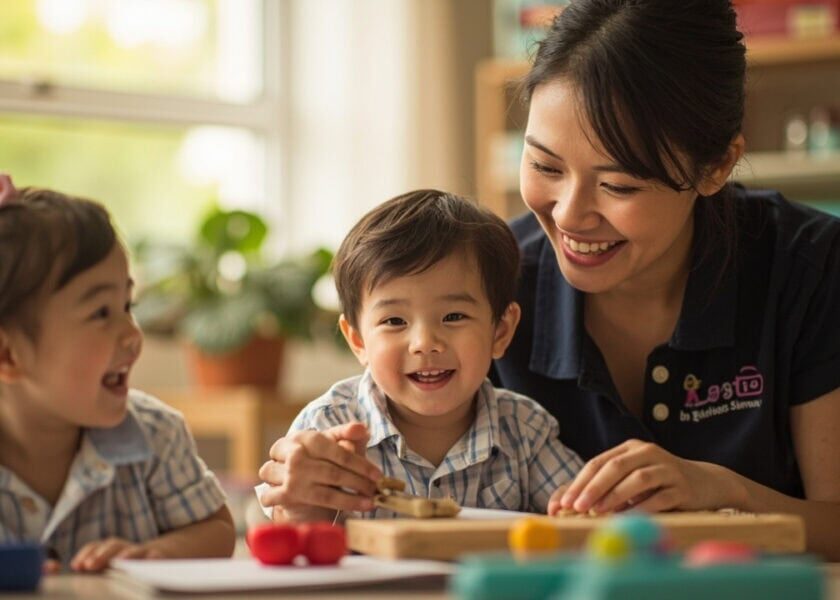
Beyond Safety The Question Every Singapore Parent Carries At The Door
The World Your Child Lives In
There is a moment, familiar to every parent who has left their child in someone else’s care, when you pause at the door. Perhaps it is the entrance to a nursery. Perhaps it is the gate of a familiar home. You look back. Your child is playing, or being soothed, or watching you with those unreadable eyes. And in that pause, a question rises that no amount of research or reassurance quite settles:
What is my child feeling right now?
You have made the decision. You have done the visits, asked the questions, weighed the options. You have satisfied yourself that the environment is safe, the caregivers are trained, the ratios meet the standards. You have given yourself every intellectual reason to feel at ease.
But the question persists, not in the mind but somewhere deeper, in the chest, in the gut. How does it feel to be your child, in this place, without you?
This is not a question about supervision. You have moved beyond that. This is a question about something far more fragile and far more important. It is a question about your child’s inner life.
Safety vs. Felt Safety: The Question at the Heart of Every Parent’s Choice
We live in an age when parents are told a great deal about childcare. We are offered tours, checklists, credentials, and accreditations. We are invited to examine floor plans and read philosophy statements. We are reassured about ratios and curriculum frameworks. All of this matters, and none of it reaches the question that sits at the center of a parent’s heart.
The question is not: Is my child safe?
The question is: Does my child feel safe?
Safety and the felt sense of safety are not the same thing. A child can be in a physically secure environment and still carry a quiet dread in their body. A child can be supervised by qualified adults and still feel, in some inarticulate way, that no one is truly paying attention to them.
The environments we build for children may be impeccable by every external measure, and still a child may feel unseen, unheld, alone.
And conversely, there are settings that may look ordinary, unremarkable, even humble by some standards, where a child thrives emotionally. Where a child’s face lights up at the sight of their caregiver. Where a child feels permission to be fully themselves.
The difference between these two scenarios is not visible in photographs or floor plans. It lives in something harder to capture but infinitely more important. It lives in the emotional architecture of the child’s day.
What Emotional Architecture Means
When we speak of emotional architecture, we mean the invisible structure of feelings, connections, and inner experiences that a child moves through from the moment they arrive in a childcare setting to the moment they are reunited with their family. This includes:
- The quality of attention they receive
- The consistency of the relationships around them
- The emotional tone that colors each transition and interaction
- The small, unremarkable moments between activities where trust is either built or eroded
This architecture is not accidental. It is not the lucky byproduct of good intentions. It is built deliberately and sensitively by caregivers who understand that their primary task is not to fill time or deliver a curriculum but to hold a child’s emotional world with care and competence.
In practice, this means caregivers who notice when a child’s play is becoming frustrated rather than joyful. Who can read the quiet distress that a child cannot yet put into words. Who respond to a shift in mood before it becomes a meltdown. These are not soft skills bolted onto the real work of childcare. These are the real work of childcare.
Inside Your Child’s Day: The Emotional Milestones of Quality Childcare
To understand what quality emotional care looks like, it helps to walk through a child’s day. Not the schedule on paper, but the felt experience of it. Each transition carries emotional weight. Each moment reveals something about what is happening inside the child.
The Arrival: When the Familiar World Falls Away
For many children, arriving at childcare is a moment of quiet tension. The familiar world falls away. The parent is leaving. The child may not yet have words for what they feel, but their body knows. Their shoulders may tense. Their grip on the parent’s hand may tighten.
Now consider what happens in a setting where emotional attunement is the practice rather than the aspiration.
The caregiver kneels down, not to command attention but to meet the child at their level. She does not rush the goodbye. She does not distract with toys or minimize with platitudes. She acknowledges what is happening. She might say, gently: “I see that you are sad that Mama is going. I will take care of you until she comes back.”
She says this not because she believes words will solve the problem, but because she knows that being seen is itself a form of comfort. The child feels that someone understands what they are experiencing. The child feels held in their distress rather than abandoned to it.
And then something shifts. The child’s shoulders relax. The eyes, which had been fixed on the departing parent, begin to take in the room. The first movement of the day is complete. The second movement begins.
Engagement: When Safety Becomes Permission
Engagement is where we see the fruits of emotional safety. A child who feels secure does not merely tolerate their environment. They explore it. They invest in it. They bring their full curiosity and creativity to the toys, the textures, the faces, the sounds around them.
The psychologist John Bowlby, whose foundational work on attachment shaped our understanding of early emotional experience, described how a secure base allows a child to venture outward. The child who trusts that their caregiver will be there when they return is the child who can lose themselves in play.
The child who is anxious about whether they will be seen, protected, loved spends their emotional energy on vigilance rather than discovery.
In quality childcare, this liberation is visible every day:
- The child who feels safe builds a tower and watches it fall and builds it again
- The child who feels safe tries a new food without the fear that failure will mean something terrible
- The child who feels safe laughs with abandon, cries without shame, asks for help when they need it
- The child who feels safe points excitedly at a butterfly and turns to share the moment with someone who will be delighted with them
This is what emotional safety makes possible. It is not a soft or sentimental outcome. It is the foundation upon which all learning, all growth, all genuine development rests.
The Quiet Moments: Where Connection Is Practiced
Between the major transitions, there are the moments that no curriculum maps. The quiet interludes that make up so much of a child’s day.
There is the moment after play when a child seeks out their caregiver not because anything is wrong but because they want to share what they have discovered. “Look,” their eyes say, if not their words. “I found something interesting. I wanted you to know.”
This is not a trivial moment. This is a child practicing connection. This is a child learning that their experiences matter to someone, that their inner life is worth sharing, that relationships are a place of joy rather than obligation.
And then there is the moment of rest. A child who has been given a consistent, attuned rhythm of care can actually fall asleep in an unfamiliar place. Sleep, in a childcare setting, is a profound indicator of emotional trust. A child who can close their eyes and surrender to sleep in the presence of their caregiver is a child who has internalized a sense of safety. They do not need to fight sleep to stay alert, to monitor for danger, to protect themselves. They can rest because they believe, in their body as much as their mind, that they are secure.
The Reunion: Your Child’s Emotional Report Card
And then there is the moment that tells a parent more than any tour, any checklist, any conversation with a director.
You walk through the door. How does your child greet their caregiver as you arrive? Is there warmth? Recognition? A sense of pleasure at seeing a familiar, beloved person? Or is there only you, a quick pivot away from the caregiver, a visible exhale of relief?
The quality of the reunion is the emotional report card that no one writes but every parent can read.
When your child runs toward you with joy but also looks back at their caregiver with warmth, something important is happening. Your child is not choosing between you and someone who cares for them. Your child is expanding their sense of who loves them, who sees them, who belongs to their world. That is not a loss. That is gain.
What Quality Childminding Looks Like in Practice
You know your child. You know the particular timbre of their cry, the specific way they hold their body when they are overwhelmed versus when they are simply tired. You know the difference between playful fussing and distressed fussing. You are, whether you have been told this or not, an expert on your child’s emotional life.
What quality childcare offers is a partner in that expertise. A caregiver who sees your child for hours each day and who learns to read them as finely as you do:
- A caregiver who notices when your child’s left ear is bothering them because of a subtle shift in how they hold their head
- A caregiver who sees when the baby is about to have a breakthrough in language because of the way they are experimenting with sounds
- A caregiver who knows your child’s rhythms, your child’s preferences, your child’s particular way of being in the world
This is what consistent caregiver relationships make possible. Not a series of interchangeable faces, each one starting from zero, but a deepening familiarity that compounds over time. Consistency is not merely a preference. It is the precondition for emotional attunement. Without it, every day is a reset. With it, every day builds on the last.
Within Singapore’s ECDA Childminding Pilot Framework
For parents in Singapore navigating infant care and childminding, the emotional dimension of childcare is compounded by real, practical pressures. You are carrying the weight of wanting to be present for your child and the weight of knowing that modern life requires certain choices. You are carrying the knowledge that early childhood is brief and formative, and that you will never get these years back.
Singapore parents often tell us that the logistics of childcare feel overwhelming before they even begin. Which framework applies? What is the difference between centre-based and home-based arrangements? How do CDA funds work? What do ECDA’s pilot structures actually mean for my child’s daily experience?
These are not superficial concerns. They are the conditions that determine whether you can show up as the emotionally present parent you want to be, or whether you spend your days anxious about logistics and finances. When these practical dimensions are handled with care, one layer of worry dissolves, and parents are freed to trust.
Within the ECDA Childminding Pilot framework, quality childminding has structural expression:
- Small caregiver-to-child ratios — up to one caregiver for every three infants. When a caregiver’s attention is divided among three infants rather than ten, she can notice the subtle shift in a child’s mood, read the quiet distress a child cannot yet voice, and respond with attunement rather than reaction.
- Home-based and community-based options — allowing care to be shaped around your family’s rhythm, your child’s temperament, and the realities of your working life.
- Transparency measures — CCTV systems, where deployed, offer a window into your child’s day. Not because surveillance is education, but because visibility builds the confidence you need to trust your choice.
- Regular communication — daily updates and open lines between caregiver and parent. These are the threads that connect your world and your child’s world throughout the hours you are apart.
- Practical accessibility — pilot fee structures, CDA and Baby Bonus fund usability, and care arrangements aligned with Monday-through-Friday working life. These remove a layer of anxiety so that parents can focus on what matters most: knowing that their child is not just supervised but emotionally held.
Addressing What Parents Actually Worry About
“Will my child feel abandoned?”
This is the worry beneath most other worries. The honest answer is that it depends entirely on the quality of the emotional environment your child enters. In a setting where caregivers are trained to attune, to acknowledge a child’s distress rather than rush past it, and to offer genuine presence, the experience of separation is not abandonment. It is the child’s first lesson in a profound truth: that people who love you can leave and return, and that you survive both.
“How do I know what my child feels when I can’t see them?”
You already know more than you think. Your child’s body language tells a story. The way they hold themselves at drop-off, the quality of their engagement during the day, the state they are in when you collect them. Over time, you will learn to read your child’s childcare experience the way you have learned to read their hunger, their tiredness, their need for comfort. The reunion is your window. Watch it.
“What if the caregiver doesn’t really know my child?”
Ask about continuity of care. Ask how long a caregiver has been assigned to your child. Ask how the service handles transitions. Within the ECDA framework, the emphasis on consistent caregiver relationships reflects a deep understanding that familiarity is not a luxury. It is the medium through which emotional attunement develops. A caregiver who has spent three months with your child knows things about them that no orientation form can capture.
“What if my child cries every morning?”
Morning separation distress is one of the most distressing experiences for a parent. It is also, in most cases, developmentally normal and time-limited when handled well. What matters is not that your child never cries, but that their crying is met with understanding rather than dismissal, and that the caregiver’s response helps the child move through the distress rather than suppress it.
A child who is always distracted or always soothed with urgency may not be learning that their feelings are valid. A child who is gently acknowledged and then gently redirected is learning that difficult emotions are survivable.
How to Choose Infant Care With Your Child’s Inner Life in Mind
When you visit a potential childcare arrangement, here is what to look for beyond the checklist:
- Watch the caregivers. Not just what they do, but how they do it. Are they kneeling to meet children at eye level? Are they narrating what they see? Are they attuned to the room or are they going through motions?
- Notice the children’s bodies. Are the children relaxed in their postures? Are they engaged in play or simply waiting? Do they seek out caregivers or avoid them?
- Ask about emotional curriculum. Not in those words necessarily, but ask: How do caregivers respond when a child is distressed? What does a typical morning transition look like? How is separation handled?
- Ask about consistency. Will my child have a primary caregiver? How long will that person be with my child? What happens if the caregiver is unwell?
- Ask to see a reunion. If possible, arrive early and watch what happens when other parents collect their children. The quality of those moments will tell you something true.
- Trust your gut. You are looking for a place where your child would be seen, not just minded.
A Place Where Your Child Is Known
The fact that this question lives in you so intensely — the fact that you pause at the door and wonder — the fact that you are reading an article like this one because you want to understand your child’s inner experience — this is not a sign of weakness or uncertainty. This is a sign of love. And it is precisely the kind of love that quality childcare is designed to honor and support.
You are giving your child the gift of a caregiver who knows them. You are giving your child the gift of peers to play beside and adults to look up to. You are giving your child the gift of a safe place to practice being a person, to make mistakes, to learn, to grow.
You are not abandoning your child. You are entrusting your child to people who will cherish the responsibility. You are making a choice that a generation ago might have been made by an extended family, a village, a network of neighbours and kin. In the absence of that village, you are building something new: a framework of care that is trained, intentional, and emotionally intelligent.
Your child knows this. Not in the way we know things with our minds, but in the way children know things with their bodies, their hearts, their felt sense of the world. Your child knows when they are in a place that feels like home. Your child knows when the person holding them is paying attention, is present, is attuned to their needs.
So the next time you pause at the door, look back, and wonder what your child is feeling, we invite you to trust that the answer may be better than you fear.
Your child may be playing with abandon. Your child may be sharing a moment of discovery with a caregiver who truly sees them. Your child may be building the foundations of security, of trust, of the capacity for connection that will shape every relationship they ever have.
Your child is not just being supervised. They are being felt. And in that feeling, they are becoming who they are meant to be.
EduNanny operates within the ECDA Childminding Pilot, offering home-based and community-based pathways designed to give families options that genuinely suit their circumstances and their child’s temperament. If you are exploring infant care or childminding options in Singapore, we invite you to take the next step.
Learn more about who we are or return to our home page to discover how EduNanny supports families across Singapore.