What Your Child’s Day in Singapore Quality Childcare Actually Looks Like
The Moment Every Parent Knows
There is a moment, every morning, that millions of parents in Singapore know intimately but rarely speak about. It happens in drop-off zones and driveways, across the threshold of childcare centres and home environments throughout the island. You hand your child over. You watch them disappear behind a door. And in that instant, a question forms—one you may not even consciously ask, but one that lives in your body all day long.
What are they doing right now?
It is not a question of doubt. You have done your research. You have checked credentials, visited classrooms, asked about ratios and curricula. You have chosen this place, this person, this arrangement. And yet. The question persists. What fills those hours? What are the small moments your child is experiencing? What does their day actually look like from the inside?
This is the question we want to answer for you—not with generalities or reassurances, but with the kind of specific, honest glimpse that transforms anxiety into understanding, and understanding into the kind of trust that lets you work, focus, and breathe.
The Morning Threshold: When Care Begins
The day begins before your child arrives. Before the transitional wobble at the threshold, before small hands reach for a caregiver’s neck, there is preparation. Not merely of space, but of attention.
In a well-designed infant and toddler environment, every element has been considered with the developmental lens of a child who learns through senses, through movement, through the exploration of objects within reach.
The lighting is soft but not dim. Harsh fluorescence creates stress in infants, and experienced parents often sense this intuitively when they walk into a room that feels jarring. The surfaces are warm. The materials are varied—smooth wood beside textured fabric, cool metal near warm ceramic. These are not decorative choices. They are the vocabulary of a sensory-rich environment that builds neural pathways through the most fundamental human activity: exploration.
For infants in Singapore’s childcare settings, oral exploration remains for the first two years the most sophisticated tool of investigation their bodies possess. Every object your child mouths, every surface they touch, is building understanding of the physical world. When materials are chosen deliberately—silicone teethers, natural wood, varied textures—your child receives consistent, safe input that builds brain architecture through play.
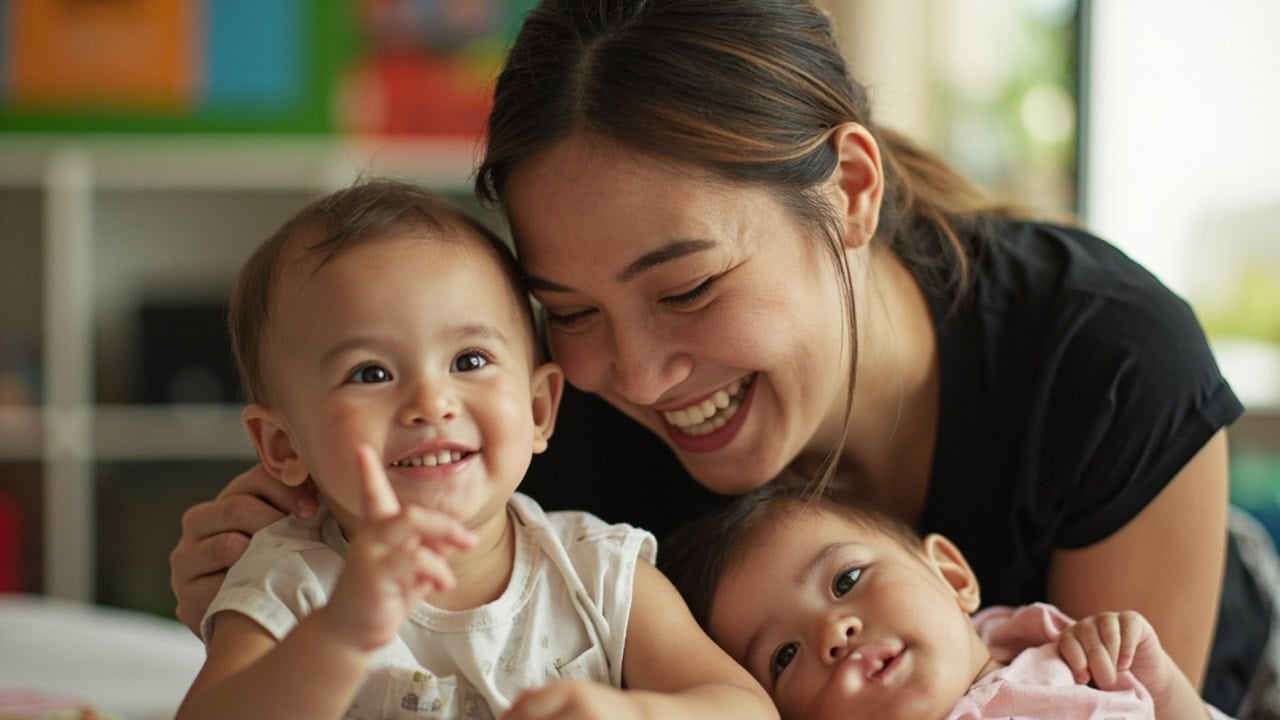
When your child arrives, the caregiver is already present in the space. Not behind a desk, not reviewing paperwork, but kneeling to a child’s level, making eye contact, extending a quiet greeting.
This is not mere politeness. It is the first thread of the relational architecture that shapes the entire day.
In those first seconds, a trained caregiver reads your child the way a translator reads a text in a foreign language—looking for cues of tiredness, hunger, anxiety, or contentment. The slight furrow between the brows that signals overstimulation from the car ride. The particular way a toddler leans when they are ready to explore versus when they need to be held. The way your infant’s breathing changes when they recognize a familiar face.
This is professional noticing. It is the skill that distinguishes quality care from mere supervision.
In home-based settings—a pathway that Singapore’s ECDA Childminder Pilot has thoughtfully expanded for families seeking smaller ratios and more intimate environments—the rhythm remains consistent in its intentionality. The ratios are smaller—up to three infants to one caregiver—and each child receives proportionally more of this responsive attention. Both pathways, when quality is present, share the same underlying architecture: trained attention, developmental purpose, relational warmth.
The Architecture of Play and Learning
The morning unfolds in rhythms that may look simple from the outside but are carefully orchestrated. Quality infant and toddler care is not a series of activities. It is a flowing architecture of transitions, each one intentional, each one serving developmental purpose.
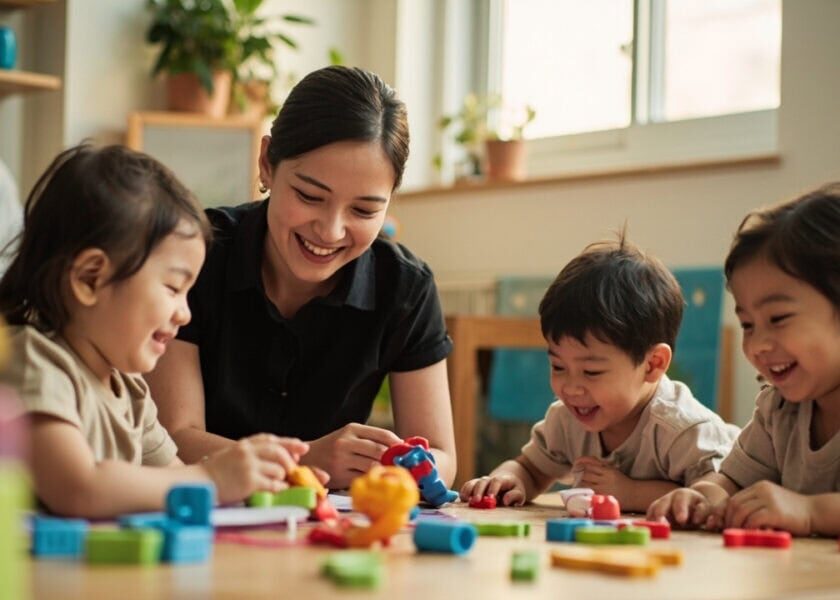
Consider the morning free-play period. To the untrained eye, this may appear as children simply playing with toys. But watch more closely.
Watch how a caregiver sits nearby—not hovering, not directing, but present as a secure base from which exploration can safely extend. Watch how she notices when a sixteen-month-old has been attempting to stack blocks for fifteen minutes and is becoming frustrated. Watch how she moves in, not to complete the task for the child, but to offer a slight modification—a broader base block, a slower demonstration, a quiet narrative of what the child is attempting.
“You are trying to make it tall. It keeps falling. That feels frustrating, doesn’t it?”
This is verbal labeling of emotion, and it is one of the most powerful gifts a caregiver offers in the first thousand days. By naming what a child feels before they have the words to express it, the caregiver builds emotional literacy directly into the architecture of the brain. Your child is not merely playing. They are constructing the capacity to understand themselves.
The sensory environment during this time has been arranged not for adult aesthetics but for child development. Low open shelves with a limited number of choices—this is not minimalism for its own sake but a deliberate recognition that infants and toddlers become dysregulated when presented with too much visual stimulus.
The materials available are selected for their developmental appropriateness:
- Objects that teach cause and effect
- Materials that offer varied textures for oral exploration
- Toys that can be manipulated in multiple ways rather than those that merely light up and demand passive watching
When your child reaches for a wooden rattle with a mirror attached, they are not just playing. They are discovering themselves as separate from the object. When they drop something repeatedly and watch it fall, they are building the foundation of physics understanding. Every moment is construction.
Feeding: More Than Nutrition
The rhythm of the day includes feeding—not as a task to be completed between activities, but as a relational anchor. For infants who are still on bottles, feeding is a moment of profound connection.
A caregiver who understands infant development will hold your child in a semi-upright position, bottle supported rather than propped, maintaining eye contact and gentle vocalization throughout. She understands that this is not merely nutrition being delivered; it is trust being built.
The infant learns that their body rhythms matter, that someone responds when they turn away and then turn back, that the world comes in manageable intervals rather than overwhelming demands.
For toddlers transitioning to self-feeding, mealtimes become laboratories of autonomy. Watch a twenty-month-old struggle with a spoon, cereal sliding off onto the tray, and then—finally—getting something to their mouth. Watch the pride that radiates from that small body.
This is not mess for its own sake. This is the painstaking, beautiful work of becoming a person who can feed themselves. The caregiver who stands nearby, resisting the urge to take over, who wipes the chin gently and says, “You did it”—is performing one of the most important developmental tasks of early childhood. She is protecting the child’s emerging sense of competence.
The Science of Rest
Mid-morning often brings a transition that parents frequently overlook but that reveals the philosophy of care as clearly as any curriculum activity: the nap.
Sleep is not merely rest. In the infant and toddler brain, sleep is construction. It is during sleep that the brain consolidates the learning of waking hours, filing experiences into memory, processing the overwhelming volume of sensation that waking life presents.
The quality of a child’s nap directly affects their afternoon mood, their capacity for learning, their physical regulation.
Watch how a quality caregiver approaches this transition. It begins before the child is visibly tired—reading the cues that precede full fatigue. The slight slowing of activity. The seeking of a caregiver’s lap. The moment a child begins to rub their eyes and a caregiver quietly says, “It looks like your body is getting tired. Let’s go to your sleep space.”
The sleep environment itself has been prepared: darkened or dimmed, white noise perhaps to mask unpredictable sounds, a consistent position, a familiar comfort item if parents have established one. The caregiver moves through the ritual with practiced calm, understanding that her own nervous system is being read by the child’s developing mirror neurons.
If she rushes, the child rushes toward alertness. If she slows, breathes, speaks softly, the child’s nervous system receives the signal that it is safe to let go.
And when your child wakes—whether after forty-five minutes or two hours, both within the normal range for developing brains—the caregiver is there. Not with a screen or a distraction, but with a presence that says, “You slept, and now you are back.” The transition from sleep to wakefulness is managed with the same intentionality as the transition into sleep.
Afternoon Rhythms and Emotional Navigation
The afternoon brings its own rhythms. Outdoor time, weather permitting, offers a different sensory palette—sky, breeze, the texture of grass or sand, the vastness of open space that indoor environments cannot replicate.
In Singapore’s climate, this may mean morning outdoor time to avoid midday heat, or indoor gross motor play that offers similar developmental benefits when outdoor access is limited. Either way, the principle holds: movement is not a luxury for infants and toddlers. It is development.
Watch how a toddler moves across a climbing structure designed for small bodies—cautious at first, then confident, then perhaps too confident, then steadied by a hand nearby. This is risk assessment being built in real time.
Watch an infant on a blanket, reaching for a ball that rolls just beyond their grasp, then crawling toward it, then grasping it, then—surprised—dropping it and watching where it went. This is physics, causality, and motor planning integrated into a single moment of learning.
Language is woven throughout the day by a quality caregiver, not in formal lessons but in continuous narration.
“You are pushing the blue truck. It is going down the ramp. Look at it go!”
This is not empty chatter. This is vocabulary expansion, sentence modeling, the building of conversational reciprocity. Research consistently shows that children raised in language-rich environments enter formal education with more sophisticated language foundations. The caregiver is not just watching your child. She is building their mind through the medium of words.
And always, woven through every activity, is the thread of emotional regulation. When two toddlers reach for the same toy, watch how a caregiver intervenes—not by arbitrarily taking the toy from one and giving it to another, but by naming the conflict, offering words:
“Both of you want the truck. There is one truck. Let’s wait. I can hold it while we take turns.”
This is not mere conflict resolution. It is the introduction of delay of gratification, of the concept that others have needs, of language as a tool for navigating social complexity. These are not small skills. They are the foundation of every relationship your child will ever have.
Homecoming: Reading What Your Child Brings Home
As the afternoon wanes, the caregiver begins preparing for homecoming. Diapers are changed with the same calm attention as in the morning—not rushed, not minimized, but handled as an opportunity for connection. “Let me change your diaper, and then you will be ready to go home to mama and papa.”
The child begins to build an understanding of time, sequence, anticipation. The caregiver speaks with the arriving parent, sharing the day’s arc:
“She slept well this morning but was a bit tired this afternoon. She loved the sand play. She said ‘more’ for the first time today—not perfectly clearly, but she said it.”
Where communication systems are thoughtfully deployed, parents receive updates that go beyond the perfunctory: not just “napped at 12:30,” but a note about how peacefully the child slept, a description of the story that made your toddler point and laugh. These are the threads that help you weave the narrative of your child’s day when you are not present to witness it firsthand.
Now, with understanding of what quality looks like, you can read the answers that are carried in your child’s body at pickup:
- The flush on their cheeks from active play—not the pallor of prolonged sitting.
- The particular kind of tiredness that comes from learning, not merely from waiting.
- The way they look toward their caregiver as they leave—not with distress, but with the easy acknowledgment of a person who was part of their day.
- The language they bring home—”more,” “uh-oh,” “go,” words that were not there this morning and are now planted in their vocabulary.
When you ask your child what they did today, you may receive an answer or you may not—they are still learning to narrate their experience. But you can read it yourself now. You can see the caregiver’s attention in the ease of your child’s transition. You can see the quality of the environment in the focused calm your child brings home. You can see the intentionality of the day in the new skills, new words, new capacities that emerge over weeks and months.
What to Look For: Evaluating Quality
Quality childcare is not a luxury available only to those who can pay premium rates. It is a standard that exists along a spectrum, and its markers are visible to any parent who knows what to look for. Here are the markers of quality that reveal themselves in observable moments:
At Drop-Off
- Does the caregiver kneel or sit to meet your child at eye level?
- Do they greet your child by name before greeting you?
- Do they ask how your child’s morning has been, indicating they want to understand the whole child?
During Your Visit
- Is the space warm and softly lit, or harsh and fluorescent?
- Are materials within children’s reach on low shelves, or stored out of access?
- Do caregivers sit near children during play, or stand at a distance watching phones?
- Do you hear caregivers narrating what children are doing, naming emotions, extending language?
At Feeding Time
- Are infants held during bottle feeds, or are bottles propped?
- Do caregivers sit with toddlers during meals, or leave them unattended with food?
- Is self-feeding encouraged even when messy, or is efficiency prioritized?
During Transitions
- Do caregivers announce what comes next (“Now we will wash hands before we eat”)?
- Are nap transitions calm and unhurried, with consistent rituals?
- Does the caregiver read early cues of tiredness before children become overtired?
At Pickup
- Does the caregiver share specific observations about your child’s day?
- Do they mention developmental milestones, favourite activities, social moments?
- Do they ask about anything at home that might help them understand your child’s day better?
Transparency as the Foundation of Trust
EduNanny by BUTLER was built on a simple recognition: Singapore’s working parents deserve to know what happens during those hours. Because transparency builds trust more powerfully than any marketing claim. Because parents who understand what quality looks like can recognize it when they see it—and can rest, finally, when they know their child is in hands that are not just present but attentive, not just watching but nurturing, not just caring but professional.
Singapore’s ECDA Childminder Pilot has created pathways that make this kind of quality accessible—home-based options with ratios that allow for deep individual attention, fee structures that work within pilot frameworks, and the ability to use CDA funds and Baby Bonus where applicable. These are meaningful options for families who want reliable, development-focused care that supports both their children and their working lives.
When you choose a childcare arrangement, communication is not an add-on—it is part of the architecture of care. Regular updates that go beyond the perfunctory. Genuine glimpses into your child’s day that help you continue their learning at home. And where systems allow, transparency features that let you witness your child’s experience without the anxiety of surveillance.
If you are feeling the weight of this decision—the search for childcare, the morning drop-off, the wondering throughout the day—you are not alone. You are doing something profoundly important: providing for your family while trusting others to care for its most precious member. That trust requires evidence, not faith. It requires transparency, not promises. It requires people who can show you what quality looks like in observable, everyday moments.
These are not secrets known only to professionals. They are observable facts, available to you, now that you know to look.
Begin the Conversation
There is a moment every evening that mirrors the morning’s drop-off. A door opens. A child reaches for you.
In that moment of reunion, something has been added to your child that was not there before—not just another day survived, but another layer of development completed, another relationship deepened, another brick laid in the architecture of who they are becoming.
You have handed your child over this morning with trust, however uncertain. You have spent your day with questions. Now, when you pick them up, you have answers—not complete ones, because no day is ever complete, but enough.
Enough to understand. Enough to see. Enough to trust.
Trust is not a feeling we manufacture. It is built, slowly, through transparency and observation and the accumulation of evidence that the people caring for our children are doing so with the same love and intentionality we would bring ourselves.
If you are searching for infant care or childminding in Singapore—if you want to see the architecture of quality for yourself—reach out to EduNanny by BUTLER. Let us show you what a day looks like from the inside.
Discover more about EduNanny’s participation in the ECDA Childminder Pilot or learn about our approach to thoughtful, development-focused childcare.