The Invisible Work of Building Your Child’s First Belonging Community
What Your Child Is Actually Doing in Those Hours
We have built an entire industry around answering the questions parents ask. Is the centre accredited? What is the teacher-to-child ratio? Is there CCTV? What do the walls look like?
These are not the wrong questions. But they measure what parents can see. And the most important thing that happens in quality childcare is invisible.
It happens in the space between a child and a caregiver who is not their parent. It happens in the tentative reach of a sixteen-month-old toward another child who has a toy they want. It happens in the small, hard-fought decision of a two-year-old to trust that the caregiver will come back, that the goodbye was not permanent, that the world is still safe even when mother is not in the room.
Quality childcare is your child’s first community beyond your family. And what your child builds there—in the hours you are not there to see—will shape how they relate to the world for years to come.
The Caregiver as Bridge, Not Just Caretaker
Let us be clear about what we mean when we say community. A community is not a place where people simply exist in proximity. It is a place where people belong. Where they are known. Where they matter. Where they learn, through daily experience, that they are part of something larger than themselves.
For your child, this begins with a single person. Not a teacher, not yet. A bridge.
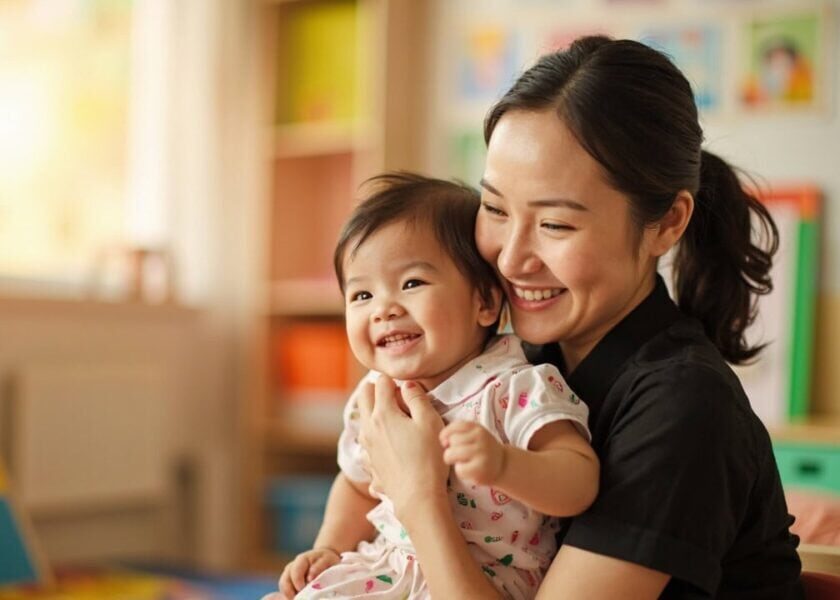
Someone who is not you, but who holds your child with the same attentiveness. Someone who notices when your toddler is tired before they begin to cry, who knows that your baby needs to be held in a particular way to settle, who reads the small signals of a child’s needs and responds with consistency, warmth, and patience.
In strong childcare environments, the caregiver does not merely supervise. They attune. They observe. They learn the particular rhythms of each child in their care—their fears, their joys, the things that calm them and the things that overwhelm them.
Over time, they become a figure of genuine trust. Not a replacement for you. Not a substitute for home. A bridge. A person your child knows they can return to when the world feels too big.
This is not sentiment. This is the architecture of emotional security. A child who has a trusted adult outside their family—someone consistent, warm, responsive—develops what psychologists call internal working models. They learn, at a cellular level, that the world contains people who can be relied upon. That relationships are safe. That they are worthy of attention and care.
In Singapore’s context, where extended family often lives across borders and parents juggle demanding work schedules, this consistency matters even more. A child needs stable, predictable relationships to build that internal working model. It cannot be built by rotating staff or overloaded classrooms. It is grown slowly, day by day, by the same caring face returning again and again.
What Peers Teach That Adults Cannot
But the caregiver is only the first chapter of the story. The next chapter is where it becomes truly remarkable.
Somewhere between the second month and the second year of regular childcare, something begins to shift. Your child starts to notice the other children. Not as background. As people.
Watch closely, and you will see it:
- The eleven-month-old who watches another baby reach for a block and then reaches herself, inspired by what she witnessed
- The eighteen-month-old who offers a cracker to a peer, unprompted, for the first time
- The two-year-old who runs to greet a familiar face at drop-off—not a caregiver, but a child
These are not random social gestures. They are your child’s first experiments with peer relationships. And they are teaching your child things that no adult, however attentive, can teach.
Equality
In the caregiver relationship, the child is always the smaller one, the one who receives, the one who is protected. But in peer relationships, your child meets other small people who are also learning, also frustrated, also figuring out how to be human.
Negotiation
Your child discovers that they are not the only person in the world with needs. That other children also want the red truck. That sharing is hard. That saying sorry matters. That sometimes people do not want to play the game you want to play.
Empathy
The discovery that other people’s feelings are real and separate from your own.
This is what developmental psychologists mean when they talk about social-emotional learning in the early years. It is not a curriculum. It is a lived experience, repeated day after day, in the company of other young children who are on the same bewildering journey.
Belonging: What It Actually Looks Like
Now let us talk about what belonging actually looks like. Because it is not what we usually think it is.
Belonging is not attendance. A child can go to childcare every day for two years and never feel they belong. They can be present in body but not in spirit. They can spend their days waiting to be collected, their whole inner life oriented toward the moment when you walk through the door.
This is not failure. For many children in their early months of childcare, this is the normal experience. Separation is hard. Home is where the security is.
But somewhere in the months that follow, something can change. If the environment is right. If the caregiver is consistent. If the peer group is stable. If the rhythms are predictable and the emotional climate is warm. The child stops merely attending. They start inhabiting.
Signs Your Child Is Belonging
- Walks through the door and immediately moves toward a familiar toy or activity
- Waves goodbye to you with ease because their attention has already shifted to what is ahead
- Talks about another child by name
- Asks if their friend will be there tomorrow
- Has begun to build a mental map of the social world that is theirs
This is belonging. This is your child understanding, in their bones, that they have a place in the world beyond your family. That there are people who know them. That they matter to others. That they are capable of connection.
The child who belongs is the child who can learn. The child who trusts the social world is the child who can take intellectual risks, who can ask questions, who can fail and try again.
Belonging is not soft. Belonging is foundational.
What Quality Childcare Looks Like in Singapore
Understanding these principles, how do you recognise quality when you are evaluating childcare options? Here is what to look for—not just on paper, but in the lived experience of the children there.
Small, Consistent Groups
Children build belonging in small communities. In home-based settings under Singapore’s ECDA Childminding Pilot, ratios of up to one caregiver for every three infants allow for genuine attunement. Consistent faces, day after day. The kind of relationship that cannot be built by rotating staff or overloaded classrooms.
Caregivers Who Attune, Not Just Supervise
Watch how caregivers interact with children—not just when parents are observing, but in the quieter moments. Do they kneel to a child’s level? Do they notice when a toddler is about to melt down before it happens? Do they respond to children’s cues with patience rather than efficiency?
Environments That Invite, Not Just Contain
Quality childcare spaces feel warm. They are not sterile or institutional. They have areas for quiet, for active play, for messy exploration. The layout allows children to move between activities while remaining within a caregiver’s warm, watchful presence.
Routines That Build Security
Predictable daily rhythms help children feel safe. When a child knows what comes next—what happens after circle time, what signals snack time—they can relax into exploration rather than spending energy on anxiety about the unknown.
Communication That Builds Trust
Regular updates about your child’s day—photos, notes, brief conversations—matter not because parents need surveillance, but because trust is built through transparency. When you feel connected to what is happening, you can let go more easily at drop-off. And when you let go with confidence, your child feels it.
Your Questions, Honestly Answered
“How do I know if my child is actually belonging?”
You will not always know. Some of your child’s experience will remain private, theirs alone. This is healthy. Children need spaces beyond parental view where they can grow into their own autonomy.
But there are textures to watch for:
- Your child settles more easily each morning at drop-off
- Your child talks about a caregiver with warmth
- Your child mentions other children by name
- Your child seems to carry a sense of security into the world rather than just anxiety about separation
- Your child begins to say “we” when they talk about their childcare world: We did this. We played this. We are a group.
When you see these signs, you will know that your child’s first community is doing its work.
“Am I failing my child by choosing childcare?”
No. This is one of the most important things we can tell you.
Children are remarkably adaptable. They are built to form attachments beyond their immediate family. What they need is not necessarily more time with parents—they need quality relationships, consistent care, and environments where they can safely practice belonging.
The guilt you feel is real and understandable. But it is not information. It is a cultural weight placed on parents, particularly mothers, who dare to share their child care with others. Let it go. Your child needs you to trust the process, not to punish yourself for using it.
“How do I choose between home-based and centre-based care?”
Both can offer quality. Both can offer belonging. The difference is in the texture of the community:
| Home-Based Childminding | Centre-Based Care |
|---|---|
| Small, intimate group (typically 3–4 infants with one caregiver) | Larger group with multiple caregivers and children |
| Caregiver develops deep knowledge of your child individually | More structured routines and programming |
| Home environment may feel more familiar and relaxed | More resources and spaces designed for child development |
| Parent develops close relationship with caregiver | Parent may have less one-to-one contact with caregivers |
| May offer more flexibility for infant care needs | May offer more consistent hours and structured schedules |
Neither is inherently better. What matters is whether the specific environment has the qualities we have discussed: consistent caregivers, small ratios, warm attunement, and the conditions for belonging.
“What about separation anxiety? How long will it take?”
Every child is different. Some settle within weeks. Others take months. This is normal. Separation anxiety is not a sign that childcare is wrong for your child—it is a sign that your child has a healthy attachment to you.
What matters is the direction of travel. Is your child gradually, over weeks and months, beginning to trust the environment more? Are the signs of belonging we described appearing, even slowly?
If separation anxiety persists for months without any movement toward comfort, that is worth discussing with your childcare provider—and perhaps reconsidering whether this particular environment is the right fit.
Practical Guidance for Choosing Infant Care in Singapore
- Visit more than once, at different times of day. The tour is staged. Return during regular hours. Watch how caregivers interact with children when they are not performing for visitors.
- Ask about caregiver consistency. How often do caregivers change? What happens when someone is sick? Consistent faces are non-negotiable for building trust.
- Observe the children. Are they engaged? Do they seem at ease? Do caregivers kneel down to children’s level, or do they stay at adult height?
- Ask about daily rhythms. Predictability matters. What does a typical day look like? How does the schedule support emotional security?
- Trust your instincts. You know your child. If something feels off, keep looking. If something feels warm and right, pay attention to that too.
- Consider communication practices. How will you know what is happening in your child’s day? What level of transparency can you expect?
- Think about your child’s temperament. Some children thrive in smaller, quieter home settings. Others are energised by more activity and peer interaction. There is no right answer—only what is right for your child.
You Are Not Abandoning Your Child
Let us come back to that moment at the door. The moment you let go.
You are not abandoning your child when you hand them over. You are trusting them to a process. You are trusting them to build something you cannot build for them. You are trusting the remarkable, resilient, adaptable capacity of a young human being to reach out and find their place in the world.
And you are trusting the environment you have chosen. Not blindly. You have done the work of choosing. You have looked at ratios and credentials and ECDA approvals. You have asked your questions.
Now we ask you to trust something else. The process itself. The slow, invisible, profound process by which your child is becoming a social being. By which they are learning that the world contains other people who matter. By which they are practicing the hardest and most important skills of all: how to connect, how to belong, how to trust.
The measure of quality childcare is not what you feel when you pick your child up at the end of the day. It is what your child carries inside themselves. The belief, quietly rooted, that they belong. That they are capable of connection. That the world is a place where people know them and welcome them and will hold them when they need holding.
This is what EduNanny is here to build. Through the ECDA Childminding Pilot, EduNanny offers pathways that prioritise your child’s social-emotional development—not just their supervision.
- Small ratios that allow caregivers to attune to each child’s individual rhythms, needs, and emerging trust
- Consistent caregivers who become the bridge your child crosses from home into the wider world
- Environments designed for relationship—where peer interaction is supported, not just tolerated
- Communication that builds parental trust—so you can let go with confidence, and your child can feel that confidence
Because your child is not just growing. They are becoming someone who belongs.
And that is the most important work of all.
If you would like to explore what EduNanny can offer your family, we would be glad to hear from you. Learn more about our approach and the standards we hold ourselves to.