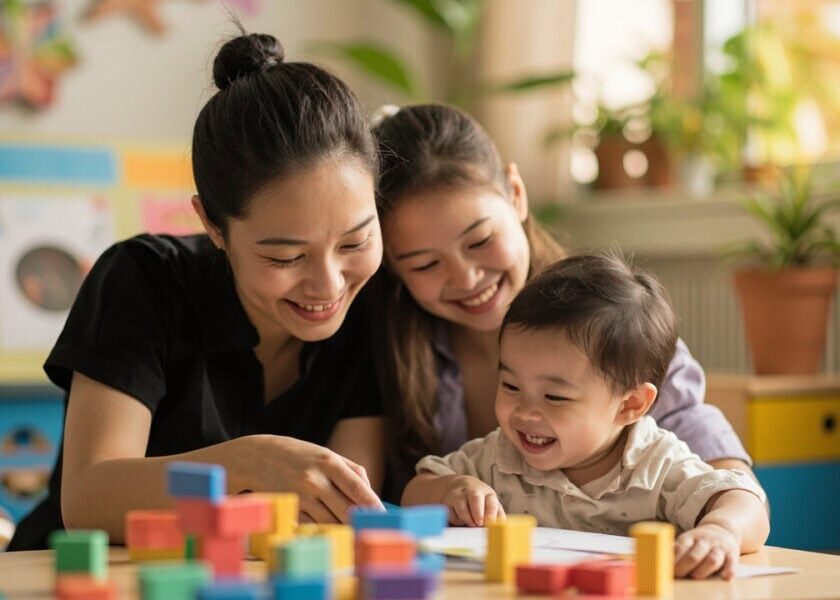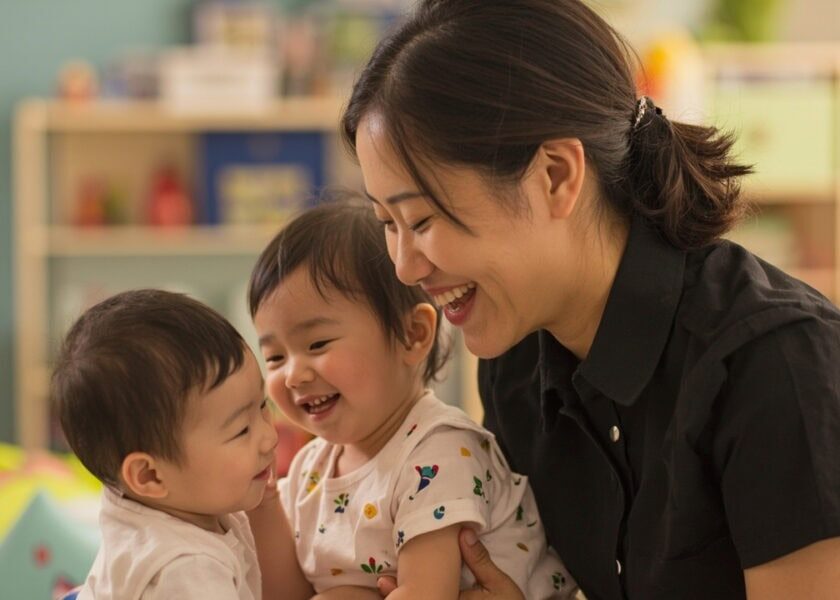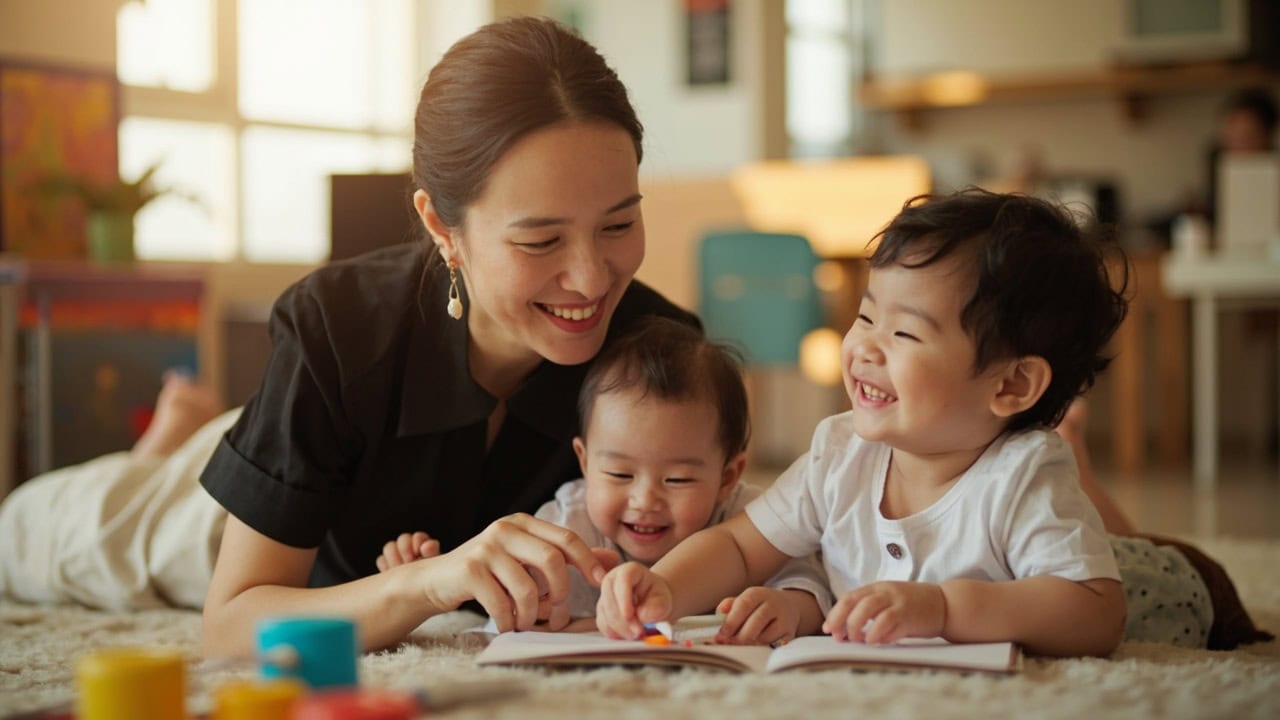
What Quality Childcare Builds in Your Child’s Brain
What Quality Childcare Actually Builds
If you are reading this between meetings or during a commute, here is what you need to know:
- A quality childcare day is not supervision. It is actively designed developmental architecture—building language, motor skills, emotional regulation, and neural connections in ways that matter.
- The rhythm of arrival, transition, free play, structured activity, outdoor time, meals, and rest is not accidental. It reflects how young children’s nervous systems process stimulation and consolidate learning.
- Trained caregivers are constantly reading your child—not just watching, but noticing developmental cues that inform how they respond, what they offer, and what they challenge.
- In Singapore’s multilingual context, quality childcare provides consistent contextual language exposure that supplements what children learn at home.
- The hours your child spends in quality care are the hours their brain is building more than a million neural connections per second—connections that will not be replicated at any other point in their lifespan.
The Architecture of the Ordinary Day
Here is what neuroscience has been mapping with increasing precision over the past twenty years: the ordinary childcare day is one of the most underappreciated pieces of architecture in a child’s early life.
The word “architecture” matters here. What appears on the surface to be a day of play, of nap times, of meals shared, of songs learned, is actually a carefully constructed sequence of experiences that map onto the developing brain in ways that are specific, measurable, and profound.
A quality childcare day follows a rhythm: arrival and greeting, transition activity, free play, structured group experience, outdoor time, meals, and rest.
This sequence is not tradition. It is design. It reflects what we know about how young children’s nervous systems process stimulation, how attention works, how hunger and fatigue create patterns, and how the brain consolidates new learning during quieter moments.
Each of these periods carries a different developmental purpose, and trained caregivers understand this not as theory but as practice. When a caregiver notices that a child is beginning to seek proximity to another child, she does not intervene immediately. She watches. She notes it. She creates an opportunity later for parallel play that might deepen into something more collaborative.
This is the unseen work. The noticing. The interpreting. The creating of conditions for what comes next.
Language, Movement, and Emotional Regulation
Language begins the moment a caregiver greets your child in the morning. It is not just the words—it is the rhythm, the pitch variation, the pausing that invites a response.
When a caregiver says to a sixteen-month-old, “You brought the blue cup. Blue. Can you point to something else that is blue?” she is doing something that might seem small but is actually quite extraordinary. She is building lexical connections. She is expanding the child’s world by expanding their vocabulary. This happens dozens of times a day, in small moments, and it accumulates into something profound.
In Singapore’s multilingual environments—where children may hear English at school and Mandarin or Malay or Tamil at home—contextual language exposure in quality childcare becomes even more significant. Children are not just learning words. They are learning that language is a tool for connection, that communication is a dialogue, that their voice matters in the space.
Movement in quality childcare is not a background feature. It is an active curriculum. When a child climbs a low structure, their vestibular system is developing. When they manipulate playdough or pour water from one container to another, their fine motor control is being refined in ways that will later support writing, drawing, and self-care skills. When they run in the outdoor space, their proprioceptive sense is strengthening—their sense of where their body is in space—which is foundational for coordination, for sports, for the confidence to move through the world.
Emotional regulation is perhaps the most invisible and yet the most important work that happens in quality childcare. When a child is dysregulated—when they are crying, hitting, or frozen in fear—they are not being difficult. They are communicating something through behavior because they do not yet have the language to do it any other way.
A trained caregiver does not see a difficult child. She sees a child who needs help regulating. She sees a nervous system that is overwhelmed and needs a regulated presence to come alongside and help it settle.
This is co-regulation: the process by which a calm, attuned adult helps a child’s nervous system move from a state of high activation to a state of calm. It happens through proximity, through a calm voice, through the caregiver’s own regulated presence. It happens through naming the feeling: “I can see you are feeling really frustrated. That is okay. I am here.”
Over time, what the child internalizes is not just the moment of calm, but the capacity to find it themselves. This is the beginning of emotional regulation, and it is one of the most powerful gifts a child can receive in their early years.
The rhythm of the day supports this too. Consistent transitions. Predictable sequences. Transitions that are announced rather than sudden. All of this is doing emotional work—teaching the child’s nervous system that the world is reliable, that the day follows a pattern, that there is safety in knowing what comes next.
The Art of Noticing: What Trained Caregivers See
Let me tell you what a trained caregiver notices that an untrained observer might miss.
She notices when a twenty-month-old uses a pincer grasp on a piece of cereal and feels a quiet satisfaction—and she understands that this small movement is connected to handwriting skills that are still years away.
She notices when a child who was non-verbal two months ago says “more” for the first time, and immediately she expands the language: “More? You want more banana? Here is more banana for you.”
She notices when a child who typically resists nap time falls asleep easily one afternoon and reads in that a developmental leap has likely occurred—because after cognitive leaps, children often sleep deeply as their brains consolidate new connections.
She notices the quality of a child’s play—whether it is rigid or flexible, whether it shows increasing complexity over days and weeks. She notices whether a child’s eye contact is fleeting or sustained, whether they seek help when frustrated or withdraw, whether they show curiosity or caution in new situations.
These observations are held in the caregiver’s understanding of the child as a whole person, and they inform everything: how she speaks to the child, what she offers, what she challenges, what she protects.
This is what quality looks like from the inside. Not the visible markers, not the accreditation certificates on the wall, not the beautiful materials arranged on shelves. The quality is in the noticing. And the noticing comes from training, from experience, and from a genuine commitment to understanding each child as a unique and unrepeatable developing person.
What Singapore Parents Are Actually Navigating
Singapore parents are managing something genuinely complex. You are navigating the demands of a high-performance economy. You are navigating the expectations of a society that values education deeply and begins early. You are navigating the logistics of a city that does not always make it easy to move through space with a young child, a stroller, a bag, and a commute that takes an hour each way.
And in the middle of all of that, you are making decisions about who will care for your child during the most developmentally sensitive years of their life—years that the research community calls the first thousand days, years when the brain is building more than a million neural connections per second, years that will not come again.
This is not a small thing. It is a profound thing. And the weight you feel is not weakness. It is the appropriate response to the significance of the decision you are making.
What you need is not just reassurance. You need to understand—not because trust doesn’t matter, but because understanding and trust are not opposites. Understanding deepens trust. When you know what quality looks like, when you understand why it works, you can make your decision with quiet confidence rather than quiet anxiety.
How to Know It Is Working
One of the questions parents ask most often is: How do I know this is working?
Here is what to look for:
Language Growth
- Vocabulary that is expanding week by week
- Sentences becoming more complex
- The child beginning to narrate their own experience: “Mama, I saw a bus today. Red bus.”
Motor Confidence
- A child who is climbing more fluidly
- Using a spoon with more control
- Interested in physical challenge and willing to try new things with their body
Emotional Vocabulary
- A child who can say “I am angry” instead of hitting
- Who can be comforted when upset
- Who can notice when another child is upset
These are the visible markers of invisible growth. They are the evidence that the architecture is being built, room by room, connection by connection.
What Quality Childminding Actually Looks Like
If you are evaluating options for infant care or childminding in Singapore, here are the elements that research consistently shows matter most:
| Element | Why It Matters |
|---|---|
| Low caregiver-to-child ratios | More responsive interaction, more language per child, more individual attention |
| Consistent daily rhythm | Builds emotional security and helps the nervous system learn predictability |
| Trained caregivers who observe and respond | The quality is in the noticing—this is what accelerates development |
| Sensory-rich environment | Active curriculum—intentional materials that build motor and cognitive skills |
| Responsive language interaction | Builds vocabulary, communication confidence, and multilingual competence |
| Co-regulation support | The invisible work that builds emotional regulation capacity over time |
EduNanny: A Thoughtful Approach to Childminding
What EduNanny offers in this context is a different kind of answer to the questions Singapore parents are asking.
Through the ECDA Childminding Pilot, EduNanny is part of a government-supported initiative that is reimagining what childminding can look like in Singapore. It offers families pathways that meet them where they are—whether that is home-based care or centre-based care—giving families options that fit the reality of their lives rather than forcing them into a shape that does not work.
The infant ratios maintained in EduNanny’s programme—up to one caregiver to three infants in infant rooms—are not regulatory minimums. They are quality standards. What the research tells us, consistently and clearly, is that lower ratios mean more responsive caregiving, more language exposure per child, more individual attention, more of the noticing that makes all the difference.
The fees within the pilot structure are designed to be accessible. CDA and Baby Bonus funding can be applied, which means that for many families, the question of affordability does not become a barrier to quality.
Parents receive regular communication and updates—built-in transparency about what their child’s day looks like. Where deployed, CCTV measures offer a window into the daily experience, not to create surveillance but to build the trust that comes from visibility.
This is not a logistical solution. It is a developmental one. It is built for parents who want more than reassurance, who want to understand, who want to know not just that their child is loved but that their child is growing.
The Hours That Build a Person
There is a view of childcare that says it is simply a service—a place where children go so that parents can work, a logistical solution to a logistical problem.
To those who hold that view, I would say: you are not wrong, exactly. Childcare does enable parents to work. It does solve logistical problems. But that view, while not wrong, is incomplete.
It misses something essential about what is actually happening during those hours your child is not with you. It misses the fact that the brain is building. That language is being acquired. That the capacity for emotional regulation is being formed. That the architecture of the self is being constructed one experience at a time.
The hours your child spends in quality childcare are not filler between the moments that matter. They are, in the most literal sense, the moments that matter.
They are the hours in which neural connections are forming at a rate that will never be replicated again in the lifespan. They are the hours in which the architecture of the brain is being built, room by room, connection by connection, experience by experience.
They are the hours in which your child is learning what it feels like to be a person in the world—to be spoken to with respect, to be seen for who they are, to be helped when they are upset, to be challenged when they are ready, to be held when they are tired, to be part of a small community of learners who are all, together, building themselves.
If those hours are designed with intention, with knowledge, with the kind of care that comes from training and experience and genuine love of children, then they are not just hours.
They are the beginning of everything your child will become.
The next time you leave your child at the door at 8:47 in the morning, you can carry something with you. Not anxiety. Not guilt. A quiet understanding of what is happening in those hours. A recognition that your child is not just being supervised. Your child is being seen. Your child is being read. Your child is being built.
EduNanny provides development-focused infant care and childminding for families in Singapore. Reach out to learn more about how our approach supports your child’s early years.