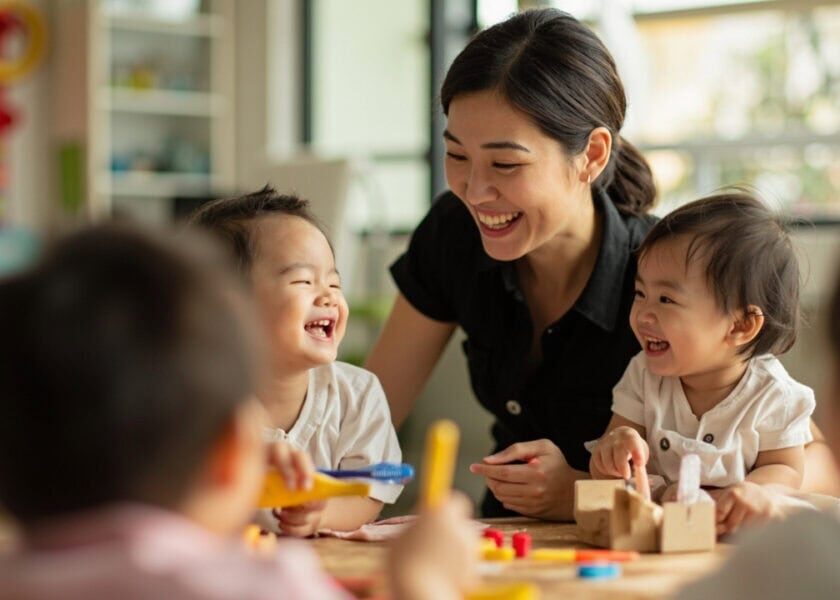
What Singapore Parents Discover When They Trust Their Instincts About Childcare
The Quiet Moment Before the Decision
There is a quiet moment that happens in many Singapore homes before a parent ever fills out an enrollment form. It happens at the dinner table, or in the car after dropping the baby at someone’s place, or in that still point just before sleep when the day’s decisions settle and you are left alone with your own judgment.
It is the moment when a parent thinks: I have chosen what I believe is right for my child, and I am not sure my own parents will understand.
This is not a dramatic moment. There are no raised voices or closed doors. It is quieter than that. It is the hesitation before making a phone call. It is rehearsing a sentence in your head, trying to find the words that will land with love and not land with resistance.
If you have felt this, I want you to know something: you are not imagining the weight. And you are not alone in carrying it.
Understanding the Singapore Reality
Singapore parents face a childcare decision that is rarely just about childcare. It is a decision that runs through the heart of family, through generations of expectation, through the particular way we have built our lives here — three generations under one roof, or two, or connected by the thin strong threads of WhatsApp and weekend visits and the assumption that family means being present for each other’s children.
We are a society that has always believed it takes a village, and in Singapore, the village has often meant grandparents.
This is not a cultural problem to be solved. It is a cultural reality to be understood.
The expectation that grandparents will be primary caregivers did not emerge from nowhere. It emerged from love — from a generation that raised their children in a Singapore that was different, harder in some ways, more communal in others, where a grandmother’s lap was the most natural place for a child to be. It emerged from parents who gave everything and who believe, with complete sincerity, that their way of loving is the right way.
They are not wrong. They are operating from a deep place of care.
But here is the truth we rarely say out loud: those assumptions are not the same as what children need now. They are not the same as what our children actually need.
The developmental science of the first thousand days has given us something extraordinary — a clarity about what infants require that our parents’ generation simply did not have. Not because they did not love their children, but because the science was not there.
We know now that the infant brain develops at a speed it will never match again. We know that responsive, attuned caregiving in the early years shapes not just intelligence but emotional regulation, not just language acquisition but the capacity for relationship. We know that the quality of care in these early years leaves an imprint that is measurable, real, and lasting.
None of this means that grandparent love is inferior. It means that grandparent love, however profound, is not the same as professional developmental care. These are not competing things. But they are not interchangeable either.
Where the Tension Lives — and How to Move Through It
A Singapore parent today is often caught between two things that feel irreconcilable.
They know, in their bones, that their child deserves more than passive entertainment, more than a screen, more than a grandmother who is doing her best while managing her own exhaustion, her own health, her own years of having already raised children. They know that professional care — with trained caregivers, age-appropriate environments, and structured developmental support — is what their child needs to truly thrive.
And they also know that suggesting this to their own parents feels like a betrayal.
What we rarely acknowledge is that this guilt is not a sign that something is wrong with the parent. It is a sign that something is true about our culture — that we have conflated grandparent involvement with grandparent caregiving, that we have assumed these are the same thing, and that when we step back from one, we fear we are stepping away from all.
Will my parents feel rejected?
The fear of rejection is real, and dismissing it would be unkind. Your parents may genuinely feel hurt, at least initially. But rejection and redirection are different things. When you enroll your child in quality care, you are not saying your parents are inadequate. You are saying that you want them in your child’s life in a way that is sustainable and joyful for everyone — and that means they cannot also be the primary caregiver.
Will my child suffer without grandparent primary care?
Children are not diminished when they spend their days in professionally attuned care. They are enriched. What they gain is not just the quality of care itself, but what that quality of care makes possible: a grandmother who shows up on Sunday afternoons with cookies and stories and a lightness that comes from not being exhausted. Your child gains the professional support they need and the grandparent love they deserve — because you created the conditions for both to exist.
What if my parents refuse to accept this?
Some resistance may not soften immediately. And that is something you will have to hold with grace. But grace does not mean reversal. It means holding your choice firmly while remaining open to understanding. Time and consistency often do what words cannot. When your parents see your child thriving, when they experience the relief of grandparent visits instead of the burden of daily caregiving, the reframing often happens on its own.
The Counterintuitive Truth: Quality Childcare Strengthens Grandparent Bonds
But here is what I have seen, working with families in Singapore who have made this decision and lived through it: the choice to enroll a child in quality formal care is not a choice against grandparents. It is, if made with intention and care, one of the most loving things you can do for your relationship with your own parents and for your child’s relationship with them.
When a grandparent becomes a full-time caregiver — responsible for meals and naps and discipline and the daily grind of raising an infant — something shifts. They stop being grandma. They become, in effect, a substitute parent.
And substitute parents carry a different emotional weight than grandparents. They become tired. They become irritable. They become protective in ways that can create friction with the child’s actual parents, because they have ownership now, real investment, real exhaustion.
Now flip it. Imagine a grandmother who is not the primary caregiver. She sees her grandchild on Saturday mornings, rested, present, joyful. She plays without the burden of responsibility. She reads stories because she wants to, not because it is nap time and she has to. She texts photos of the child’s laughter to the parents, not because she is obligated but because she is delighted.
She is a grandparent in the truest sense — a person who loves without having to carry the weight.
This is what quality childcare gives back to grandparents. It gives them themselves.
A grandmother who is present as a grandmother shows up differently than one who is present as a caregiver. She is more patient. She is more playful. She is more able to be the emotional anchor that grandparents uniquely provide — the link to family history, to cultural continuity, to a love that comes from somewhere older and deeper than parents can offer.
Children need both. And children can only have the grandparent version if we create the conditions for it.
What Quality Childcare Actually Looks Like
Research consistently shows that children in quality early childhood settings develop stronger language skills, better social-emotional regulation, and greater cognitive flexibility than those in unstructured or inconsistent care. This is not a slight against family. It is simply what professional environments designed for infant development provide.
In practice, quality infant care means:
- Small ratios — one caregiver to a small number of infants, allowing for the individual attention that young children genuinely require
- Trained, supported caregivers — not just loving adults, but professionals who understand infant development and know how to respond to a child’s cues
- Environments designed for infants — age-appropriate stimulation, safe spaces for exploration, routines that support development
- Transparent communication — parents who know what is happening in their child’s day, who receive updates and feel connected
- Partnership with families — not a replacement of the family, but an extension of it
Language for the Conversations You Need to Have
Choosing quality childcare is not a withdrawal of family. It is a reorganization of family. It is the recognition that different people in a family system have different roles to play, and that honoring those roles means letting them be what they are meant to be.
Here is language I have heard work:
“I need you in my child’s life, but I need you there as a grandparent, not as a primary caregiver. I need you to be the person who shows up with energy and love and patience, not the person who is running on empty because you have been doing this all week.”
“What we are choosing is not about you not being enough. It is about our child having more than one kind of love — the professional care that supports their development, and the family love that connects them to who they are. We need both.”
You do not have to convince your parents that they are wrong. You do not have to prove that their way was inadequate. You simply have to articulate what you are choosing and why it includes them, not excludes them.
Singapore parents who navigate this well share something in common: they stopped waiting for agreement and started acting from clarity. They stopped apologizing and started explaining. They stopped defending and started offering.
They stopped asking, “How do I make them understand?” and started asking, “How do I honor both the choice I am making and the relationship I want to keep?”
Built for This Moment: The EduNanny Approach
This is why EduNanny Singapore exists — not just to provide quality infant care, though we take that responsibility with the seriousness it deserves, but to stand alongside Singapore parents in the fullness of what they are navigating.
We know that choosing childcare in Singapore is rarely just a logistics decision. It is a family decision. It is a cultural decision. It is a decision that touches your relationship with your own parents, your sense of who you are in your family, your understanding of what it means to be a good son or daughter alongside being a good mother or father.
EduNanny operates as part of the ECDA Childminding Pilot, which situates our work within a broader recognition that Singapore families need options — real options, that are accessible, that are structured, that come with the accountability and support that parents deserve.
Our childminding pathways are designed to be flexible enough to meet the realities of Singapore family life, whether that means home-based care or community and centre-based settings, with ratios that allow for the individual attention that infants require.
We know that trust is not abstract for parents. Trust is practical. It is knowing who is with your child, what they are doing, how your child is developing and feeling and growing throughout the day. That is why our approach is built on transparency — communication that keeps you connected, measures that give you visibility into your child’s day, and a commitment to working with you as partners in your child’s care.
Our caregivers are not anonymous figures. They are known to you, trained, supported, and held to standards that reflect the sacred responsibility of being with your child when you cannot be.
Cost is a real consideration for Singapore families. The pilot structure has been designed with affordability in mind, and we help parents navigate the practical tools available to them — CDA and Baby Bonus usability, for instance — so that quality care is not something that only families with significant means can access.
A Note to You, Sitting With This Decision
If you are in that quiet moment I described at the beginning — the one where you have made your choice in your heart but you have not yet said it out loud, because you are not sure what saying it will cost — I want to speak directly to you.
You are not abandoning your parents by choosing professional care. You are not saying that what they did was wrong. You are saying that the world your child is growing up in is different, and that what children need today is different, and that you are brave enough to make a choice based on what your child actually needs rather than on what would be easiest for your family to accept.
That is not a small thing. That is courage. And it is the kind of courage that children learn from, even when they are too young to understand the words.
A grandparent’s role is not to replace a parent. It never was. And when we ask grandparents to be primary caregivers, we are not honoring them. We are burdening them with something they were never designed to carry full time.
Engagement and caregiving are not the same. Presence and primary responsibility are not the same. And the child who has a grandmother who comes for weekend afternoons, who takes them to the park, who tells them stories about when their father was small — that child is not lacking something. That child is being given something that no amount of full-time grandparent care can replicate.
Your child will grow up knowing that their parents made hard choices for them. They will grow up with grandparents who are present and joyful and emotionally available — not because they were obligated, but because they were freed to love without exhaustion. They will grow up in a family that found a way to be strong not by clinging to what was, but by evolving toward what could be.
And you — you will grow, too. You will grow in your capacity to hold a decision with clarity, even when those around you do not understand it. You will grow in your ability to navigate family dynamics with both firmness and grace. You will grow into the parent your child needs you to be, which is not always the parent that is easiest or most comfortable, but is always the one that is most loving.
The Family You Are All Becoming
There is a version of family that Singapore has always believed in — the village, the extended network, the generational web of love and support. That version is not wrong. But it can evolve. It can become something that works for the children of today, not just the children of yesterday. It can include professional care as part of the village, not as a replacement for it, but as a structure that makes every other part stronger.
EduNanny Singapore is part of that village. We are not here to take your place, or your parents’ place. We are here to be part of something that is larger than any one family, larger than any one generation — a commitment to raising children well, in all the ways that raising children well requires.
You do not have to choose between your child’s future and your family’s harmony. You can have both. You can have a child who thrives in professionally attuned care and a grandmother who shows up on Sunday afternoons with cookies and stories and a lightness that comes from not being exhausted. You can have a family that is stronger not because it is the same as it was, but because it has found a new shape that works.
You already know what is right for your child. Trust that knowing, and hold it gently but firmly in the face of whatever questions or doubts come your way.
The conversation you need to have is not with your parents, not really. It is with yourself. It is the conversation where you stop apologizing for what you know to be true and start standing in it. Everything else — the words you choose, the approach you take, the grace you extend — flows from that.
Your child is lucky to have you. Your parents are lucky to have you. And somewhere in the middle of all of it, there is a place for EduNanny, doing what we do best: caring for the children you love, in the way they deserve to be cared for, while you build the family that you are all becoming.
If you are ready to explore what quality infant care can look like for your family — care that is designed to work with your family, not instead of it — we invite you to connect with us.
Not as a service that you purchase, but as a partner that you trust. Not as a solution to a problem, but as a foundation for everything your family is building.
We are here when you are ready.
Learn more about EduNanny Singapore and our ECDA-registered childminding pathways, or reach out to speak with our team about your family’s childcare needs.