Growing Your Children Together: The Sibling Bond in Singapore Childcare
The Question Every Parent With Multiple Children Is Actually Asking
When Singapore parents are choosing childcare — weighing options, visiting centres, asking questions about ratios and curriculum and caregiver qualifications — the sibling dimension is almost entirely absent from the conversation. It is as if each child is being considered in isolation. As if the question is only ever: how will this care serve my individual child?
But you know, in the quiet part of your mind where the real questions live, that this is not the question keeping you awake at night.
The question you are actually wrestling with belongs to every parent with more than one child. and it sounds like this: am I giving enough to each of them?
You feel it in the morning, when you are getting the older one ready for school and the younger one is reaching for you, and you cannot be in both places at once. You feel it in the evening, when one child needs help with something and the other is asking for something different, and you are stretched across two needs like a wire about to snap.
You look at childcare not just as a solution for one child, but as a kind of arithmetic. How do you solve for two? How do you find care that does not just manage your children side by side, but somehow grows them together? How do you choose a place that will not add to the division you already feel, but will instead give your children something you, despite all your love, cannot give them alone?
What Siblings Give Each Other That Adults Cannot
When a child learns alongside a sibling, something fundamentally different is happening than when they learn alongside an adult. Adults are guides. Adults are patient. Adults are kind. But adults are also, in a certain sense, finished — they have already made the mistakes, already had the breakthroughs, already solved the problems. When a child learns from an adult, they are learning from someone for whom the struggle is over.
When a child learns alongside a sibling, they are learning from someone who is still in the struggle with them. Their peer is figuring it out at the same pace they are. Their peer does not have the answer waiting in the back of their mind. Their peer is surprised, frustrated, delighted, and confused in real time — just like them.
This is what developmental psychologists call a peer mirror. It is the experience of seeing your own process reflected in someone who is close enough to you to understand, but different enough from you to surprise. When your child watches their sibling figure out how to stack blocks, they are not just watching a demonstration. They are watching someone who matters to them — someone whose opinion they care about, whose reactions they read, whose success they want — wrestling with the same challenges they themselves are facing.
And in watching, they are learning something that no amount of adult instruction can teach: that learning is not solitary. That struggle is shared. That progress is possible.
The Difference Between Managing Siblings and Growing Sibling Bonds
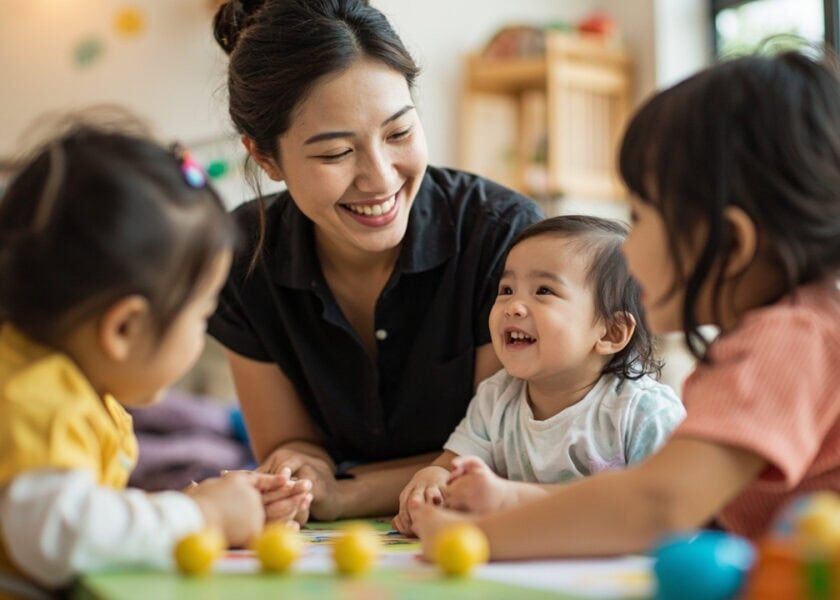
Take this and place it in a quality childcare environment, and something remarkable becomes possible. The environment becomes a space where sibling learning is not just possible but deliberate. Where children are given opportunities to collaborate, to solve problems together, to be co-learners rather than parallel learners. Where the presence of a familiar face creates a foundation of security from which exploration can safely grow.
This is not the same as simply having siblings in the same room. Any childcare setting can claim that. What we are talking about is something more intentional. It is the difference between childcare that manages siblings and childcare that grows sibling bonds.
When Siblings Are Merely Managed
- They are kept comfortable
- They are kept safe
- They are kept from bothering each other too much
This is not nothing. It is valuable, and any parent who has tried to work while managing two children at home knows exactly how much relief comes from mere management. But management does not grow anything. It preserves. It maintains. It keeps the peace.
When Sibling Bonds Are Grown
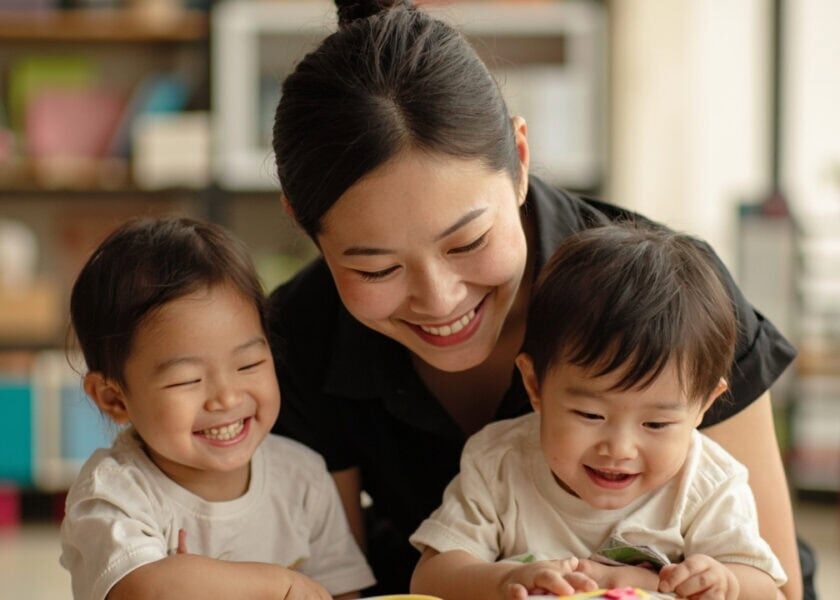
Something different is happening. Children are given the language and the space to negotiate. They are supported in the friction that comes from wanting the same toy at the same time — not rescued from it, but guided through it. They are learning, in a supported environment with skilled caregivers who understand sibling dynamics, how to be partners with someone they love who is also, sometimes, frustrating and difficult and hard to understand.
They are learning the hard, essential skills of collaboration: how to assert yourself, how to yield, how to find a third way that neither of you saw alone. These are not skills that can be taught. They can only be practiced. And they need a context that is safe enough for failure — where a caregiver can step in, where the stakes are low, where the lesson can be gentle and repeated and gradual.
This is the hidden developmental outcome of great childcare. It is not just that your children are safe. It is not just that they are learning colours and numbers and motor skills. It is that they are becoming, day by day, the siblings they will be for the rest of their lives. They are building the relational foundation that will carry them through school, through adolescence, through adulthood.
What to Look for in Quality Sibling Care
For Singapore families, several markers distinguish childcare designed to grow sibling bonds from childcare that simply manages them. These are the questions worth asking when you visit a centre or meet a caregiver.
- Intentional grouping structures — opportunities for siblings and familiar peers to work together, not just be in the same building
- Caregiver attention to sibling dynamics — trained observers who notice what is happening between children, not just with each child individually
- Supported conflict resolution — guided experiences with friction that teach negotiation rather than simply separating children
- Communication about relationships — updates that help you understand how your children are developing together, not just apart
- Appropriate ratios — enough attention available to nurture group dynamics, not just manage safety
Will My Children Actually Bond, or Just Tolerate Each Other?
Sibling bonds are not automatic. They require conditions — space to interact, guidance through friction, and adults who understand that conflict is not failure but practice. In environments designed to grow sibling relationships, children learn that disagreements can be resolved, that cooperation has rewards, and that the person who frustrates them is also the person who understands them best.
What if They Fight More Because They Are Together All Day?
This is possible, and it is not a sign that sibling care is failing. Sibling friction in a supported environment is practice. Children who learn to navigate conflict with a sibling in a childcare setting — with skilled caregivers who guide rather than simply separate — develop conflict resolution skills that will serve them throughout their lives. The goal is not peace. It is competence.
I Already Feel Guilty About Not Being Enough. Will Childcare Add to That?
The guilt you carry is the natural byproduct of a system that tells parents they should be able to do it all, do it perfectly, and somehow emerge unscathed. Quality sibling care does not add to this guilt. It reframes the question. It acknowledges that your children need something you cannot give them — and that something is each other. When sibling bonds are deliberately cultivated, you are not failing your children by needing support. You are giving them access to their first and most formative team.
How EduNanny Singapore Approaches Sibling Care
EduNanny by BUTLER operates within the ECDA Childminding Pilot, offering Singapore families access to home-based and centre-based pathways for quality infant and childcare. Our approach begins with ratios that allow for genuine attention — with up to one to three infants per caregiver in our settings, your child receives the observation and responsiveness that infant development requires. This is not a marketing claim. It is a structural commitment that shapes everything else.
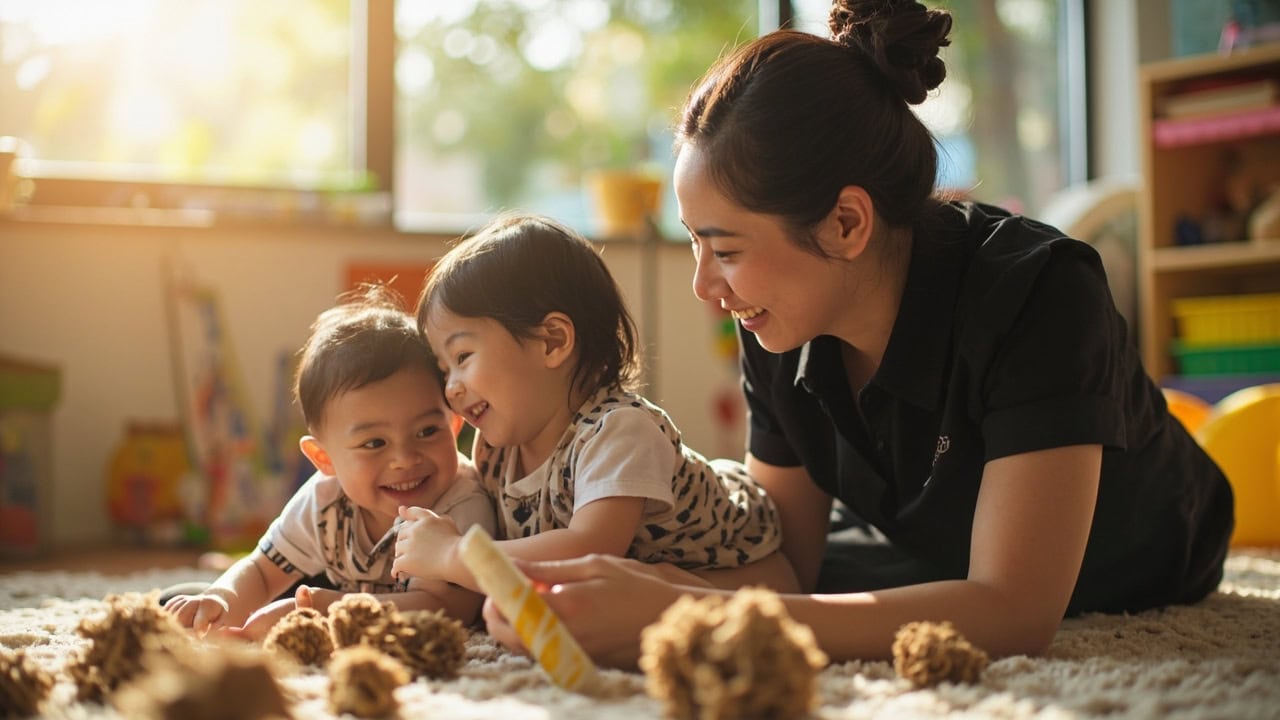
When a caregiver can genuinely know your child — when they can notice the small shifts in mood, the emerging interests, the moments of frustration and breakthrough — they can also notice what your child needs from their sibling. They can create the conditions for collaboration. They can step back when siblings are working well together and step in when they need guidance. They can be the steady presence that allows siblings to take risks with each other — to push each other, to learn from friction, to grow.
Designed for Singapore Families
EduNanny’s care operates across Monday to Friday blocks, with fee structures designed to be affordable within the pilot framework. For families navigating the cost of multiple children in care, we support the use of CDA and Baby Bonus subsidies, making quality care accessible in ways that respect the financial realities of raising children in Singapore.
Transparency as Trust
We know that trust is not abstract for parents. It is immediate, practical, and earned through transparency. That is why communication is built into every layer of our service — from regular updates that help you understand not just what your children did today, but how they are developing, where they are growing, what relationships are forming. Where CCTV measures are deployed, they provide an additional layer of reassurance that your children are in a space where nothing is hidden, nothing is obscured, nothing is left to worry.
Support Beyond the Classroom
Parenting is not only about what happens in the childcare room. Your questions, your doubts, your everyday concerns do not pause from nine to five. We have developed Thomas, our AI-powered chatbot, available to support you whenever you need guidance. Thomas is not a replacement for the human relationships that matter. It is simply another way we stay connected to your family’s needs, answering questions, offering resources, being present in the way that modern parents need support to be present themselves.
The Long View: What Your Children Will Carry With Them
There is a way of thinking about sibling relationships that sees them purely in terms of rivalry. Siblings competing for resources, for attention, for parental love. And it is true that siblings can be rivals. They can be jealous, resentful, competitive in ways that hurt. Every parent with multiple children has seen it.
But siblings are also, and perhaps more fundamentally, the first team your child will ever belong to. They are the first group of people who did not choose them, who were simply placed alongside them by circumstance, and who must therefore be negotiated with, collaborated with, loved in spite of friction. This is, in miniature, the whole project of human social life. And the skills your children learn in navigating this first team — in a safe, structured, supported environment — will travel with them everywhere.
When your children are grown, they will not remember the curriculum. They will not remember the toys or the routine or the walls of the room. But they may remember — and research suggests they often do — the feeling of being in something together. The memory of a sibling who was there in the hard early years, who was present in the struggle and the discovery, who shared the first classroom and the first friendships and the first experiences of learning how to be a person among people.
Begin the Conversation
The first teacher who is not your child is their sibling. The first collaborator. The first rival. The first mirror. The first person who will walk beside them through the whole long strange journey of growing up.
We do not pretend that sibling bonds are simple. We do not promise that siblings will always get along, always cooperate, always be easy with each other. We know that sibling relationships are complex, demanding, sometimes painful, and ultimately irreplaceable.
What we promise is that we will take them seriously. That we will invest in them as the developmental force they are. That we will create the conditions in which your children can grow into the siblings they are meant to be.
If you are a parent with multiple children in Singapore, exploring your childcare options, we invite you to have a conversation with us. Not about our features. Not about our prices. About your children. About what you want for them. About what you hope they will become to each other.
We believe quality sibling care is one of the most meaningful gifts you can give your children. And we would be honoured to help you give it.
Explore how EduNanny Singapore supports sibling development. Get in touch to learn about our ECDA Childminding Pilot placements, subsidy options, and how we approach sibling care as a deliberate developmental practice.
Learn more about EduNanny’s approach to quality childminding or read about who we are and what we stand for.