Where Your Village Begins
Finding Your Village in Modern Singapore
We used to raise children in clusters. Grandparents who lived down the road, who knew your child’s second cousin’s name and could recall exactly how they slept at six months. Neighbours who heard a cry and knocked on the door with something warm. Older siblings, cousins, the woman three doors down who had raised four children and had opinions about everything and wisdom about something.
That was the village. Not a metaphor. A literal arrangement of people, proximity, and accumulated care that had been doing the work of child-rearing for longer than any of us had been alive.
And then something happened.
Flats got smaller, though the prices did not. Grandparents kept working, or moved to the other side of the island, or eventually, gently, became the ones who needed care instead of those who gave it. The neighbourhoods where children once roamed in loose packs became carparks and cafés. Remote work, that great liberator, turned out to also be a great isolator, replacing the accidental encounters of office life with the accidental encounters of grocery runs, which are not the same at all. Families shrank. Support systems scattered.
The phone in your pocket gives you access to the entire accumulated knowledge of human civilization, but it does not hold your baby at three in the morning while you fall apart.
Singapore parents are doing something extraordinary in circumstances that are, in a very specific and modern way, extraordinarily isolating. We are building lives for our children in apartments where the walls are thin and the neighbours are unknown. We are making decisions about development and nutrition and screen time and sleep training that previous generations made collectively, if they made them consciously at all. We are trying to give our children roots in soil that has been paved over. And we are doing it, largely, on our own.
This is not a failure of will. This is not a lack of love. This is the sound of something that has quietly and without fanfare shifted beneath the feet of an entire generation of Singapore parents.
What You Are Really Searching For
Here is what makes the childcare search so difficult: the very act, which should be a straightforward practical exercise, instead becomes loaded with something much larger.
Because when you walk into a childcare centre or meet a childminder or fill out the forms for that home-based arrangement you heard about, you are not just solving a logistics problem. You are making a decision about what kind of world your child will belong to. You are choosing, whether you frame it that way or not, what your village will look like.
Most parents go into the search thinking about ratios and curriculum and whether the centre has air purifiers and what the food is like. These are reasonable things. They matter. But they are the surface of something deeper, and if we stay only on the surface, we miss what is really at stake.
What you are actually searching for, even if you do not yet know how to say it, is a place where your child belongs. Where they are known, not just supervised. Where someone notices the way they turn the pages of a book or the sound they make when they are about to cry, and that noticing is passed between caregiver and parent like a conversation that never really ends.
You are searching for people who will love your child in your absence. Not instead of you. Alongside you. You are searching for the beginning of the village your child deserves.
Building Your Village: The Role of Quality Childcare
The collapse of the traditional village did not happen because families stopped caring about each other. It happened because of the way modern life reorganised itself around efficiency and mobility and the particular pressures of a city that moves very fast. There is no single villain in this story. There is only the accumulated weight of choices none of us made consciously and circumstances none of us chose.
But villages can be built. They do not have to be inherited. They do not have to look like the villages our parents knew. They do have to be built with intention, and the first intentional choice many modern Singapore parents make is the choice of childcare.
Think about what happens when you choose well.
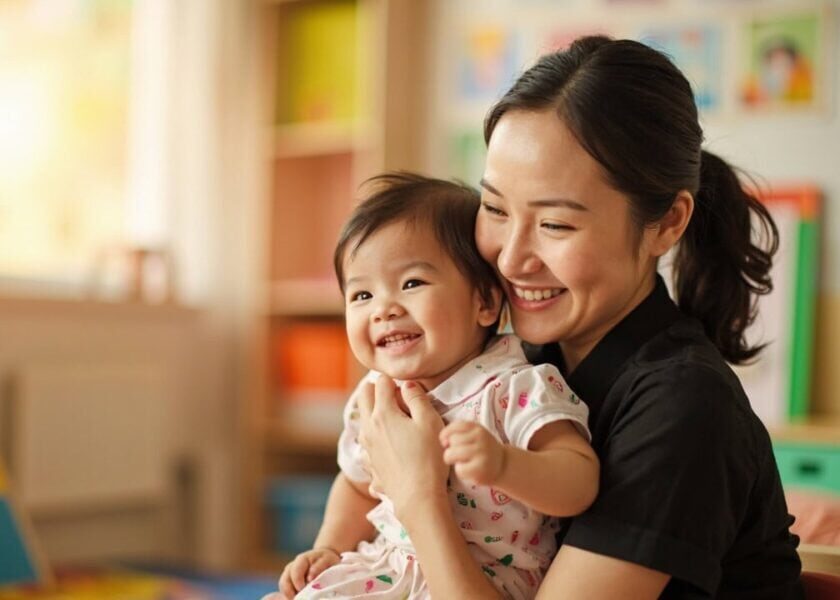
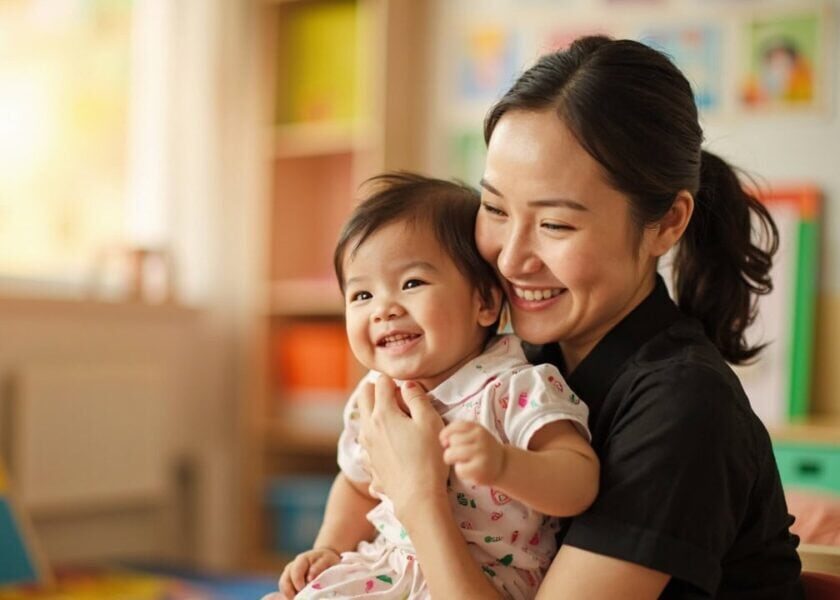
A caregiver who has held your child every day for months begins to know them in a way that goes beyond the clinical. She knows that your daughter needs a moment to warm up to new toys but once she does, she plays with fierce concentration. She knows your son is not really hungry at four o’clock but he is tired, and tired children sometimes think they are hungry.
This knowledge does not replace your knowledge of your own child. It extends it. It creates a second pair of eyes, a second heart, a second presence in your child’s life that is genuinely invested in their wellbeing.
Quality childcare has a strange and wonderful tendency to attract the kind of families who are looking for the same thing you are. When a childcare environment is built on warmth and genuine engagement rather than mere supervision, it creates a gravitational pull. The families who find their way there are not there by coincidence. They are there because something in the approach resonates with what they are actually looking for.
And before you know it, you are standing in a pickup line or a drop-off corridor, and you are talking to another parent, and you discover that you share something beyond proximity. You share values. You share concerns. You share the particular exhaustion of trying to raise a small human in a world that was not designed with small humans in mind.
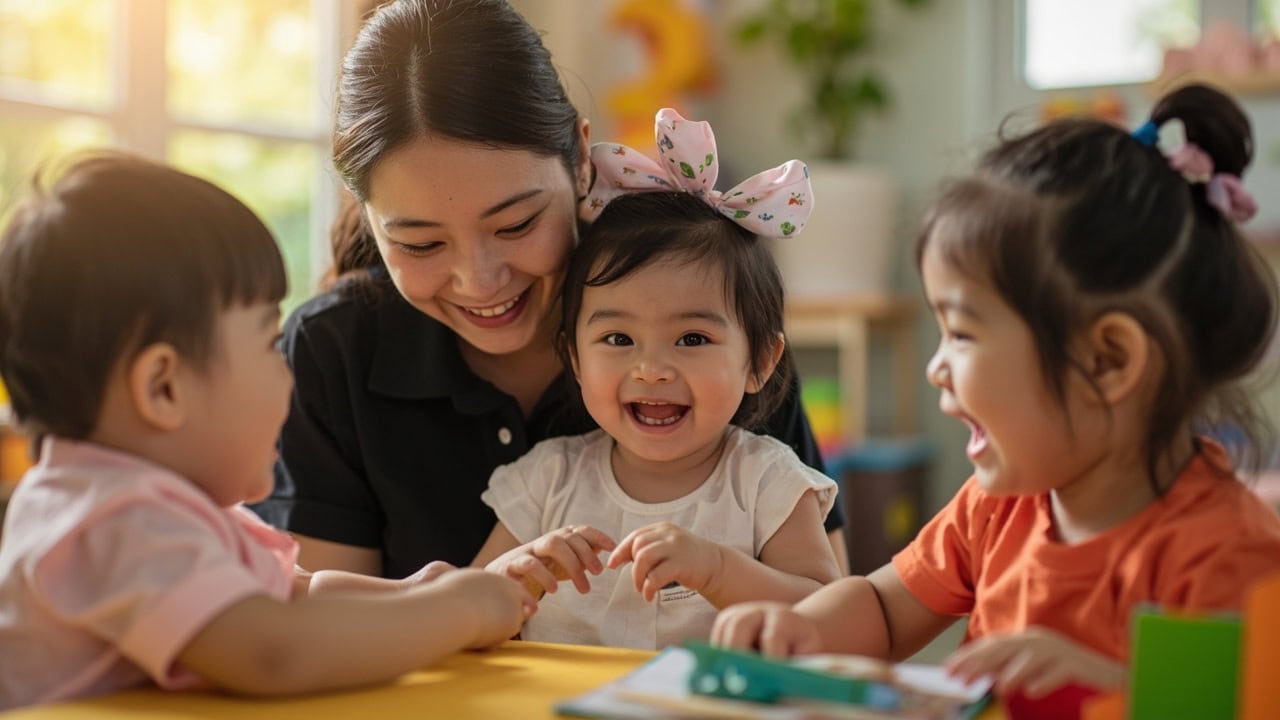
These families become your village too. Not all at once. Not in a dramatic fashion. But slowly, over coffee after drop-off and messages about stomach bugs and the gentle exchange of recommendations and concerns, a community forms. Your children grow up together. Their caregivers know each other. The isolation that defined the early months of parenthood begins, gradually, to lift.
What Belonging Actually Looks Like in Practice
There is a word that keeps surfacing when parents describe what they are looking for, even when they do not use it directly. That word is belonging.
Not just attendance. Not just safety. Belonging. The sense that this place is mine, that my child is known here, that I am known here, that this is where we are supposed to be.
Belonging is not something that can be manufactured through good branding or comfortable furniture, though those things help. Belonging is the accumulated result of hundreds of small moments of genuine care:
- The caregiver who texts you not because the app requires it but because she thought you would want to know
- The centre director who remembers that your family speaks Mandarin at home and makes sure your child hears songs in both languages
- The environment where your child’s artwork is displayed not as decoration but as evidence that what they make matters
- The place where, when you pick up your child at the end of the day, the handover conversation is not a transaction but a continuation of something ongoing
This is the difference between childcare that solves a problem and childcare that becomes part of your solution to the larger problem of raising children in a world that has lost its villages. The first kind is perfectly fine. Sometimes it is exactly what you need. But the second kind is what you are actually searching for, even when you do not call it that, even when you fill out the checklist looking for something else.
The second kind changes the shape of your parenthood. It gives you back something you did not know you had lost until you felt it return.
Safety, of course, is the foundation. Quality childminding arrangements in Singapore operate within regulatory frameworks that set baseline standards. Beyond the checklist, look for environments where caregivers know your child well enough to notice when something is off—before it becomes a problem. That observational knowledge, the ability to read your child’s signals before they become full cries, cannot be faked or rushed. It is earned through consistent, attentive presence.
Grandparents and Extended Family: Holding the Whole Village
There is something else that quality childcare does, something that often goes unmentioned because it is harder to quantify. It creates space for grandparents and extended family to remain part of the village architecture instead of being sidelined by the logistics of modern childcare.
Here is a truth that is rarely spoken aloud: the transition from grandparent caregiving to formal childcare can be experienced as a kind of grief by everyone involved.
- Grandparents who have been primary caregivers for years suddenly find themselves on the outside of daily life with their grandchildren
- Parents feel caught between gratitude and guilt
- Children experience the disruption in ways they cannot articulate
- The village, which was already fragile, seems to shrink further
But it does not have to shrink.
A childcare environment that understands community, that sees itself as a partner with families rather than a replacement for them, can hold space for grandparents. It can include them in transitions. It can communicate with them. It can recognise that a grandmother who has spent every Tuesday with a child for two years is not a relic of the old way of doing things but a pillar of the new one, if she is given the chance to remain woven into the fabric.
Research on attachment tells us that children benefit from multiple consistent, caring relationships—not one caregiver and that’s it. What matters is that each relationship is warm, responsive, and reliable. A caregiver who becomes genuinely attached to your child adds to their secure base, not divides it.
This is the difference between childcare as a service and childcare as community infrastructure. A service solves your logistics problem and sends you home. Community infrastructure holds everyone in it, including the people who love your child, including you.
EduNanny: Where Your Village Begins
What makes EduNanny different is not a curriculum or a facility, though both are well considered. What makes it different is the understanding that the caregiver is not just a person who watches your child. The caregiver is the first person outside your family who will know your child deeply, and that relationship, handled with care and respect and genuine warmth, is the seed from which your village grows.
EduNanny participates in the ECDA Childminding Pilot, which represents something important: the formal recognition that home-based and community-based care are not lesser options but different pathways, each with its own strengths, each capable of creating the conditions for genuine belonging.
With small-group settings that allow for the kind of individual attention that young children need, with structures that make quality care accessible within the pilot fee arrangements, and with the flexibility to serve families across Singapore, EduNanny is doing something that matters.
The practical elements are in place, as they should be. Monday to Friday care blocks that work with the rhythm of working families. The usability of CDA and Baby Bonus funds, because financial logistics should not be a barrier to quality. Communication and transparency measures, including CCTV where deployed, because trust requires visibility. These are not the things that make EduNanny special, but they are the things that make it reliable, and reliability is what you need when you are building something as important as your village.
There is a moment, and parents tell me about it often, when you realise that the person caring for your child has become part of your family. Not in a legal sense. Not in a contractual sense. But in the way that matters most: your child runs to them. Your child is delighted when they arrive. Your child feels safe with them in a way that goes beyond comfort and becomes a kind of security that shapes how they move through the world.
That moment is the beginning of the village. Everything else grows from there.
The Decision That Changes Everything
The loneliness of modern parenting is real. It is not dramatic, and it does not announce itself, but it is there, in the quiet apartment, in the difficult nights, in the searches for childcare that feel heavier than they should.
That loneliness is not a personal failing. It is the natural consequence of living in a world that has reorganised itself around individual achievement and away from collective care.
But loneliness, even the quiet kind, even the kind that has become so familiar you have stopped noticing it, can be addressed. It can be met with something other than self-help articles and well-meaning platitudes. It can be met with the kind of intentional community-building that begins with a single choice: the choice of who will help you raise your child.
This is the choice in front of you, if you are a Singapore parent who has found your way here. Not just a choice about childcare. A choice about what kind of village your child will grow up in. A choice about who will know them besides you. A choice about whether you will do this alone, or whether you will build something that holds.
The villages of previous generations were not perfect. They had their tensions and exclusions and blind spots. We do not need to replicate them. We need to learn from their deepest truth: that children thrive when they are surrounded by people who know them and care about them and show up consistently for them.
That parents thrive when they are not alone. That community is not a luxury. It is infrastructure. And like all infrastructure, it has to be built deliberately, with the right materials and the right intentions.
Search for childcare the way you are searching for it, with all the practical criteria and the emotional weight that you cannot quite name. And when you find yourself standing in a space that feels different, that feels warm and genuine and full of the kind of attention your child deserves, pay attention to that feeling.
That is the village speaking. That is what you were looking for, even before you knew you were looking for it.
You are not just choosing a service. You are choosing your village.
And the village you build will shape your child in ways you will never fully see. It will shape who they trust. It will shape how they move through relationships. It will shape the kind of parent they become, someday, when it is their turn.
The village is not a metaphor. The village is a future, and it starts with the choice you make today.
EduNanny is here for that. For your child. For you. For the village that is waiting to be built.
All you have to do is choose to build it.
Ready to explore what belonging looks like? Get in touch to learn more about how EduNanny creates the conditions for genuine community—for your child, your family, and the village that will support you through the years ahead. You can also read more about EduNanny’s approach.