Why Your Child’s Bond With Their Caregiver Shapes Everything
The First Hello: Understanding the Caregiver Relationship That Changes Everything
There is a moment, right at the beginning, that most parents remember clearly even though it lasts only seconds. You are standing in a room that is new to you. Your child is in your arms or held carefully by someone you have just met. The caregiver is kneeling down, speaking softly, and your child is staring—this wide, careful stare that is neither acceptance nor rejection. It is assessment. It is a child doing what children have always done: figuring out who is safe, who is real, whether this place and these people will hold them.
You feel it all. The hope that your child will like this person. The quiet prayer that they will be kind. The strange, complicated ache of watching your child look at someone else with that searching expression that they have only ever directed at you.
This is where it begins. Not with you, not in the past tense. This is where it begins, and what happens next is one of the most meaningful things your child will experience in their earliest years.
The Story Nobody Tells You
Most conversations about childcare focus on what happens during the hours you are apart. The meals, the naps, the learning activities, the safety of the environment. These things matter, of course they do. But the real story—the one that unfolds over weeks and months and sometimes years—is the story of a relationship. A small, human relationship that starts with hesitation and, when it goes well, becomes something that your child carries with them long after the childcare years are over.
Understanding this relationship is not about easing your mind with vague reassurances. It is about seeing what is actually happening, and what it actually does for your child. Once you see it, you cannot unsee it. It changes how you feel about the decision you are making right now.
The Phases of Attachment: How Trust Builds Over Time
When a child meets a caregiver for the first time, they are not simply evaluating a stranger. They are drawing on everything they have learned about the world so far. They are asking, in the language that comes before words: Is this person like the people who take care of me? Will they be here tomorrow? Can I trust what they do and say?
The answers do not come from a single interaction. They come from repetition. From the caregiver who always hands the child the same cup at snack time. From the afternoon nap routine that happens the same way, every day, until the child stops watching so carefully and starts trusting. From the voice that says the same good morning greeting each morning, until the child begins to expect it, to look forward to it.
This is how all trust begins. Not with grand gestures, but with the ordinary accumulation of sameness. With someone who shows up, and shows up, and shows up.
The Four Phases of the Child-Caregiver Bond
- Observation: The child is close to the parent, watching the caregiver from behind a familiar body, gathering data about this new person.
- Tentative Engagement: A reaching hand. A response to a silly sound. The beginning of eye contact that lasts more than a moment.
- Comfort and Exploration: The child moves further away from the parent in the room. They play with the caregiver nearby rather than beside them. They stop checking in so frequently. They begin to explore.
- Secure Base: The caregiver becomes a reliable foundation from which the child can venture out and return. The relationship has its own shape, its own trust, its own meaning.
This progression is not a sign that your child has forgotten you. It is a sign that they are using what they have learned from you to test the world. Your child is not replacing you with someone else. They are doing what human beings are designed to do: they are expanding.
What This Relationship Gives Your Child
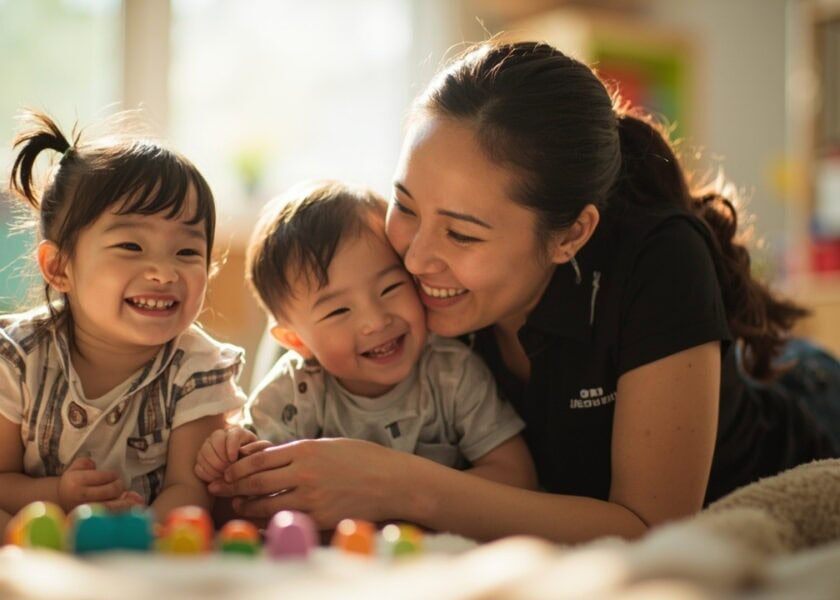
The caregiver is giving your child the gift of a wider world—one in which your child is held by more than just you, and therefore held more firmly in the world at large.
This is why the quality of that caregiver relationship matters so much. Not just for the practical reasons—though those matter too—but because your child is building something foundational. They are building the internal working model that will shape how they relate to teachers, to coaches, to friends, to eventually colleagues and partners and their own children someday.
Think about what your child is actually doing in those early months with a caregiver. They are learning to trust someone new. They are learning that their communications—their cries, their gestures, their growing words—have an effect on someone who is not you. They are learning that this person pays attention, that they respond, that they remember. Your child is learning about reliability, about reciprocity, about the fact that relationships require effort from both sides.
What Research Tells Us About Multiple Attachments
There is a quiet fear that lives beneath the surface of this decision. It is the fear that someone else will become irreplaceable to your child. That the bond you have built with such effort and love will somehow be diminished by another bond.
I understand that fear. It comes from a beautiful place—from the depth of your love for your child and your awareness of how much your role in their life matters. But what research and observation have shown us, again and again, is that the opposite is true.
When a child forms a secure, warm attachment to a caregiver, they are not taking something away from you. They are adding something to their world. Children who have secure attachments to more than one consistent, loving adult do not love their parents any less. They love them more fully. They are more secure. They are more confident. They have more resources to draw on when they are stressed, when they are tired, when they need comfort.
A child’s brain is not a limited container that can only hold so much attachment. It is a growing system that becomes more capacious, more resilient, more capable of connection when it has multiple secure bases to rely on.
When you are the only secure base your child has, your child is bound to you by necessity as well as love. But when your child has another secure base—someone they trust completely, someone they feel safe with—that child is not clinging to you out of fear. They are resting in you out of love.
What Quality Childminding Looks Like in Practice
For parents in Singapore researching infant care, it helps to know what to look for. Quality childminding is not primarily about impressive facilities or a long list of activities. It is about the quality of attention your child receives.
When you observe a quality childminding environment, here is what you will notice:
- Consistent caregivers: Your child does not have a different person every day. They have a person, day after day, who knows them, anticipates their needs, and grows alongside them.
- Predictable routines: The same greetings, the same rhythms, the same small rituals of the day. This is not rigidity; it is the architecture of trust.
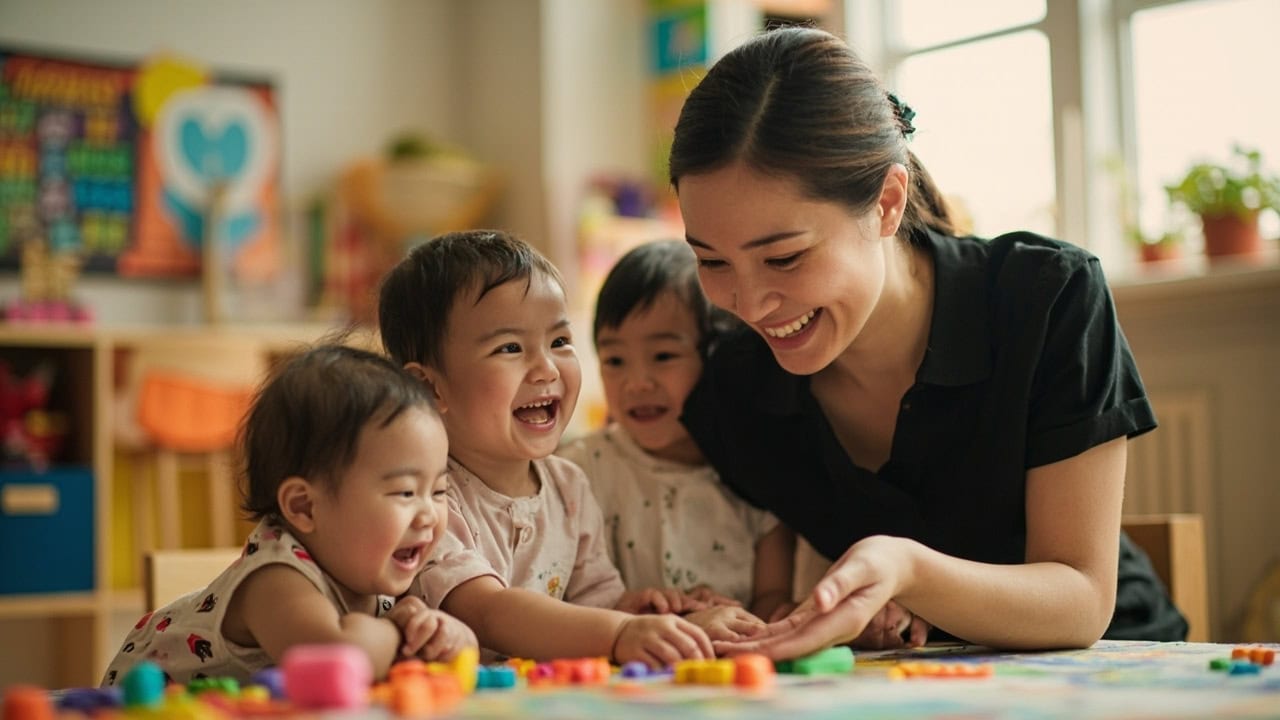
- Responsive interaction: The caregiver notices your child’s communications and responds. A gesture is acknowledged. A need is met before it becomes a cry. Your child learns that their voice matters.
- Warmth without intrusion: The caregiver is present but not overwhelming. They give your child room to explore, to try, to fail, to try again.
- Attentive observation: The caregiver notices things. How your child plays alone versus with others. What makes them laugh. What makes them frustrated. This knowledge becomes the foundation of responsive care.
How EduNanny Singapore Supports This Partnership
When you choose a caregiver for your child, you are not just choosing a person. You are choosing a system, a structure, a set of values that will shape that person’s ability to show up well, day after day.
EduNanny Singapore operates within the ECDA Childminding Pilot, which means that the caregivers who work with your child are not operating in isolation. They are part of a supported framework—a community of practice, ongoing training, and structured oversight that ensures consistency and quality.
When care is delivered through the EduNanny model, your child benefits from carefully maintained ratios. For infants, that ratio is never more than one caregiver to three children. Your child is not one of seven or eight. Your child is seen. Your child is known.
Monday to Friday care blocks offer the consistency that children need to build trust. This is how the arc I described earlier has room to complete itself. The pilot fee structures have been designed with affordability in mind, and CDA and Baby Bonus funds can be used, making quality care accessible to more families.
Your Role in the Caregiver Relationship
The question is not just what the caregiver relationship does for your child. The question is what your role is in this relationship, and how you can support it without disrupting it.
Here is what I have seen work well:
- Take genuine interest in the caregiver relationship—not as a manager checking on an employee, but as a co-developer of your child’s world.
- Ask, at pickup, how the day went. Listen to the answers with curiosity rather than suspicion.
- Share what you noticed at home that might be relevant to how the child was feeling during the day. A new tooth coming in. A restless night. A new word they learned.
- Welcome the caregiver’s observations, even when they differ from what you see at home. Two different relationships will show you two different pictures of your child. Both are true.
- Build, between the two of you, a shared understanding of your child that benefits everyone—especially the child at the center of it.
The children who thrive most are not the ones whose parents micromanaged the caregiver relationship or tried to control every aspect of it. They are the ones whose parents approached it with curiosity, with respect, with the understanding that their child was building something important with another human being, and that this was a gift, not a threat.
Answering the Questions You Really Have
Will my child still know me? When you pick up your child at the end of the day and they run to you, or settle into your arms with relief and joy, or show you something they made with the caregiver—this is not evidence that the caregiver did not matter. This is evidence that the caregiver succeeded in what they were trying to do: your child felt safe enough to explore, to learn, to enjoy, and now feels safe enough to come home and share that joy with you. The caregiver did not take your child away from you. The caregiver gave your child an experience to bring back.
Will the caregiver really know my child? The caregiver knows your child differently than you do. They see your child in a different context. How your child relates to peers. How your child responds to structure. How your child plays when the stakes are lower. Your child may show the caregiver things they do not show you—not because they are hiding something, but because different relationships bring out different parts of a person. This is not a threat to your position as a parent. This is the gift of the relationship. Your child is being seen fully. Your child is being known in their entirety, by more than just you.
What if something goes wrong? The structured framework within EduNanny’s model means that caregivers have support, training, and oversight. This is not about distrust—it is about creating the conditions where quality care can consistently happen. When caregivers are well-supported, they can show up for your child with patience, attention, and warmth, day after day.
Choosing Infant Care in Singapore: What to Look For
When you begin researching your options, here are the questions that matter most:
- Will my child have a consistent caregiver, or will they be cared for by rotating staff?
- What is the caregiver-to-child ratio, especially for infants?
- What training and support do caregivers receive?
- How does the daily routine support trust and security?
- What communication systems are in place to keep me informed?
- How does the program support the transition period when we first begin?
- Can I visit, observe, and ask questions before committing?
The answers to these questions will tell you whether the care you are considering is positioned to become a developmental partnership, or whether it will remain merely supervision.
What You Are Actually Choosing
The fear that I described earlier—the fear that someone else will replace you—is not a sign that you are being unreasonable or overprotective. It is a sign that you are a good parent. It is a sign that you understand the magnitude of what is at stake in your child’s early years.
But I want to suggest something to you, gently.
When you choose a caregiver with intention, with care, with the seriousness this decision deserves, you are not surrendering your child to someone else. You are choosing who will accompany your child during some of the most important developmental years of their life. You are choosing a partner in your child’s growth. You are investing in a relationship that will teach your child about trust, about warmth, about the goodness of people outside their family.
The caregiver relationship belongs to your child. It is theirs. But the conditions you create for that relationship—the thoughtfulness with which you choose, the respect you show to the caregiver, the openness you bring to hearing about what happens in your child’s day—this is yours. This is your contribution to something that will outlast the childcare years.
Coming Back to That First Moment
You are standing in a room. Your child is looking at someone new. There is uncertainty in your chest, and hope, and the quiet wish that this will go well.
It will. Not because childcare is simple, and not because children do not sometimes struggle with the transition, and not because every day will be easy. But because what your child is beginning is not a temporary arrangement or a convenient solution to a logistical problem. What your child is beginning is a relationship. And if that relationship is built on a foundation of training, of intentionality, of consistency and warmth, then what your child is building is something they will carry with them.
They will carry the memory of being known. Of being responded to. Of learning that people outside their family can be trusted, and kind, and reliable. They will carry the lessons they learned before they could speak, about how the world works and what it means to be in relationship with another person.
And when they walk into school for the first time, when they meet their first teacher, when they make their first friend, when they eventually navigate the complexities of adult relationships—they will do so with a foundation that was laid, in part, by a caregiver who showed up every day and did the quiet, patient, profoundly important work of loving your child.
That is what EduNanny Singapore offers. Not just care. Not just supervision. But a developmental partnership with a trained caregiver, within a supported framework, designed to give your child the best possible beginning to their relational life outside your family.
You are not giving your child to someone else. You are giving your child the gift of another person who will love them, see them, and walk alongside them during the years when everything that matters is taking shape.
That is not something to fear. That is something to trust.
If this resonates with you, we invite you to explore how EduNanny Singapore’s childminding programme is designed to support exactly this kind of developmental partnership. Speak with our team about your family’s needs, ask your questions, and discover what a consistent, trained, supported caregiver relationship can offer your child.
The first hello is just the beginning.
EduNanny Singapore | About Us | ECDA Childminding Pilot