What Your Child’s Senses Tell Them About Their First Thousand Days
What Your Child Actually Feels at Childcare (And Why That Feeling Is Everything)
There is a moment familiar to every parent who has handed their child to someone else. You have done the walkthrough. You have read the credentials. You have asked about the curriculum, the caregiver ratios, the meal plans. And yet, when you drive away, there is this quiet, persistent wondering: what is it actually like in there? Not for you. For your child. What does the morning feel like through their eyes?
That question is not small. It is the question underneath every childcare decision you make. You are not only choosing a schedule or a location or a fee structure. You are choosing a world your child will inhabit for thousands of hours in their earliest years — a world where their senses are absorbing everything, where their emotional architecture is being quietly built, where a sense of safety or belonging is forming in ways they will not be able to tell you about when you pick them up at the end of the day.
Quick Summary: What Matters Most at Childcare
- Before children learn anything, they feel everything — the temperature, the light, the sounds, the pace
- Quality care is not a list of features; it is a felt experience your child lives through each day
- Sensory regulation, emotional safety, and belonging are not extras — they are the foundation of early development
- The caregiver relationship shapes your child’s internal model of trust for life
- What your child feels during those hours is actively forming who they are becoming
The World Through Your Child’s Senses
Consider what your child notices that you do not.
The floor is a different temperature here than at home. The light through the windows has a particular quality — softer, perhaps, or filtered in a way that makes familiar objects look strange and new. There is a hum of other voices, the clatter of a spoon against a bowl, the distant sound of someone laughing in another room. And then there is the smell — not a clinical smell, not a cold institutional smell, but the smell of warm milk, of hand cream, of wooden toys, of clean cotton.
That smell, for a child, becomes a whole language. It tells the body: this is a place. This is a somewhere.
We talk so much about what children learn at childcare — the milestones, the skills, the developmental checklists. And those things matter. But before any of that registers in a child’s mind, it registers in their body. Their nervous system is taking in the environment the way a photograph takes in light. The textures they touch. The sounds they hear. The temperature of the air. Whether there is enough space to move or too little. Whether the pace of the morning rushes them or lets them linger.
What a Thoughtful Environment Feels Like
Imagine the light is warm and even. Imagine the spaces between activities are not rushed but allowed to breathe — because a child does not experience a day as a series of tasks. They experience it as a continuous, embodied flow of sensation and feeling.
When that flow is respected — when there is time to sit with a toy and really look at it, when there is space to move from one activity to another without being hurried — something remarkable happens. The child does not just feel comfortable. They feel regulated. Their nervous system learns, quietly and without instruction, what it feels like to be in a body that is safe, that is held, that belongs.
This is what we mean when we talk about sensory regulation. It is not a technique. It is a condition. And it is built into the texture of a quality childcare day.
The Experience of Belonging and the Caregiver Relationship
There is another dimension to this that is even less visible, and perhaps even more important: the experience of belonging.
We spend a great deal of time as adults talking about belonging — in workplaces, in communities, in families. But for a young child, belonging is not an abstract concept. It is a felt sense. It is the difference between being in a room and being of a room.
It is noticing that someone remembered they like their toast cut a certain way. It is the small, repeated pleasure of seeing the same familiar face when they walk in each morning. It is knowing that another child’s laugh sounds — knowing that child, knowing they will be there tomorrow and the day after, knowing this is not a one-time place but a consistent, reliable world.
A child who feels they belong does not cry at drop-off for long. Not because they have been trained or comforted into silence, but because their body has registered — in a way deeper than language — that this place is theirs. That these people know them. That they are expected, and welcome, and safe.
Caregiver warmth and consistency are among the most powerful predictors of a child’s early social and emotional development. But let us describe what that actually looks like — not from the research, but from the inside.
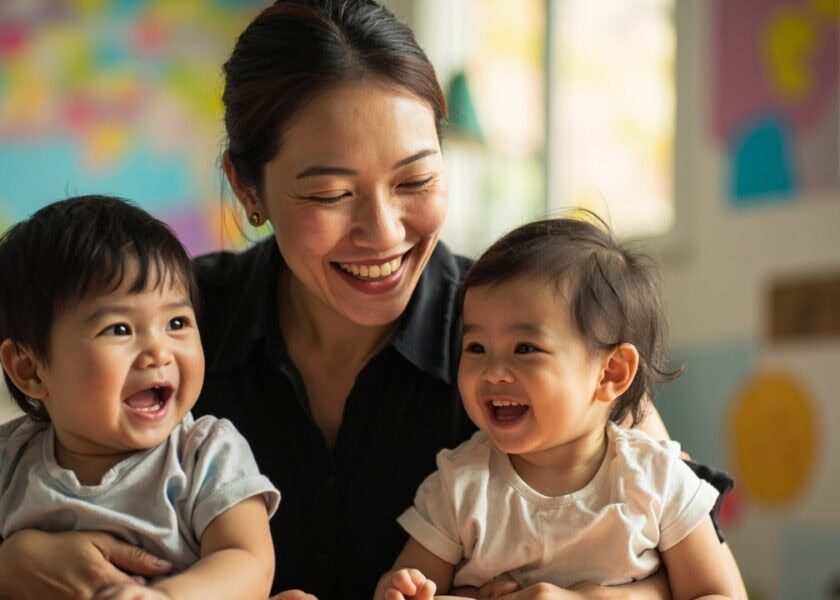
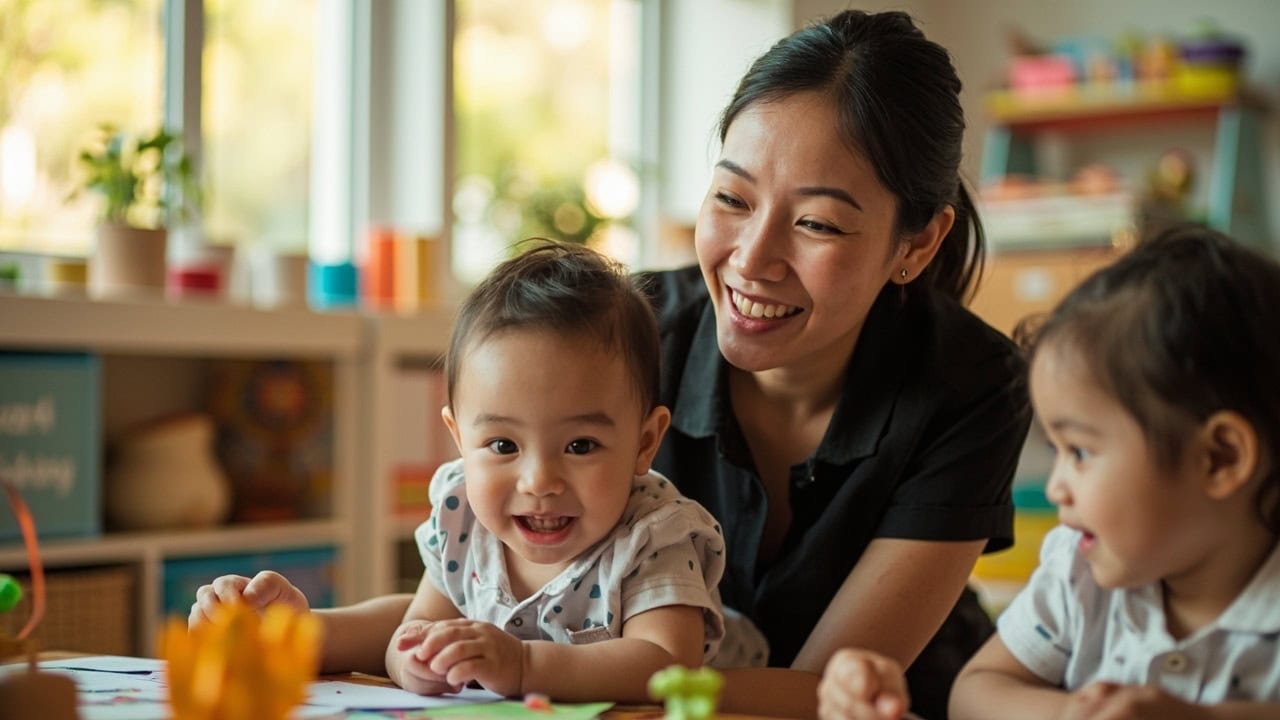
It looks like a caregiver who kneels down to a child’s level — literally and figuratively — so that the child’s gaze is met without intimidation. It looks like a voice that stays calm even when the morning is chaotic. It looks like hands that are consistent, that a child can learn to anticipate, that reach for them the same way every single day.
It looks like someone who notices the small things. That this child is tired today. That this one is working through something. That the child who is unusually quiet needs a few extra minutes of proximity before they are ready to engage.
Why Ratio Matters
At EduNanny, which operates under the ECDA Childminding Pilot, this relational depth is supported by something tangible: infant ratios of up to one to three. That is not a marketing figure. It is a structural reality that means a caregiver can truly know each child — their rhythms, their preferences, their particular way of experiencing the world.
It means that when your infant reaches for a toy, there is a hand nearby that already knows what they are reaching for. It means that when your toddler needs comfort, the response is not delayed by the demands of an oversized group. It means that the feeling of safety and belonging has the conditions it needs to actually exist.
What This Means for Singapore Families
In Singapore, where dual-income households are common and children often begin formal care at a young age, this sense of belonging is not a luxury. It is a developmental necessity. Your child is spending significant waking hours in this environment. The emotional quality of those hours matters — not just for today’s comfort, but for the foundational sense of security your child carries into every future relationship.
Quality childcare offers your child a daily experience of social belonging that is not performative, not superficial, but rooted in genuine relational continuity. The same caregivers. The same small group of peers. The same rhythms and routines. Week after week.
Your child is not a visitor in that space. They are a resident. And children know the difference.
What You Are Actually Investing In
Singapore parents carry particular weight when making these decisions. The cost of living, the pressures of dual-income households, the ambitions you hold for your child’s future — all of this sits in the background when you are choosing childcare.
You want quality. You want warmth. You want trust. You also want it to be sustainable, and you want to understand what you are actually paying for. These are not conflicting desires. They are the honest desires of parents who care deeply about getting this right.
EduNanny’s approach was built with this reality in mind. The Childminding Pilot, which operates across home-based and community or centre-based pathways, is designed to make quality infant care genuinely accessible — not as a compromise, but as a real option for families across Singapore.
Monday to Friday care blocks, fee structures within the pilot framework, and the ability to utilise CDA and Baby Bonus funds where applicable — these are not afterthoughts. They are deliberate structures that reflect a belief: that financial pressure should not force a family to choose between affordability and excellence.
And because trust in this space must be earned, EduNanny maintains communication and transparency as a core practice — including CCTV measures where deployed, so that the door between you and your child’s day remains, in a real and practical sense, open. You cannot step inside their experience. But you can have confidence that what happens in that space is visible, accountable, and held to a standard you can see.
The First Thousand Days: Why the Feeling Lasts
The first thousand days of a child’s life are not simply a developmental phase to be endured or optimised. They are the period in which the foundational architecture of the self is being laid — not just cognitively, but emotionally, socially, sensorially.
Every sensation, every interaction, every moment of safety or uncertainty, every experience of being known by another person — these are not events that happen to a child. They are events that shape what the child becomes.
When a child spends their day in an environment that is warm, consistent, sensory-rich, and relationally deep, they are not just being cared for. They are being formed. Their emotional baseline is being set. Their capacity for trust, for curiosity, for connection, for resilience — these are not things that appear later, when they are old enough to be taught. They are being built right now, in the hours between drop-off and pick-up, in the textures and sounds and small repeated kindnesses of a quality childcare day.
This is not an exaggeration. It is not a sales claim. It is simply what the science of early childhood development tells us, stated plainly: the emotional experience of the early years leaves a mark that no later intervention can fully erase. For better and for worse.
Which is why the question of what your child feels at childcare is not a soft, sentimental question. It is one of the most consequential questions you will ever ask.
Choosing With Clarity and Confidence
If you are researching infant care or childminding in Singapore, here are some questions that go beyond the checklist to the heart of what your child will actually feel:
- What does the space feel like? Warm light? Natural materials? Space to move at their own pace? Visit at different times of day if possible — observe how the environment feels before you ask what the programme includes.
- Who will be with my child? Same caregiver each day? Small, consistent group? Watch for attunement — does the caregiver notice when a child is tired, frustrated, or needs something before the child signals it?
- What does the rhythm feel like? Is there time between activities or is the schedule rushed? Children do not experience a day as a series of tasks. They experience it as a continuous flow. Does the environment respect that?
- How does my child respond? After a visit, notice your child’s behaviour. Are they curious? Anxious? Do they seem to have formed any sense of the place? Trust your child’s felt response — it is data.
- Can I see what is happening? Transparent communication and visible accountability are not suspicious asks. They are reasonable expectations. Ask how the centre keeps parents informed throughout the day.
The Door Between You and Your Child’s Day
When you choose childcare, you are doing something that feels administrative but is, in truth, profoundly intimate. You are selecting an environment that will hold your child during the hours when you cannot be beside them. You are trusting other people with the most precious, vulnerable, rapidly-developing human being in your life.
And you are doing so in a context where you cannot fully verify — moment to moment, sensation to sensation — what that experience is like. That is not a failure on your part. That is the nature of early parenting. It requires a kind of trust that is both rational and emotional, both chosen and felt. And it requires finding a childcare partner whose philosophy and practice give that trust a solid place to rest.
You brought your child into the world, and you are doing the extraordinary work of raising them in a city that moves quickly and asks a great deal of its families. The hours apart are hard. The questions are real. The care you are taking in making this decision is itself a form of love — the kind that does not announce itself but quietly, persistently insists on the best for someone else.
What EduNanny offers is not a promise that every moment of your child’s day will be perfect. No honest childcare provider would make that claim. What EduNanny offers is something more grounded and more meaningful: a daily environment that is designed and committed to the quality of your child’s inner experience. Where the sensory environment is considered. Where the rhythms are predictable and gentle. Where caregivers are consistent, trained, and present. Where the ratio of adults to infants makes genuine attunement possible. Where communication with you is not a feature but a habit. Where belonging is not taught but lived.
EduNanny was built for parents like you. Not because childcare is a problem to be solved, but because the early years are too important, too tender, and too formative to be anything less than excellent.
Because every child deserves an environment where their senses are respected, their emotions are held, their belonging is certain, and their days are full of the small, steady, irreplaceable feeling of being safe.
That is what EduNanny stands for. And that is what we are here to offer — not just as a service, but as a shared commitment to the children of Singapore, to the families who love them, and to the belief that how a child feels in their earliest years matters enormously.
It matters. And you, in choosing to ask the question we have explored today, already know that in your heart.
Now, let us walk through that door together.
Explore EduNanny’s childminding options and discover how we support your child’s sensory, emotional, and social development from day one.
Learn more about EduNanny · About the ECDA Childminding Pilot · Get in touch
#SingaporeChildcare #InfantCareSG #ChildmindingSingapore #EarlyChildhoodDevelopment #EduNannySG