The Science of Sharing Your Child’s Heart With Another
The Fear That Means Everything
Here is what decades of attachment research have shown us — and what we see again and again in the families who walk through our doors: the parent who fears being replaced is the parent who loves the most.
That fear is not a weakness. It is evidence of a secure foundation. It is the instinctive wisdom of a parent who has built something so precious that the thought of sharing it feels like risk.
But here is what is also true, and what we wish more parents knew: that fear, as real and as valid as it is, is often built on a misunderstanding of how attachment actually works.
What Science Tells Us About Secure Attachment
Bowlby gave us the language. Ainsworth gave us the science. What they demonstrated, across years of careful observation and rigorous study, is that secure attachment is not a finite resource. It does not work like a pie, where every slice given to someone else means less for you.
Think about what you already know. You have watched your child crawl toward another adult — a grandparent, a familiar neighbour, a teacher they trust — and then look back at you. That look back is everything. It is your child checking: Is this okay? Are you still here? Do you still love me even when I’m loving someone else?
And when you nod, when you smile, when you communicate in a thousand small ways that yes, this is safe, yes, this is good — your child takes another step forward. Not away from you. Into a bigger version of the world, with you still at the center.
A child who is securely attached — your child, the one you have been so carefully building a relationship with — will turn toward new people with curiosity, not fear. They will welcome a caregiver not as a rival for your place, but as a trusted person in a growing constellation of safety.
A child who is secure looks like this: they are comfortable when you’re not in the room. Not because they don’t miss you — they do, and that’s healthy — but because they trust you’ll return, and they can be present where they are.
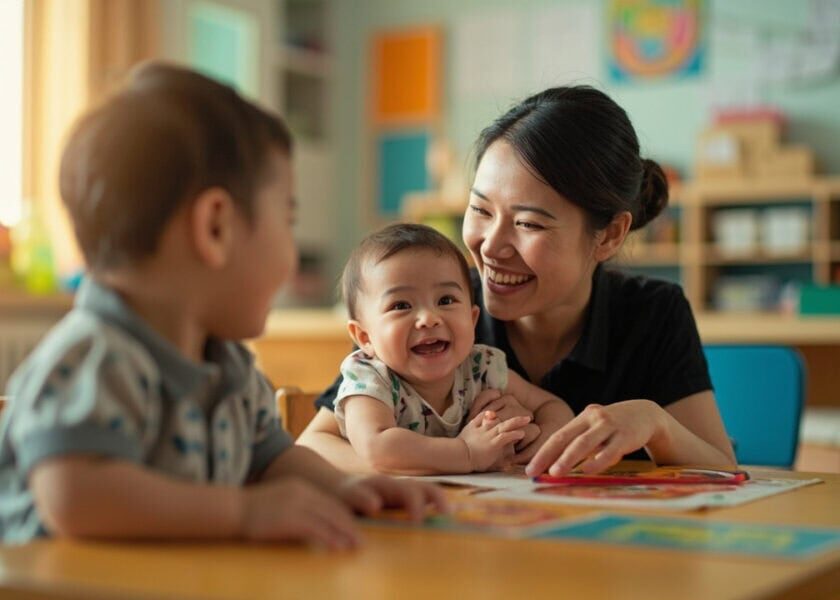
They form genuine affection for the adults around them without confusion about who their parent is. They explore, they play, they test boundaries — and when they fall, they look for comfort from whoever is near, and they accept it.
They are not anxious. They are not clinging. They are, in the truest sense of the word, free.
This is not a theoretical outcome. This is what we see in children who grow up in environments where their primary bonds are strong and their secondary relationships are warm, consistent, and respectful.
What EduNanny’s Model Actually Looks Like
When a Singapore parent walks through our doors and says, I want someone who will love my child, what we hear is something deeper than care preferences or scheduling needs. We hear a parent who is building a relational ecosystem. We hear someone who understands that a child’s world should not be small and fragile. It should be wide, warm, and full of people who hold them well.
EduNanny operates within the ECDA Childminding Pilot, and that designation matters. It is a framework built not around convenience but around developmental integrity — the idea that a child in someone else’s care should be held to the same standards of attention, responsiveness, and love that a parent would expect.
In practice, this means:
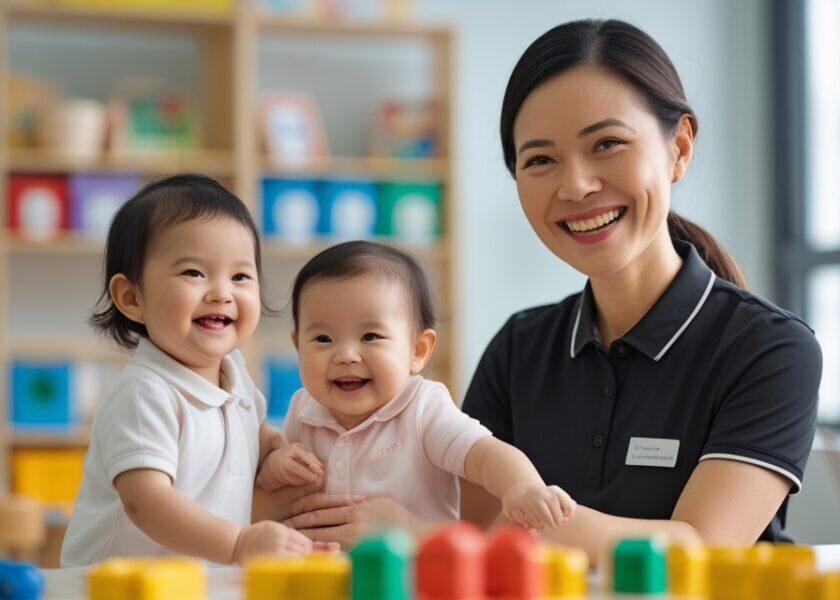
- Small ratios — up to one caregiver to three infants at a time, depending on the arrangement. This is not an industry standard. This is a philosophy made tangible.
- Unhurried interactions — the caregiver can hear your child’s breathing change before a cry begins. Every moment has space.
- Consistency — your child sees the same familiar faces, not a rotating series of strangers.
- Open communication — daily updates, dialogue, and where deployed, CCTV access that allows you to look in without interrupting.
A childminder who has been chosen with this much care, in a model built with this much intention, is not a compromise. She is a professional, a partner, someone who understands that their role is not to replace you but to extend the circle of safety your child lives in.
Honest Answers to the Questions You’re Actually Asking
“Will my child feel abandoned?”
A child with a secure primary attachment does not experience consistent, warm childcare as abandonment. They experience it as an expansion. The child who trusts that your love is permanent can afford to love someone else freely. The child who is not sure will cling, will resist, will fear.
If your child shows separation anxiety that feels excessive or persistent, that is information — not a reason to avoid all childcare, but a reason to ensure the foundation you are building is as strong as it can be.
“What if the caregiver doesn’t understand my child’s cues?”
This is a legitimate concern, and it is exactly why small ratios and rigorous caregiver selection matter. In our model, the caregiver learns your child’s rhythm because they have the time and attention to do so. They follow your child’s cues because there are not ten other children demanding simultaneous attention. This is not an accident. It is design.
“Is this financially within reach?”
Raising a child in Singapore is a serious financial undertaking, and we have designed our pilot fee structures to be within reach for families who take this decision seriously. CDA and Baby Bonus funds are usable, and we have structured our care blocks — Monday through Friday, reliable and consistent — so that working parents can plan, can commit, and can return to their children at the end of the day knowing that the hours in between were hours of genuine care.
“How do I even begin evaluating childcare options?”
For many parents, the question of how to find this kind of care — how to evaluate it, how to vet it, how to begin — can feel like its own barrier. Our Thomas AI Chatbot is available to help you navigate the questions you might not even know how to ask yet. It is not a replacement for conversation — nothing is — but it is a starting point. A place to begin when you are not sure where to begin.
Why Singapore Parents Choose EduNanny
Singapore is not an easy place to raise a small child. The cost of living, the demands of the working week, the distances between family, the cultural expectations — it is a landscape that asks a great deal of parents.
What we have tried to build at EduNanny is not just a service. It is an answer to that landscape. It is a model that says: you do not have to choose between being present for your child’s developmental years and being present in your own life. You do not have to feel that every hour away is an hour stolen.
You can trust someone else with your child and come home at the end of the day to a child who runs to you, who has had a good day, who has been held well — and who has been held well in addition to the way you hold them, not instead of it.
Your Child Is Lucky to Have You
Every child begins life in a world that is, by necessity, very small. Two arms. A voice. The smell of the same person, over and over. And that is exactly right. That is how attachment begins — in the closeness, the sameness, the perfect smallness of an infant’s universe.
But the job of every parent — the real, quiet, enormous job — is to build that child a world that is bigger than the one you can personally hold. Not because you are failing to hold it yourself, but because you are succeeding so well that your child is ready for more.
The parent who chooses thoughtful, development-oriented care is not the parent who loves less. You are the parent who loves enough to share it.
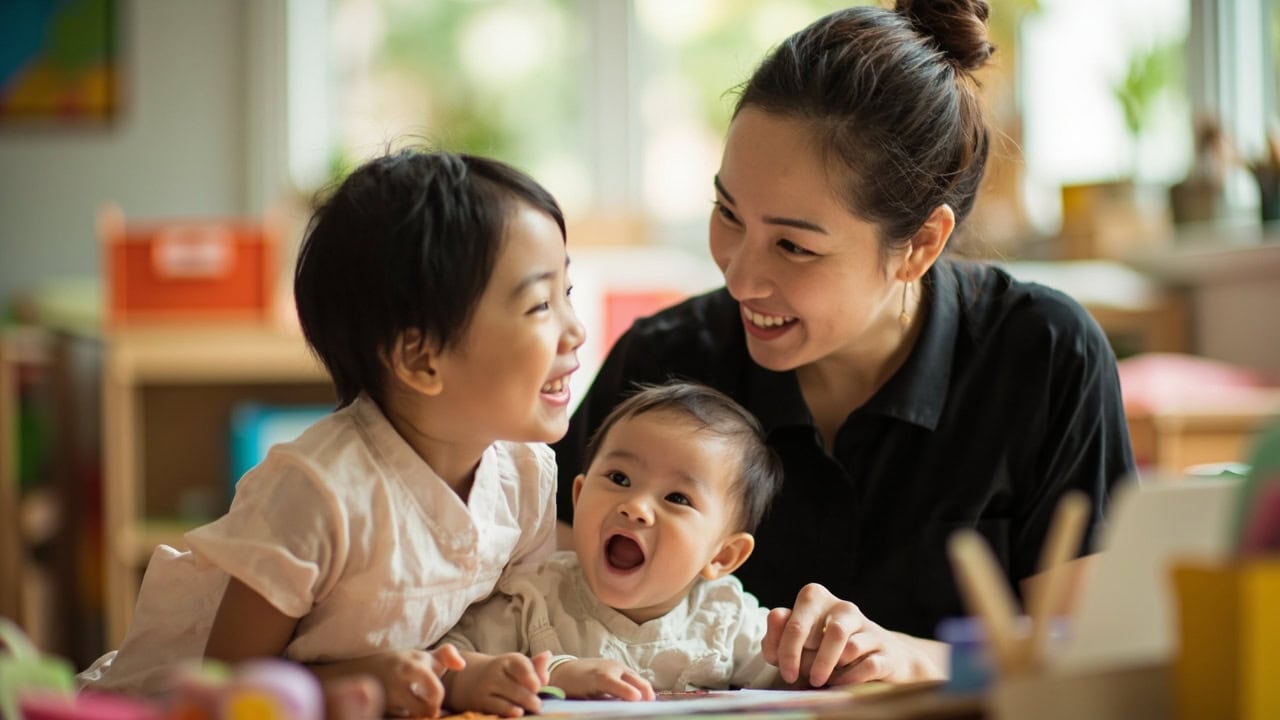
You are the parent who understands that a child’s heart is not a zero-sum game. You are the parent who has built such a solid foundation that you are not afraid to let your child reach beyond it. You are the parent who knows that the caregiver sitting on the floor with your infant, singing the song you taught them, following the rhythm of your child’s cues, is not a threat to your bond — she is a testament to it.
Because only a secure bond can bear the weight of a second relationship. Only a child who trusts that your love is permanent can afford to love someone else freely.
This is not softness. This is developmental science.
Your child — wherever they are right now, in your arms or reaching for the table or trying to say a word they’ve only just learned — your child is lucky to have a parent who asks the questions you’re asking. Because those are the questions of someone who is paying attention. And paying attention is the beginning of everything that matters.
If you are considering what thoughtful, developmentally-grounded childcare looks like in Singapore, we would welcome the opportunity to speak with you. Whether you have specific questions or simply want to understand your options, we are here.
The love you have built is strong enough to be shared. Let us show you how.