Why Growing Up Together Makes Siblings in Singapore Stronger
Why Your Children Are a System, Not Just Two Children
There is a prevailing assumption in how Singapore families approach childcare. It is so embedded that we rarely examine it: each child has individual needs, and therefore each child requires an individual solution. You find infant care for the baby. You find preschool for the older child. You evaluate each choice on its own merits, comparing curricula and facilities and teacher qualifications as though your children were unrelated students making independent decisions.
This assumption makes sense on the surface. Children are individuals. They have different temperaments, different developmental timelines, different needs for sleep and food and stimulation. Of course you would not treat a toddler and a preschooler the same way.
But here is what this assumption misses: your children are not just individuals. They are siblings. And siblings are not simply two children who happen to share a genetic code. They are a developmental system. They are each other’s first peers, first rivals, first collaborators, first mirrors. The relationship between them is not a complication to be managed alongside their individual needs. It is, in many ways, the most important social laboratory they will ever enter.
When siblings are together in quality childcare, they bring that laboratory with them.
Does Together Mean Less? The Hidden Curriculum of Siblings
Now let us address the question you are probably already asking yourself. You have probably wondered whether enrolling your children together means accepting diluted attention. If one caregiver is watching two or three children instead of one, does that mean your children are receiving less?
This is the fear that keeps many families in parallel arrangements, and we understand it completely. But here is what that fear gets wrong: it assumes that the number of children in a space is the only variable that determines quality of care. It assumes that isolation equals intensity. That alone means more.
The reality, in quality settings, is very different.
What siblings actually learn together
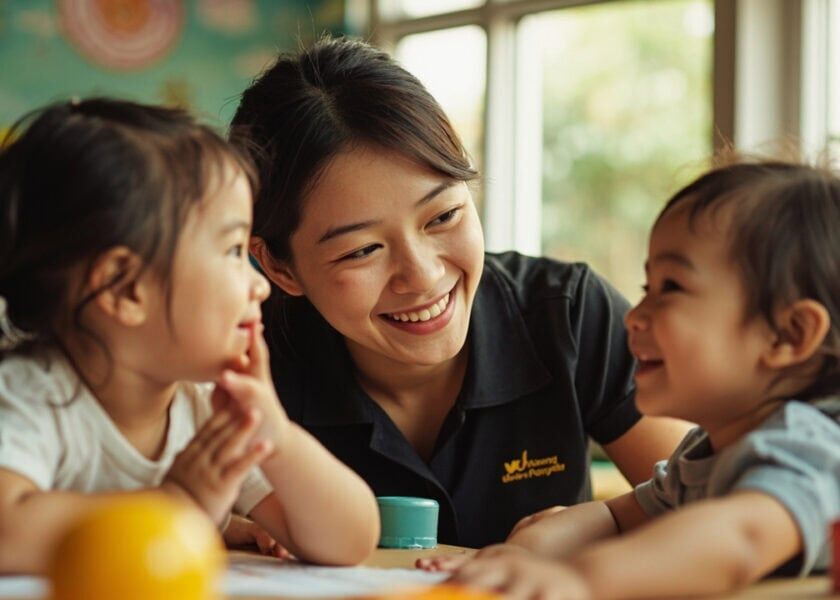
Your three-year-old and your five-year-old are not just sitting in the same room. They are engaged in a constant, low-grade negotiation of social reality. Your three-year-old watches how your five-year-old talks to the caregiver and learns, without being taught, how to navigate adult authority. Your five-year-old learns patience, and the hard-won skill of explaining things to someone who does not yet understand.
When your three-year-old is frustrated, your five-year-old offers comfort in a way that no adult can — because your five-year-old knows exactly what that frustration feels like. When your five-year-old is unsure, your three-year-old provides something equally valuable: the reminder that uncertainty is survivable, because someone else is uncertain too.
Psychologists call this social scaffolding. When children engage with peers who are slightly more advanced than themselves, they stretch toward skills they could not reach alone. But the scaffolding does not only flow in one direction. Younger siblings often serve as teachers too — forcing older siblings to articulate what they know, to slow down, to explain. The act of teaching consolidates learning. Your five-year-old becomes more fluent in her understanding of the world because she has someone to share it with.
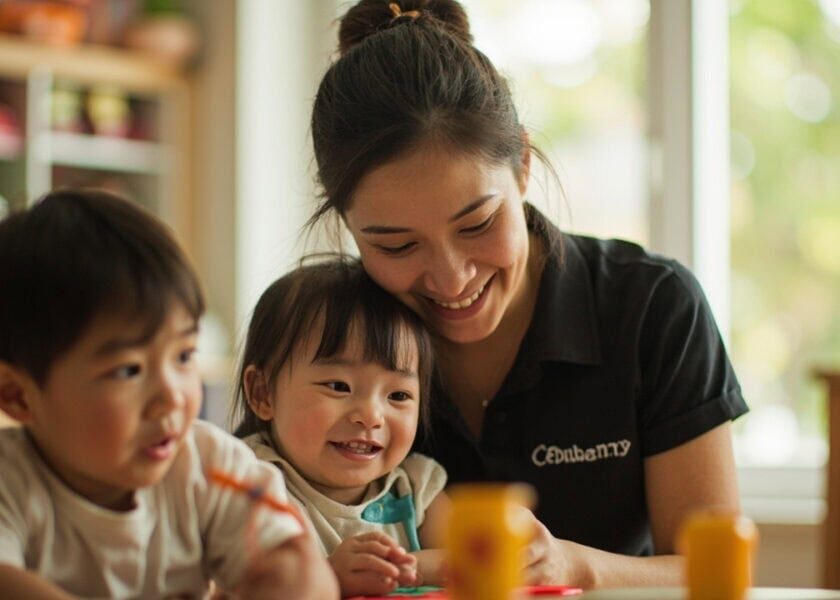
Your toddler learns to share because there is someone to share with. Your older child learns responsibility not from lectures about being a big brother or sister, but from the daily lived experience of being one.
School readiness that goes beyond letters and numbers
Research into social-emotional development consistently shows that children who have strong sibling relationships in early childhood carry advantages into formal schooling. They tend to have better emotional regulation, stronger collaborative skills, and greater social fluency — precisely because they have had daily practice navigating a complex, emotionally charged relationship in a safe environment.
When siblings are together in quality childcare, they enter primary school not just academically prepared, but socially prepared. They know how to read a room, how to negotiate, how to ask for help, how to offer it. They have been practising these skills every day in the most natural laboratory available: the relationship with their sibling.
One story instead of two
Here is something else parallel arrangements cannot offer: the coherence of a single developmental narrative.
When your children are in separate settings, you are piecing together two stories. You hear about your toddler’s day from one caregiver and your preschooler’s day from another. You try to reconcile different philosophies of discipline, different approaches to mealtimes, different rhythms of play. You become a translator between worlds. The mental load of that translation is invisible but enormous.
When your children are together, you have one story. One team who knows both your children. One set of rhythms that both children share. One place you can call to understand how your family is doing, not just how your individual children are doing.
What Quality Sibling-Inclusive Childcare Actually Looks Like
You deserve to know what to look for, because not every arrangement that keeps siblings in the same building delivers this advantage. Here is what genuine quality looks like when it is designed for sibling pairs or groups.
- Structured sibling interaction, not just sibling proximity. Quality sibling-inclusive childcare does not simply place your children in the same room and hope for the best. Educators trained in this approach understand when to let sibling interaction unfold naturally and when to guide it. They recognise the developmental value in a disagreement over a toy and intervene with intention, not just to restore order.
- Individual observation within a family lens. Each child is still seen as an individual with their own developmental trajectory. But the observation happens within the context of the sibling relationship. Caregivers notice how your older child’s behaviour shifts when your younger one is tired, or how your toddler reaches new communication milestones because of the attention she receives from her sibling.
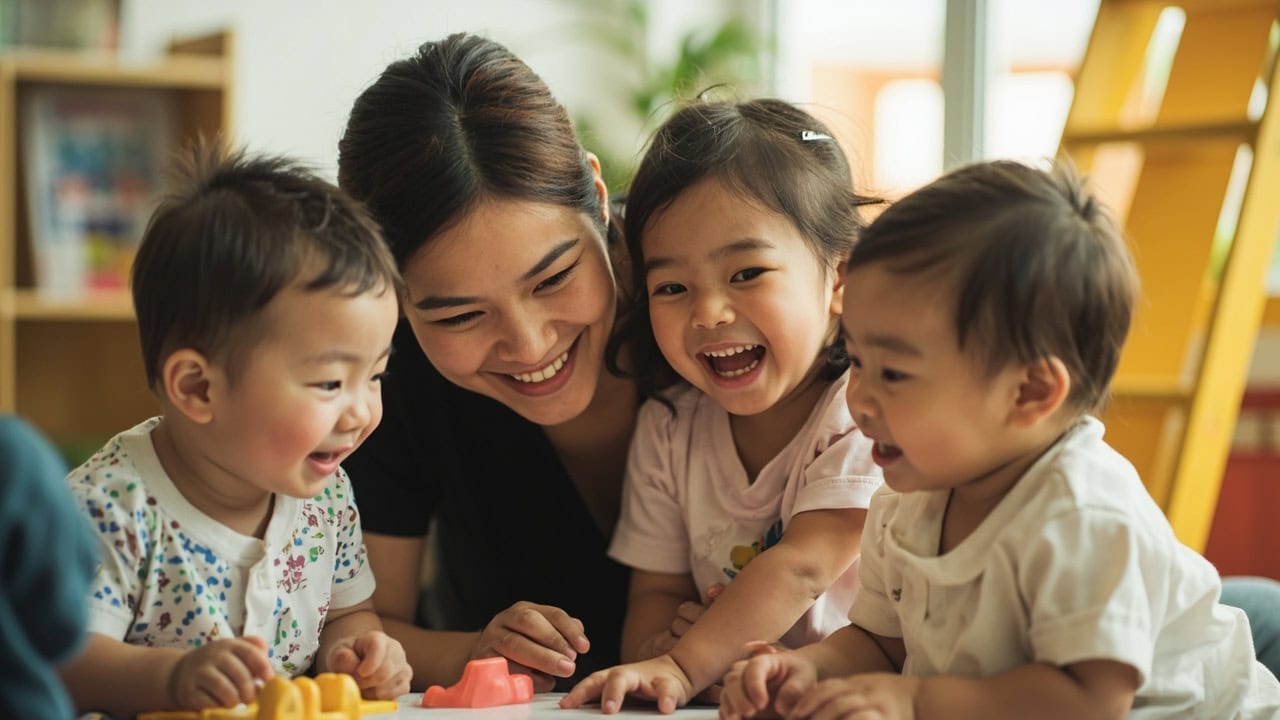
- Age-appropriate activities that include both children. Activities are designed so that both siblings can participate meaningfully, regardless of age difference. The three-year-old and the five-year-old are not doing identical tasks, but they are engaged in shared experiences — collaborative art, guided play, group routines — that draw on their unique strengths.
- Family-level communication. Reporting and communication are built around your family unit. You hear about both children in the same conversation, see how they interacted, understand what each one contributed. This is fundamentally different from receiving two separate updates from two separate caregivers in two separate settings.
What EduNanny Offers Families with Multiple Children
EduNanny was designed around the understanding that your children are a connected system, not isolated individuals.
Operating as part of the ECDA Childminding Pilot, EduNanny maintains regulatory oversight and standards that go beyond what the market might demand on its own. For you as a parent, this means you are not navigating an entirely unregulated space where quality is impossible to verify. The pilot structure reflects a genuine investment in understanding what Singapore families actually need and what works in our specific context.
EduNanny offers both home-based and centre-based pathways, because families are not uniform. Some parents prefer the intimacy and flexibility of home-based care, where children settle into a domestic environment that mirrors, in some ways, the feeling of home. Others prefer the structure and community connections of centre-based settings. What matters is that EduNanny has designed its model to serve siblings in either pathway. The sibling advantage is not dependent on a specific physical format. It is dependent on a developmental philosophy that sees siblings as a connected system — and that philosophy travels with your children whether they are in a home setting or a centre.
Caregiver ratios that enable observation
With up to one to three for infants, your baby is not lost in a crowd. Your toddler is not just another body in a room. The smaller ratios mean caregivers can observe the interplay between your children — can notice when your older child is stretching toward a skill and your younger one is watching with fascination, can intervene thoughtfully when sibling dynamics need guidance rather than simply supervision.
Affordability that does not force a choice
EduNanny’s pilot fee structures have been designed with accessibility in mind. For Singapore families making decisions about how to allocate resources across multiple children, this is not a trivial consideration. You are not choosing between quality and affordability when those two things are in tension. EduNanny’s model reflects the belief that every family deserves access to childcare that treats their children as whole persons, not as separate problems to be solved. You can also access CDA and Baby Bonus funds where applicable.
Trust built on transparency
Trust is not a warm feeling. Trust is a system. You are handing your children to people you do not yet know fully. That is terrifying. It is also necessary.
What EduNanny has built is a transparency architecture that goes beyond the usual reassurances. Communication protocols keep you informed about what your children are experiencing, not just whether they ate and slept. Where visibility measures are in place, you have insight into the environment. Where they are not, you have something equally important: caregivers who are trained to narrate your children’s days in ways that help you understand what is actually happening, not just what went wrong.
When your children are siblings enrolled together, this transparency becomes even more valuable. You are not receiving two separate reports from two separate caregivers in two separate settings. You are receiving one picture of your family. The caregiver can tell you not just how your toddler ate today, but how that eating was affected by your older child’s presence. She can tell you that your preschooler seemed more confident because he was able to help his sister with something and felt needed.
Addressing the Guilt You Carry
Let me speak directly to the guilt for a moment, because I know it is there.
You love your children. You love them differently, because they are different people, but you love them completely. And yet you have this persistent feeling that you are failing them — that by being a working parent, by needing childcare, by having two children instead of one, you have somehow fractured something that should have stayed whole.
Here is what I want you to hear: that guilt is a story you are telling yourself, and it is not the full picture.
The fracture is not in your family. The fracture is in the systems we have built around families. We have created a world where childcare is a logistical puzzle, where the assumption is that each child requires a separate solution, and where the emotional reality of raising siblings gets lost in the mechanics of enrollment and pickup times and different school schedules.
What you are feeling when you feel guilty is not the failure of your family. It is the failure of the system to hold your family as a whole.
Quality childcare designed for siblings does not just relieve the logistics of your Tuesday morning. It restores something deeper. It says to your children: you belong to each other. Your relationship matters. The bond between you is not a complication to be scheduled around — it is a gift you are giving each other by being together.
And it says to you: you are not a divided parent. You are a whole parent who made a thoughtful decision to give your children something extraordinary — the chance to grow up together, in a place that understands what that means.
Choosing Childcare for Multiple Children: A Practical Guide
Here is what to look for and what to ask when you are evaluating childcare options for siblings in Singapore.
1. Ask how they structure sibling interaction
Do not just ask whether your children can be enrolled together. Ask how the programme uses sibling dynamics as a learning tool. A quality programme will have a thoughtful answer. A programme that treats siblings as a logistical box to check will not.
2. Understand the ratio and what it actually means
Ratios like one to three for infants are important, but ask how those ratios are used. In quality sibling-inclusive care, the ratio enables observation of sibling interplay, not just individual supervision. Your toddler’s development is being tracked in the context of his relationship with his sibling, not in isolation.
3. Look for family-level communication
Ask how the programme reports on your children. Do you get one update that encompasses both children? Can you have a single conversation with caregivers who know your whole family? Or are you managing two separate communication channels? The coherence of that communication reflects the coherence of the programme’s philosophy.
4. Consider the logistics honestly
One pickup instead of two is not a small thing. It is hours of your life back every week. It is the difference between running and arriving. It is the energy you will have left at the end of the day to be present with your children, rather than depleted by logistics.
5. Trust your gut on developmental philosophy
Visit the setting. Watch how the caregivers interact with sibling pairs. Do they see the interplay? Do they intervene thoughtfully when siblings disagree? Do they seem to understand what siblings give each other? The answers to these questions will tell you more than any brochure.
Your Children Belong to Each Other
If you are a parent with multiple children, you have been operating under an assumption that was given to you by the system, not by your own intuition. The assumption is that each child needs a separate solution. That logistics are the main challenge. That the question of childcare is primarily about finding the right individual programme for each child.
But your intuition has been telling you something different. Your intuition has been telling you that your children belong to each other. That they are brighter together. That there is something about their bond that you do not want to lose in the machinery of working parenthood.
EduNanny is built on that intuition. It is built on the understanding that siblings in quality childcare together access a hidden curriculum that children in separate settings simply cannot reach. That the sibling relationship is not a logistical complication — it is a developmental asset. That your family deserves to be seen as a family, not as a collection of individual enrollees.
The sibling effect is real. It is not sentiment. It is developmental science. When your children are in quality childcare together, they become more than the sum of their parts. They learn from each other in ways that no curriculum can replicate. They regulate each other’s emotions. They scaffold each other’s growth. They build the social skills that will carry them through primary school and beyond.
You do not have to choose between giving your children individual attention and giving them the gift of each other. With the right childcare partner, you can give them both.
And you, as their parent, are not just managing logistics when you choose sibling-inclusive childcare. You are making a statement. You are saying: your relationship matters. The bond between you is one of the most important things you will ever give each other.
For Singapore families with multiple children, finding a place where your whole family is seen, nurtured, and understood as a connected system is rare. EduNanny was designed with this understanding — built around the sibling relationship rather than the assumption that children are isolated individuals. Find out more about EduNanny and what it offers your family.
EduNanny is a Singapore-based childcare and childminding service operating as part of the ECDA Childminding Pilot. To learn more about our approach, read about our team or get in touch with us directly.