The Quiet Transformation of Choosing Childcare With Intention in Singapore
The Weight of This Decision
There is a moment—quiet, unremarkable on the surface—when you realize the childcare decision you are facing is not really about childcare at all. It is about who you are becoming as a parent.
You may be sitting with a form, or standing in a nursery, or lying awake at three in the morning with the weight of a choice that seems simple on paper but feels enormous in your chest. You are trying to decide who will care for your child. And somewhere beneath that practical question is another one, one you may not have voiced even to yourself: what kind of parent does this decision make me?
That question is the one we want to speak to today. Because if you are a parent in Singapore navigating this moment—and you are, or you will be, or you have been—you already know that the decisions we make for our children are never just about logistics. They are about identity. They are about the quiet, profound work of becoming the parent your child needs.
The Disorientation of Early Parenthood in Singapore
There is a particular kind of disorientation that comes with early parenthood in Singapore. You love your child with a ferocity that surprises you. You also live in a city that moves fast, that expects things of you, that offers both abundance and pressure in equal measure.
The question of childcare arrives not as a philosophical exploration but as a practical necessity—returning to work, needing support, wanting your child to have rich experiences and social connection. And yet the decision carries weight far beyond what the logistics suggest.
You find yourself caught between wanting to trust your choice and fearing you are abandoning your child. Between needing support and wanting to be enough. Between the life you had before and the person you are becoming now.
These are not weaknesses. These are the contradictions of loving deeply and wanting to do well. And they are the very tensions that, when understood and honored, can lead you toward a clarity you did not know you were searching for.
Choosing With Intention: The First Movement
The first movement of this transformation is the hardest: the willingness to sit with the question rather than rush past it.
To ask not just what childcare arrangement makes sense logistically, but what kind of parent I want to be, and what kind of care reflects that.
Consider the parent who pauses before signing the enrollment form. She does not ask, “Is this the most convenient option?” or “Is this the cheapest?” She asks, “What does this choice say about who I am becoming? What values do I want reflected in the way my child experiences the world when I am not the one holding them?”
This is not overthinking. This is the beginning of intentional parenting. This is you, choosing to show up to this decision with your eyes open and your values clear.
From Uncertainty to Conviction
From that willingness comes something unexpected: conviction.
There is a moment—a real, tangible moment—when the anxiety softens into something more grounded. It is not the absence of care. It is the presence of purpose. You begin to understand that choosing quality care for your child is not a compromise of your role as a parent. It is an affirmation of it.
Guilt is the voice that tells you that needing help is weakness, that choosing quality childcare is somehow less than.
Conviction is the voice that tells you that you are making a thoughtful, values-driven decision on behalf of your child and your family.
Guilt erodes. Conviction builds.
Conviction is not indifference. It is not carelessness. It is not choosing the easiest option or the cheapest one or the one that simply solves the logistics problem. It is choosing with your eyes open, understanding what your child needs, what your family needs, and what kind of parent you are becoming in the process.
What Happens When You Choose Well
When you choose quality care with that kind of intentionality, something shifts in your relationship with your child. You begin to show up differently.
When you are with your child—whether it is mornings before work, evenings after, or weekends together—you are more present. You are not depleted. You are not running on empty, trying to be everything while carrying the weight of exhaustion and obligation. You have had time to restore. Time to be yourself, not just your child’s parent.
And that time, that restoration, is not selfish. It is prerequisite. It is the foundation from which genuine presence becomes possible.
Parents who describe this transformation consistently use similar language. They say they are more patient. They say they listen better. They say they catch themselves playing on the floor with genuine joy instead of going through the motions. They say they are more themselves, and that their children respond to that.
Sharing care strengthens attachment. When children experience consistent, warm, responsive care from capable caregivers, they develop a sense of security that radiates outward. They trust the world. They trust that their needs will be met. And that foundational security actually frees them to engage more fully with their parents, not less.
The parent who returns from work feeling restored brings something different to the table than the parent who returns feeling hollowed out.
The Village and What Quality Care Looks Like
There is another dimension to this transformation that matters deeply: the dimension of belonging.
Parenting can be isolating. In a city like Singapore, where families are often nuclear, where work demands can be consuming, where the rhythms of daily life keep people moving quickly, it is easy to feel alone in the experience of raising a child. But that isolation is not inevitable. When it lifts—when you find yourself part of a village—everything changes.
When you choose childcare with intention, you are not just selecting a service. You are choosing a community. You are saying: this is part of who we are as a family.
Attention That Makes a Difference
In infant care settings, the ratio of caregivers to children is not just a regulatory number—it is an investment in attention. At EduNanny, the pilot maintains a ratio of up to one caregiver to three infants. What does that mean in practice? It means that when your infant reaches for something, there is a hand there. When your child needs comfort, there is presence. When your baby is ready to explore, there is someone watching with the kind of attention that makes exploration safe.
Pathways That Fit Families
Quality care recognizes that families are not all the same. The ECDA Childminding Pilot, within which EduNanny operates, offers pathways designed with this diversity in mind:
- Home-based care: Your child is looked after in the familiar environment of your own home, by a trained caregiver who becomes part of your family’s rhythm.
- Community and center-based options: Where children benefit from rich peer experiences, structured learning environments, and social development that comes from being with other children.
Practical Dimensions of Quality
Quality care also means care that fits the rhythms of real families. This includes care blocks during weekdays structured around working family schedules, fees designed to be accessible within the pilot framework, and the ability to use the Child Development Account and Baby Bonus funds where applicable. These are not afterthoughts—they are designed with the real pressures of real families in mind.
Transparency as Trust
One of the most meaningful aspects of quality care is the trust it builds through openness. EduNanny’s approach includes communication practices that keep parents informed—not just of what their child ate and slept, but of how their child engaged, what emerged, what surprised. Regular updates and visual access offer parents the reassurance that comes from knowing. Not surveillance. Reassurance.
The Caregiver at the Heart of Quality
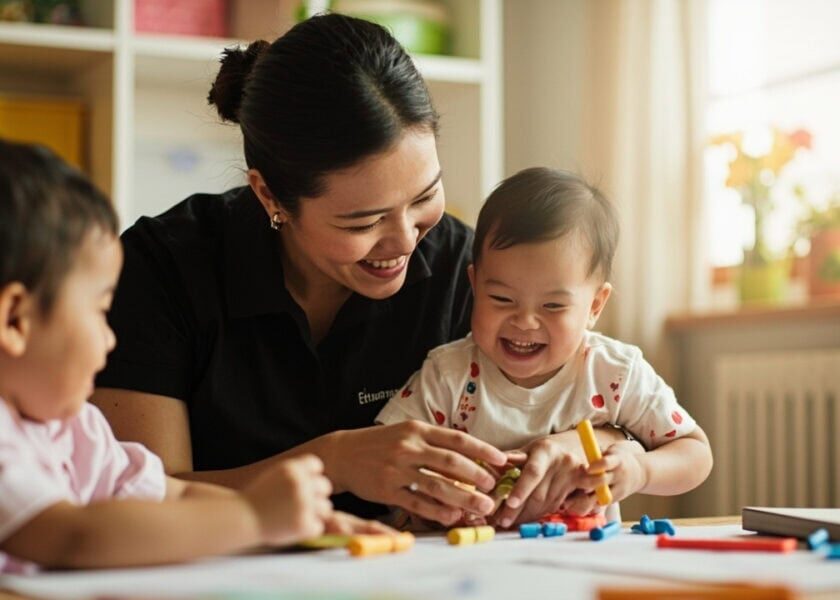
The childminder—not a babysitter, not a domestic helper, but a trained, respected professional—is at the heart of quality care. They are not interchangeable. They are not background figures. They are the ones who hold your child when they are tired, who celebrate their small victories, who notice the emerging personality and the developing preferences.
When childcare is done well, the caregiver is not just an employee. They are an extension of the family’s care, a trusted presence in your child’s life, a professional whose work deserves recognition and dignity.
When you trust the person caring for your child—when you know they are skilled, respected, and genuinely committed—the letting go becomes easier. This is not a competition between parents and caregivers. It is an ecosystem. And when the ecosystem is healthy, every relationship within it thrives.
Your Questions, Answered
We understand that this decision comes with real questions. Here are some of the most common ones, addressed honestly.
“Am I abandoning my child by choosing childcare?”
Research and experience consistently show that children thrive when they experience secure, loving relationships with capable caregivers—not just their parents. What matters is the quality of those relationships, not the quantity of hours spent exclusively with parents. When children feel secure in multiple caring relationships, that security radiates outward, strengthening their ability to engage fully with the world, including with you.
“How do I know if a childcare arrangement is truly quality?”
Look for these markers:
- Responsive ratios: Fewer children per caregiver means more attention for each child.
- Trained caregivers: Look for professional development, not just experience.
- Transparent communication: You should feel informed, not kept at a distance.
- Values alignment: Does the care reflect what you believe about how children learn and grow?
- Partnership orientation: You should feel like a parent in collaboration, not a customer to be satisfied.
“What if my child has difficulty adjusting?”
Adjustment is normal, and quality caregivers expect it. The question is not whether adjustment will happen, but whether the caregivers understand it and support it with patience. A good care arrangement includes a transition process that honors your child’s need for gradual familiarity and your need for confidence in the arrangement.
The Transformation and Your Next Step
There is a movement that happens in parents who choose well. It begins in disorientation—the weight of the decision, the fear of getting it wrong, the sense that you are navigating something enormous without a map.
And it moves toward recognition. The recognition that this choice is not just practical. It is personal. It is about who you are becoming.
And then, if the choice is made with intention and supported by the right kind of care, it moves toward something else.
Pride.
Not the pride of having done the expected thing, but the pride of having shown up. Of having asked the harder question. Of having chosen not the easiest path, but the one that reflected your values. Of having grown alongside your child, becoming not just a caregiver, but a parent—present, restored, intentional, convinced.
This is not about childcare logistics. This is not about service quality metrics. This is about identity. This is about the quiet, profound work of becoming a parent who shows up with intention, conviction, and love.
The parent you become when you choose well is not diminished. You are more present, more restored, more yourself. Your child is more secure, more curious, more ready to explore the world because they trust the world. And your family—your particular, unique family with its own rhythms and values and hopes—is stronger because you made a choice that reflected who you are.
Ready to Explore What Intentional Childcare Looks Like?
Every parent in Singapore who chooses quality care with intention is doing something brave. They are choosing growth over comfort. Conviction over guilt. Trust over fear.
You are becoming someone. You are becoming the parent your child needs. And you do not have to do it alone.
EduNanny Singapore welcomes conversations with families who are navigating this decision. Reach out to learn more about the pathways available through the ECDA Childminding Pilot—and to find out how we can walk alongside you in this journey.
To learn more about EduNanny’s approach to quality childminding, visit our homepage or explore the ECDA Childminding Pilot framework. You can also read about our team and what drives our commitment to thoughtful, development-oriented care.