Understanding Your Child’s Full Childcare Day in Singapore
The Morning: Settling In After Goodbye
Let us begin where your child begins. Let us say her name is Mira. She is two years and four months old. She is wearing the yellow dress with the small strawberries on the hem, the one she insisted on this morning, and you did not argue because these small insistences matter, and because you were already running late, and because the weight of the morning goodbye was heavy enough without a wardrobe negotiation.
The caregiver kneels. This matters more than you know.
The caregiver kneels so that she is at Mira’s level, so that her face is not looming, so that this transition is not one of giants and a small person but of two people meeting in the middle. She says good morning. She uses Mira’s name. She does not rush.
And then she extends her hand—not grabbing, not pulling, simply offering—and says, “Shall we go see what Adeline brought for show and tell today?”
This is not a throwaway line. This is intentional. This is trained responsiveness. The caregiver knows that Mira’s transition will be smoother if there is something to anticipate, something slightly more interesting than the monumental fact of separation. She is not lying; Adeline did bring something. But she is also doing something more important: she is giving Mira a bridge. A bridge from you to the morning. From the held child to the exploring child.
You force yourself not to look back. You already know what happens if you look back.
What Unfolds After You Leave
Mira and the caregiver walk through the door of the classroom together. The room is already alive with morning light and the low hum of other children settling. There are wooden blocks on the low table and a doll’s tea set arranged with great care and a small watering can beside a row of seedlings that the children planted last week.
These are not accidents. These are environments designed for entry—open-ended, visually inviting, not so structured that they demand immediate participation but structured enough to offer a place to land.
Mira sees the blocks. Her body language shifts. She looks back once at the caregiver, a quick, checking glance, the kind that says, “You are still here, and this is still okay.” The caregiver nods. She does not swoop in with reassurance but she does not dismiss the glance either. She acknowledges it. She says, “The blue ones are still on the shelf,” and Mira moves toward the shelf with the careful, purposeful walk of a child who has found her direction.
There is settling. There is orientation. There are other children arriving, some more tearful than others, and the caregiver must hold space for all of it—the child who runs in eagerly, the child who clings, the child who has already dissociated because too many goodbyes have taught her that crying does not change anything.
Each child requires something different. Each child is met where they are.
The Architecture of the Morning Day
The morning in a quality childcare environment has a rhythm, and that rhythm is not accidental. It is the architecture of safety.
Children, especially in the first five years, do not experience time the way adults do. They experience it in bodies. In sensations. In the repetition of predictable sequences that tell them, over and over: “This is the shape of the world. You know what comes next. You are held by this structure even when you do not feel held by any particular person.”
The morning unfolds something like this:
- Arrival and settling—which we have begun to see
- Free play—where children choose their engagement and the caregiver observes, watching for patterns, for interests, for the moments when a child reaches the edge of their competence and needs just a little scaffolding to move forward
- Circle time—a small, warm gathering. A song. A story. A few minutes of collective attention that teaches children that attention itself can be shared, that they are part of something larger than themselves
- Snack time—which is a curriculum, not an afterthought
At snack time, children learn to wait. They learn that others have needs too. They learn the words for what they want—”more water, please”—and they learn that their words have power, that someone will respond. They learn to sit together, to eat together, to notice that others like the same crackers they like and different crackers entirely.
They are building the foundations of social life, right there at the low table with the plastic cups.
What Attunement Looks Like
The caregiver is present at all of this. Not frantically, not performatively, but with that quality of attention that we want to name because it is the most important thing that happens in the hours you cannot see.
The caregiver is attuned.
Attunement is a word that gets used in parenting articles, but let us describe what it actually looks like in practice.
It looks like the caregiver noticing that Mira has not touched her snack, not because she is watching Mira specifically, but because she is watching all of them, the way a conductor watches an orchestra, and something in Mira’s stillness registers as different from her normal stillness.
It looks like the caregiver moving closer, not with intervention but with proximity, crouching down, saying, “Mira, you seem quiet today. Would you like to sit by the window while you eat?”
It is a small thing. It is a tiny thing. But it is the thing that distinguishes care from mere supervision.
This is why ratios matter. This is why a commitment to attentive ratios is not simply a logistical feature but a philosophical stance. It says: we believe that attention is not a luxury. It is the work.
Midday: Rest, Nutrition, and the Quiet Hours
Midday is a transition. This is something that often goes unremarked, but it is one of the most important shifts in the childcare day.
The morning is about engagement, about exploration, about the child’s expanding world. The midday is about the contraction, the return, the settling that must happen before the afternoon can begin.
For many children, midday means rest. This is not a break from learning; it is learning of a different kind. Sleep, for infants and toddlers, is not passive. It is the brain consolidating the experiences of the morning. It is the body restoring itself. It is the nervous system processing the sheer volume of input—the social complexity, the sensory richness, the emotional weight of a morning away from primary attachment figures.
The caregiver knows this. She has prepared the environment for rest: dimmed lights, soft music or silence, the small cots arranged with care. She knows that some children fall asleep easily and others do not, and she holds space for both.
For the child who protests rest, she offers a book, a quiet activity, a place to be while the body gradually surrenders. For the child who falls asleep immediately, she watches the face go slack, the tension leave the small hands, and she understands that this is a sacred thing.
This is the child unguarded. This is the trust made manifest.
You, at midday, are eating your own lunch at your desk, or in a hawker centre, or in a meeting that runs long. You are not thinking about the caregiver singing a soft song to your child. You are not thinking about the way your child’s breath has slowed, about the moment of genuine peace on a face that, an hour ago, was navigating the social complexities of the sandpit.
But it is happening. And it matters.
Lunch as Curriculum
And then there is lunch, and the midday meal is its own curriculum. Nutrition is not simply fuel. It is about learning to eat together, to try new foods, to develop preferences, to understand that the body needs certain things to grow strong.
In a quality childcare environment, the midday meal is unhurried. It is not a cafeteria line. It is a small gathering, a family-style experience, where children pass the dishes and serve themselves and learn, through repetition, the rhythms of shared eating.
Mira is learning to use a spoon with more precision. She is learning that spinach, which she would refuse at home, seems more interesting when Josiah is eating it too. She is learning that meals are not just about the food but about the company.
Peer Interaction: Lessons No Parent Can Teach
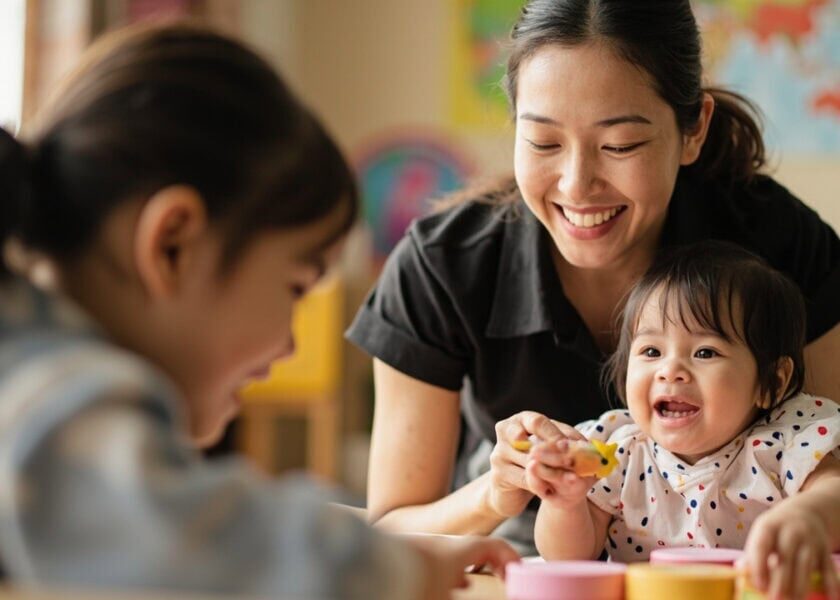
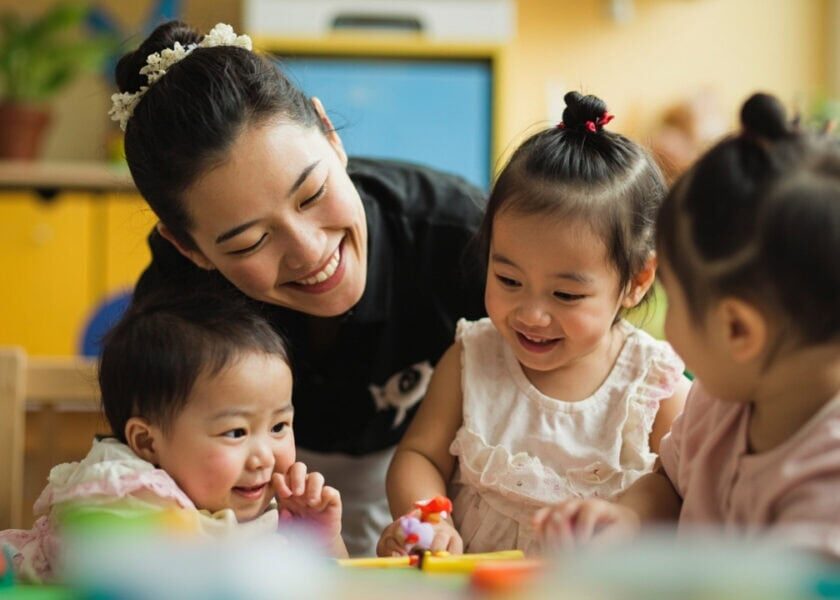
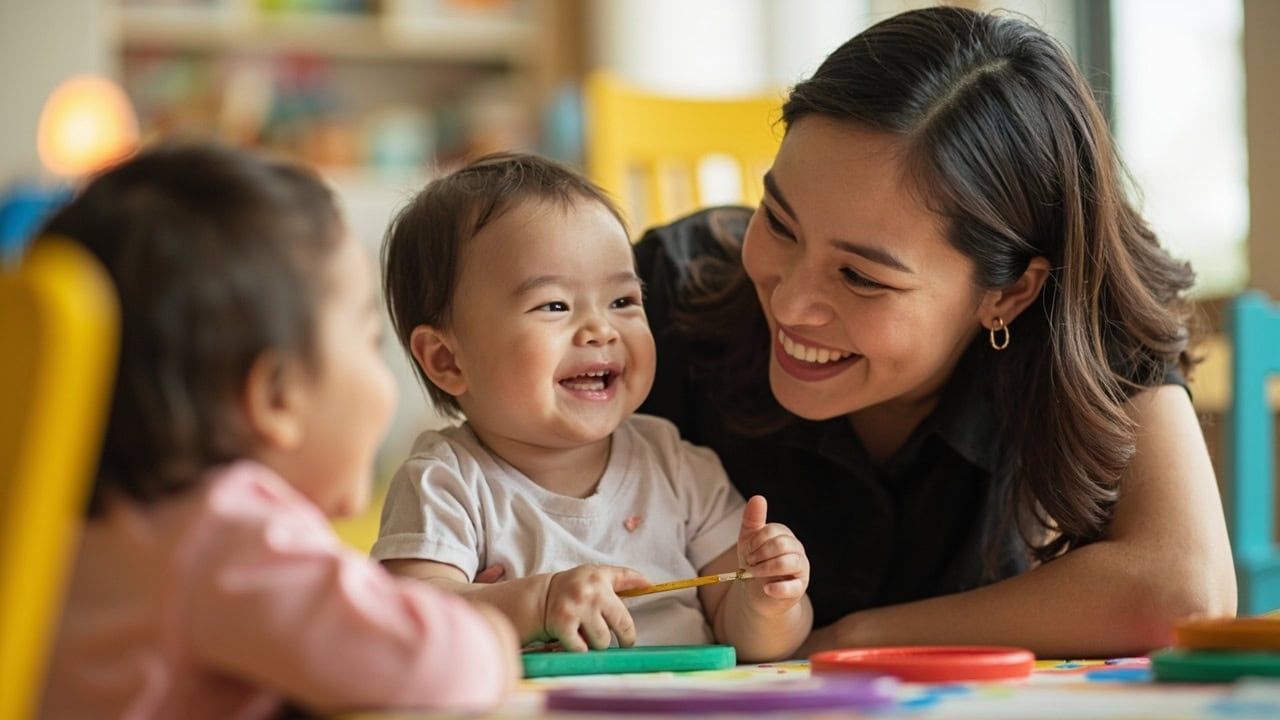
After snack, there is outdoor time. Mira might be on the tricycle today, her feet finding the pedals with the concentration of a pilot at the controls of something infinitely important. She might be in the sandpit, the feel of it between her toes, the bucket and spade her instruments of world-building. She might be chasing a butterfly with three other children, their laughter high and sharp and unselfconscious.
This is where peer interaction enters the picture, and we want to say something about that because it is so often misunderstood.
Parents sometimes think of peer interaction as a bonus—a nice-to-have, a social skill that will matter eventually but is not really the work of the early years. But peer interaction, for a child, is not a bonus. It is a curriculum that no parent can teach.
The lessons that children learn from other children are qualitatively different from the lessons they learn from adults. Adults adapt. Adults smooth over conflict. Adults, out of love, make things easier.
Other children do not.
When Mira takes a toy from another child, she learns something about cause and effect that no amount of adult explanation could convey. When another child takes a toy from her, she learns something about the injustice of the world and the variability of fairness that lands differently when it comes from a peer.
When they negotiate—who goes down the slide first, who gets the red cup, who sits next to whom at lunch—they are building the architecture of compromise, of perspective-taking, of the understanding that other people have desires that are as real and valid as their own.
The caregiver is present for this too, but not as a director. As a guardian of safety, a near presence that makes the experiments possible. When conflict arises, the caregiver does not swoop in with solutions. She moves close enough to ensure no one gets hurt—physically or emotionally—and she waits. She gives the children a chance to work it out.
Because she knows that the working-out is the point. That the struggle toward resolution is where the learning lives.
The Afternoon and Pickup: Winding Down Toward Home
The afternoon is a different creature than the morning.
There is a deepening that happens. The children have settled now. The morning’s uncertainty has given way to a kind of ease. They know where they are. They know who is caring for them. They know the shape of the day.
The afternoon is when the caregiver’s work becomes even more subtle. The mornings require management—orientation, transition, the constant energy of helping children find their footing. But the afternoons require something else.
Presence. The quiet, sustained attention of someone who has moved from guide to companion.
Mira might be engaged in a project now—painting with watercolors, or building with the wooden blocks, or engaged in the dramatic play that emerges spontaneously in a quality environment. The caregiver is nearby, but she is not directing. She is available. She answers questions when asked. She offers a word of encouragement when a block tower threatens to topple. She introduces a new element when a child seems stuck or frustrated.
This is where the afternoon builds toward home.
The Reunion You Have Been Working Toward All Day
And then you arrive.
You come through the door, or you wait at the gate, or you follow the procedure that your childcare has established for pickup. And Mira sees you, and her face does something that you will remember for the rest of your life.
It does not matter how many children you have or how many pickups you have survived. That moment—the moment when your child sees you after the day—is always and forever a reunion.
But here is what we want you to notice now, having walked through the day together. Notice what you see at pickup.
You see a child who is tired, yes. Tired in the way that good work makes you tired. You see a child who has eaten, who has rested, who has played and learned and grown in ways that you cannot fully measure. You see a child who might show you something—a painting, a leaf from the garden, a new word she learned in circle time.
You see a child who is ready for home.
And here is what we want you to understand: the readiness you see at pickup is not separate from the day. It is the day. The caregiver has spent eight or nine hours preparing this moment. Preparing your child to be with you, to be open to you, to be hungry for the evening the way she was hungry for the morning.
The caregiver has been working toward your reunion all day long.
This is the thing that is so rarely said. The childcare day is not a replacement for family life. It is not a holding pen. It is not even, primarily, an educational institution, though education happens there.
The childcare day is a companion piece to home. It is designed, in its highest form, to make your evenings richer. To make your child more ready to engage with you. To make the whole of family life more possible by carrying some of its weight.
The Question Every Working Parent Asks
There is a question that every working parent in Singapore asks themselves, usually in the quiet moments, usually at three in the morning, usually when the guilt feels like it might swallow them whole.
The question is: Is this okay? Is it okay that I am not there? Is it okay that someone else is raising my child? Is it okay that I have chosen this, that I need this, that I cannot be both at my desk and at the sandbox at the same time?
We want to answer that question honestly, and we want to answer it with something more than reassurance.
It is okay. Not because your feelings of doubt are unfounded—they are not. They are reasonable, and they are shared, and they are a sign that you take this responsibility seriously.
It is okay because you are doing something that humans have always done: you are entrusting your children to a village. The village has changed shape. It looks different than it did a hundred years ago, or even twenty years ago. But the structure is the same.
Someone holds your child while you do the work of providing. Someone sees your child while you are elsewhere. And the someone who holds them matters.
What you are looking for, when you search for childcare, is not a replacement for yourself. It is a worthy member of the village. Someone who will kneel down and meet your child at eye level. Someone who will build the bridges. Someone who will hold the child’s world steady and also stretch it, gently, toward all that the child might become.
Mira, One Year Later
Let us return, for a moment, to Mira.
Mira is three years old now. It has been a year since that morning in the yellow dress with the strawberries. She is different. She walks into childcare now with something like confidence, not because she has forgotten you, but because she has learned that you always come back, and so has the freedom to walk away.
She has friends there. She has a favourite spot at the snack table. She knows the words to the morning song.
But sometimes, on difficult mornings, she still hesitates at the door. She still looks back. She still needs the caregiver to kneel down and say something specific and kind and bridging. And the caregiver does. Because that is the work. The work does not stop mattering just because it is routine.
You are still extending trust every morning. You are still walking away. But now you know something about what happens next. You know about the settling and the snack and the peer negotiations and the rest and the afternoon and the winding down and the reunion that is being prepared for you all day long.
You know that the caregiver is there. That she is reading the signals. That she is building the bridges. That she is holding your child’s world steady while you hold your own.
And this knowledge changes something in you. It does not eliminate the ache of the morning goodbye. That ache is appropriate. It is the price of love, and it is worth paying.
But it transforms the ache from anxiety to something else. It transforms it into the understanding that you are not abandoning your child. You are entrusting her. And she is being entrusted well.
Recognising Quality Childcare: What to Look For
Understanding the full arc of the childcare day is important, but it should also help you recognise quality when you see it—or know what questions to ask when you are evaluating your options.
Here are some markers of quality that you can look for:
- Caregiver-to-child ratios that allow for real attunement. In the early years, when the need for responsive care is most acute, fewer children per caregiver means more attention per child. Ask about ratios, especially for infants.
- Environment designed for entry. When you visit a centre or meet a caregiver, notice whether the space feels welcoming to a child who has just said goodbye to a parent. Are there places to land? Things to discover? Is it stimulating without being overwhelming?
- Predictable rhythm. Children thrive on structure not because they are rigid but because predictability creates safety. Ask about the daily schedule. Does it feel consistent?
- Responsive transitions. Watch how caregivers handle drop-off. Do they kneel? Do they use the child’s name? Do they offer a bridge to the morning?
- Observational practice. Quality caregivers are always watching—not hovering, but noticing. Ask how they track your child’s development and share it with you.
- Rest and nutrition as priorities. These are not afterthoughts. They are curriculum. Ask about food quality, meal style, and how rest is handled.
- Communication and transparency. You should feel informed, not anxious. Ask what updates look like. Ask about visibility measures that help you trust what you cannot see.
How EduNanny Addresses the Hours Between
EduNanny by BUTLER is built on a simple premise: that the hours between matter. That they should not be invisible. That parents deserve not just to drop off and pick up but to understand, in some meaningful way, what happened in between.
That is why EduNanny participates in the ECDA Childminding Pilot, offering pathways that are both home-based and community or centre-based, because families are different and the best solution is one that fits the family rather than forcing the family to fit a solution.
EduNanny works with ratios that prioritise attention. Up to one caregiver for every three infants in the early years, when the need for responsive care is most acute. This is not an accident of policy. It is a reflection of philosophy: that attention is not a luxury, that attunement requires capacity, that the quiet work of reading a child’s signals cannot happen when those signals are lost in a crowd.
EduNanny offers Monday to Friday care blocks, structured with pilot fee structures that aim to make quality care accessible. CDA and Baby Bonus funds are usable, because financial considerations should not be a barrier to the kind of care that shapes a child’s early years.
And where deployed, EduNanny offers communication and transparency measures, including CCTV access, because trust must be built and visibility is part of building it.
But here is what matters most about all of this. These are not features designed to reassure you despite the absence of something deeper. These are manifestations of something deeper: the belief that childcare is sacred work. That the hours between drop-off and pickup are not just a service to be rendered but a relationship to be honoured. That the child in those hours is not a task to be managed but a person to be seen.
EduNanny’s Thomas AI Chatbot exists because parenting in Singapore is demanding. That the questions do not stop at the childcare door. That you might be sitting in your office, or on the commute home, or lying awake at three in the morning, and you need answers that are specific and practical and grounded in real expertise. Thomas is there. Not as a replacement for human care but as an extension of it—the same commitment to responsiveness, now available whenever you need it.
The Hours Between: Your Next Steps
The hours between.
This is where your child lives while you are working. This is where friendships are forming. This is where independence is being built. This is where the foundations are being laid for everything that comes later: for Primary One, for relationships, for the ability to be in the world without you, to navigate its complexity, to find their place in it.
You will not see most of it. You will see the photographs and hear the stories and receive the updates, and all of that matters. But you will not see the whole picture. The whole picture is too rich, too complex, too ongoing to be captured in any report.
So instead, we want to offer you this. We want to offer you the knowledge that the picture is there. That it is being painted, every day, with intention and care. That your child is not in a void while you are apart. That they are in a place of rhythm and safety and attention. That they are being seen.
And when you arrive at pickup, and you see that tired, bright, whole child running toward you with a leaf in her hand and a story on her lips, we want you to know: you are seeing the result of the hours between. You are seeing the work.
And the work matters.
If you are researching infant care or childminding options in Singapore, we invite you to schedule a consultation to discuss your family’s needs—whether home-based care, community-based care, or centre-based arrangements work best for you. Learn more about the EduNanny approach, or ask us anything about ratios, routine, the ECDA Childminding Pilot, or how we handle the transitions, the rest, the peer learning, the reunion. We believe the answers should be transparent.
The hours between matter. Your child is held there. And you do not have to navigate this alone.
The next time you stand at that door in the morning light, and you kneel down, and you smooth the collar of her dress, and you say goodbye, know this:
You are not leaving her in the dark. You are placing her in a day that has been prepared for her. You are entrusting her to people who understand what is at stake. You are participating in something ancient and essential: the raising of a child by a community, not just a family.
And when you come back at the end of that day, and you see her face, and she runs to you with everything she has become in those hours, you can carry this with you:
You understand now. You understand what happens in the middle.
And you are not alone.
#SingaporeChildcare #InfantCareSingapore #ChildmindingSingapore #QualityChildcareSG #EduNannySG