Why the Sibling Bond Should Guide Your Singapore Childcare Search
The Moment That Tells You Everything: Understanding Sibling-Aware Childcare
There is a moment you have probably noticed, though you may not have named it. It happens after you arrive at pickup, after the bags are collected and the handover notes are exchanged. Your children find each other.
Two children who have been apart all day. A younger one who runs toward an older one with a stick of rice crackers half-hidden in her fist. An older one who kneels down, not to give instructions, but simply to listen as the younger one tries to explain something that happened hours ago.
There is proximity. There is a language between them that has nothing to do with words. And if you watch closely, you will see something remarkable: they have been waiting for each other.
That reunion is not accidental. It is not simply the result of shared blood or shared bedrooms. It is the product of something that has been quietly shaping them both all day—sibling learning. And it is one of the most powerful, most underappreciated forces in child development.
The Longest Relationship Your Children Will Ever Have
If you are a parent with more than one child, you know what I mean when I say that siblings are not simply people who happen to share a home. They are, in many ways, the longest relationship your children will ever have.
Before friendships form. Before romantic relationships. Before professional mentors or community ties. There are these two people who grew up side by side. They remember the same meals, the same car rides, the same corners of the same playground. They carry shared history like a second skin.
But here is what many parents quietly worry about, even if they rarely say it aloud: what if our childcare arrangements are making this harder? What if the environment that is supposed to support our children is inadvertently pulling them apart, creating competition instead of companionship, resentment instead of closeness?
This is not an unreasonable fear. It is a sign of how deeply you love your children that you even consider it. And it is precisely because this concern deserves a thoughtful answer that sibling-aware childcare matters—not as a buzzword, but as a genuine quality marker that Singapore families should look for.
What Siblings Teach Each Other That Parents Cannot
Siblings are often better teachers for each other than adults can be.
Consider what happens when an older child plays alongside a younger one. The older child does not simplify language the way an adult caregiver might. Instead, the older child simply plays. And in playing at their own level, at the edge of their ability, they create what developmental psychologists call a zone of proximal development for their younger sibling.
The younger child watches. Imitates. Attempts. Falls. Tries again. The older child, in turn, learns patience, narration, the experience of being looked up to. Neither of them knows this is education. It simply feels like being together.
This is why siblings raised together develop shared vocabularies, inside jokes, a shorthand of gestures and expressions that no one else can decode. They have been teaching each other, all along, in ways that parents and caregivers simply cannot replicate.
- The younger child sees, in the older one, a version of themselves a little further along—and wants to reach it.
- The older child sees themselves reflected in the younger one’s admiration—and learns what responsibility feels like before anyone tells them they must.
The adult can model good behavior. The adult can facilitate. But the peer dynamic between siblings has a quality of mutuality that is irreplaceable. It happens all day, in small moments, through the natural pull of love and proximity.
Conflict Is a Classroom, Not a Failure
Here is where many parents feel the most anxiety—and where quality childcare makes the most visible difference.
When two children reach for the same toy. When an older one tells a younger one they cannot have a turn. When emotions rise and bodies tense. Something profoundly important is happening. These children are learning, for the first time in their lives, how to navigate disagreement with someone who matters to them.
- That people they love can frustrate them.
- That frustration does not end love.
- That repair is possible.
- That saying sorry has power.
- That being told no is not the end of the world.
A trained caregiver in a sibling-aware environment does not swoop in and resolve every dispute before the children have a chance to practice. Neither do they leave children to flounder, interpreting adult silence as indifference.
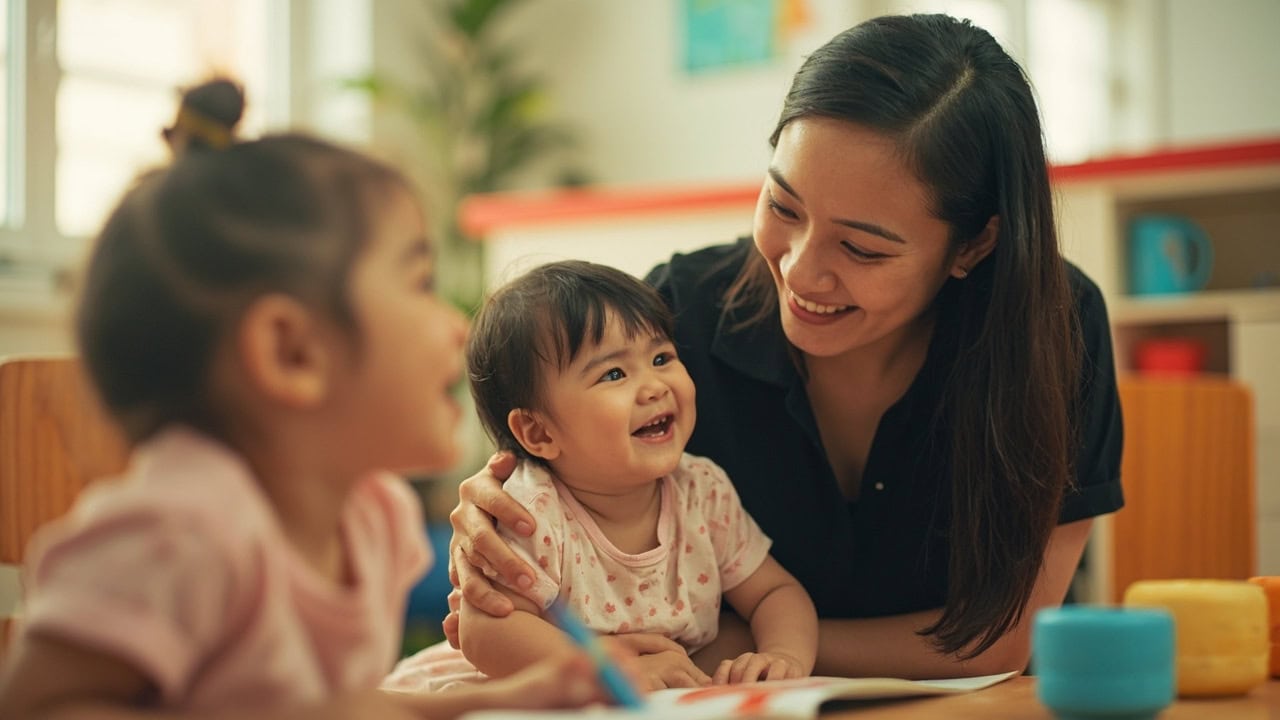
They stay close. They create the conditions for resolution. They model repair when needed, narrate what they see, and give children the language and the space to find their way back to each other.
“I see both of you wanted the truck. What could we do?”
That sentence, repeated across hundreds of small moments, teaches children something that no lecture can: that conflict is a problem to be solved, not a person to be defeated.
What Quality Childcare Actually Looks Like
The distinction between adequate childcare and exceptional childcare becomes visible in how sibling dynamics are handled throughout the day.
In Adequate Care
- Siblings may be present in the same space but there is no intentional design to support the sibling bond.
- Siblings are treated as two individual children, each with their own developmental needs.
- The relationship between them is left to chance.
In Exceptional, Sibling-Aware Care
- Caregivers observe how older and younger siblings interact across the day.
- They notice when the older child is ready to be a helper and when they need to simply play without responsibility.
- They notice when the younger child is seeking challenge and when they need space to succeed on their own terms.
- They create opportunities for cooperative play, for shared accomplishment, for quiet collaboration.
What This Looks Like in Practice
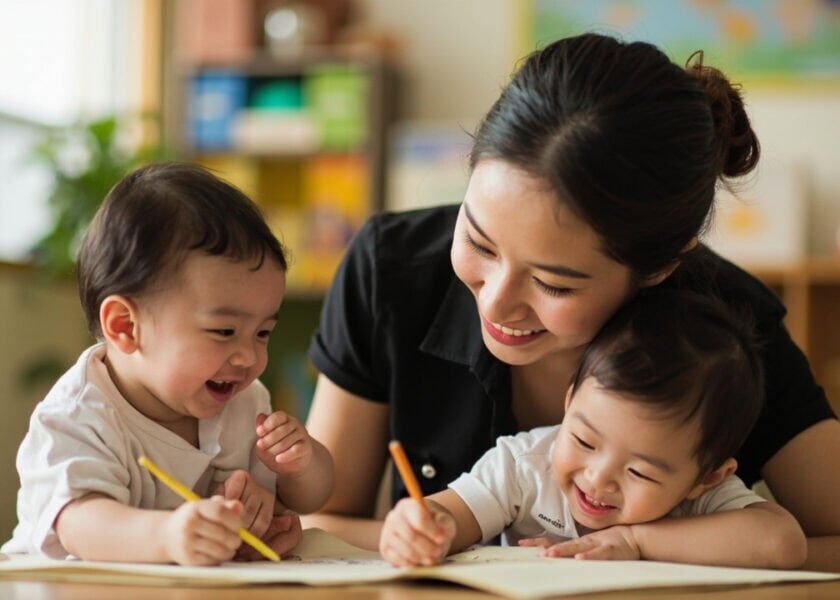
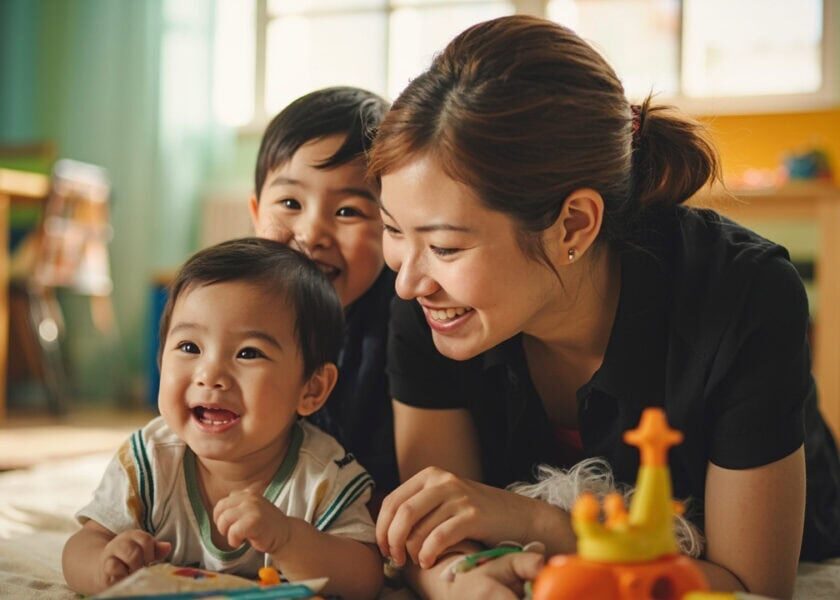
During free play, a caregiver might notice a three-year-old building something complex and draw the younger sibling in as a helper, adjusting the task so both can participate meaningfully. During group activities, the caregiver gives the older child a leadership role that is real enough to matter but bounded enough to prevent overwhelm.
At moments of transition, when the room is shifting from one activity to another, the caregiver gently pairs siblings to move together—reinforcing the sense that they are a team. And when siblings do fight—and they will—the caregiver ensures that after the fight, there is repair. There is warmth. There is the return to connection.
That pattern—the rupture and the repair—is what builds the emotional resilience that will carry your children through disagreements with friends, conflicts with colleagues, and eventually the inevitable tensions of their own adult relationships.
What to Look For When Choosing Childcare in Singapore
You wonder whether your childcare arrangement is dividing your children rather than connecting them. You wonder whether the older one feels displaced by the attention the younger one requires. You wonder whether the younger one is always in the shadow of the older one’s accomplishments.
These are not irrational fears. They are the fears of parents who understand that sibling rivalry is real, that jealousy is a natural emotion, and that the home environment is not the only shaping force.
The right childcare will not eliminate rivalry. Rivalry is a feature of sibling relationships, not a bug. What the right childcare will do is ensure that rivalry is not the whole story.
- Alongside the competition, there is collaboration.
- Alongside the comparison, there is complementarity.
- Alongside the moments of friction, there are moments of pure, uncomplicated delight in each other’s company.
Questions to Ask at Every Tour
- How do caregivers support sibling interactions during the day?
- What happens when siblings disagree or fight over toys?
- Do you create opportunities for older and younger children to play together?
- How do you ensure both children feel seen and valued?
- Can I observe how my children interact with each other during the settling period?
What to Watch For
- Caregivers who know your children’s names, temperaments, and preferences—not just their ages.
- An environment where siblings can see and reach each other during play.
- Caregivers who narrate sibling interactions positively: “You remembered she likes the red cup.”
- Conflict handled with patience, not speed—giving children time to work things out.
- After conflicts, a visible return to warmth and proximity between siblings.
How EduNanny Approaches Sibling Dynamics
In an EduNanny programme, the sibling-aware philosophy is embedded in the daily design—not as an afterthought, but as a foundational principle.
Caregivers are trained to observe sibling pairs with the same attentiveness they bring to individual development. They understand that an older child may need moments of undivided attention to feel secure, and that a younger child may need space to explore without the pressure of comparison. They hold both needs, and they hold the relationship between them.
With ECDA Childminding Pilot frameworks guiding the approach, families have access to a programme designed around real developmental principles, not just logistical convenience. The home-based pathway, in particular, offers something that centre-based care often cannot: a small, stable environment where sibling dynamics can be observed closely and responded to in real time.
Affordability matters. The accessibility of pilot fee structures, the usability of CDA and Baby Bonus funds, and the flexibility of Monday to Friday care blocks are not simply administrative conveniences. They are what make consistent, high-quality care possible for families who might otherwise feel they have to choose between financial stability and developmental excellence.
When childcare is accessible, families can commit to it. And when families can commit, sibling bonds have the stability they need to deepen.
Communication channels remain open. Regular updates allow you to track not just your children’s individual days but how they are relating to each other—how the sibling dynamic is unfolding across time. You remain the primary expert on your children. The programme is designed to work with your instincts, not replace them.
The Question to Carry With You
Sibling-aware care is not about creating perfect siblings. It is not about guaranteeing that your children will be best friends, that they will never fight, that they will share everything graciously and without resentment.
What sibling-aware care offers is something more grounded and more valuable: the assurance that your children’s sibling relationship is being actively tended. That caregivers understand its importance. That the daily environment is designed with sibling bonds in mind.
There is a question I would invite you to carry with you, long after today. It is not:
“Is this childcare good for my child?”
It is:
“Is this childcare good for my children—for the relationship between them?”
Ask it at tours. Ask it of directors. Ask it of caregivers. And listen not just for the words but for the quality of attention behind the answer.
Because when someone truly understands siblings—when they have watched sibling pairs grow and stumble and find each other again, when they know that the sibling bond is fragile and resilient all at once, when they have built their practice around protecting it—you will hear it in the way they answer.
That answer is what you are looking for.
When childcare understands siblings, it becomes something more than supervision. It becomes a space where the longest relationship your children will ever have is actively nurtured—one small moment at a time.
If you are ready to explore what sibling-aware care looks like in practice, speak with our team. We would be glad to walk you through what a thoughtfully designed childcare arrangement can offer your family.
Learn more about EduNanny’s ECDA-approved Childminding Pilot and the standards that guide our approach to sibling-aware, development-oriented childcare in Singapore.