The Hidden Foundation Your Child Needs Before Primary One
The Readiness Question You Are Already Asking
There is a moment — maybe during a playdate, maybe when something does not go their way — when you see something that troubles you quietly.
Your child knows their letters. They can count to twenty. They are bright, curious, and eager. But then you see it: a frustration that seems to come from nowhere. A collapse into tears over something that seemed small. A difficulty bouncing back.
And in that moment, you wonder: are they really ready for what comes next?
You have likely been asked this question before — at a gathering, at a paediatrician’s clinic, from well-meaning relatives. Can your child read? Can they write their name? How many words do they know?
These questions are not wrong. Academic preparation matters. But they do not tell you what you most want to know as a parent.
What you want to know is whether your child will be alright. Whether they will cope when things do not go according to plan. Whether they will raise their hand in class or call out. Whether they will share a toy even when sharing feels impossible. Whether they will make a mistake and try again.
These are not academic skills. They are emotional ones. And research increasingly shows that emotional self-regulation is the single greatest predictor of how a child will fare in those first years of school — not because knowledge is unimportant, but because a child who can manage their emotions can access everything else. A child who cannot may find that all the knowledge in the world feels out of reach.
What Self-Regulation Actually Means for Young Children
Emotional self-regulation is not the ability to suppress feelings or to act as though nothing affects you. It is something far more sophisticated — and far more important.
For a young child, self-regulation means noticing when they are starting to get upset, tolerating the discomfort of that feeling for a moment rather than immediately reacting, recovering when something has gone wrong, and re-engaging with what comes next.
It is the ability to manage big feelings without being swallowed by them. It is what allows a child to sit through a lesson even when the lesson is hard. To wait their turn. To feel frustrated and still move forward.
You can often see this capacity developing long before a child can name it. A toddler who used to fall apart completely over a broken tower of blocks, who now takes a breath and rebuilds. A preschooler who, after months of meltdowns over sharing, can now say “I am angry” instead of hitting. These are not small things. These are the signs of a child building the foundation that everything else will rest upon.
Why the Early Years Matter Most
The prefrontal cortex — the part of the brain responsible for self-regulation, attention, and impulse control — develops most rapidly in the early years. This is not a passive process. It is a dynamic one. The brain grows stronger in the areas that are exercised and used.
When children experience consistent, responsive caregiving, when they are held in predictable rhythms and guided through manageable challenges with warm support, the architecture of their brain develops in ways that lay the groundwork for self-regulation, attention, and the capacity to learn.
This development does not happen in isolation. It happens in connection — when a child is held, responded to, and guided through frustration by someone who understands what they are feeling and helps them find their way back to calm.
This is precisely why emotional regulation cannot be taught from a worksheet, cannot be learned from a screen, and cannot be developed in a room where a child is always redirected with commands rather than guided with understanding. It is built in the presence of skilled, trained, emotionally attuned adults.
How Quality Childcare Builds This Capacity
Parents sometimes imagine that quality childcare means constant stimulation — activities, lessons, structured learning. But the most powerful developmental work in a quality childcare setting is, in many ways, quiet.
The Architecture of Security
Consider what a typical morning looks like in a well-designed childcare environment. There is a rhythm. There is predictability. Children know what comes next, and this predictability is not a limitation — it is a gift. It tells a child’s nervous system: you are safe, you can relax, what you need will be provided.
Within that structure, children encounter moments of friction. These moments are not failures of the environment. They are the environment working exactly as it should.
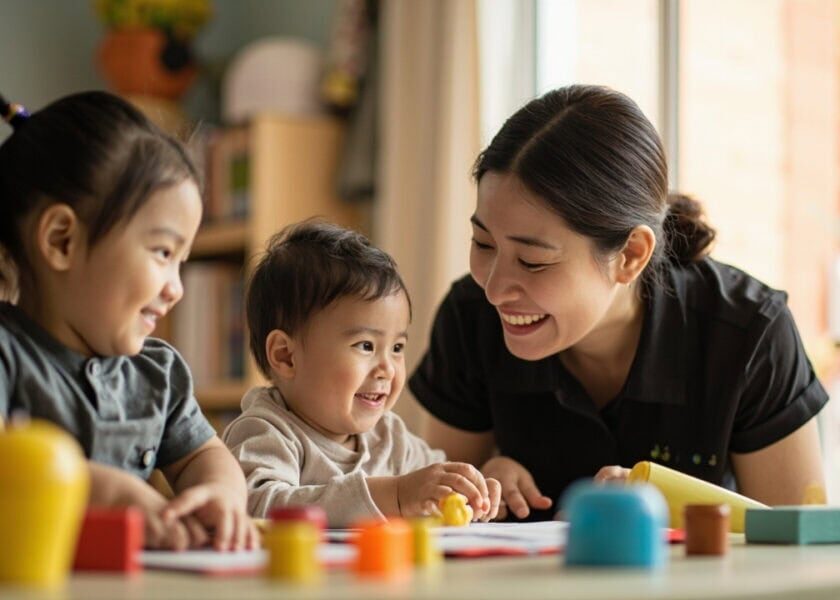
Two children want the same toy. A skilled caregiver does not immediately resolve the conflict, though they step in when safety requires it. Instead, they help each child name what they are feeling. They stay present while the children work through the frustration. They offer just enough support to help each child find their way back to equilibrium.
A planned activity does not happen. A caregiver acknowledges the disappointment directly. They do not rush to fix it or distract from it. They stay with the child through the feeling, helping them learn that difficult feelings are survivable.
Over time, with repetition, with consistency, with warmth, children internalise this process. They begin to say to themselves what the caregiver once said to them: I am getting upset. I can take a breath. I can wait. I can try again.
What You Can Observe at Pickup Time
You will not necessarily see the full picture in any single moment. Much of this development is quiet and cumulative. But if you watch carefully, you may begin to notice things that tell you your child’s emotional world is expanding.
- A child who can now say “I am angry” instead of simply acting out
- A child who recovers from disappointment within a few minutes instead of spiralling
- A child who initiates play with others, navigates small conflicts, and moves on
- A child who, when frustrated, can pause and then try again
These are not minor observations. These are the markers of a child building the capacity that will carry them through every challenge school brings — and every challenge life brings after that.
Why Parents Need Support — And Why That Is Not a Failing
Here is something important to say clearly: this is not a criticism of parents.
Parents are extraordinary. You know your child in ways no one else ever will. You hold their history, their joys, their vulnerabilities. There is no bond more profound than the one between a parent and their child.
But even the most devoted, most attentive parent faces a unique dynamic at home. A child is often the centre of the universe. The adults around them are there because of them. The attention is theirs. The household rhythms often bend toward their needs.
This is love. It is right. It is what children should have.
But school will not bend. School will have a schedule. School will have expectations. School will have other children, each with their own needs, their own feelings, their own moments of frustration.
The child who has only ever experienced care in a context where they were the sole focus will find that transition harder than the child who has learned, gradually and with support, how to exist within a structure, how to wait, how to share, how to be one among many while still feeling held.
That is not something that happens by accident. It is something that is built. And it is built best in an environment designed for exactly this purpose — where trained caregivers hold the emotional space a young child needs, day after day.
What to Look for When Choosing Childcare in Singapore
Not all childcare is the same. When you are evaluating your options, it helps to know what actually matters — and what to look for in practical terms.
| What to Look For | Why It Matters for Self-Regulation |
|---|---|
| Predictable daily rhythm | Routine tells a child’s nervous system they are safe, freeing emotional energy for learning and growth |
| Low caregiver-to-child ratios | Caregivers can truly know each child, respond to distress promptly, and individualise support |
| Trained, emotionally attuned caregivers | Self-regulation is built through relationships with adults who model and guide it — not through programmes alone |
| Supported peer interaction | Children learn conflict resolution, sharing, and emotional recovery through guided experiences with other children |
| Transparent communication with parents | You should know what is happening in your child’s day and why — genuine partnership, not just reporting |
Questions to Ask Any Provider
- How does a typical day flow for the children? Is there a consistent rhythm?
- What happens when a child has a big feeling — frustration, upset, conflict?
- How are caregivers trained in child development and emotional responsiveness?
- What is the ratio of caregivers to children?
- How do you communicate with parents about their child’s day?
EduNanny: Building the Foundation Before the Structure
For families in Singapore, one option that may not yet be on your radar is EduNanny by BUTLER, which operates through the ECDA Childminding Pilot. They offer both home-based and community-based pathways designed to give families real, structured, professionally supported childcare.
What sets this approach apart is its understanding that childcare is not about filling time — it is about using time. Every single day.
EduNanny’s caregivers are trained for this work. They understand child development. They know how to hold the emotional space a young child needs, how to support through frustration, how to build the rhythms and routines that give children security.
They maintain the low ratios that allow caregivers to truly know each child — to be responsive, to build the kind of relationships that become the engine of emotional development. Their caregivers communicate with parents with transparency and care, because families deserve to understand what is happening in their child’s day and why it matters.
The pilot is structured to be affordable, and CDA and Baby Bonus funds can be used. This kind of developmental investment should not be out of reach for the families who need it most. Care is available across Monday to Friday blocks, providing the consistency that allows this work to happen over time.
Because the truth is — this kind of emotional development is not a one-month project. It is built day by day, through hundreds of small moments, through the patient, skilled, emotionally attuned presence of a caregiver who understands what young children need to grow.
Moving Forward with Confidence
Here is what becomes clear when you look beneath the surface of school readiness: the years before Primary One are not simply a waiting period before real learning begins. They are the period when the capacity to learn is itself being built.
In quality childcare, through the patient, skilled, emotionally attuned work of trained caregivers, your child is developing something that no worksheet can measure and no test can capture. They are learning that big feelings are not their enemies. They are learning that they have the capacity to manage what life brings. They are learning that when they fall apart, they can come back together.
They are learning that school is not something to fear, because they have what it takes.
That is readiness. That is what quality childcare builds.
If you are researching infant care or childminding in Singapore, you are already doing something important. You are looking beyond the surface of what is easy to measure and asking what your child truly needs to be ready — for school, and for everything that comes after.
When you choose that kind of care for your child, you are not choosing a convenience. You are making a statement about what you believe matters most for your child’s future. You are saying: I believe in investing in the foundation before the structure. I believe in building the capacity to learn before the content of what is learned. I believe my child deserves to be known, to be responded to, to be guided by people who understand what they are going through in these critical years.
And you would be right.
If you are ready to explore what quality childminding can look like for your family, learn more about EduNanny’s home-based and community-based pathways under the ECDA Childminding Pilot.