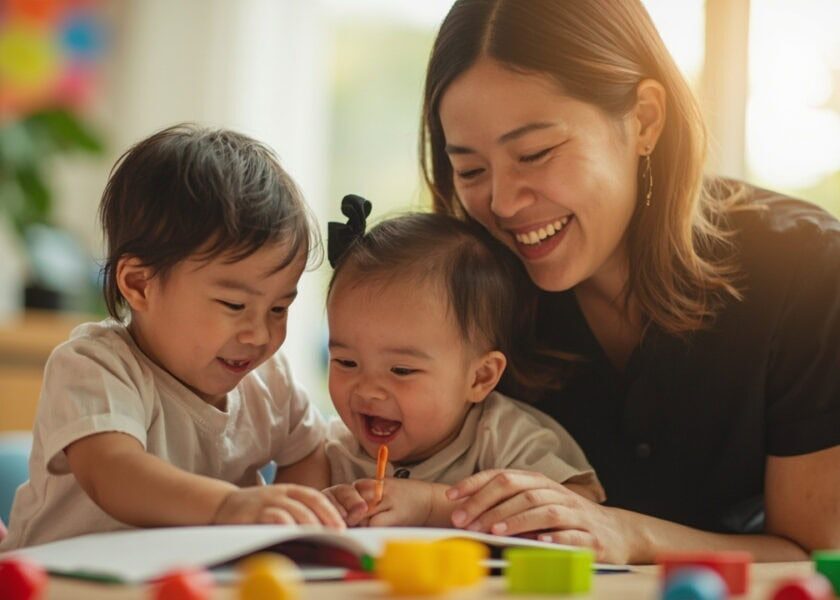
What Your Child’s Senses Are Learning at Childcare
The Quiet Question Every Singapore Parent Carries to the MRT
There is a question that sits in the space between your morning goodbye and your evening reunion. It does not announce itself. It does not demand an answer. But if you are a parent who has left your child in someone else’s care, you know this question intimately — you may have felt it in your chest this morning, even as you smiled and waved and walked to the station.
The question is simple, and it haunts you quietly:
What is my child actually experiencing right now?
Not what is the schedule. Not who is watching. What are they experiencing? What sounds are reaching their ears? What textures are their fingers touching? Whose voice are they listening for? What are they feeling in their small body as the hours pass?
This is not an easy question to hold. And it is, perhaps, the most important question a parent can ask about childcare — because it reaches beneath logistics and supervision and into something far deeper. It reaches into your child’s interior world. The world that cannot be photographed. The world that develops not in spite of your absence, but in response to it.
Today, we want to walk you into that world. We want to show you what a quality childcare environment looks like through your child’s eyes — not as an institution, but as a sensory universe. A living, breathing place where your child’s brain is doing its most important work.
Where All Understanding Begins: The Sensory Foundation
The first thing your child knows about the world is not language. It is not a name or a face or a concept. It is physical. It is sensory. It is the weight of their own body, the temperature of air against their skin, the vibration of sound through their chest, the pleasure of being held and the slight shock of being set down.
Before your child can tell you what they feel, their body has already learned a thousand lessons. Before they speak their first word, their nervous system has made sense of gravity, texture, distance, and rhythm. This is not metaphor. This is neuroscience.
The sensory cortex — the part of the brain that processes everything your child touches, hears, smells, and moves through — develops before the parts of the brain that handle language. Your child is, in the most literal sense, a sensory creature first.
What this means for childcare is simple and profound: the hours your child spends away from you are not empty hours. They are sensory hours. Your child’s body is learning, adapting, and building itself through every experience in that environment.
Movement and Neural Development
Consider what movement means to an infant. When a child crawls across a room, reaches for an object, pulls themselves up on a low shelf, they are not merely exercising. They are building neural pathways that will later support attention, focus, and the ability to sit still when a teacher asks them to listen.
The vestibular system — the part of the inner ear that detects motion and spatial orientation — develops rapidly in the first three years. And it develops through movement. Rolling. Climbing. Spinning. Falling. Getting up again.
A quality childcare environment gives your child the space, the freedom, and the safe challenge to move. Not in front of a screen. Not in a playpen. In a space designed for physical exploration, with trained eyes watching to ensure safety but not hovering so close that curiosity is stifled.
Sound and Language Building
Your child’s ears are open in ways yours are not. The auditory cortex in an infant is extraordinarily receptive — primed to absorb the full range of human speech, the rhythm of conversation, the music of a caregiver’s voice singing a morning song.
In the first three years, the brain is literally sculpting itself around the sounds it hears. Neural connections are formed. Language pathways are laid down. The capacity for listening — truly listening, the kind that will one day allow your child to follow a lesson in Primary One — is being built right now, through the simple act of being in a sound-rich environment.
A quality childcare setting is a symphony of sound. Voices. Laughter. The clatter of toys. A child learning to use words instead of fists. A caregiver narrating what she is doing — “Now we are washing our hands. Can you feel the water? It is warm.”
This narration is not small talk. It is language input. It is your child’s brain receiving the raw material it needs to build vocabulary, comprehension, and the ability to think in sentences.
The Emotional Temperature of Voices
There is another dimension of sound that we rarely consider: the emotional weather of the room. Your child cannot read a mood board or parse subtext. But they hear the difference between a tense voice and a warm one. They feel the vibration of comfort or the edge of irritation. They are exquisitely attuned to whether the adults around them are calm, present, and genuinely engaged.
A caregiver who is calm and warm creates a sonic environment of safety. A caregiver who is distracted or brittle creates an atmosphere of subtle unease that your child’s nervous system absorbs without words.
Touch and the Sensory Body
Your child’s skin is not just a covering. It is a sensory organ — the largest in the body. Through touch, infants learn about temperature, pressure, texture, and comfort. Through touch, they learn whether the world is safe.
A firm but gentle hold. A hand on the back during a stumble. Arms that open before they are asked. In a quality childcare setting, these are part of the daily diet of sensory development.
Research on touch and early development is striking. Studies of infants who received consistent, warm physical contact in their early months show stronger vagal tone — a measure of the parasympathetic nervous system’s health — in later childhood. Better emotional regulation. Lower cortisol responses to stress. This is the measurable result of a baby’s body learning, through repeated experiences of being held and comforted, that they are safe.
In a home-based or community childcare environment, touch is more intimate and continuous. The caregiver knows your child’s rhythms — when they are tired, when they are hungry, when they need to be picked up immediately versus when they need space to self-soothe. This is the advantage of smaller ratios: the caregiver becomes, in a real sense, an extension of the family. A familiar body. A known touch.
Smell and the Primal Sensory World
Smell is perhaps the most primal of senses. It is the one that most directly accesses memory and emotion. Your child cannot yet name what they smell, but their body responds.
The smell of a familiar caregiver’s skin — a combination of soap, laundry detergent, and something unique — becomes a signal of safety. The smell of food being prepared triggers hunger and anticipation. The smell of clean floors and fresh air signals a cared-for environment.
In childcare, smell is also an indicator. A childcare environment that smells stale or overly perfumed may be masking issues. One that smells like real food — cooking, not reheating — is a sign of attention to nutrition and care.
Small things accumulate. They become the texture of a child’s day. And it is in this accumulation of small sensory experiences that a child’s inner life is built.
The Social Sensory World: Reading Faces, Voices, and Emotional Temperature
Perhaps the most important sensory world in childcare is the social one.
Your child is not just inhabiting a physical space. They are navigating a human landscape. Faces. Voices. Proximity. Emotional temperature. Eye contact. The subtle signals that communicate safety, interest, or dismissal.
By six months, infants can read faces with extraordinary sophistication. They know the difference between a smile of welcome and a look of worry. They track who is paying attention to them and who is not. They begin, in their own pre-verbal way, to understand social dynamics — who is friend, who is stranger, who is ally.
Peer Interaction and Developmental Richness
In childcare, your child’s social sensory world expands. They encounter other children — small humans with their own needs, their own cries, their own ways of demanding attention. They learn, through experience, that they are not the only person in the room.
This is a profound developmental lesson. It cannot be taught through books or screens. It can only be lived.
They also encounter multiple caregivers — consistent primary caregivers and secondary trusted adults who are part of the same caring community. This is not confusion. It is richness. Your child learns to adapt, to read new faces, to generalize the sense of “this is a person who cares for me” beyond a single individual. This is a protective skill — one that will serve them in Primary school, in Secondary school, in every social environment they will ever enter.
Attunement: What Your Child Actually Needs
Your child does not need constant stimulation. They need attunement.
The caregiver who notices when a child is beginning to overwhelm and gently redirects. The caregiver who matches their energy to the child’s — active during play, calm during rest, warm during feeding. This attunement is not a feeling. It is a skill. And it is the skill that separates quality care from mere supervision.
At EduNanny, caregivers are trained to understand that the way they speak — the warmth, the pace, the attunement — is not incidental to the job. It is the job. The ECDA Childminding Pilot framework ensures that this training is not optional or variable. It is standardized, supported, and part of a system designed to protect the quality of your child’s auditory and emotional environment.
Reading Your Child After Pickup
After a rich, sensory-filled day in a quality childcare environment, your child does not arrive home as an empty vessel. They arrive as a changed being. Their body has been active. Their brain has been building. Their social world has been complex and engaging.
You can read this in their signals:
- The child who comes home flushed from running
- The child who is hungry in a way that goes beyond missing a meal — a hunger born of expenditure
- The child who uses a new word or phrase, absorbed from the day’s conversations
- The child who is slightly more settled, slightly more confident, slightly more themselves
These are the sensory signals of a good day. Not the absence of tiredness, but the presence of engagement. Not the absence of adjustment, but the presence of growth.
If you know what to look for — the posture, the eye contact, the appetite, the vocabulary, the quality of play — you can feel, in your own body, the answer to that quiet question you have been carrying all day.
They are okay. They are more than okay. They have been living.
Addressing the Voice Inside You
There is a voice — sometimes it is the voice of others, sometimes it is your own inner critic — that suggests you should be able to provide all of this yourself. That leaving your child in someone else’s care is a failure of sorts, a compromise, a concession to the demands of modern life.
Let us offer a different frame.
You cannot replicate a quality childcare environment at home. Not because you are lacking — but because quality requires structure, community, and trained attention that a single caregiver, however devoted, cannot fully provide alone. The sensory richness of peer interaction. The physical space designed for exploration. The trained eye that can distinguish normal development from signals that need attention. The social world of multiple trusted adults.
These are not luxuries. They are developmental necessities.
This is not a statement against parents. It is a statement about the science of early development. The first three years matter more than any other period of life for sensory and neural development. And that period deserves more than a single environment, however loving. It deserves a community.
Quality childcare is not a substitute for parental care. It is an extension of it. A partner in your child’s development. A second room in the house of your child’s early life.
What Quality Childminding Actually Looks Like in Singapore
For parents researching infant care in Singapore, understanding what distinguishes quality care from adequate care matters enormously. Here are the dimensions worth evaluating:
Ratio and Attention
The number of children per caregiver directly affects the quality of sensory attention your child receives. Fewer children means more observation, more attunement, more moments caught and responded to. Ask about ratios. Ask how they handle feeding, transitions, and moments of distress.
Physical Environment
Quality environments are designed with sensory development in mind. Look for varied textures, natural light, acoustic consideration, and space for movement. The environment should feel warm and intentional, not institutional.
Caregiver Training and Stability
Training matters, but so does consistency. A well-trained caregiver who stays builds familiarity with your child’s rhythms, signals, and needs. Ask about turnover rates and ongoing professional development.
Communication Practices
Quality childcare creates transparency around the invisible world of your child’s day. Ask how they share information about your child’s experiences, development, and wellbeing. Understand their approach to daily updates and parent partnership.
Regulatory Alignment
In Singapore, alignment with ECDA frameworks provides a baseline of quality assurance. Programs operating within structured pilots — like the ECDA Childminding Pilot — operate under standards designed to protect developmental quality.
EduNanny: A Sensory World for Your Child
EduNanny by BUTLER is not just a childcare service. It is a philosophy of early development made tangible.
Operating under the ECDA Childminding Pilot, EduNanny offers Singapore parents pathways that are both rigorous and flexible — home-based care for families who value intimacy and continuity, community-based and centre-based options for those who seek additional structure and community integration.
The pilot structure is designed to make quality care accessible. With Monday to Friday care blocks, transparent fee structures, and support for CDA and Baby Bonus utilization, EduNanny is built for real families navigating real budgets. This is not charity. It is infrastructure. It is Singapore recognizing that early childhood is not a private concern but a public responsibility.
Because EduNanny understands that parents need to feel, not just trust, there are measures in place that bring transparency to the invisible world of childcare. Depending on the pathway chosen, communication protocols and even CCTV measures may be deployed — not as surveillance, but as windows. Because your child’s inner life may be invisible, but it should not be inaccessible.
You should be able to know what kind of day your child had. You should be able to ask, and receive an answer grounded in observation, not reassurance alone.
Making Your Decision
If you are researching infant care or childminding in Singapore, here is what we hope you carry with you:
The hours your child spends in childcare are not a gap to be managed. They are a sensory world to be chosen carefully — a world where their senses are being tended to with the same care and intention you bring at home.
When you choose childcare well, you are not leaving your child in a holding place. You are placing them in a carefully designed world where their brain is building the neural pathways that will one day allow them to read, and write, and sit still, and listen, and think.
Visit. Observe. Ask questions about sensory environment, caregiver training, ratios, and communication. Trust your instincts about whether a place feels warm and attentive. And know that asking these questions — carrying that quiet wondering — is not weakness or over-concern. It is exactly what a thoughtful parent should feel.
The next time you say goodbye in the morning, we want you to know: you are not leaving your child in a waiting room. You are placing them in the first meaningful living world they have known outside your home.
And in that world, they are not being kept.
They are being built.
EduNanny offers home-based, community-based, and centre-based pathways designed to give your child the sensory-rich environment they deserve. Connect with their team to understand which option fits your family’s rhythm, your budget, and your peace of mind.
Because the quiet question you carry every morning deserves an answer you can feel in your body — not just believe in your mind.
Learn more about EduNanny and the standards behind thoughtful, development-oriented childminding in Singapore.