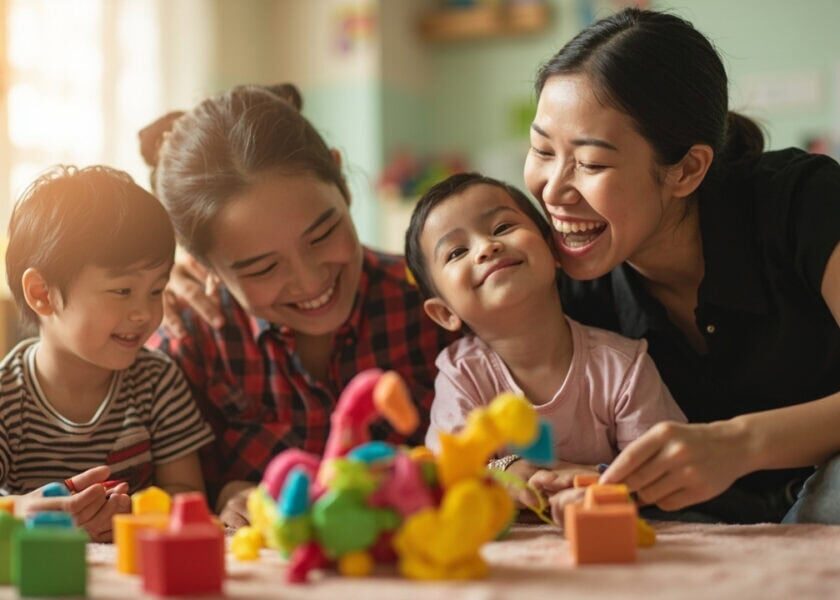
The Childcare Partnership Model Singapore Families Are Looking For
The Question You Are Actually Asking
When Singapore parents tour childcare centres, they typically arrive having already resolved the safety question in their minds. They have walked through the premises, checked caregiver-to-child ratios, verified certifications, inspected CCTV where available, and reviewed daily updates.
What keeps them awake at night is something subtler. Something harder to verify. Something that does not fit neatly onto a checklist.
They want to know whether their childcare provider is working with them or simply for them.
Working for you means following instructions, adhering to schedules, completing daily logs, and maintaining safety standards. These are baseline expectations, and they matter. But they do not address the deeper question.
Working with you means something more demanding: a deliberate alignment between the developmental goals your family holds for your child and the daily practices of a trained caregiver — an alignment so consistent that it begins to feel, to your child, like one continuous presence rather than two separate ones.
This is the distinction at the heart of the partnership model. And it is the question worth asking every time you evaluate a childcare arrangement.
What Genuine Partnership Looks Like in Practice
Let us be specific, because specificity is where the difference becomes visible.
Imagine a morning with a fifteen-month-old who has recently begun pulling herself to standing. A trained caregiver notices that this child is now experimenting with releasing her grip — testing her balance, hesitating, experiencing tiny moments of triumph and uncertainty.
What does a caregiver who is merely working for you do? They ensure the child is safe. They change the nappy. They follow the schedule.
What does a caregiver who is working with you do? They notice the experimentation over the course of the morning. They do not intervene unnecessarily, because they understand that the child’s brain is building something critical in that moment: the neural architecture for risk assessment, for self-trust, for motor planning. But they also do not miss it. They are watching with trained eyes, and they are seeing what you would want seen.
That observation becomes part of a record. That record becomes part of a conversation. And that conversation becomes part of a shared developmental map that both the caregiver and you are building together, in real time, over months and years.
When a caregiver is trained to observe — really observe — they begin to notice patterns that matter:
- The particular way your child self-soothes when upset
- The specific sound your child makes just before a tumble
- The facial expression that means they are processing something new and need patient proximity rather than active intervention
- Which toys they return to again and again, and what that reveals about their current interests and developmental preoccupations
That level of attention requires something that goes beyond warmth and goodwill. It requires training. It requires systems. It requires a communication architecture so consistent that you do not have to wonder what happened during the hours you were not there. You already know, because you are part of the story.
Why Ratio Is Not Just a Number
The question of caregiver-to-child ratio is one of the most concrete expressions of partnership philosophy.
When a caregiver is responsible for one or two infants — never more than three — the quality of attention changes in kind. A child does not simply receive care. A child receives responsive, attuned, individualised care.
The caregiver can notice the subtle. They can interpret the ambiguous. They can respond to what is actually happening, rather than what a schedule says should be happening.
Under Singapore’s ECDA Childminding Pilot, which EduNanny participates in, these ratios are not aspirational. They are structural requirements that make genuine partnership possible.
The Gap Parents Describe — and How Partnership Closes It
Singapore parents describe something they often cannot quite articulate. They feel a gap:
- A gap between the hours they are physically present and the hours their child is not with them.
- A gap between what they know their child needs and what they can verify is happening in their absence.
- A gap between their parental instincts — which are real, which are valuable, which science tells us are finely tuned by thousands of hours of interaction — and the professional knowledge of someone trained in early childhood development.
Parents often feel they have to choose between trusting their gut and trusting the expert. They should not have to choose.
Trained observation and parental intuition are not competing systems. They are complementary ones. When they are operating in genuine partnership, your child benefits from both simultaneously.
Your intuition tells you your child is frustrated about something, even if they cannot yet articulate it. A trained caregiver, working from the same developmental map you have contributed to, can observe the specific behavioural signals — the increased need for proximity, the disruption in play flow, the regression in a recently mastered skill — and interpret them not in isolation but in the context of what your family has shared about your child’s life.
A new sibling. A change in sleeping arrangements. A grandparent’s visit. These are not trivial details. These are the texture of your child’s inner life. When a caregiver knows them, the quality of their responsiveness changes fundamentally.
Your child does not experience a stranger in their home or their centre. Your child experiences someone who is oriented to them, who knows the shape of their world, who responds with a kind of informed gentleness that is distinguishable from generic kindness in ways that matter enormously.
Communication That Tells You What Matters
Most childcare centres send home a daily log. Most parents skim-read it with a slight sense of guilt for not studying it more carefully.
The perfunctory log tells you what your child ate and when. It tells you when they slept and for how long. It meets a compliance requirement. It does not tell you anything meaningful about your child’s day.
Partnership communication tells you something different. It tells you what your child noticed. What they attempted. What surprised them. What they returned to again and again because something in it called to them.
That kind of communication is only possible when the caregiver has been trained to observe, has the time to observe, and has a system for translating observation into meaningful dialogue. It is labour-intensive. It is intentional. It is the opposite of transactional.
The ECDA Childminding Pilot and What It Makes Possible
EduNanny Singapore participates in the ECDA Childminding Pilot, and this participation is not simply a credential. It is a philosophy made tangible.
The Pilot was designed to expand the quality of childcare available to Singapore families, with the understanding that flexibility matters. Some families need home-based care, where the caregiver comes to the child. Others need the community and structure of a centre.
Both pathways, under EduNanny’s model, are built on the same foundational commitment:
- Trained caregivers who observe with developmental intentionality
- Bidirectional communication that keeps parents informed and involved
- Developmental alignment with the family’s own priorities
- Ratios that allow caregivers to truly see each child rather than simply manage them
The Pilot also makes this level of care accessible. Within its fee structures, it is designed to be a genuine option for families across Singapore, not a premium service available only to those who can afford the top tier. For families who qualify, the use of CDA and Baby Bonus funds means the financial architecture of childcare becomes manageable in ways it has not always been.
Questions Worth Asking
If you are evaluating childcare options, here are the questions worth asking — beyond the checklist of safety certifications and centre tours:
- How does this centre or service describe the relationship between caregivers and parents? Look for language of partnership, collaboration, and alignment rather than service and supervision.
- What does daily communication actually look like? Request samples. Notice whether entries describe individual children or generic activities.
- How are developmental goals set and tracked? There should be a process — not just hope that development will happen, but a deliberate framework for noticing and responding.
- What are the caregiver-to-child ratios, and why? Understand why those ratios exist and what they make possible.
- How does this service handle transitions and changes in your child’s development? Ask for an example of how they adapted when a child’s needs shifted.
- What training do caregivers receive, and how is it supported? Warmth is not sufficient. Training is what transforms observation into understanding.
If you are already in a childcare arrangement and wondering whether it is working, look for specificity in communication. If the daily update tells you what happened but not how your child responded to what happened, the observation is surface-level.
And if you do not feel like your caregiver really knows your child — if they cannot tell you something about your child that surprises or delights you — the partnership has not yet formed. Nice is not enough. Your child deserves someone who is oriented to them as an individual.
The Village Your Child Needs
Singapore parents know something that the research confirms: the first thousand days of a child’s life are not a period to be survived. They are a period to be tended — carefully, attentively, and in concert with the people who love that child most.
You feel this in your bones. You do not need permission to believe your child deserves good hands — trained, attentive, aligned, and ready to work alongside you as one team with one purpose.
You are not looking for someone to replace your presence. You are looking for someone to extend it. The second set of eyes. The second set of ears. The second set of hands. These are not luxuries. When they are done right, they are an amplification of everything you are already giving.
EduNanny Singapore was built for parents who understand that choosing childcare is not a surrender of responsibility but an act of intentional partnership. For parents who want their village to speak their language, share their vision, and move in the same direction they are moving.
You can feel the difference. Your child feels the difference. And you, at the end of a workday, when you open that communication and read what your child’s morning was actually like, feel the difference in a place that goes beyond reassurance.
You feel it as confirmation: The person looking after my child is paying attention. They are working in my direction. They are not a replacement for my presence. They are an extension of it.
The village your child needs exists. And it does not work parallel to you. It works with you.
Ready to explore what genuine developmental partnership looks like for your family? Connect with EduNanny Singapore to learn more about our home-based and centre-based pathways, or to discuss what your child’s first thousand days could look like with a team that works in your direction.