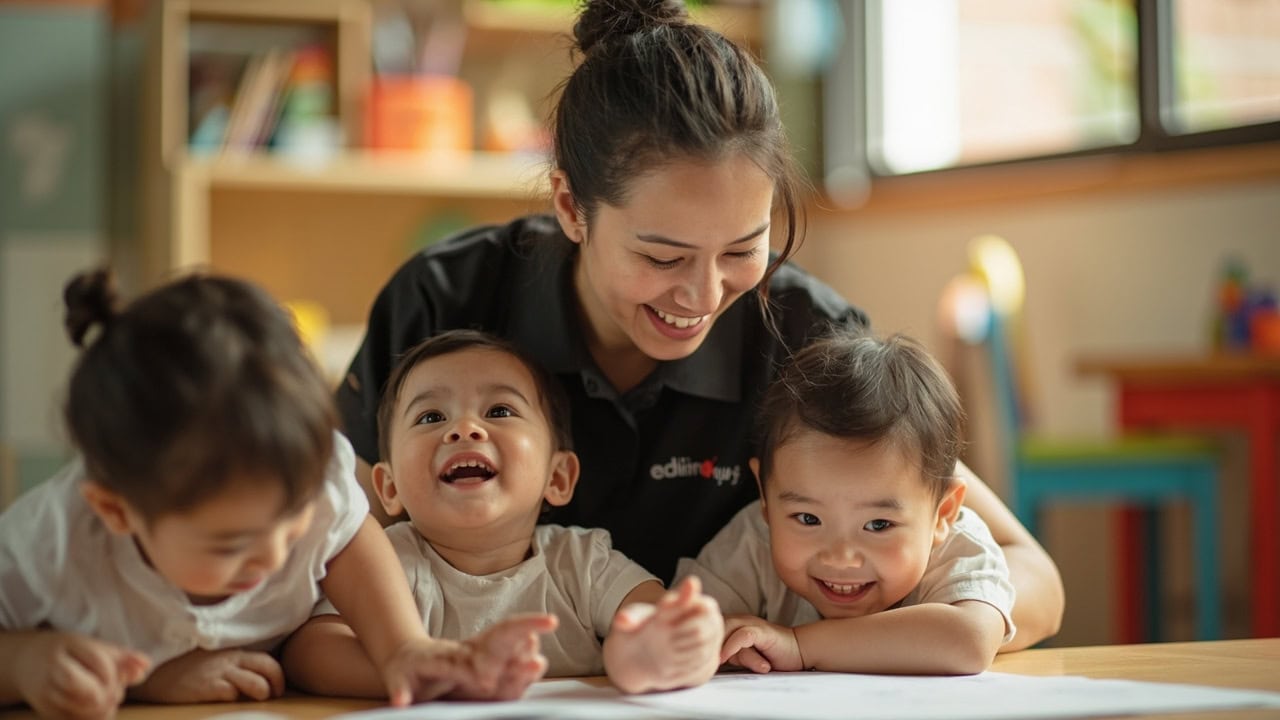
The Unspoken Story of Who Singapore Parents Become When They Choose Childcare
The Hidden Story Behind Every Childcare Decision
When Singapore parents begin searching for childcare, the conversation almost always stays on the surface. Which centre. Which programme. What are the teacher qualifications. How is the curriculum aligned with MOE frameworks.
These are important questions, and they deserve careful answers. But they are not the questions that keep you awake at night.
The questions that keep you awake are the ones you do not say out loud at the parent-teacher meeting. The ones you scroll past in parenting forums because someone else seems to have it more figured out. The ones that sound something like this:
Am I still a good parent if I am not the one who is there every single day?
Here is what nobody tells you: the decision to enrol your child in childcare was made with your rational mind, but it reached into somewhere much deeper. Choosing to share your child’s daily care quietly and persistently asks something of your identity.
Singapore’s Cultural Reality
There is a particular weight to this question in Singapore, where the cultural memory of family-based care runs deep. For generations, the expectation was clear. Grandparents provided care. Extended family was the village. Children belonged within a household structure that everyone understood.
But the modern Singapore family does not always look like that:
- Careers require mobility and flexibility
- Extended family may live across the Causeway or on different continents
- Housing configurations mean the multi-generational household is not always practical
- Both parents often work in households where one income is not sufficient
And so, more and more families are quietly building something different. They are choosing paid care. They are choosing professional childminders. They are choosing partners who walk alongside them through structured, registered programmes.
What they discover, often to their own surprise, is that choosing differently does not mean abandoning who they are. It means becoming someone new.
The Unspoken Grief of Sharing Care
Here is what nobody tells you about the early days of sharing your child’s care with someone else: it is common to feel a grief that has no socially acceptable name.
This grief does not announce itself. It does not look like the grief that follows a loss you can explain to others. It is quieter than that:
- The sting of watching your child reach for someone else
- The strange ache of walking into a room that is now shared by another adult who knows the particular pitch of your baby’s cry
- The exact way your toddler likes to be held when they are tired
- The moment you realize your child does not need you in the same exclusive way they once did
And that can feel, for just a breath, like a diminishment.
What you are experiencing is real. It is the mourning of a role that was profoundly significant, and that is genuinely changing shape.
When you were the sole caregiver, you were everything to your infant in a specific and irreplaceable way. You were food and comfort and safety and the whole of their known world. That is a sacred thing.
And as your child grows, as they begin to include others in their circle of trust, a part of that sacred exclusivity does shift. Your child is learning to love and be loved by more than one person.
This is not a failure of your bond. This is the expansion of it.
But still. The feeling is real. And the culture around us does not always give you permission to sit with it honestly.
The Transformation: From Diminishment to Becoming
Here is where I want to offer you something different than what you might have heard before.
The feeling you are having—this quiet dissonance between the decision you made and the identity you are living—is not a sign that something went wrong. It is a sign that you are in the middle of a transformation, and that transformation is not diminishment. It is becoming.
Because the parent who walks out of the door each morning knowing their child is in trusted, quality care is not the same parent who stayed home all day. That parent has a different relationship with time, with energy, with the limits of their own attention.
That parent returns in the evening not depleted from the grinding repetition of needs, but actually available. Available to listen. Available to play. Available to be fully present in a way that feels, paradoxically, more intentional than ever before.
Surviving Versus Integrating
There is a difference between the parent who sends their child to care and resents the arrangement, and the parent who sends their child to care and builds something intentional inside of it.
- One parent is surviving
- The other is integrating
And the child can feel the difference, even if they cannot name it.
The child of the integrated parent learns something profound in those early years:
- That love is not a fixed resource that depletes when it is shared
- That a parent who is whole is not a parent who is absent
- That the world contains reliable, caring people beyond the walls of their own home
This is not a lesser truth. This is a richer one.
What Your Child Is Learning
Your infant in a quality childminding arrangement is learning something foundational: the world is reliably populated. Not just by you, but by other competent, caring adults who respond when they cry, who comfort when they are afraid, who celebrate when they discover something new.
Children who develop trust with multiple consistent caregivers often develop:
- Stronger social confidence
- Greater ease with separation and reunion
- A deeper belief in their own ability to navigate relationships
Your child is not confused by the presence of another trusted adult. Your child is being formed by it. They are learning that love is not exclusive, that care is not limited to one source, that they can be securely attached to you and also securely connected to others.
This is not a threat to your bond. It is the beginning of a lifetime of healthy relational capacity.
Addressing Your Real Concerns
If you are currently navigating this transition, you may recognise some of these thoughts. Let me address them honestly.
“Am I abandoning my child?”
No. You are entrusting your child to capable, vetted care while you attend to the other roles that keep your family functioning. Abandonment is absence without intention. Childcare with trusted partners is deliberate, structured, and responsive to your child’s needs.
“Will this damage our attachment?”
Research consistently shows that secure attachment develops through the quality of responsiveness, not the quantity of hours. A parent who returns from work present and attuned builds stronger attachment than a parent who is physically present but emotionally depleted.
“I should be able to do this myself”
The belief that good mothers or fathers must do everything alone is not wisdom—it is isolation dressed as dedication. The most sustainable families are those that know how to build community, ask for help, and integrate support.
“What will people think?”
This concern is real, especially in Singapore’s intergenerational context. But your family’s wellbeing matters more than external expectations. Your child benefits from parents who are whole, not martyrs.
What Quality Childminding Actually Looks Like
In Singapore’s context, understanding what quality care looks like matters more than people often realise. The village that used to arrive automatically—grandmother, aunt, cousin, neighbour—is not always available.
Here is what distinguishes professional childminding from mere babysitting:
| Element | What It Means for Your Child |
|---|---|
| Small ratios | One caregiver to three infants allows for genuine attunement—not just supervision |
| Trained caregivers | The person holding your child is learning their cues, rhythms, and emerging personality |
| Structured support | Caregivers are vetted, trained, and supported—not left to figure things out alone |
| ECDA alignment | The programme meets regulatory standards for infant care development |
| Transparent communication | You receive regular updates; you feel like an informed partner, not a distant overseer |
When these elements are present, the caregiver becomes part of your village—not a replacement for family, but a modern extension of the community that helps children thrive.
For many Singapore families, practical barriers matter too. The CDA, Baby Bonus contributions, and structured fee programmes exist because policymakers recognise that quality care should not be reserved for those who can afford premium private solutions. When the practical barriers are lower, the emotional ones can finally be faced honestly.
Who You Are Becoming
Let us return to that quiet moment. The one you did not expect.
You are in the car, or standing in the kitchen, or sitting at your desk. You have just left your child in trusted care. And you feel the dissonance.
Here is what I want you to know about that moment: it is not the feeling itself that matters. It is what you do with it.
If you sit with the feeling only as evidence of failure, it will narrow you. It will keep you in the loop of guilt and justification, always defending a choice you secretly doubt. That is not a sustainable way to be a parent, and it is not a good model for your child.
But if you sit with that feeling as evidence of your own growth—if you recognise that the dissonance is the friction of a new identity taking shape—then something opens.
The Question Worth Sitting With
The question you asked yourself on that first morning, the quiet one that nobody else heard:
Who am I now, if I am not the one who is there?
The answer is: you are the parent who is becoming.
You are becoming someone who knows that love is not measured in hours. You are becoming someone who models for your child that adults can be whole, can have multiple roles, can care for themselves and others simultaneously.
You are becoming someone who has learned to trust—not just the caregiver, but the process. The process by which your family is finding its own shape in the modern world.
You are becoming the kind of parent who shows up in the evening not depleted but ready. Who plays without distraction. Who listens without agenda. Who loves not from overflow, because there is no overflow when you have given everything away, but from a place of genuine fullness.
And your family is becoming something too. Not a lesser version of what families used to be, but a new version of what families can be:
- A family that knows how to ask for help
- That knows how to build community
- That knows how to integrate care rather than sacrifice themselves to it
That is not a small thing. That is everything.
Moving Forward with Confidence
If you are beginning this journey, here is what I want you to carry with you:
- Your feelings are valid. The grief, the dissonance, the questioning—none of it makes you a bad parent. It makes you a human one.
- Your child will be fine. Quality care with attentive, trained caregivers builds confidence and social capacity, not confusion.
- Integration is the goal. You are not surrendering your role as parent. You are expanding it.
- Your family is not broken. It is adapting to the world it actually lives in, and that adaptation is strength, not failure.
- The weight you feel is the gravity of becoming. Not evidence of wrong choice. Evidence of significant change.
When you choose childcare, you are not just choosing who watches your child while you work. You are choosing who you are becoming. You are choosing what kind of family you are building.
If you have felt that weight, that quiet dissonance, that question without an easy answer—I want you to know that the weight is not evidence of a wrong choice.
The weight is the gravity of becoming.
And you are becoming something remarkable.
For families in Singapore who are ready to explore what supported, quality childminding looks like—grounded in ECDA standards, designed for real circumstances, and built around honest partnership—EduNanny is here to walk alongside you. This is not about finding someone to replace what you do. It is about building a village that works for the family you are actually living in.
If you have questions or would like to learn more about how EduNanny supports Singapore families, we welcome you to reach out.