The Neuroscience of Secure Attachment: What Your Child’s Brain Learns in Childcare
What Neuroscience Tells Us About Your Child’s Brain
The neuroscience here is remarkable, and quietly hopeful. We have known for decades that secure attachment in the earliest years shapes the architecture of a child’s brain in ways that persist across a lifetime. What is newer—and what speaks directly to you—is the understanding that this capacity for secure attachment does not belong to one relationship alone.
It does not live exclusively in the bond between mother and infant or father and toddler. It is, in fact, a skill your child is learning to practice.
A secure child can form secure relationships.
This is what developmental psychologists call the internal working model—the template your child is building for how relationships work, how trustworthy people behave, and how love is given and received. And here is what I find most beautiful about this science: that template does not require a single source. It can be written and rewritten across multiple caring relationships.
Each responsive caregiver adds vocabulary to your child’s emotional language. Each instance of being seen, being comforted, being held with consistency—this builds the child’s faith that the world is reliable, that people can be trusted, that they themselves are worthy of care.
So when you drop your child at their EduNanny caregiver and drive away, something is not being lost. Something is being built.
Watching Trust Being Born: A Scene You Will Not See
Let me describe what this building looks like, because I think you will find it unfamiliar and then, suddenly, recognizable.
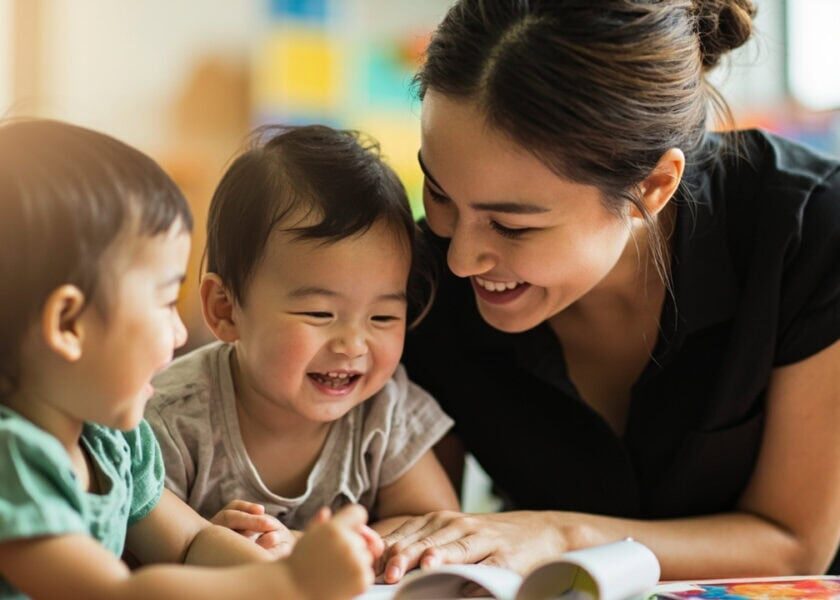
Your eighteen-month-old enters a room she has been in before. The EduNanny caregiver is there—let us call her Mei, because these women deserve names in this story. Mei has been with your daughter before. She remembers that your daughter reaches for comfort when she is tired, that she points to the window when she wants to see outside, that she has recently discovered the joy of stacking blocks and will spend twenty focused minutes building a tower just to watch it fall.
Mei knows these things because Mei has been paying attention. Not because she read a file. Because she has been present, again and again, in the specific and unrepeatable reality of your child’s inner life.
Now watch your daughter. She is not passive. She is not simply waiting for Mei to meet her needs. She is, in her own way, testing. Experimenting. Learning the parameters of this relationship. She reaches for a toy and looks up—checking. Mei responds, and something settles in your daughter’s face. A small relaxation. A micro-expression of recognition: this person is reliable. I can predict what will happen here.
This is trust being born. Not in grand gestures but in thousands of small moments of correspondence between your child’s needs and Mei’s response. The child who learns that her signals produce consistent, caring reactions does not simply feel loved in that moment. She is building something structural. She is constructing the neural pathways that will tell her, for the rest of her life, that relationships can be trusted, that people are responsive, that she herself is capable of connecting.
Your child is not a recipient of care. Your child is a relationship-maker. And in Mei’s arms, your daughter is practicing this skill in a new context, with a new person, in a relationship that will matter to her—not instead of you, but alongside you.
What Secure Attachment at Childcare Actually Looks Like
I want you to hear this carefully because it may not be what you expect.
It does not look like a child who never cries at goodbye. Some children cry; many do not. But the child who is building genuine security in both environments—home and childcare—will show something remarkable. She will use her caregiver as a base of exploration. She will move away from Mei to investigate a toy, then turn back. She will run to her when a sound startles her, then run out again.
She is not confused about who her mother is or which relationship is primary. She is, in the language of attachment research, using multiple figures as sources of comfort and courage.
This is what developmental psychologists call a secure base. At home, you are her secure base. When she is with Mei, Mei becomes a secondary secure base—not a replacement, but an expansion. And children who have this experience of multiple secure bases do not love their parents less. They love more easily. They trust more readily. They enter relationships throughout their lives with a foundational faith in human reliability that is one of the greatest gifts a child can receive.
The question is not whether your child can love more than one person. Your child should love more than one person. This is what health looks like.
The Difference Between Presence and Availability
Not all childcare creates these conditions, and the difference matters enormously.
It comes down to something I want you to hold: the difference between presence and availability.
A caregiver can be physically present in a room with ten children and not truly available to any of them. Availability means something different. It means a quality of attention that notices the child who is about to cry before the tear falls. It means memory—the caregiver who remembers that your son slept better after his afternoon snack, that your daughter has been working on saying “more” for three weeks and will be triumphant when she finally manages it. It means the capacity to regulate one’s own emotional state so that a child’s distress does not trigger alarm but rather calm, competent comfort.
This kind of availability is what EduNanny is building toward. In the ECDA Childminding Pilot, the ratio of caregivers to infants is never higher than three to one. In home-based and community pathways, your child is not one face in a crowd of twenty. Your child is seen.
The caregiver-to-child ratio is not an administrative detail. It is the precondition for the kind of attention that builds genuine trust.
And this trust, once built, does not erase the parent’s role. Research consistently shows that children who have secure attachments outside the home bring that security back to their parent-child relationships. A child who has learned to trust, who has practiced being comforted, who has discovered that separation ends in reunion—this child is better equipped to regulate her emotions when you pick her up, not worse. She is more available for connection because she has been connected all day.
When your daughter runs to you at pickup, laughing, and then turns to wave goodbye to Mei, she is not choosing between two loyalties. She is showing you that she has learned how to love across contexts. She is showing you that her relational world is expanding, healthily and appropriately, and that you are still at its centre.
Addressing What Singapore Parents Really Want to Know
Beyond the science, there are specific concerns that Singapore parents carry. Let me speak to the ones I hear most often.
Is someone really seeing my child?
This is the question beneath the question. Not: is my child supervised? Is my child fed? Is my child changed? But: is my child seen?
The answer is yes—if the conditions are right. Yes, if the caregiver has the time to notice. Yes, if the environment is designed for attention rather than throughput. Yes, if the programme values observation as a core practice rather than a byproduct.
EduNanny’s approach is built around this premise. The caregiver’s role is not merely custodial. It is relational. The training, the ratios, the daily rhythms—all of these are designed to create the space in which a genuine relationship can form.
Will my child still know I’m their parent?
More than that. Your child will bring the security of your relationship into every new connection they form—including the one with their caregiver. And the security they build with their caregiver will flow back into your relationship, not drain from it.
What if something happens and I don’t know about it?
Transparency matters. When you cannot see what is happening during the day, you need trust, and trust requires evidence. EduNanny provides this through clear communication channels, regular updates, and measures that allow you to know in real time that your child is safe and engaged.
These are not substitutes for trust. They are foundations for it. They allow you to release some of the vigilance that exhausts you so that you can be more present in the evenings, more available on weekends, more capable of being the secure base your child needs you to be.
For the everyday questions—the “how was her day” that you ask at 7 PM when you are both tired and she cannot yet answer—there is support. EduNanny’s Thomas AI Chatbot is available to help parents navigate the small anxieties and practical questions of daily childcare.
You are not meant to do this without support. That is the point.
Practical Guidance: What to Look For When Choosing Infant Care
If you are evaluating childcare options in Singapore, here are the things that actually matter when it comes to your child’s emotional development:
- Caregiver-to-child ratio: For infants and toddlers, lower ratios mean more availability. Ask specifically how many children each caregiver is responsible for at one time.
- Consistency of caregiver: Does your child have one primary caregiver, or does the arrangement rotate? Consistent, predictable relationships are what allow trust to form.
- Responsiveness you can observe: During a visit, watch how caregivers respond to children. Do they notice when a child is about to cry? Do they respond with warmth before the distress escalates? This is the availability that builds attachment.
- Communication practices: How does the programme keep parents informed—not just about meals and naps, but about how your child is engaging, what they are discovering, who they are becoming?
- Training and values: Ask about the caregiver’s training in child development and attachment theory. The best facilities invest in their caregivers’ understanding of why responsiveness matters, not just what to do.
- The child’s cues in your presence: After a short settling period, observe your child’s behaviour. Do they explore the environment while still checking in with their caregiver? Do they show signs of comfort rather than persistent distress? These are the markers of a child who is building a secondary secure base.
The Hope Beneath the Anxiety
I want to close by speaking to something I know you carry, because I have heard it in the voices of parents across Singapore—in the hesitant questions and the late-night searches and the conversations that begin with “I know this is probably fine, but—”
You are doing something extraordinary. In a city that moves at Singapore’s speed, in the gap between what you wish you could give and what the modern economy demands, you are making a choice that serves your family. You are trusting someone else to partner with you in the care of your most precious responsibility.
That trust requires something of you. It requires that you believe your child is capable—of growth, of connection, of building relationships that do not diminish your place in their heart but rather expand their capacity for love. It requires that you see your child’s time at childcare not as absence but as presence in a different form. Not your presence, but presence nonetheless. Warm, attentive, developmental presence.
EduNanny is honoured to be that presence for you. To be the secondary secure base. To be the space where your child’s relational world grows. To watch what you cannot see and to tell you about it with care and honesty and the deepest respect for what you are trusting us with.
The child who comes home to you each evening has had a day. She has explored and learned and perhaps struggled and recovered. She has built something with her caregiver—a small but real relationship that will fade in memory but persist in the way she approaches all future relationships. She has practiced being separate from you and returning to you. She has tested the world’s reliability and found it sufficient.
And she has done all of this because you made a choice. A hard choice. A brave choice. The choice to trust that your child is more resilient than your fear allows, and that love is not diminished by being shared.
This is what the first thousand days are really about. Not the absence of struggle. Not the elimination of anxiety. But the building of a human being who is secure enough to explore, connected enough to trust, and flexible enough to love across the many relationships that will shape their life.
You are building that child. And EduNanny is grateful to walk part of that road with you.
If you are exploring infant care or childminding options in Singapore and would like to learn more about how EduNanny supports your child’s development, visit our website or speak with our team today.
We are here to answer your questions with care, honesty, and the respect your family deserves.