The Hidden Curriculum Your Child’s Body Is Teaching Every Day
The Body Is Not Waiting for the Mind to Catch Up
Watch a toddler for five minutes. Any toddler — yours, a stranger’s, the one at the kopitiam table next to yours on a Saturday morning. Watch the way she moves. The way she climbs onto a chair that is slightly too high. The way she reaches for a cup of Milo and then pulls her hand back from the heat. The way she drops a piece of paper over and over, watching it fall, catching it mid-air, dropping it again.
Now ask yourself: what is she doing?
Most parents, given a moment of honesty, would pause. Because the honest answer is — they are not entirely sure. They know she is curious. They know she is busy. They know she is, somehow, learning. But the precise shape of that learning, the machinery beneath the moment, remains invisible. And that invisibility creates something very particular in a parent’s chest. Not panic. Not even anxiety, exactly. More like a low, quiet hum of uncertainty — the sense that something important is happening and they are standing outside a door that has no window.
This is the experience this article explores. Not because it is unique to Singapore parents, but because Singapore parents feel it with particular intensity. You are a generation of parents who read widely, who compare carefully, who worry with almost scholarly precision about your child’s language development, emotional regulation, and school readiness. You can describe, in tender detail, the texture of their personality.
But ask yourself: how much do you know about what is happening in your child’s body right now?
Not their health. Not their growth charts. I mean: what is happening in their sensory world — this week, in this phase of development? How their nervous system is learning to process the feeling of sand between the toes? How the vestibular system — the deep, inner architecture of balance that lives in the inner ear — is being calibrated every time she spins, every time she tilts her head back to look at the ceiling? How proprioception — the body’s internal map of itself — is being drawn, line by line, every time she climbs and reaches and misjudges and adjusts?
If you are like most parents, the answer is: not very much. And that is not a criticism. It is simply the gap this article is here to address.
What Trained Caregivers Notice
Here is something most parents do not know: the body is not just what a child occupies. The body is how a child thinks.
Before a child has language, before a child can reason or abstract, the body is the primary instrument of learning. Every sensation that enters — the texture of a wooden block, the resistance of water, the pull of gravity when a push leads to a fall — is building something. Not just motor skills. Something deeper. Neural architecture. The scaffolding of perception itself.
This is what developmental scientists call sensory integration: the process by which the brain takes in information from the senses — sight, sound, touch, taste, smell — and from movement and position in space, and weaves it into a coherent experience of the world. By the time a child is three, this system has laid more foundations than any classroom ever will. It is the hidden curriculum of early childhood, and almost no one teaches parents how to read it.
Consider what this looks like in practice.
A child who recoils from certain fabrics, refuses to touch glue or playdough, seems distressed by tags in clothing — a parent might see this as fussiness or pickiness. What a trained caregiver sees is a nervous system that is still learning to filter sensation — and a body that needs specific, gentle, calibrated exposure to develop that capacity.
A child who bumps into things, who seems to misjudge the distance to a chair — a parent might worry about coordination. What a trained observer recognizes is a proprioceptive system still under construction — and opportunities to support it through activities that provide resistance, weight-bearing, deep pressure: climbing, pushing, pulling, carrying.
A child who never stops moving, who spins endlessly, who seems driven to hang upside down from the sofa — not hyperactivity. Not a need for discipline. A vestibular system seeking the input it needs to calibrate balance and spatial awareness.
These are not problems to solve. These are windows to understand. And the difference between a child who is simply moving and a child who is building their physical intelligence often comes down to whether someone is watching closely enough to know the difference.
Quality sensory-motor development requires someone who knows what they are looking at. Not someone who supervises play. Someone who understands that when a child spends forty-five minutes pouring water from one container to another, they are not just occupying themselves. They are developing visual tracking skills needed for reading. Building hand-eye coordination needed for writing. Learning cause and effect, patience, and concentration. In the most literal sense, building their brain.
A trained caregiver reads the body like a language. They notice when a child who usually seeks movement is unusually still — and they wonder why. They notice when a child who typically avoids textured surfaces is now tentatively touching wet sand — and they recognize this as progress worth protecting. They notice when a toddler is falling more than usual and consider whether a growth spurt has changed their center of gravity.
They design environments that challenge and support development in equal measure: enough risk to promote growth, enough safety to allow exploration, enough structure to create learning without killing the joy.
The Singapore Reality: Why This Matters More Here
In Singapore, parents face a particular version of this challenge. You are making decisions about childcare under conditions of significant pressure — financial, social, professional. You want the best for your child and you want to be present, and often these two wants pull in different directions.
Many parents tell me they feel guilty about returning to work. They worry that time in childcare is somehow time lost. They imagine their child playing passively, being entertained, marking time until Mum or Dad comes home.
What this article offers is a different way to understand that equation.
When your child is in the care of someone who understands physical development — who knows sensory integration, who can read motor milestones, who designs environments with intention — your child is not being merely kept. Your child is being built.
Those hours are not empty. They are foundational. The climbing frame is not just a climbing frame. The sand pit is not just a sand pit. The water table is not just a water table. They are classrooms without walls, and the teacher is someone who speaks the body’s language fluently.
In Singapore’s early childhood landscape, this matters especially. Children here often grow up in high-rise living, in air-conditioned environments, with structured schedules and screen time that competes with sensory exploration. The opportunities for the kind of free, messy, physically demanding play that builds vestibular and proprioceptive systems are not always naturally available. Quality infant care needs to compensate for this — not by recreating the kampong, but by designing intentional environments where a child’s body can do its essential work.
What Quality Childminding Actually Looks Like
When you visit an infant or childminding environment, here is what you are really looking for — even if you do not yet have the language to know it:
Gross Motor Development
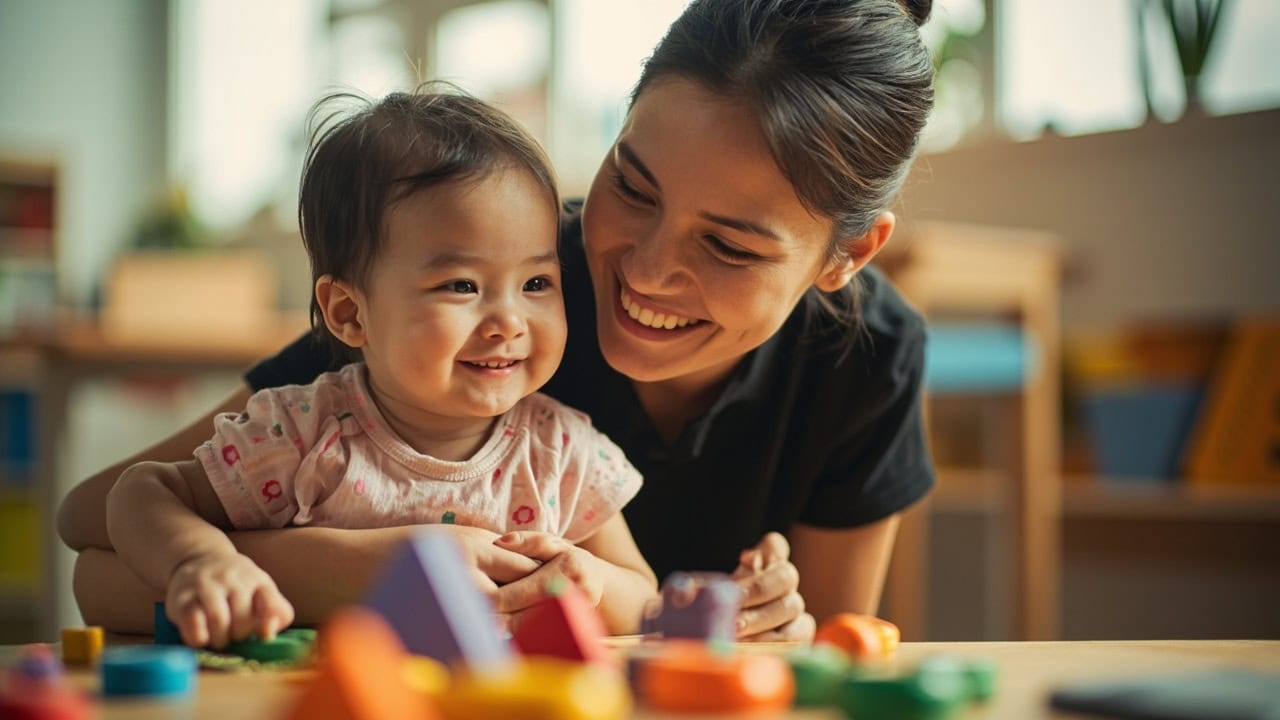
Look for children who are moving freely: crawling through tunnels, climbing on low structures, running in safe outdoor spaces. Gross motor development — walking, running, jumping, climbing, balancing — is not separate from cognitive development. It is part of it.
Each of these movements challenges the vestibular system, builds core strength, and teaches a child about their body in space. A child who cannot run and climb may struggle later with sitting still in class. A child who has built strong gross motor foundations tends to have better attention and fewer behavior challenges.
Fine Motor Exploration
Watch children pouring, scooping, squeezing, threading, and manipulating objects. These activities are building the hand strength, finger isolation, and bilateral coordination that will eventually allow a child to hold a pencil correctly, use scissors, button their own shirt, and feed themselves with growing independence.
Fine motor skills are not just about dexterity. They are about the brain learning to plan and sequence movements — a skill that underpins almost every academic task.
Sensory-Rich Environments
A quality environment offers texture, temperature variation, sound variety, and movement opportunities. Sand, water, playdough, fabric, natural materials. These are not luxuries. They are the raw materials of sensory integration.
A child who plays in sand is learning to modulate tactile input. A child who pours water is learning about volume, resistance, and gravity. A child who climbs is calibrating their vestibular system. Every surface, every material, every opportunity to touch, taste, smell, and move is educational — whether or not it looks like school.
Observation Without Interruption
Perhaps most importantly, watch the caregivers. Do they hover and direct? Or do they observe, wait, and intervene only when needed?
A trained caregiver knows that a child’s concentration is sacred. When a child is deeply engaged in an activity — even if that activity looks like “just pouring water” — interrupting them breaks the building process. Good caregivers protect those states of flow. They know when to step back and let a child’s nervous system do its work.
EduNanny: Where Physical Development Happens With Intention
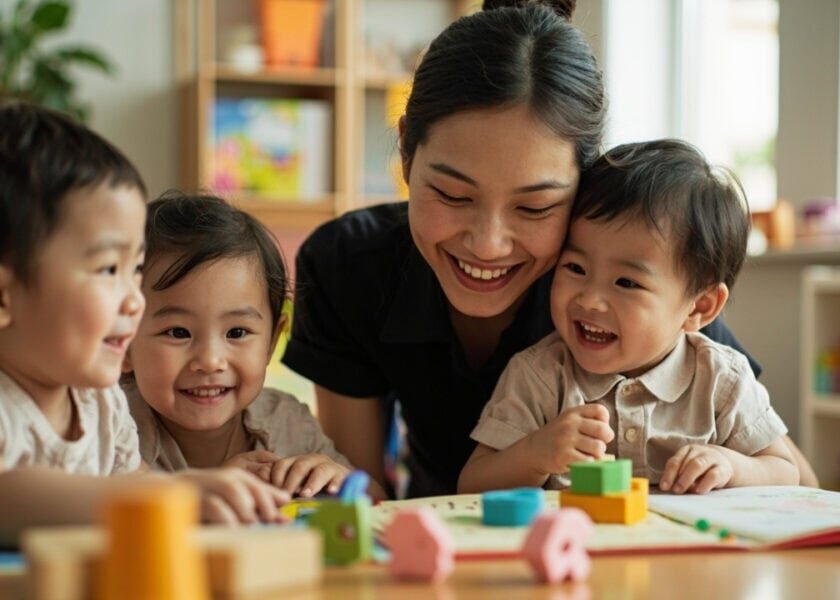
This is what EduNanny by BUTLER understands. We are part of the ECDA Childminding Pilot — a structured, supported initiative designed to bring quality infant and childminding into reach for families across Singapore. Our approach is built on a simple conviction: every child deserves to have their body read, understood, and supported in the most important work it will ever do.
We offer both home-based and community or centre-based pathways, because we know that every family has different needs and different rhythms. Some children thrive in the familiarity of their own home. Others benefit from the social richness of a group setting. We work with you to find the right fit.
We maintain ratios of up to one to three infants in our care, which means your child is not a number in a crowd. They are an individual, with individual needs, individual rhythms, individual things their body is trying to build. At this ratio, caregivers can truly observe. They can notice when your child’s climbing patterns change. They can see when your toddler is seeking more sensory input or when they need more calm. They can protect your child’s concentration and support their development in ways that larger group settings simply cannot.
Our care runs Monday through Friday, in blocks that work for working families. The pilot structure keeps costs accessible, and for eligible families, CDA and Baby Bonus funds can be used, so the financial logistics need not be a barrier to quality.
And because we know that trust is built on transparency, we maintain clear communication with families — with clear visibility into how your child’s day unfolds, for your peace of mind.
Common Questions From Singapore Parents
“How do I know my child is really developing, not just being babysat?”
This is the right question to ask. You know by what you can observe over time. Watch your child after a few months in quality care. Are they more confident in their movements? Do they seem more comfortable with different textures and sensations? Are they attempting new physical challenges they would not have tried before?
These are signs that their body is learning — and that someone is helping it learn.
“I feel guilty about returning to work. Is childcare really as good as being home with me?”
Here is the truth that may help: your child does not need you to be their only teacher. They need you to be their parent — their source of attachment, their emotional home base, their secure foundation.
They also need a rich environment where their body can develop, where trained adults are watching and supporting their physical growth. The best outcome for your child is not necessarily more hours with you. It is more hours in an environment that can meet their developmental needs in ways you, working full-time, cannot. Good childcare does not replace you. It complements you.
“What if my child has sensory issues I do not know about?”
This is one of the most important reasons to choose trained caregivers over casual supervision. Trained caregivers learn to notice the signs of sensory processing differences early — before they become problems, before they affect school readiness, before they create unnecessary struggles.
A child who is hypersensitive to touch but whose parents do not know this may be labeled difficult or uncooperative. The same child in quality care receives the understanding and gentle sensory support they need. Early identification and appropriate support can make a profound difference.
“My child seems to just play all day. Is that really enough?”
Every moment of play is building. But you are right to ask the question, because not all play is equally valuable. The key distinction is intentional environment design.
When a caregiver has deliberately set up sensory-rich experiences, when they understand what each activity is building neurologically, when they protect concentration and support emerging challenges — then yes, play is enough. It is, in fact, everything. But when children are simply entertained, left to their own devices without observation or intention, play becomes passive.
Ask potential caregivers what your child will be doing and why. Listen for answers that reveal understanding, not just activity.
How to Evaluate Any Childcare Option
When you are making this decision, here are the questions that matter most — the ones that go beyond safety checklists and into the territory of developmental quality:
- Ask about observation. How do caregivers track your child’s physical development? Do they notice patterns over time? Ask them to describe what your child might be building when they play with water, sand, or climbing structures. Answers that reveal understanding are good signs.
- Ask about ratios. How many infants per caregiver? At EduNanny, we maintain ratios of up to one to three infants, because this is the ratio that allows genuine observation, genuine responsiveness, and genuine support.
- Observe the environment. Is there sensory-rich material available? Textures to touch, movement opportunities, space to climb and explore? A quality environment looks a little messy, a little tactile, a little alive.
- Watch the caregivers. Are they on the floor, at the child’s level, watching with attention? Or are they distant, distracted, directive? The quality of caregiver attention is the quality of care.
- Ask about training. What do caregivers understand about sensory integration, motor milestones, and the physical foundations of learning? It is not about credentials alone — it is about whether the people caring for your child have been taught to see what is happening in their body.
- Ask about communication. How will you know what your child did today? Look for genuine transparency: updates that reveal developmental observation, not just schedules and meals.
The First Thousand Days Are Not Just a Window
Let me come back to that parent I asked you to imagine at the beginning. The one watching a toddler at the kopitiam. The one who sees the climbing and the reaching and the dropping and does not quite know what it means.
Here is what I want her to know, and what I want every parent reading this to understand: you do not need to see every moment of your child’s physical development to trust that it is happening. You do not need to become a developmental specialist to give your child the best start. What you need is to find people who are that specialist, and to trust that they are doing that work with care, with intention, with love.
That is what EduNanny offers. Not just a place where your child is looked after — a place where your child’s body is read, understood, and supported in the most important work it will ever do. The work of becoming.
The first thousand days of your child’s life are not just a window. They are a foundation. And foundations, as any builder will tell you, are not visible when the building is finished. But you know they are there. You know they matter. And you know, if you chose them wisely, they will hold everything that comes after.
Your child is building something extraordinary in their body right now. Something that will outlast every toy and every lesson and every milestone you can name. The coordination to write. The balance to ride a bike. The body awareness to sit still and pay attention. The sensory foundations for emotional regulation. The physical confidence to try, to fail, to try again.
These are not separate from academic success. They are the scaffolding that makes it possible.
And when you trust someone to care for that process — to protect it, to challenge it, to celebrate it — you are not stepping away from your child’s life. You are stepping into partnership with the people who will help shape it.
That is what childminding can be. That is what it should be. And that is what EduNanny is, every single day — the quiet, invisible, profoundly important work of caring for the whole child.
The body is learning. Let us make sure it is learning well.
If you are a parent in Singapore researching infant care or childminding, contact us to learn about our ECDA-supported childminding pathways, our ratios, our approach, and how we support the sensory-motor foundations that matter most. You can also learn more about EduNanny and our commitment to quality, developmental childcare.