Beyond Academic Prep: Emotional Skills for Your Child’s Primary 1
The Skills That Actually Matter
Every Primary 1 teacher will tell you the same thing when you ask what makes the difference in those first chaotic weeks: it is not the children who arrive knowing the most. It is the children who can recover when things go wrong.
A child who has learned, over time, that a scraped knee will heal, that a mistake is not the end of the world, that an unfamiliar situation can be navigated rather than fled from, that an adult she does not know can still be trusted to help her. This is the child who settles. This is the child who learns.
Emotional Regulation: The Foundation
Not the ability to suppress feelings, but the capacity to experience them fully and still find a way forward. A child who can notice that she is frustrated, who has learned through consistent, calm guidance that frustration is manageable and that help is available, walks into Primary 1 with something invaluable. She carries the belief that she can cope.
Social Confidence: The Willingness to Connect
This sounds simple but is actually one of the most complex skills a young child develops. It is not extroversion. It is the willingness to approach other children, to wait for a turn, to negotiate, to handle rejection without collapsing, to find joy in collaboration. These are not personality traits. They are learned capacities, built in the thousands of small social moments that happen when children play together under thoughtful supervision.
Adaptive Flexibility: Being Ready for Change
The child who can move from activity to activity without falling apart. The child who can manage a change in routine, who can be in a new space with new people and still feel like herself. This capacity for flexibility is what allows learning to actually happen, because school is nothing if not a series of transitions.
The Distinction That Changes Everything
Most parents intuitively sense but rarely see articulated clearly: the academic preparation that dominates the school readiness conversation in Singapore is not wrong, but it is insufficient. It addresses the surface concern while missing the deeper need.
You have seen the worksheets. The pre-primary programmes. The drilling. They may teach a child to recognize letters or perform simple sums. But they do not build emotional regulation. They do not teach a child how to recover from frustration, how to navigate a conflict over a toy, how to manage the disappointment of not being chosen first.
These skills require something worksheets cannot provide: live human interaction, repeated over time, in an environment designed for development.
Academic Preparation vs Developmental Readiness
Academic preparation is about content. Developmental readiness is about capacity. A child with capacity can acquire content. A child filled with content but lacking capacity will struggle when the content becomes difficult, when the environment becomes demanding, when the social world of school asks more than rote knowledge can answer.
The research on this is consistent. Children who enter school with strong social-emotional foundations outperform peers who arrive academically advanced but emotionally fragile. Not because academics are unimportant, but because the emotionally regulated child is the one who can actually focus, persist, ask questions, and absorb what is being taught. The foundation enables the learning.
How Quality Childcare Builds Real School Readiness
When childcare is designed with development in mind, it becomes a deliberate system for building the capacities your child needs. Here is what that looks like in practice.
Daily Rhythm: The Scaffold That Holds
Children thrive on predictability. Not because they need to be controlled, but because a consistent rhythm allows their nervous systems to settle. When a child knows, without being told, that circle time follows snack time follows outdoor play, something in her body relaxes. She does not need to spend energy anticipating what comes next. She can instead spend that energy on the activity in front of her, on the social interactions happening around her, on the learning that requires genuine attention.
In a quality childcare environment, the rhythm is not a schedule imposed for adult convenience. It is a scaffold that holds the child while she builds the capacity to hold herself. Over months and years, this consistency becomes internal. The child learns to regulate her own expectations, to move through her day with a sense of continuity and safety.
Peer Interaction: The Crucible of Social Confidence
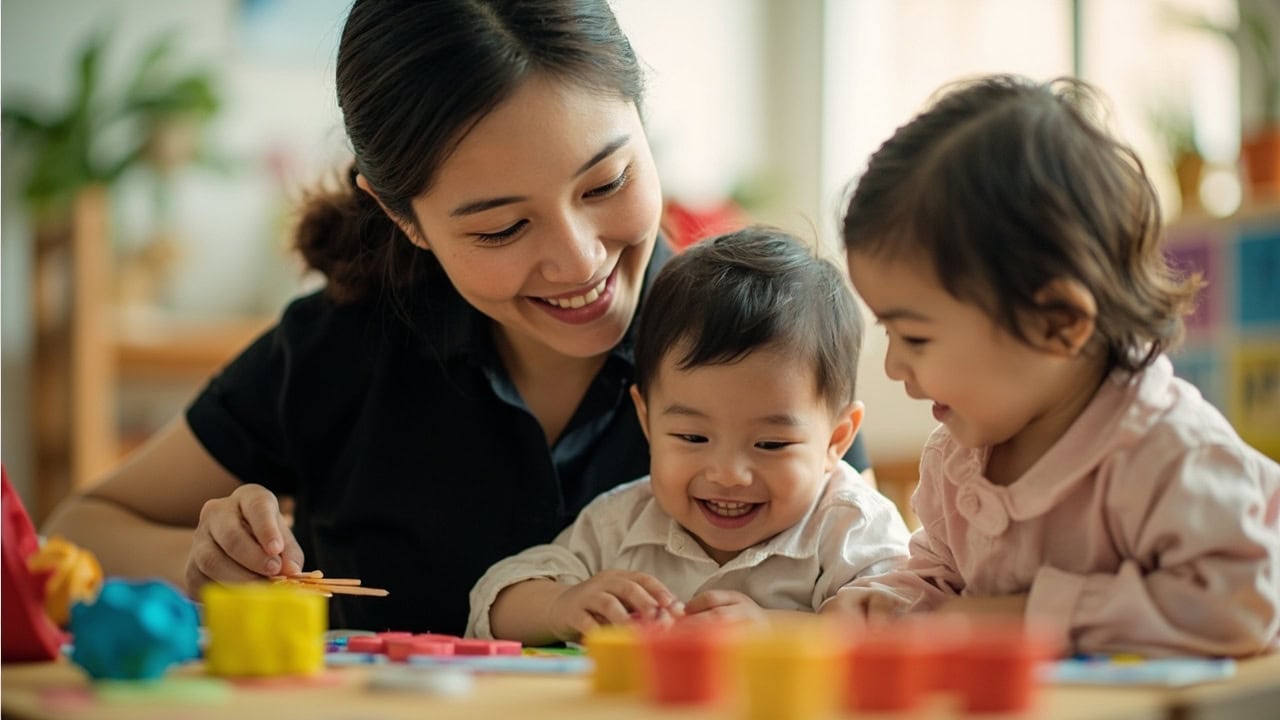
Play with other children is not mere entertainment. It is a deliberate learning system, perhaps the most powerful one available to young children. When two children negotiate over a block structure, when a group decides together what game to play, when a child experiences the sting of being excluded and learns that it is survivable, these are not trivial moments. They are the crucible in which social confidence is forged.
In a quality setting, this peer interaction is thoughtfully facilitated. Adults observe, scaffold, and intervene with just enough support to keep the play productive without taking it over. A child learns to share because she has been in environments where sharing was practiced, guided, and gradually expected. She learns to manage conflict because she has experienced conflict in a safe context with adults who helped her make sense of it.
Responsive Caregiving: Being Seen Before Words
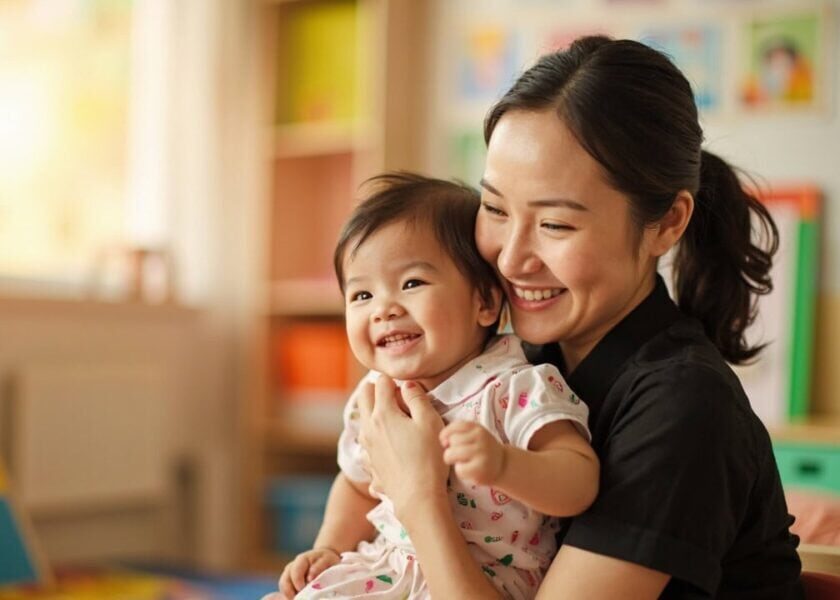
This means an adult who notices what a child needs before the child knows how to articulate it. A caregiver who recognizes when a child is approaching overwhelm and gently intervenes with distraction, comfort, or redirection. Who celebrates effort rather than outcome. Who models emotional language and helps the child name what she is feeling.
When an adult is responsible for only a handful of children, she can truly see them. She can notice the child who is about to have a meltdown and intervene before it happens. She can comfort the child who has fallen and needs human presence more than any other intervention. She can engage in the kind of play that builds language and social skills, because she has the mental space to do so.
Managing Transitions and Separations
Every parent knows the scene. The child clinging at the gate. The tearful goodbye. The fear that the child will never settle, that she will spend the whole day anxious and unreachable.
What most parents do not realize is that separation anxiety is not a sign of failure. It is a sign of healthy attachment. A child who is deeply bonded to her parents experiences their absence as significant, because they matter.
In quality childcare, separation is a learned skill. The first weeks involve a gradual process of building trust, not just with the child but with the parent. The caregiver shows the parent what the day looks like, invites her to stay initially, then shortens the goodbye, then extends the separation in manageable increments. The child learns, through repetition and consistency, that goodbye is temporary. That the caregiver is a safe person. That she can be comforted by someone other than her parents and still love her parents completely.
This is the capacity that serves her in Primary 1. Every morning at the school gate is a small separation. Every transition between subjects, between classrooms, between activities is a tiny disruption that requires flexibility. A child who has learned to manage separation and transition carries that skill everywhere.
What to Look for in Quality Infant Care
When you are evaluating childcare options in Singapore, here are the markers of an environment that is genuinely building school readiness.
- Observe the rhythm. Does the day have a predictable flow that allows children to anticipate what comes next? Predictability builds internal regulation.
- Watch how caregivers interact with children. Are they truly present or distracted? Do they name emotions? Do they intervene with warmth rather than control?
- Notice peer interaction. Is it facilitated by adults who understand what social learning is happening? Adults should scaffold, not take over.
- Ask about transitions. How does the programme handle hellos and goodbyes? Is there a gradual process for building trust?
- Check ratios. Smaller numbers of children per adult means more responsive, individualized care.
- Look for observation. Does the programme track developmental progress and share it with you? Care should be intentional, not just supervisory.
Common Questions from Parents
Will my child be ready if we do not do academic prep?
A child with strong emotional regulation, social confidence, and adaptive flexibility enters Primary 1 with the capacity to learn anything. She can focus because she is regulated. She can engage because she trusts adults and peers. She can persist because she has learned that effort leads to progress. Academic knowledge comes more easily to a child who has these foundations.
My child cries every time I leave. Is something wrong?
No. Separation anxiety is a sign of healthy attachment, not a failure to thrive. The question is whether your childcare environment is helping your child learn that separations end, that caregivers are trustworthy, and that the world without you is still safe. This takes time, consistency, and skilled guidance. A quality caregiver will work with you to make the transition gradual and reassuring.
EduNanny’s Approach
EduNanny by BUTLER operates within the ECDA Childminding Pilot, reflecting a belief that childcare is not a monolithic service. Families are different. Children thrive in different environments.
The ratios of up to one to three infants are not bureaucratic requirements. They are structural commitments to responsiveness. When an adult is responsible for only a handful of children, she can truly see them. She can notice the child who is about to have a meltdown and intervene before it happens. She can comfort the child who has fallen and needs human presence. She can engage in the kind of play that builds language and social skills, because she has the mental space to do so.
EduNanny approaches childcare as a developmental system, not a convenience service. The caregivers are trained to observe, to document, to understand what each child is building in any given week. They notice when a child moves from parallel play to collaborative play, when a child’s language explodes, when a child who once struggled with transitions begins to manage them with growing ease. This observation is not administrative. It is how the care stays responsive to what children actually need.
The communication and transparency measures, including CCTV where deployed, reflect a commitment to trust. Parents should not have to wonder what is happening in their child’s day. They should be able to see it, to hear about it, to feel like partners in their child’s development rather than passive consumers of a service.
The Child You Are Building
When you imagine your child walking through the gates of Primary 1, I want you to imagine something different. Not the fear, but what lies on the other side of it.
A child who walks in with her shoulders relaxed, because she has learned that new places can be navigated rather than dreaded. A child who looks for other children to play with, because she has learned that other children are sources of joy, not threat. A child who can sit with the discomfort of not knowing something yet, because she has been supported through frustration before and knows she can survive it. A child who trusts adults, because she has been in the care of responsive, warm, consistent caregivers who showed her that the world has safe people in it.
This is what school readiness actually looks like. Not a child who knows more. A child who can be more. Who can learn, because she is regulated enough to learn. Who can connect, because she has confidence in her own social capacity. Who can adapt, because she has been in environments that prepared her for change.
The skills your child needs for Primary 1 and beyond cannot be found in a worksheet or a drilling programme. They are built in the daily rhythm of a quality childcare environment, in the peer interactions carefully facilitated by trained adults, in the responsive caregiving that shows a child she is seen and understood, in the gradual mastery of separation and transition that builds resilience over time.
You do not have to build everything alone. You can be part of a community of care, with trained caregivers and thoughtful environments and a national framework that takes childcare seriously as the foundation it is.
Your child will walk into Primary 1 not because she was filled with facts, but because she was prepared. She was built, day by day, for the life ahead of her.
That is what school readiness truly means.
If you are researching infant care or childminding in Singapore and want to understand how quality care builds the foundations your child needs, we invite you to connect with us to learn more about what EduNanny offers.