Releasing Grandparents to Love Singapore’s New Family Caregiving Model
The Cultural Reality of Multigenerational Caregiving in Singapore
In Singapore, grandparent childcare is not just a family arrangement. It is a cultural expectation, a social norm so deeply woven into our understanding of family that questioning it can feel like questioning love itself.
When grandparents step in to care for grandchildren, they fulfill a role that has been honored across generations. The wisdom passed down. The bond between young and old. The practical reality that childcare in Singapore is expensive and that many families simply cannot survive without this support.
All of this is real. All of this matters.
But here is what we do not talk about enough: this system, for all its love, comes with hidden costs that accumulate over time.
Grandparents who entered retirement expecting leisure, travel, perhaps a slower pace, find themselves back in the trenches of parenting. Not the joyful parts, necessarily, but the grinding, repetitive, energy-intensive work of caring for a toddler all day.
The physical exhaustion is real. The mental load is real. And something else happens too—something quieter and more insidious. Grandparents begin to define their relationship with their grandchildren through the lens of obligation rather than presence. They become the ones who must manage nap schedules and picky eating and the thousand small negotiations of early childhood. Somewhere along the way, the grandparent-grandchild bond gets buried under the weight of caregiving logistics.
What Parents Experience
You come home from work caught between gratitude and guilt in a way that has no good resolution. You want to give your parents a break, but you also need to get dinner on the table, finish the report due tomorrow, and somehow find a moment to actually be with your child rather than simply managing their care.
You watch your parents grow older, more tired, and you wonder if you are asking too much. You watch your child and wonder if they are getting what they need. The tension does not resolve. It just lives there, in the background of your family life, shaping conversations you do not have and decisions you keep postponing.
What Children Experience
Your child experiences love—enormous love from grandparents who adore them. But they also experience inconsistency. They experience two or three different approaches to feeding, to sleeping, to discipline, to play.
They experience the subtle stress that flows between stressed grandparents and guilty parents. They experience a developmental rhythm that shifts depending on who is in charge, because each caregiver brings their own philosophy, their own habits, their own way of interpreting what a child needs.
This is not catastrophic. Children are resilient, and love goes a long way. But it is not nothing either. The early years matter profoundly, and the quality of care in those years shapes how a child learns, how they form relationships, and how their brain develops the architecture that will serve them for their entire life.
The Reframe That Changes Everything
So where does this leave you? Caught between honoring what your family has given you and trusting what you know in your gut is true. Caught between the cultural expectation that grandparents will care for grandchildren and the quiet knowledge that this arrangement is not serving anyone as well as it could.
I want to offer you a reframe. Not a rejection of what your parents have done, but an expansion of what is possible for your family.
Professional childcare is not the replacement for grandparent involvement. It is the infrastructure that protects and preserves it.
Think about what happens when you remove the obligation of full-time caregiving from your parents. They are no longer required to be the primary source of developmental stimulation, the daily manager of meals and naps and tantrums.
Instead, they become what they were always meant to be: grandparents.
They show up on Saturday morning and they are rested. They are present. They have energy to play, to read, to take your child to the park without checking their watch. The time they spend with your child becomes quality time rather than obligation time.
The bond deepens because it is no longer buried under the exhaustion of caregiving. Grandparent and grandchild get to have the relationship that grandparents are meant to have with the children they love: joyful, relaxed, focused on connection rather than logistics.
Love and caregiving are not the same thing. Sometimes the best way to honor what your parents want for your child is to make sure they never lose the relationship they have with them.
When you build the infrastructure for professional care, you are not pushing your parents out. You are giving them a different role—one they can sustain for twenty years rather than burn out in two.
Navigating the Conversation with Your Parents
But I know what you are thinking. What about your parents’ feelings? How do you even begin to have this conversation?
The anxiety is real. You worry that they will feel rejected, that they will think you do not trust them, that you are saying their care was not good enough. These fears are not small, and they deserve to be taken seriously.
Here is the truth: your parents have already given you everything they have. They raised you. They gave up their own time and their own dreams to build a life for your family.
And somewhere, beneath the exhaustion and the obligation, many grandparents are waiting for permission to step back. They are waiting for someone to tell them it is okay. They are waiting for a graceful exit that does not feel like failure.
When you approach this conversation, you are not telling your parents they failed. You are telling them they succeeded. You are telling them that because of everything they gave you, you now have the capacity to build something sustainable.
“Mum, Dad, I want you to be in my child’s life for the next twenty years. I need you to have the energy for that. I need you to be grandparents who show up with joy, not exhaustion. Let me figure out the childcare piece so that you can show up as family members who love my child, not as caregivers who are managing my child’s care.”
“I want my child to grow up knowing you as the people who take them to the zoo and teach them to cook and show them what it means to be loved by grandparents. I do not want you to be so tired from the daily work that you miss those years.”
“This is not about replacing what you have done. This is about making sure we all have the relationship with my child that we are meant to have.”
These are not easy conversations. But they are honest ones. And when families find their way to the other side of them, what emerges is not estrangement but a new configuration that serves everyone better.
Grandparent Love and Professional Care: Different Gifts, Both Needed
Let me be clear about something. This is not about saying that grandparent love is somehow deficient or that family care is inadequate.
Grandparents bring irreplaceable gifts to a child’s life: history, unconditional love, a sense of belonging to something larger than themselves, the knowledge that they are part of a lineage that stretches backward and forward through time. No professional caregiver can replicate this. It would be foolish to try.
But professional care brings something different and equally important.
It brings developmental intentionality. It brings the understanding that a child’s brain is developing at a pace that will never be matched again, that the early years are a window of extraordinary possibility, that the way we respond to a child, the language we use, the stimulation we provide, the security we cultivate—all of these things are shaping the person that child will become.
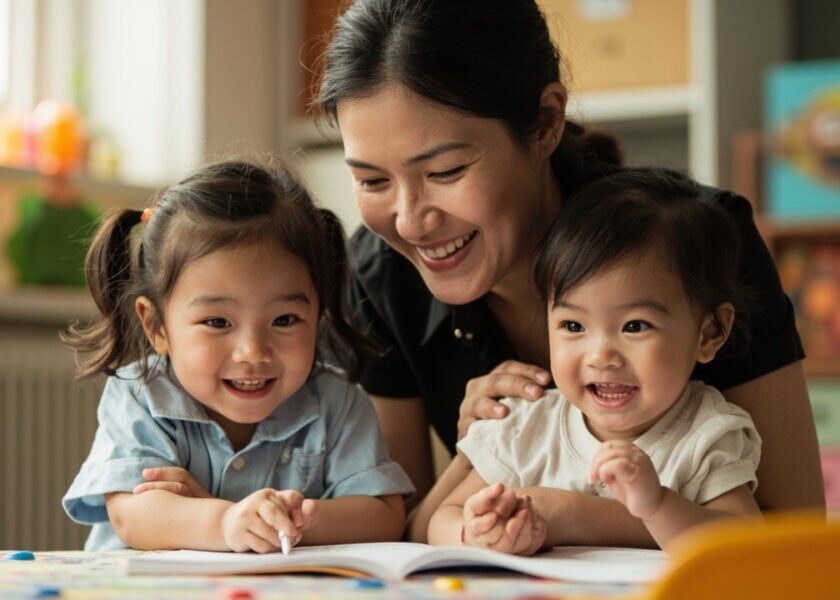
Professional caregivers are trained to observe, to understand developmental milestones, to create environments that support learning through play, to recognize when a child needs support and when they need space.
This is not a criticism of grandparents. It is simply a different role, with different training and different purposes.
The Ecosystem Your Family Can Build
The unconditional love that grandparents offer and the structured, intentional care that professional caregivers provide—these are not competing forces. They are complementary pieces of a whole.
When professional childcare is in place, the family becomes an ecosystem rather than a hierarchy:
- Parents lead. You remain the primary decision-makers in your child’s life.
- Professionals support. Trained caregivers provide consistent, developmentally appropriate care.
- Grandparents love. They show up as rested, present family members who can give fully of themselves because they are not depleted by daily caregiving.
- Children thrive. They move through these relationships with the security of knowing they are held by many hands, each offering something different and valuable.
What Quality Childminding Actually Looks Like
If you are considering professional childcare, it helps to know what you are looking for. Quality childminding is not just supervision—it is active, intentional care that supports your child’s development.
Here are the elements that matter most:
- Small ratios. Fewer children per caregiver means more individual attention, more responsive interaction, more genuine connection. Your child is not just being watched; they are being seen.
- Developmental intentionality. Quality caregivers understand how children learn and grow. They create environments and experiences that support language development, motor skills, social-emotional learning, and cognitive exploration.
- Consistency and routine. Children thrive when they know what to expect. Predictable rhythms for feeding, sleeping, and play create security.
- Warm, responsive interaction. The quality of caregiver-child interaction matters more than the setting. Look for caregivers who are genuinely present, who respond to children with attunement and warmth.
- Home-like environment. Young children learn best in settings that feel domestic and intimate rather than institutional. Smaller, home-based settings often support this naturally.
- Communication with families. You should know what is happening in your child’s day. Regular updates, transparent communication, and genuine partnership between caregivers and parents.
Professional Care in Singapore
In Singapore, options for professional childcare include center-based care and home-based childminding. Each has its place, and the right choice depends on your family’s needs.
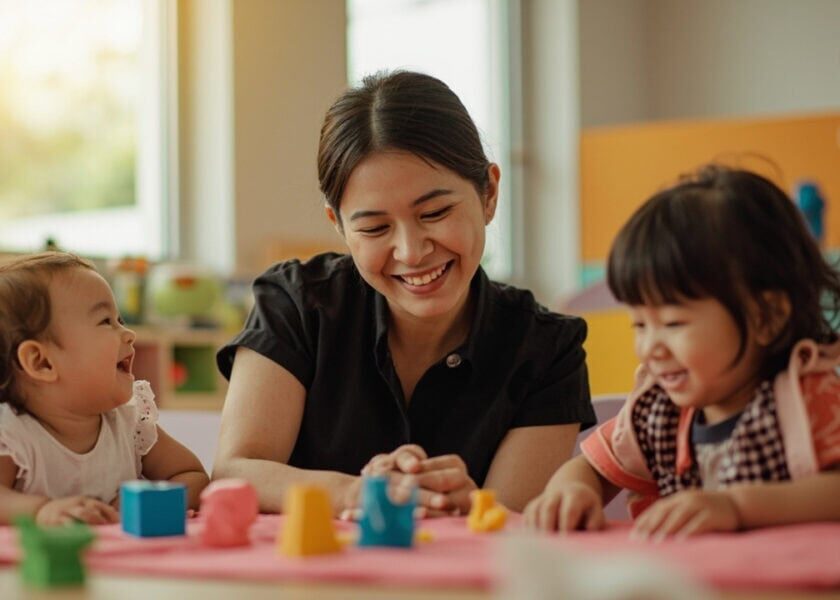
Home-based childminding, like what EduNanny offers, provides the intimacy and individual attention that infants and toddlers need, while still being part of a supported, professional framework. The smaller ratios allow for genuine relationship-building between caregiver and child. The home-like setting reduces the transition stress that some children experience with larger centers.
Government schemes like the Child Development Account (CDA) and Baby Bonus provide meaningful subsidies for eligible families. When you consider the alternative—grandparent burnout, reduced work capacity due to stress, the long-term cost of developmental gaps—quality professional childcare often represents an investment that pays for itself.
The EduNanny Approach: Building Your Family’s Care Ecosystem
At EduNanny, this is the work we have dedicated ourselves to. We are part of the ECDA Childminding Pilot, and we believe deeply in what home-based and community-based care can offer Singapore families.
We know that children thrive when they are cared for in environments that feel like home, with small ratios that allow for genuine attention, with caregivers who are trained and supported and compensated fairly for the work they do.
We know that families need flexibility—that arrangements need to work alongside the realities of Singapore life. We understand that cost is a real consideration and that tools like the CDA and Baby Bonus should make this accessible rather than out of reach.
We know that parents need to trust the people caring for their children. This is why transparency matters to us, why communication with families is not an afterthought but a foundation of what we do.
What We Actually Offer
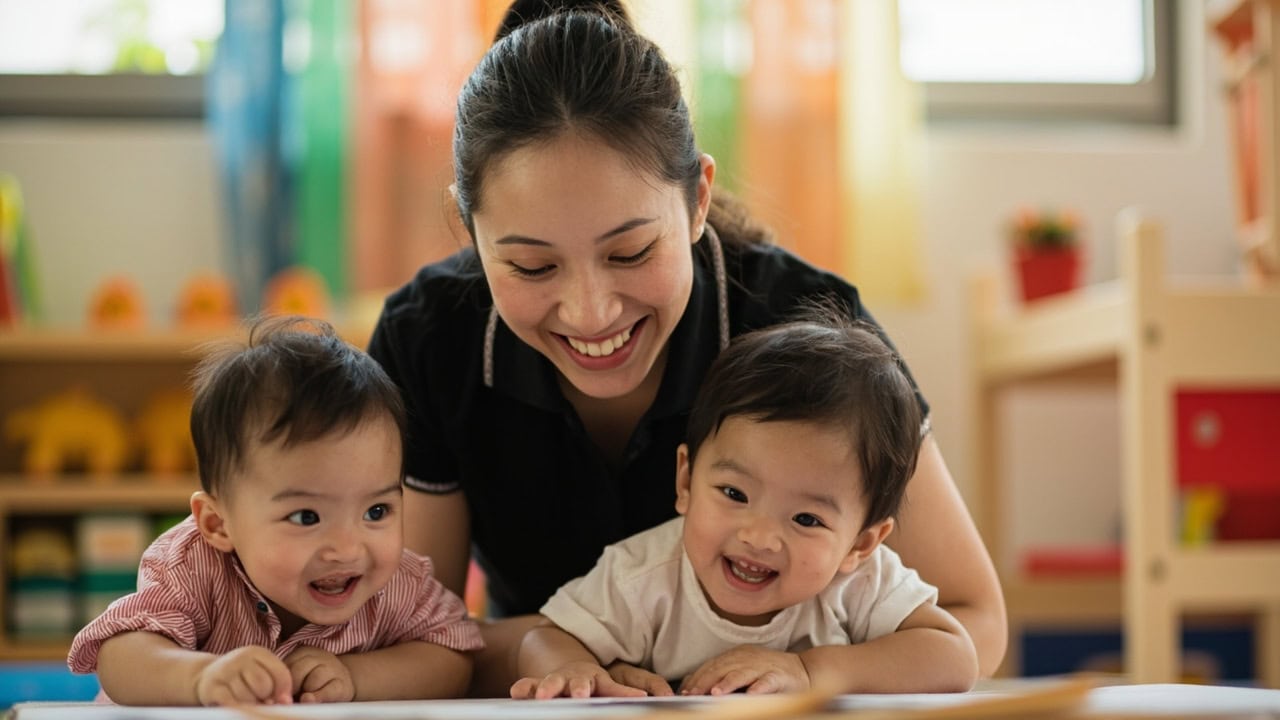
We offer home-based childminding for infants and toddlers in Singapore. Our caregivers are trained, supported, and part of a professional framework. Our ratios are small—your child receives individual attention and genuine care, not just supervision.
We communicate regularly with families. You know what your child’s day looked like. You are a partner, not just a customer.
We are flexible where families need flexibility. We understand that Singapore life involves odd hours, last-minute changes, and the genuine complexity of raising children while also working, aging, and navigating multigenerational family dynamics.
What We Stand For
Beyond logistics, beyond structures and ratios and training, what drives us is a simple conviction: Singapore families deserve care options that honor their complexity.
You should not have to choose between family and professional care as if they are opposing forces. You should be able to build the ecosystem that works for your family—and that ecosystem should include your parents, showing up as grandparents, not burnt-out caregivers.
When we talk about EduNanny, we are talking about a partner who understands that the best childcare decision is the one that makes your parents smile again. We are talking about care that frees up your evenings for actual family time rather than catching up on the moments you missed. We are talking about a system that lets grandparents grandparent, that lets parents parent, that lets children develop in an environment that was designed for them.
Practical Steps: How to Move Forward
If this article has resonated with you, here is where to begin:
- Get honest with yourself. Name the tension you have been carrying. Acknowledge that you want something different without judging yourself for wanting it. The tension is not a sign that you are ungrateful—it is a sign that you are paying attention.
- Start the conversation with your parents. Not about childcare options first, but about what you want for your child—and for them. Use the language suggested above. Frame it as a gift you want to give them, not a change you are imposing on them.
- Research your options. Look into home-based childminding, infant care centers, and other professional care options. Visit settings, ask questions, trust your instincts. You know what feels right for your family.
- Explore financial support. Check your eligibility for CDA and Baby Bonus. Ask your employer about childcare support. Factor in the full cost of the alternative—grandparent burnout, reduced work capacity, developmental trade-offs.
- Build gradually. You do not have to make a dramatic shift overnight. Many families start with part-time professional care and increase as they see the benefits. The goal is a sustainable system, not an overnight transformation.
- Give it time. New arrangements take adjustment. Your child will adapt. Your parents will adapt. The ecosystem will take shape over months, not weeks.
The Families Who Get This Right
The families I have seen navigate this tension most successfully are not the ones who figured out how to do everything alone. They are the ones who were honest about what they needed, who trusted their parents enough to give them a different role, who built systems rather than just hoping for the best.
They are families who understood that love is not diminished by structure. That asking for help is not the same as failing. That the best thing you can do for your child is to create an environment where everyone who loves them has the capacity to show up fully.
Your parents have given you the foundation to build this. They raised you. They made sacrifices so that you could be here, in this city, with these opportunities, raising your child with ambitions they may never have imagined for themselves.
The way you honor that gift is not by keeping everything exactly as it was. The way you honor that gift is by building something sustainable—something that will sustain your parents as they age and your child as they grow and you as you navigate the impossible, beautiful work of raising a human being.
A Final Thought
The tension you feel is not a sign that something is wrong with your family. It is a sign that you are paying attention. That you want something better—not instead of what you have, but in addition to it. That you are willing to do the hard, honest work of building something sustainable rather than simply enduring what was handed to you.
That is the kind of parent your child needs. And that is the kind of family we want to support.
Welcome to a different way of thinking about what family care can look like. Welcome to the ecosystem.
If you are ready to explore what a grandparent-childcare partnership could look like for your family, we invite you to get in touch with EduNanny Singapore to learn more about our home-based childminding services.
To learn more about who we are and what we stand for, visit our About Us page.