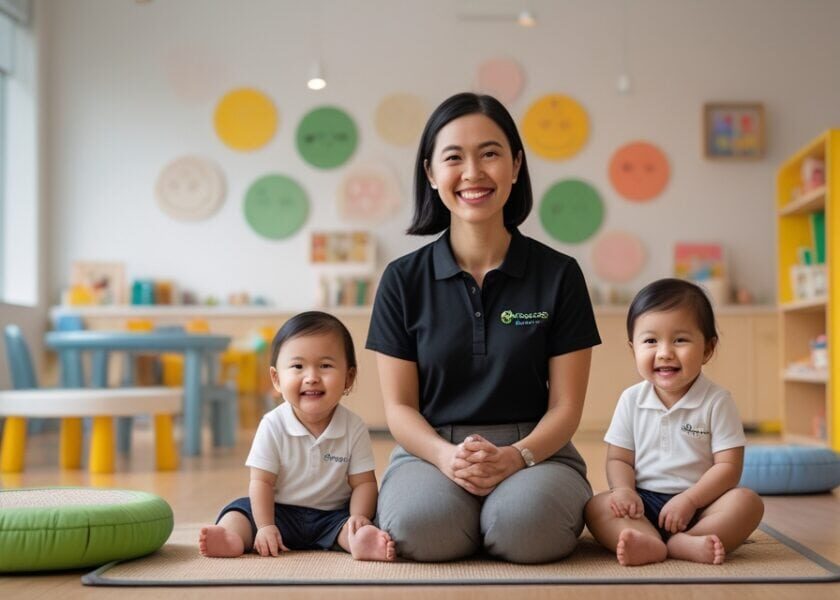
The Small Moments That Create Lasting Childcare Partnerships
The Feeling You Are Looking For
That something is the feeling of partnership.
Not partnership as a model. Not partnership as a word in a brochure. Partnership as a lived, daily, invisible practice that builds itself through every exchange between you and the person who cares for your child.
In Singapore, we have become very good at talking about quality childcare. We have frameworks, ratios, accreditations, pilot programmes. What we have not always done is describe, with honesty and precision, what it actually feels like to be inside a childcare relationship that works.
And I think that matters — because the parents I have spoken to, thoughtful and committed parents navigating the particular pressures of raising children in this city, are not looking for reassurance. They are looking for recognition. They want someone to say: I understand what you are doing, and I am doing it with you.
So let us begin there. In the space between drop-off and pickup. Because that is where partnership is built, or not built. That is where it is either happening or it is not.
The Question Every Parent Carries
Every parent in Singapore makes a series of decisions that, taken together, amount to something enormous. We choose where to live partly based on proximity to schools. We map commutes against nursery hours. We calculate whether we can afford one income, or whether both parents must return to work and, if so, what kind of childcare fills those hours.
These are not small decisions. They are freighted with anxiety, guilt, hope, and practicality in equal measure.
And at the centre of all of it — at the very heart of the decision — is a question that parents rarely articulate but carry everywhere:
Is this person going to see my child the way I see my child?
Not better. Not differently. The way they truly are, as a complete person, and — crucially — as your child. The one you carried. The one whose rhythms you learned in the dark of night. The one whose preferences and fears and sudden joys are a language you have been building since before they could speak.
The question is not, Will they keep my child safe? That is the baseline. The question is deeper: Will they know my child? And will they tell me what they know?
Trust Is Built in Small Moments
Singapore parents are sophisticated. We read reviews, we visit centres, we ask neighbours, we cross-reference ECDA records, we bring our children for trial sessions and watch their faces for signals we cannot quite interpret.
We do all of this because we know that the person we choose will, in a very real sense, shape our child’s earliest experience of the world outside our home. And we know, too, that we cannot be there to witness it.
Here is what I think we have underestimated: trust is not built in a single decision. It is built in a thousand small moments.
It is built in the way a caregiver hands your child to you at pickup and tells you, without prompting, that she said a new word today.
It is built in the way a childminder remembers that your son does not like his hands washed with cold water and adjusts accordingly, without you having reminded them.
It is built in the evening note that says not just what your child ate, but how — whether she ate alone or beside a friend, whether he lingered at the table or moved through it quickly.
These are not data points. They are the raw material of understanding. And when they accumulate, day after day, something remarkable happens: the distance between home and childcare begins to collapse.
The First Thousand Days and What Singapore Parents Already Know
In those early years — the first thousand days, which researchers and educators so rightly emphasise — your child’s brain is forming connections at a rate it will never match again. The quality of care, the responsiveness of caregivers, the richness of interaction, the security of attachment — these are not abstract pedagogical concepts. They are the architecture of your child’s future capacity for trust, curiosity, and resilience.
Singapore parents know this. We read the research. We understand the stakes.
And yet the institutions and frameworks we rely on to deliver this care can sometimes feel, from the outside, like a kind of black box. We send our children in at eight in the morning and we receive them back at six in the evening, and the hours in between belong to someone else. We are asked to trust that the hours were well spent. We nod. We hope.
What EduNanny understands is that trust cannot rest on hope alone. Trust must be constructed. Daily. Deliberately. In ways that respect both the parent’s need to know and the caregiver’s need to do her work without being micromanaged.
This is a delicate balance, and it is one that Singapore’s childcare landscape has not always navigated well. But it is possible — when both sides are committed to the same thing: your child.
The Handover and the Transition Back to Work
The handover is one of the most underrated relational anchors in all of early childhood care. It is the threshold. The daily crossing between your world and your childcare provider’s world. In those ten minutes at drop-off and those ten minutes at pickup, the entire relationship is either reinforced or quietly weakened.
And I say quietly because the handover is rarely dramatic. It does not announce itself. But its quality is felt.
When a caregiver is present, unhurried, able to make eye contact, able to receive not just the information you give but the emotion behind it — you leave that exchange with something. A calm. A confidence. The feeling that the day is beginning on solid ground.
When it goes poorly — when the exchange is rushed, or distracted, or dominated by administrative tasks — you carry that too. You spend the morning wondering. You arrive at pickup with questions you are not sure will be answered.
Why This Matters More in Home-Based Care
EduNanny’s approach to handover reflects an understanding that this moment is not administrative. It is relational.
Singapore parents, particularly those in the ECDA Childminding Pilot, are often navigating a more personal form of childcare than a large centre can offer. Home-based and community-based pathways bring their own particular quality — a smaller environment, a more intimate ratio, a caregiver who may see your child most days of the week in a setting that feels less institutional and more like an extension of home.
In that context, the handover becomes even more significant. You are not passing your child through a system. You are handing them to a person. And the person should be ready to receive them — fully, attentively, with all the context that makes that particular morning meaningful.
The Return to Work: What Parents Rarely Hear Acknowledged
There is another dimension to this that deserves to be named honestly, because it is something that Singapore parents feel but rarely hear acknowledged.
The return to work after maternity or paternity leave is one of the most disorienting transitions in family life. You have spent months — sometimes a year, sometimes less — learning your child’s cues, developing your own rhythms, building a private language of care that belongs to the two of you.
And then, almost without ceremony, you return to work, and someone else begins to learn that language too.
This is necessary. It is often financially essential. And it is, for many parents, genuinely difficult. Not because they do not trust their childcare provider, but because the transition challenges something fundamental: the sense that you are the one who knows your child best.
A childcare partnership that works does not try to smooth over this difficulty with false reassurances. It works with it. It acknowledges it.
It says to the parent: you remain the expert on your child, and our role is to support that expertise, not to supersede it. We are here to extend what you are doing, to create continuity between your home and ours, to hold your child in the way you would hold them — with warmth, with attention, with responsiveness to their individual needs — and to bring back everything we observe so that your understanding deepens rather than gets replaced.
What Genuine Partnership Looks Like
Within the ECDA Childminding Pilot frameworks available through EduNanny, this mutual respect takes specific, practical forms:
- Caregiver-to-child ratios — up to one to three in infant care settings — mean that each child receives the kind of individual attention that makes observation meaningful.
- Communication tools and transparency measures — including CCTV where deployed — mean that the parent is never operating from a position of not knowing. You are always part of the picture.
- Regular updates that bring back what happened in your child’s day, in language that connects to what you know of your child at home.
The best caregivers in Singapore are not simply fulfilling a role. They are practising a craft. They are reading cues that most people would miss. They are managing transitions — the shift from parallel play to group activity, the move from home language to centre language, the delicate negotiation of a child’s first friendships — with a skill that is equal parts compassion and expertise.
Within EduNanny’s approach, these caregivers are supported, trained, and positioned not as substitutes for parental care but as skilled partners in a child’s development.
And when a caregiver is treated as a professional — when her observations are taken seriously, when her insights are shared with parents as valued contributions rather than routine updates — the quality of care rises. It rises because she feels seen. And a caregiver who feels seen by the family she works with is a caregiver who sees your child with even greater clarity and care.
Home-Based Care Is More Accountable, Not Less
Singapore parents sometimes wonder whether choosing a home-based or community-based pathway means choosing something less structured, less accountable.
And I understand that anxiety. But the ECDA Childminding Pilot is built on exactly the opposite premise.
It is a structured, supported, accountable framework — with training standards, quality benchmarks, and oversight — that enables a more personal form of care. Not less.
A caregiver within this pilot is not operating in isolation. She is part of a system that values her competence, invests in her development, and holds her accountable to standards that put your child’s safety and development first.
The CCTV measures and communication protocols that EduNanny employs are not surveillance. They are transparency. They are the mechanisms by which trust is not just felt but verified. And for a Singapore parent — who has every right to be thoughtful about who holds their child — that verification matters.
A Practical Guide for Choosing Infant Care in Singapore
There is a test I would offer Singapore parents. Not a scientific one. An observational one.
Listen to the conversation at your dinner table after pickup. Listen to what your child says about their day — unprompted, in their own words. If they say things like “Mummy, today I played with the blocks with the lady” or “Auntie remembered I like the blue cup” — those are not small things. Those are evidence of a relationship. Evidence that the hours you were not there are not lost hours. They are hours that belong to a shared story.
When that story is told well — when each day’s chapter is rich with detail, when the language of home and the language of childcare share vocabulary, when the transitions between them are handled with care rather than routine — something extraordinary happens. The anxiety softens. Not because it has been removed, but because it has been met.
Before You Visit Any Centre or Service
- Clarify what matters most to your family — proximity, ratios, philosophy, flexibility
- Understand the difference between centre-based and home-based care and what each offers
- Research the ECDA Childminding Pilot and whether it suits your situation
- Know your budget and what fee structures are available to you
When You Visit
- Stay longer than the tour — watch how caregivers interact with children when they are not performing for visitors
- Ask specific questions: how do you handle transitions? what does a typical morning look like? how do you communicate with parents?
- Notice the handover — if possible, arrive at pickup time and watch how children are received and released
- Trust your instincts about the caregiver, not just the centre
Questions to Ask Yourself After
- Did I feel seen as a parent, not processed as a client?
- Did the caregiver seem interested in my child as an individual?
- Was I given real information, or pleasant generalities?
- Did the space feel warm, or merely clean?
What Quality Childminding Looks Like Over Time
At pickup, a quality caregiver will:
- Share at least one specific observation about your child’s day — not a general summary, but something particular
- Remember details from previous days and connect them to what is happening today
- Allow time for a real exchange, not rush through the handover
Over time, you should notice:
- Your child becoming more comfortable, not less, in the childcare setting
- Your own understanding of your child deepening through what you learn at pickup
- Consistency between what you are doing at home and what is happening in care
- A sense that you are being included in your child’s day, not updated from a distance
When something difficult happens — and it will — you should expect:
- Honest communication about what occurred
- Context that helps you understand without minimising or dramatising
- Collaboration on how to address it together
Building the Partnership, One Day at a Time
If you are a parent in Singapore and you are making this decision — this enormous, consequential, loving decision about who will care for your child — I want you to know that you are not looking for perfection. No one offers perfection.
You are looking for partnership. And partnership is not a thing you find. It is a thing you build.
It is built in the small moments:
- In the specific observation shared at pickup
- In the caregiver who remembers what your child was afraid of last month and notices that they are no longer afraid
- In the evening report that tells you not just what happened but what it meant
- In the handover that says, without words: your child was happy here, and I am glad you are here now to take them home.
EduNanny Singapore is not here to replace you. It is here to stand beside you — in your home, in community settings, within the frameworks that make quality care accessible and accountable — and to build with you, one day at a time, the partnership that your child deserves and that you, as a parent, have already earned.
The best childcare relationships are invisible in the best way. They do not feel like transactions. They feel like trust.
And trust, once built through a thousand small moments, is the most durable thing you can give your child.
Ready to Explore What Partnership Looks Like?
If this resonates with you — if you are looking for childcare that sees your child the way you see your child, that builds trust through daily micro-moments rather than promises on paper — EduNanny invites you to start a conversation.
We are here to answer your questions honestly, walk you through your options within the ECDA Childminding Pilot, and help you understand what a genuine childcare partnership could look like for your family.
Because you are not looking for a service provider. You are looking for a partner.
And that partnership is waiting to be built — one small, specific, observed moment at a time.
Learn more about EduNanny’s approach to the ECDA Childminding Pilot, our story and standards, or get in touch to begin a conversation.
Because your child deserves to be known — and so do you.