The Complete Guide to Quality Childcare for Singapore Infants and Toddlers
Why the Early Years Carry Extraordinary Weight
Before we can understand what quality childcare looks like, it helps to understand why the early years matter so much.
In the first thousand days of life — from conception to approximately age three — the human brain builds connections at a pace it will never match again. During peak periods of development, neural connections form rapidly. This is the actual biological architecture being laid down: the foundation upon which language, reasoning, emotional regulation, and social capacity will eventually rest.
What happens in these days is not a preview of learning. It is learning. The sensory experiences, the motor explorations, the back-and-forth exchanges with responsive adults — these are not warm-up exercises for school. They are the real thing, shaping what your child becomes.
This is why the question of what happens in childcare is not trivial. It is everything.
What Quality Childcare Actually Looks Like
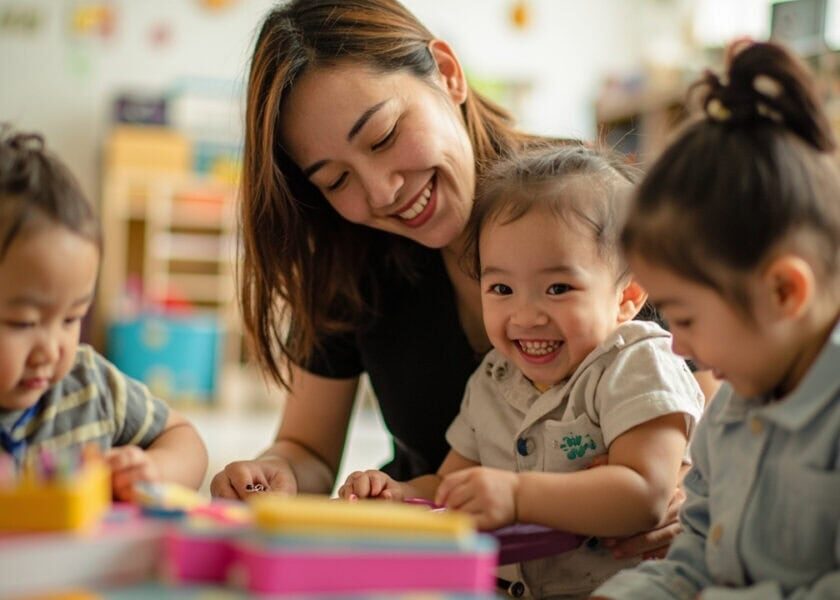
Walk into a well-designed infant room, and at first glance, you might see what any observer might see: small bodies exploring surfaces, caregivers moving among them with calm purpose, perhaps soft music playing or the smell of a recently changed infant.
Look closer. Listen more carefully. What you are witnessing is a carefully orchestrated environment for development.
The Six-Month-Old Reaching for a Rattle
A six-month-old is lying on a textured mat, reaching for a rattle that hangs just beyond her grasp. She has been working at this for several minutes. Her caregiver has positioned the toy at precisely the distance that challenges without frustrating — close enough to motivate, far enough to require sustained effort.
This is not idle entertainment. This is the refinement of depth perception, the development of hand-eye coordination, the earliest mathematics of spatial awareness. The caregiver watches, notes the child’s increasing persistence, and will subtly adjust the distance over the coming days as the infant’s skills develop. This is responsive caregiving informed by developmental knowledge. This is curriculum in its earliest and most authentic form.
The Twelve-Month-Old Stacking Blocks
Consider the twelve-month-old learning to stack blocks. He places one block on another. It falls. He looks at the caregiver — not with frustration, but with curiosity, seeking information.
The caregiver does not fix the problem for him. Instead, she places her hand over his and gently guides the placement of the next block, feeling the weight, finding the center of gravity. Then she releases his hand and waits.
He tries again. The block holds. His face lights up with something that goes beyond pleasure — this is the birth of confidence, of the understanding that effort leads to outcome, that the physical world responds to his actions in learnable ways.
The Twenty-Month-Old at the Door
Consider the twenty-month-old who has just arrived for her first week and is crying near the door. A trained caregiver kneels to her eye level, acknowledges what she is feeling: “I see you are missing Mama. That is okay to feel sad here.”
She then gently redirects the child’s attention toward a sensory bin of rice and small shells that another child is happily exploring. Within minutes, the new child is kneeling beside the other, fingers sifting through the material, her tears forgotten.
This is not a trick. This is social-emotional scaffolding — the gradual building of trust and the capacity to manage difficult feelings in the presence of others. It is one of the most important skills your child will ever develop, and it happens not in a lesson but in a moment of human attunement.
Five Developmental Domains Quality Care Addresses
What you are beginning to see is that quality childcare is not a series of activities punctuated by nap time. It is an integrated developmental environment — what early childhood educators sometimes call a learning landscape — where every interaction, every material, every spatial arrangement is intentional in service of your child’s growth.
Here are the five domains that trained caregivers attend to throughout every single day.
Sensory Integration: The Foundation Beneath All Other Learning
Before a child can write, she must have a body that understands pressure, resistance, and fine motor control. Before a child can read, he must have auditory processing that distinguishes between similar sounds. These capacities do not appear magically when a child turns four or five. They are built in infancy and toddlerhood through hundreds of sensory experiences.
The feel of textured surfaces against bare feet. The sound of language spoken slowly and musically. The visual richness of looking at faces at different distances. In quality childcare, sensory experiences are not accidents. They are planned — the sand table, the water play, the textured books, the music and movement sessions, each a deliberate input into your child’s sensory architecture.
Motor Development: Movement as Cognitive Work
When a toddler climbs a low structure, she is learning about height, risk, balance, and her own body in space. She is building proprioception — the sense that tells her where her limbs are without looking at them. She is developing the vestibular system that underlies attention and the ability to sit still.
When she scribbles with a crayon, she is refining the pincer grasp that will eventually allow her to hold a pencil. Each of these seemingly simple actions is a building block for academic learning that will come years later.
Language Development: Immersion, Not Instruction
Language development happens continuously, not just during circle time. A skilled caregiver narrates what she is doing throughout the day, modeling rich vocabulary and grammatically complete sentences. She echoes and expands on the child’s attempts at speech, repeating words with corrections woven in naturally.
She reads books with genuine engagement, pausing to let the child point and explore the pages. She sings songs that introduce rhyme, rhythm, and the musical patterns that underlie literacy. This is language immersion, sustained and intentional, delivered by someone who understands how words become the foundation of thought.
Social-Emotional Development: The Most Invisible and Most Consequential Domain
In quality childcare, children learn to exist alongside others. They learn to read facial expressions, to understand that other people have feelings different from their own, to negotiate sharing, to experience disappointment without falling apart, to find comfort in the presence of a trusted adult, to separate from parents and survive the anxiety — and in surviving it, to grow.
These capacities are not soft skills. They are the core competencies that predict academic success, mental health, and relationship quality throughout life. The caregiver who helps a toddler navigate a conflict over a toy is doing work that is as rigorous and as important as any mathematics lesson.
Play-Based Learning: The Child’s Laboratory
When a two-year-old pours water from one container to another, she is experimenting with volume, causality, and prediction. When a group of toddlers builds a tower together, they are negotiating roles, managing frustration, and experiencing the pleasure of shared creation. When a child pretends to feed a doll, she is processing her own experiences, rehearsing emotional scenarios, and developing the narrative capacity that will later support reading comprehension and creative thinking.
Play is the work of childhood. The child’s laboratory. Her gymnasium. Her therapy room and her university combined. When children play with genuine engagement — not performing play for an adult’s observation, but truly absorbed in their own exploration — they are learning at their highest capacity.
A quality childcare environment is designed to invite this kind of play. The materials are open-ended, meaning they can be used in multiple ways rather than having a single prescribed outcome. The space is organized to allow for sustained focus, with minimal unnecessary transitions. The caregiver’s role is to be a facilitator — present enough to ensure safety and to extend learning when a child seeks connection, absent enough to allow for the independent discovery that builds confidence and resilience.
How to Evaluate Whether Your Childcare Is Really Delivering
Here is what you need to know: this kind of environment does not happen by accident. It requires trained caregivers who understand child development, who can observe a child’s behavior and read what it reveals about their developmental stage, who can scaffold learning moments as they arise, who can design a daily rhythm that balances activity with rest, challenge with comfort, independence with support.
This is curriculum literacy — and it is the missing layer in Singapore’s childcare conversation. Here are concrete indicators you can look for.
What to Look For During Visits
- Predictable daily rhythm — not rigid, but reliable enough that children can anticipate what comes next, which is itself a form of security that supports learning
- A play-to-structured-activity balance that leans heavily toward open-ended play, with brief, intentional moments of group engagement woven in
- Caregivers who kneel to a child’s level when they speak — not towering above, but meeting the child where they are
- Caregivers who narrate their own actions and echo and expand on children’s speech throughout the day
- Children allowed brief moments of productive struggle before a caregiver intervenes — enough to build persistence, not so much as to foster helplessness
Questions to Ask
- How do you individualize care and learning support for children at different developmental stages? A one-size-fits-all approach cannot serve a six-month-old and a two-year-old equally well.
- How do you track each child’s progress across developmental domains — motor, language, cognitive, social-emotional? This is not for grades; it is to understand where each child is and how to meet them there.
- How will I know what my child did today? Will there be daily updates, photographs, written observations? Transparency is not a bonus feature. It is a sign of confidence.
A Simple Observation Framework
| What to Watch | What It Tells You |
|---|---|
| Are children engaged in open-ended play? | Whether the environment invites real learning or just fills time |
| Do caregivers respond to children with warmth and verbal engagement? | Whether language modeling is continuous or intermittent |
| Are materials varied, sensory-rich, and age-appropriate? | Whether the environment is intentionally designed for development |
| Do children appear settled and secure? | Whether social-emotional needs are being met alongside physical ones |
| Is there a visible daily rhythm? | Whether children can anticipate their day — a key contributor to emotional security |
What This Means For Your Decision
Here is what I want you to understand: the act of learning to evaluate curriculum is not something that makes you more anxious. It makes you more confident.
When you know what questions to ask, when you can read the signs of quality, when you understand what your child needs and can recognize whether she is receiving it — you stop second-guessing and start trusting yourself. You become a more informed parent, and that is always better than an anxious one.
There is a narrative in our culture that says parenting is something you do alone, or that you do perfectly, or that you choose between career and child. This narrative is false, and it has caused enormous unnecessary suffering.
The truth is that children have always been raised within communities — within webs of support, knowledge, and care that extend beyond the immediate family. The presence of a skilled caregiver in your child’s early life is not a failure of parenting. It is an expression of the same instinct that has always driven humans to seek the best possible environment for their young.
When you choose childcare — when you research, visit, ask questions, evaluate, and ultimately decide — you are not outsourcing love. You are making a thoughtful, informed choice about your child’s developmental environment. That is parenting at its most serious and its most loving.
What EduNanny Believes — and Why It Matters
EduNanny was built on a simple conviction: that Singapore parents deserve more than supervision. That infants and young children deserve environments designed not just for their safety, but for their development. That trained caregivers deserve to be recognized as the skilled professionals they are, rather than conflated with casual babysitting.
We believe that the gap between what parents fear childcare might be and what it could actually be is a gap worth closing.
We are proud to participate in the ECDA Childminding Pilot, a government initiative that recognizes home-based care as a legitimate, high-quality pathway for infant and toddler development in Singapore. Home-based care, when delivered by trained and supported caregivers within a structured quality framework, offers genuine developmental advantages: smaller ratios, individualized attention, a domestic environment that can feel more settled and responsive than a large centre, and continuity of caregiver relationships that are especially valuable in the earliest months of life.
We also work alongside centre-based pathways, offering families in Singapore a range of options suited to their circumstances. What matters to us is not the setting itself but the principles that govern what happens within it.
What EduNanny Actually Offers
- Infant ratios designed to ensure every child receives the attunement and individualized response that developmental science tells us is essential in the first years of life
- Caregivers trained not only in safety and basic care, but in the principles of early childhood development — sensory integration, motor milestones, language acquisition, and social-emotional scaffolding
- Transparent communication protocols that give parents genuine insight into their child’s day — not to surveil, but to reassure
- Accessible fee structures where Singapore families can utilize CDA and Baby Bonus funds for eligible care, with Monday to Friday care blocks structured to support working parents
- Thomas AI Chatbot — practical, developmental-knowledge-informed support available whenever a parenting question arises between the moments of direct care
What we are offering through EduNanny is not simply an alternative to centre-based care. It is a vision of what infant and toddler care can be when educational knowledge is placed at its center — when caregivers are seen not as babysitters but as developmental guides, when parents are seen not as anxious bystanders but as collaborative partners in their child’s growth.
The First Thousand Days Are Not a Rehearsal
To close: the choices you make during these early days — choices like the one you are considering right now — matter in ways that are profound, measurable, and lasting.
You have every right to ask the hard questions. You have every right to expect real answers. And you have every right to trust that when you leave your child in quality care, something valuable is happening — something that builds on what you are doing at home, that works alongside you rather than instead of you, that recognizes your child as a full human being with extraordinary potential waiting to unfold.
The first thousand days are not a rehearsal. They are not a warm-up for the real thing. They are the real thing.
EduNanny was built for this. For you. For the work of raising children who will grow into curious, capable, emotionally whole people who will contribute to this city and to the world.
That is not babysitting. That is education at its most fundamental.
And that is what we are here to provide.
Ready to learn what quality looks like up close? Visit EduNanny to explore infant care and childminding options in Singapore — and to ask the questions that matter most to you.
Learn more about who we are or get in touch with our team.