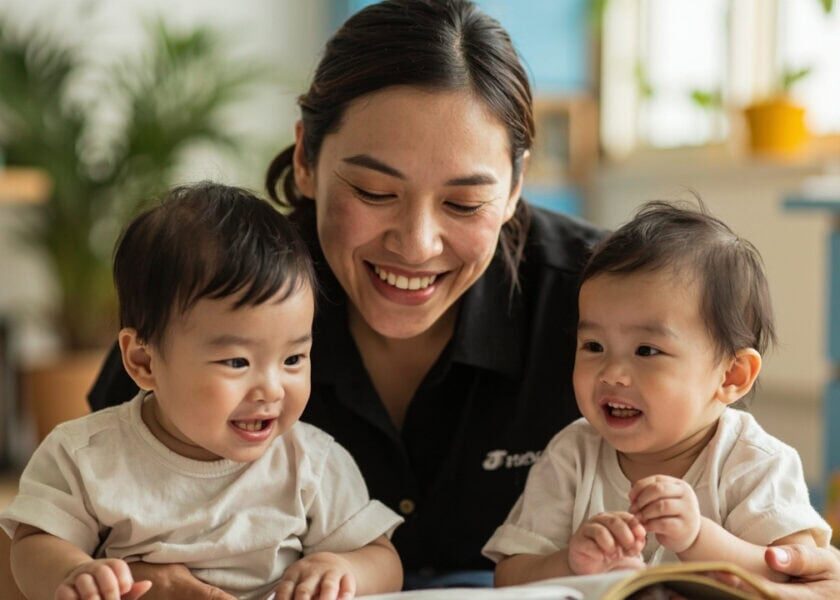
How Singapore Parents Can Cut Through the Childcare Noise and Choose Well
The Moment Every Singapore Parent Recognizes
There is a moment every parent in Singapore eventually recognizes. It arrives quietly, usually on a Sunday evening, when the workweek is still hours away but already pressing at the edges of your thoughts.
You are sitting with your phone, or perhaps your laptop, scrolling through childcare centre websites, reading reviews, checking ratios, comparing fees. Your mother has already told you what she thinks you should do. Your colleague swears by her child’s centre. Your Instagram algorithm has decided to show you only Montessori content. And somewhere in the back of your mind, a small voice is asking: What if I get this wrong?
This is not a dramatic moment. It is, in many ways, the most ordinary moment in Singapore parenting. And yet it carries a weight that is almost impossible to explain to anyone who has not felt it.
Because the decision you are trying to make is not simply about childcare. It is about who will be with your child during the hours when you are not there. It is about whether your infant will be held by someone who notices the small things—the way their brow furrows before a cry, the rhythm of their hunger, the difference between tired and overstimulated. It is about whether, when your child is learning to trust the world for the first time, the people surrounding them will be worthy of that trust.
Here is what makes this moment so difficult: you are trying to make a decision of enormous consequence while being pelted with information from every direction, most of it conflicting, much of it designed to sell rather than to inform.
Your mother-in-law tells you that formal childcare is unnecessary. A parenting forum tells you that the first three years are critical and you must choose wisely. A centre’s marketing materials tell you their curriculum is unique. A Facebook group tells you that no centre is worth the money. Your PLB reminds you about Baby Bonus. Your bank account reminds you that none of this is free.
And somewhere in the middle of all that noise, you are supposed to make the right choice.
Why Feeling Overwhelmed Is Actually a Good Sign
The fact that you feel overwhelmed is not a sign that you are unprepared for this decision. It is a sign that you understand, on some level, that this decision matters.
The parents who feel no pressure are often the ones who have not yet realized what is at stake. That you are sitting there, Sunday evening, trying to research instead of defaulting to the easiest option tells me something important about you.
It tells me that you care. And that you are capable of making this decision well, if you have the right framework to cut through the noise.
The Reframe That Changes Everything
Most parents approach this decision as a search for the perfect childcare centre. They imagine that somewhere out there, there is an ideal option—a place with the right philosophy, the right facilities, the right price, the right reputation—and their job is to find it.
This is a seductive frame because it feels manageable. You are looking for an object. You can compare and contrast. You can make a spreadsheet.
But I want to suggest a different frame, one that is harder to visualize but far more useful. When you choose childcare, you are not selecting a product. You are choosing a developmental partner. You are selecting the people and the environment that will shape a significant portion of your child’s waking hours during a period of neurological development that will not repeat.
You are not furnishing a room. You are building infrastructure for your family system.
This reframe changes everything about how you evaluate your options. Because when you are looking for a product, you compare features. When you are looking for a developmental partner, you ask different questions.
What Trained Observation Actually Looks Like
When you visit a childcare centre—whether for a formal tour or a casual drop-in—you are seeing a curated version of that place. You see clean floors and colorful walls. You see children engaged in activities designed to be observed. You see teachers prepared to answer your questions in a particular way. None of this is dishonest. But it is incomplete.
When a caregiver is truly attuned to infants, they are noticing subtle shifts in tone, in movement, in the quality of a child’s alertness. They are reading a baby’s cues long before the baby escalates to crying. They are tracking developmental milestones not by running assessments but by knowing each child well enough to notice when something is emerging, when something is being practiced, when something is beginning to consolidate.
This kind of observation is quiet, continuous, and largely invisible. It happens during diaper changes and feeding times, during walks and transitions, during moments when no one is watching the tour group.
You cannot see this on a tour. But you can learn to ask about it.
Why Caregiver Consistency Is Non-Negotiable
In a field with high turnover—and childcare, both here and globally, is notorious for high turnover—consistency is not a small thing. It is the foundation on which trust is built.
When an infant or toddler is forming attachments to caregivers, they need those relationships to be stable. They need the same faces, the same voices, the same patterns of response. When caregivers change frequently, children spend energy that should be directed toward development on adaptation and re-attachment.
This is one reason why the home-based childcare pathway deserves serious consideration from Singapore parents. When your child is in a home environment with one or two consistent caregivers, the conditions for attachment and secure exploration are structurally different from those in a centre where your child may be one of fifteen or twenty.
The Rhythm That Allows Development to Unfold
In the first years of life, young children are not ready for the kind of scheduled, activity-driven programming that older children benefit from. Infants and toddlers need rhythm. They need the comfort of knowing what comes next, not because they are incapable of adaptation, but because predictability is what allows them to feel secure enough to explore.
When a childcare environment has a thoughtful daily rhythm—consistent meal times, nap times, outdoor times, transition rituals—children can relax into it. They know that after snack comes play, after play comes rest, after rest comes a story. This predictability is not a limitation. It is a gift. It is what allows development to unfold.
The Communication Culture That Builds Trust
When you pick up your child at the end of the day, what do you actually learn? Are you told what your child ate and how much they slept, in a checklist that could have been filled out by anyone?
Or are you told something more human: that your child seemed particularly engaged with the water table today, that they had a moment of frustration during a transition but were soothed by a caregiver who sat with them, that they tried a new sound during circle time and seemed delighted by it?
The first kind of communication is transactional. The second kind is relational. It tells you that the people caring for your child actually see your child. It tells you that there is something like knowledge and care behind the daily report.
The Questions That Cut Through the Noise
When you are visiting or researching childcare options, these are the questions that will tell you far more than any brochure or website:
About the People
- Who will actually be caring for my child? Can I meet them?
- What is the turnover rate? How long have the current caregivers been in their roles?
- What training or background do caregivers have in infant development?
- How do they handle it when a child is consistently difficult to soothe?
About the Approach
- How do caregivers understand and respond to infant cues?
- What does a typical day look like for an infant or toddler?
- How much of the day is child-directed versus scheduled?
- What happens when a child’s needs do not align with the group schedule?
About Partnership
- Can I see a sample of daily communication updates?
- How do you share observations about development, not just routine?
- What happens when there is a concern about my child’s development or behaviour?
- How do you involve families in care decisions?
About Stability
- What is the caregiver-to-child ratio?
- How often do caregivers change?
- Is there a backup plan if a caregiver is sick?
- How do you handle transitions—my child arriving, a new caregiver starting?
The answers to these questions will tell you whether this is a setting that has thought deeply about its work, or one that is simply going through the motions.
What Quality Childminding Actually Looks Like
Quality childminding is not primarily about facilities or curricula or impressive-sounding philosophies. It is about the quality of attention that children receive. It is about:
- Responsive caregiving. Adults who notice distress before it escalates, who read cues accurately, who respond promptly and appropriately. Not because they have a protocol, but because they are genuinely attuned.
- Consistent relationships. The same caregivers over time, so that trust can form and development can proceed without the disruption of constant re-attachment.
- Developmentally appropriate environment. Not a miniature school, but a space that supports exploration, movement, rest, and feeding according to each child’s needs.
- Reflective practice. Caregivers who think about their work, who notice their own responses, who grow in their understanding over time.
- Honest partnership with families. Communication that goes beyond logistics to share real observations, real questions, real collaboration.
These are the things that produce developmental value. And none of them are visible on a tour. They can only be felt over time, or assessed through thoughtful questions and careful observation of how the setting responds when you ask them.
Trusting Your Instincts (With Scaffolding)
Now, I want to speak to something that is at the root of a lot of parental uncertainty in this process: the sense that your own instincts are not to be trusted.
You may have felt this. A friend recommends a centre that looks fine on paper, but something in you hesitates. A grandparent dismisses your concerns, and you wonder if you are being too anxious. A centre’s director speaks with such authority that you second-guess your own questions.
Here is my answer to that question, and I want you to hear it clearly: Your instincts are trustworthy. But they need scaffolding.
What do I mean by that? Your intuition about your child is real and valuable. You know your child better than anyone. You know their temperament, their sensitivities, their particular rhythms. But intuition alone is not enough when you are navigating a complex decision in an unfamiliar landscape. You need a framework that helps you translate your instincts into questions, and your observations into informed judgment.
A thinking partner does not tell you what to choose. It helps you think more clearly about what you are choosing and why. It helps you name what matters to you, even when you could not have articulated it at the start of the process. It helps you notice when something feels off, and gives you the language to investigate that feeling rather than dismissing it.
Answering the Questions You Are Really Asking
What if I make the wrong choice?
You might. And that is worth acknowledging honestly. No childcare setting is perfect, and no choice is without risk. But the question is not whether you will make a perfect choice—there is no such thing. The question is whether you will make an informed one.
An informed choice, made with attention to the right variables, with attention to your own instincts, with ongoing engagement rather than passive trust, is a choice you can feel good about. And if circumstances change, you can adjust. This is not a decision that locks you in forever.
How do I know if my instincts are right?
You will not know with certainty. But you will know more than you think. Pay attention to what you feel when you visit a setting. Do you feel welcomed, or merely tolerated? Do the caregivers seem genuinely interested in your child, or going through professional motions? Do you feel like you could ask questions without being made to feel difficult?
These gut responses are data. They are not the whole picture, but they are part of it.
How do I balance quality with what we can afford?
This is a real tension, and I do not want to pretend otherwise. Quality care costs money, and Singapore families face genuine financial pressures. But I would also encourage you to think about what you are actually paying for.
If a setting has low ratios, trained caregivers, reflective practice, and genuine communication, those are not overheads that inflate fees unnecessarily. They are the conditions that produce developmental value. Sometimes paying more means getting something fundamentally different in kind, not just degree.
EduNanny: Built for Singapore Families
EduNanny by BUTLER was built with this philosophy at its core. When we designed our approach to infant care and childminding in Singapore, we did not start with the question: How do we attract families? We started with a different question: What do families actually need when they are making this decision?
The answer, we found, was not more marketing. It was more clarity. It was someone who could help them think through the variables, understand what quality looks like, and ultimately feel confident in their choice—not because they had been reassured, but because they had been informed.
This is why EduNanny participates in the ECDA Childminding Pilot. We believe that Singapore families deserve access to more than one pathway to quality care, and that home-based childminding—when done with skill, intention, and professional rigor—offers something that centre-based care often cannot: small ratios, consistent caregivers, family-like environments, and the kind of individual attention that allows infants to be truly known rather than simply supervised.
Our infant ratios, where applicable within pilot structures, reflect this commitment. Up to one-to-three or one-to-two caregiver-to-infant ratios mean that our childminders can observe, attune, and respond in ways that larger settings simply cannot replicate. This is not a selling point. It is a structural reality that produces different developmental conditions for the children in our care.
We use tools like CCTV where deployed, because we believe in transparency. We use technology to make information accessible and questions answerable at any hour, because we know that parental anxiety does not keep business hours. We are here, not as a vendor you choose and forget, but as a partner you engage with and grow alongside.
Practical Considerations
We understand that Singapore families carry real financial pressures alongside their desire for quality. Our pilot programme is designed to be accessible: Monday to Friday care blocks, fee structures within the pilot framework, and where applicable, the ability to use CDA and Baby Bonus funds so that families can access subsidies and support without navigating unnecessary complexity.
But the practical alone would miss the point. What matters most is not the logistics of payment, but the quality of attention your child receives.
You Are Not Alone in This
There is something that happens when a child is in a genuinely good care environment—one where the adults are reflective, the ratios are thoughtful, the rhythm is predictable, and the communication is honest. The child feels it.
Not consciously, of course. But in their body, in their nervous system, in the quality of their exploration and the security of their attachment. A child who is well cared for in these early years carries that feeling forward. It becomes part of the foundation on which they build their capacity for relationships, for learning, for resilience.
This is what I mean when I talk about the compounding value of choosing well. You are not making a decision about next month. You are making a decision that will shape, in ways both visible and invisible, the conditions under which your child grows.
So when you feel the weight of this decision—and you should feel the weight of it, because it is heavy—you are not feeling something that should alarm you. You are feeling the appropriate recognition of what is at stake.
The question is not whether to feel this weight. The question is what you do with it.
What you do with it is this:
- You stop looking for the perfect centre. There is no such thing.
- You start looking for the right developmental partner. This is different for every family.
- You ask better questions. Not “what is your curriculum?” but “how do your caregivers understand infant cues?”
- You learn to see past the surface appeal to the hidden variables that actually matter.
- You trust your instincts enough to ask the hard questions, and you give the answers the careful consideration they deserve.
And when you find the setting where your child will be known, where the caregivers are consistent and reflective, where the rhythm is thoughtful and the communication is honest—that is when you know you have found something valuable.
Not because it is perfect, because no setting is perfect. But because it is right for your child and your family. Because the adults there understand what they are doing and why. Because you feel, when you drop your child off in the morning, something like peace instead of dread.
The fact that you are reading this, thinking carefully, trying to get it right—already tells me that you are the kind of parent your child needs. And you do not have to navigate this alone.
If you are ready to explore what a thoughtful, relationship-based approach to infant care looks like in Singapore, we invite you to start a conversation. Not to pressure you into a decision, but to help you think through your options with clarity and confidence.
Because choosing well matters. And you are already on your way.
At EduNanny, we believe every family deserves a care partner who sees their child clearly, responds with intention, and grows alongside them. Learn more about our approach or get to know us.