What Your Child Cannot Yet Say
The Gap Between Goodbye and Hello
Here is what we have observed, working alongside families across Singapore: that hunger does not fade as your child grows older. It simply learns to dress itself in different clothes.
You stop wondering whether they were fed and start wondering whether they were understood. You stop worrying about physical safety and start worrying about emotional safety—about whether anyone noticed the small wound no one can see.
This is the gap we want to help you close. Not by becoming the voice you rely on, but by becoming the guide that helps you hear more clearly.
At EduNanny Singapore, we believe the most important thing a caregiver can do is help you understand your own child. The way we do that is through observation—not the casual watching of a watchful eye, but the trained, intentional noticing that transforms information into insight.
What Trained Caregivers Actually Do
You know your child better than anyone. You know the particular quality of their laugh, the specific way they like to be held, the face they make when they are thinking hard about something. You have been their observer since the day they were born.
But there are hours in the day when your child is having an experience you cannot access. A whole inner life unfolds while you are apart. And in those hours, trained caregivers learn to read the language that precedes words.
They learn to see subtle shifts in a child’s body, the micro-expressions that flicker across a face, the posture that tells a story no child can narrate. When a caregiver is trained to observe, they are not gathering data for a report. They are learning to translate.
Reading the Body’s First Vocabulary
Think about it in sensory terms. When your child is truly comfortable, truly secure in a space, what does that look like?
- The way their hands are open, not fists
- The quality of their breathing—slow and easy rather than shallow and quick
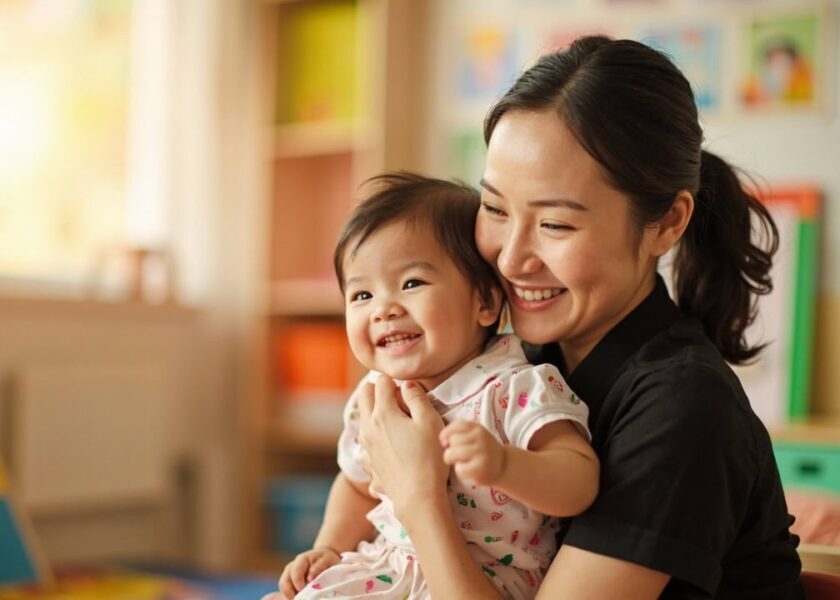
- The way their weight settles in a caregiver’s arms, trusting enough to go fully limp with relaxation
A child’s body is their first vocabulary. Long before they have words for “I am frustrated” or “I need you” or “I just figured something out,” their body is speaking fluently. The trained caregiver’s job is not just to respond to what they see, but to help you understand what you are beginning to see too.
Pickup as a Window
So let us talk about pickup. Because pickup is a window, and most parents walk past it without looking through.
When you arrive at the door and your child looks up, what is actually happening? Their body is telling you something. A trained eye notices:
- Is there a moment of stillness before the recognition, or an immediate brightening?
- Does their posture shift toward the caregiver, or toward you, or somewhere in between?
- Are they settled into their body, relaxed, moving easily—or are they carrying some invisible weight of tension?
These details are not trivial. They are not just the surface noise of a child’s day. They are the evidence of an inner life in progress.
What Different Bodies Tell You
A child who has had a genuinely good day will often show it in their body at pickup. There is a looseness, an ease. They may reach for you, or they may simply turn toward you with a quiet acknowledgment that you are the person they most wanted to see.
A child who has had a difficult day might show it in a different posture—guarded, watchful, or strangely still. A child who has been overstimulated may not show much at all, already retreated into a kind of quiet that is not peace but protection.
These are not rules. They are starting points for your own observation. What matters is not just what you see at pickup, but what you begin to notice over time.
Observation Is a Skill That Compounds
The more you look, the more you see. The more you see, the more you understand. And the more you understand, the more confidently you can trust your own reading of your child.
You are not passive recipients of caregiver reports. You are active participants in understanding your child’s experience. As you grow in this capacity, something shifts. You stop relying entirely on others to tell you how your child is. You begin to know it yourself.
That knowledge is the foundation of real partnership between parents and caregivers. Because when parents can observe their own child with growing skill, they are not at the mercy of secondhand accounts. They are not left wondering whether to trust what they are told. They have their own evidence. They have their own eyes.
How EduNanny Approaches Observation
Observation requires trained caregivers and a setting designed to support it. This is how we build both.
EduNanny caregivers are trained through the ECDA Childminding Pilot, a framework that shapes how our caregivers approach each day with intention and attention. When your EduNanny caregiver communicates with you about your child’s day, they are not simply reporting activities. They are sharing what they observed:
- The quality of your child’s engagement
- The patterns in their mood
- The moments of breakthrough and the moments of struggle
- A child who was learning to crawl, or a child who finally let themselves be comforted, or a child who showed a flash of fierce independence that surprised everyone
Ratios That Allow for Real Observation
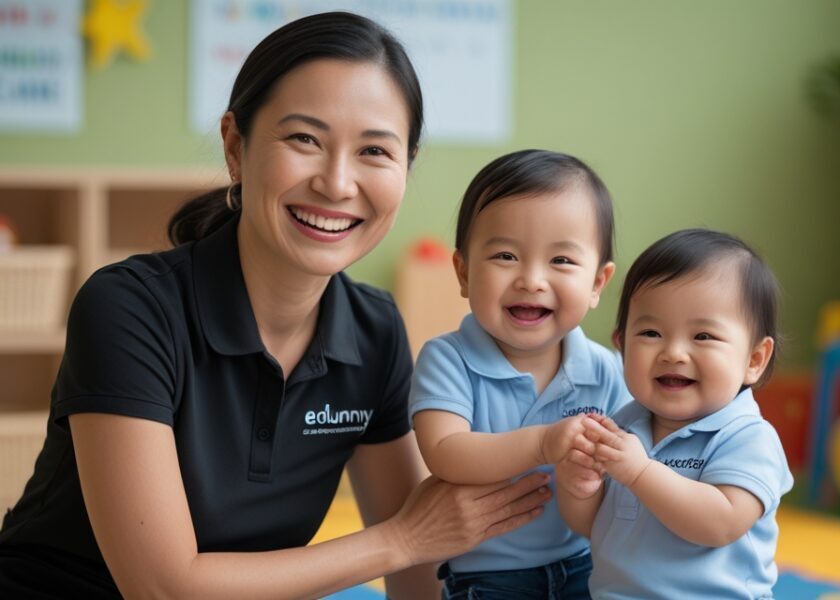
Our caregiver-to-child ratios matter. With up to one to three infants per caregiver in our infant care settings, there is space to observe. There is time to notice. There is attention left over from the necessary work of feeding, changing, and soothing to do the quieter work of noticing:
- The way your child’s face lights up when they solve a small problem
- The way their curiosity pulls them toward new textures and sounds
- The way they reach out for connection and then pull back, testing the world
The Singapore Dimension
In Singapore, where cultural norms shape how emotions are expressed, where the pace of life can flatten the subtle textures of a child’s inner world, there is a particular need for caregivers who can read between the lines. Who can notice when a child’s excitement has been quietly redirected into something more acceptable. Who can see when a child’s quiet is composure and when it is suppression. Who can hold space for a child’s full emotional range.
What Quality Childminding Looks Like
When you are evaluating childcare options, here are the signals that matter more than the ones most programs advertise:
- Communication goes beyond activities. You hear about engagement levels, emotional patterns, and moments of significance—not just what was on the menu.
- Caregivers notice transitions. How does your child move between activities? Where do they linger? What pulls them out of themselves?
- Pickup conversations feel substantive. When you ask “How was their day?” you get something you can work with, something that helps you understand your child better.
- Your observations are invited. The caregiver asks what you noticed at home and connects it to what happened in care.
Your Role as Your Child’s Interpreter
Here is what we want for every family we serve. Whether your child is in home-based care, where a dedicated caregiver tends to them in the comfort of your own space, or in our community and centre-based environments, where carefully designed settings support infant development in ways that feel warm rather than institutional—we believe every child deserves to be seen clearly.
And every parent deserves to learn how to see them.
The real gift of observation is that it creates connection. Not just between caregiver and child, but between you and your child, and between you and the person caring for your child. The three of you become a small team, all looking in the same direction, all trying to understand the same small, fascinating, endlessly surprising person.
Some parents already do this instinctively, without anyone teaching them how. But for most of us, it is a skill that grows over time. The best thing anyone can do for a parent is not to tell them what their child needs—they already know more than they think. The best thing is to help them see what is already there.
Observation is not about adding more to your plate. It is about paying attention in small moments you already have—during pickup, during bath time, during the quiet minutes before sleep. Even five minutes of intentional noticing compounds over time.
When you have a trained caregiver as a partner, you have someone to check your interpretations against, someone who sees your child in a different context and can help you understand what you are noticing.
Begin With Your Own Eyes
When you go to pick up your child, look at them. Not just at their face, though their face is telling. Look at their body. Look at their hands, their shoulders, the way they hold themselves in space.
Ask yourself: what is my child communicating right now that they cannot yet say in words?
You were always meant to read your child. You just needed someone to show you how. And your child has always been speaking. You just needed to learn how to listen.
EduNanny Singapore is here to stand beside you in those early years—not as the authority on your child, but as a companion in the work of understanding them. To be the trained eyes that help you trust your own. To be the bridge between what you see and what you need to know.
Your child’s inner life has been waiting for you to notice it. Begin looking.
At EduNanny Singapore, our caregivers are trained through the ECDA Childminding Pilot to observe with intention and communicate with care. We welcome the opportunity to learn about your family.