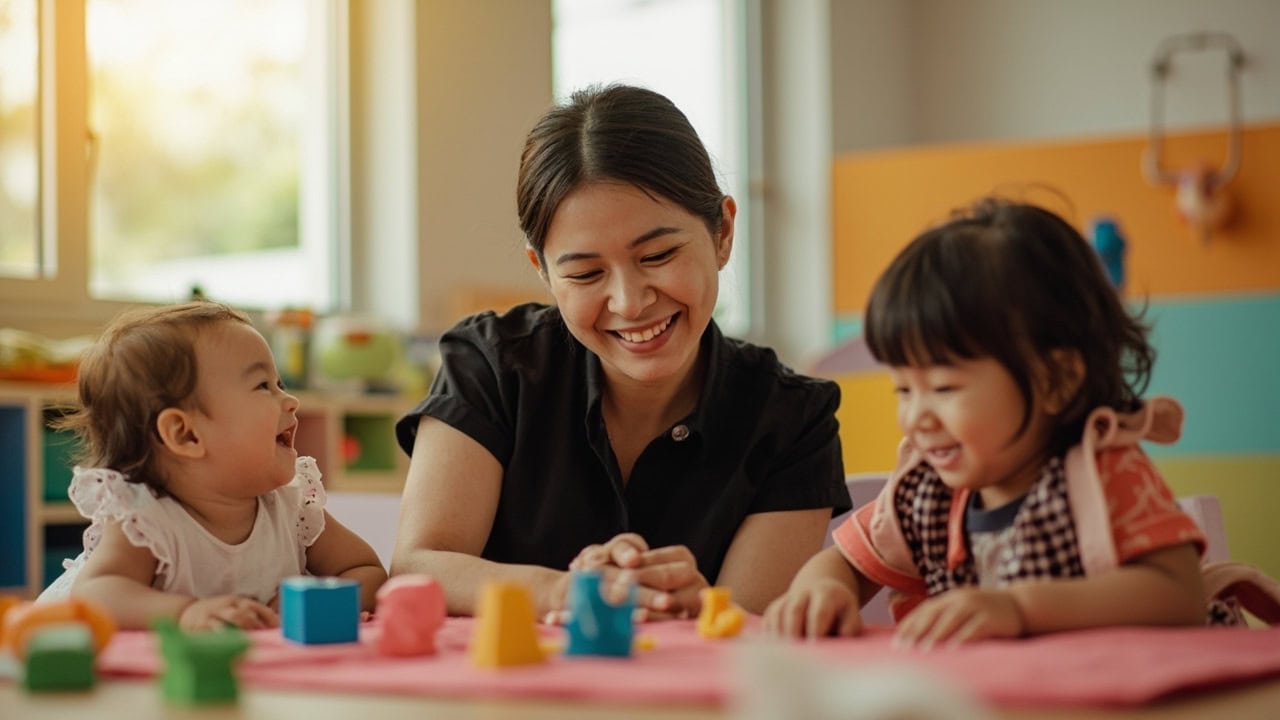
From Watching to Seeing: What Singapore Parents Can Learn From Professional Caregivers
From Watching to Truly Seeing Your Child’s Care
There is a moment every parent knows. You are standing at the doorway of a childcare centre or sitting in a home-based setting, watching your child move through the room. Something catches your eye. A gesture. A hesitation. The way your child reaches for a toy, pulls back, reaches again. You notice it, but you cannot name it.
This is one of the most honest experiences of early parenthood. You are present, you are attentive, and still the picture remains incomplete. You are watching, but you are not yet seeing.
For Singapore parents navigating the search for quality infant care and childminding, this gap is not a personal failing. It is a structural one. No one has taught us to read what trained caregivers read. We evaluate on aesthetics, on atmosphere, on how a space feels when we walk in. We listen for warmth in a caregiver’s voice. These things matter. But they are not the whole picture, and sometimes they can mislead us.
What follows is a professional observation guide designed to close that gap. You will learn how trained caregivers see, what they look for, and how you can develop that same lens. Not to replace professional judgment, but to recognise it when it stands before you. So that you can ask the questions that matter and understand the answers you receive.
This is not about anxiety. It is about capability.
The Difference Between Watching and Observing
A parent watching their child in a new environment is doing something important. You are present, protective, and gathering data through the most sophisticated instrument available: your intimate knowledge of your own child. You notice when something is off, when the energy shifts, when your child seems tense or suddenly small in a way that concerns you. This is not nothing. Trust it. But understand its limits.
A trained caregiver observes differently. Observation is not just looking more carefully. It is looking with intention, guided by a framework that organises what is seen into meaningful patterns.
When a trained caregiver watches an infant, they are simultaneously asking a series of questions:
- Where is this child developmentally?
- What skills are emerging right now?
- Where are the sensitivities, the strengths, the areas of rapid growth?
- What does this child need from me in the next twenty minutes to feel secure and to progress?
This is not an abstract exercise. It is practical, moment-to-moment work that shapes how a caregiver responds, speaks, sets up the environment, and supports the child through transitions. The difference between supervision and intentional developmental support lives here, in this frame of mind the caregiver brings to every interaction.
What Professionals Actually See: Two Examples
Consider a toddler who has just arrived at a childcare setting and is standing at the edge of the play area, watching other children. A parent might read this as hesitation or shyness. A trained caregiver reads it as assessment behaviour, a sophisticated cognitive process in which the child is gathering information, calculating risk, preparing to engage on their own terms. The caregiver does not rush this child. They offer proximity and the option to join, and they wait with professional patience.
The difference between these two readings is the difference between managing behaviour and supporting development.
Or imagine an infant, around nine months old, in a caregiver’s arms during a feeding transition. A parent might see: a caregiver holding a baby, moving toward a high chair. A trained caregiver sees: a child who is learning object permanence, who may show anxiety during transitions because the caregiver is about to move out of direct sight, who needs a running commentary of reassurance and predictability to build trust.
The caregiver narrates the movement, names the transition, maintains eye contact. This is not just feeding. This is developmental scaffolding delivered through the ordinary act of a meal.
These professional observations are not secret knowledge reserved for those with certificates on their walls. They are learnable. You can develop this lens. And in doing so, you become a more confident evaluator of the childcare settings you visit.
The Five Developmental Areas Trained Caregivers Observe
There are specific developmental areas where trained caregivers anchor their observations. These will become your framework, your vocabulary, your toolkit for evaluating any childcare setting in Singapore.
Attachment and Emotional Regulation
This is the foundation of everything in early childhood. A trained caregiver watches for the quality of the bond between the infant and their primary caregiver. They observe how the child responds to separation, how they seek comfort, and when they are distressed, what brings them back to equilibrium.
These are not small questions. The answers reveal the child’s internal working model of relationships, the template they are building for every connection they will ever have.
In practice, this means you should notice:
- Whether caregivers acknowledge every transition, even small ones
- Whether they name emotions before they name solutions
- Whether they give children the time and space to regulate without rushing the process
When you visit a setting, observe whether the caregiver is simply managing the schedule or whether they are reading the emotional weather of the room and responding to it.
Cognitive and Language Development
Here is where much of the marketing language you encounter will be most misleading. Trained caregivers do not look for children performing milestones on command. They look for the process of learning.
They notice:
- Is the child exploring cause and effect?
- Are they engaging in symbolic play, using objects to represent other objects?
- Are they beginning to understand perspective, that another person can have a different point of view?
These are the quiet, invisible processes that precede measurable language acquisition and problem-solving.
When you visit, do not look for children sitting quietly in rows doing worksheets. That is not how development happens in quality infant care. Look instead for children engaged in sustained, purposeful play. Look for a caregiver who is narrating what is happening, extending language through conversation, asking open questions rather than supplying answers.
Look for the quality of the back-and-forth between caregiver and child. This back-and-forth, sometimes called serve-and-return interaction, is where language and thinking are built.
Motor Development
Here I want to challenge a common misconception. Parents often associate physical development with obvious markers: walking, running, climbing. But fine motor development, the small movements of hands and fingers, is equally significant and often overlooked in casual observation.
Trained caregivers watch for the progression from gross motor to fine motor skill, for the integration between both hands, for the precision emerging in grasp and release. They notice whether a child is learning to use tools, to manipulate objects with intention, to solve physical problems through trial and error.
In a quality setting, the environment is set up to support this progression. There are materials at appropriate heights, textures to explore, opportunities for both large movement and precise work.
Social Development
This is where many parents feel most uncertain, particularly when their child is very young. We tend to assume that social skills develop later, in preschool, but the foundation is laid in infancy.
Trained caregivers observe: Is the infant beginning to notice other children? Are they showing interest, curiosity, the first stirrings of social awareness? As children grow, caregivers watch for cooperation, for the ability to share space and objects, for the emergence of empathy and concern for others.
When you observe a group setting, notice the ratio of children to caregivers. Notice whether there is space for small-group interaction alongside large-group activity. Notice whether the caregiver facilitates social moments or simply supervises them.
Supervision keeps children safe. Facilitation builds social competence. The trained caregiver does both, but they know the difference.
Sensory and Environmental Engagement
This is perhaps the most overlooked in quality evaluations by parents who have not yet learned what to look for. Trained caregivers understand that infants and toddlers are sensory learners. Everything they know about the world comes through their senses, and the quality of sensory input matters enormously.
They observe:
- Is the environment overstimulating or appropriately rich?
- Are children given opportunities for both active engagement and quiet rest?
- Is there access to natural materials, varied textures, light and shadow, sound and silence?
The trained caregiver curates the sensory environment with the same intentionality that a good teacher curates a lesson.
When you visit a setting, notice the atmosphere. Not just whether it is clean and bright, but whether it feels considered. Is there a variety of materials? Are they organised in a way that invites exploration? Is there evidence of the children’s work on the walls, or is the environment generic and impersonal?
A trained caregiver makes their philosophy visible in the environment. You can learn to read it.
How to Evaluate Any Childcare Setting Like a Professional
Knowing what to look for is only the first step. The second is learning how to look, and the third is knowing what questions to ask.
The quality you are seeking is not visible on the surface. It is not in the lobby or the branded materials or the cheerful signage. It is in the interactions you cannot schedule, in the moments when no parent is watching, in the small decisions a caregiver makes about how to respond to a child’s distress, how to extend a child’s play, how to set the emotional tone of a room.
The trained caregiver difference is visible in the space between the visible moments.
Questions to Ask During Your Visit
Do not ask only: Is this place clean? Is this place safe? Is the schedule convenient? These are threshold questions, necessary but not sufficient.
Ask instead:
- How do caregivers respond to a child who is upset?
- Can you show me how you individualise activities for different developmental stages?
- How do you document a child’s progress, and how is that shared with parents?
- What is your approach to supporting children through separation and reunion?
- How do you communicate with parents throughout the day?
These are not aggressive or accusatory questions. They are professional questions, the kind a knowledgeable parent asks. When you ask them, watch the response. Does the caregiver pause and consider, or do they reach immediately for a scripted answer? Does their eyes light up when they talk about a child’s development, or does the conversation return quickly to logistics?
What to Look For in Any Setting
Whether you are considering a home-based arrangement or a centre-based programme, some features are worth evaluating as concrete commitments to quality:
- Caregiver-to-child ratios that ensure individual attention
- Transparent communication systems that keep you informed throughout the day
- Documented observation practices that track your child’s development
- Environments that reflect intentional design for learning
- Caregivers who speak about children with warmth and professional insight
The Question of Trust
There is one more dimension I want to address, because it is where many parents feel the most vulnerability. That is the question of trust.
Trust is not built on vague reassurances. It is built on knowledge. When you understand what professional observation looks like, when you can recognise it in action, when you know what questions to ask and what answers to expect, you move from trusting blindly to trusting intelligently.
This is a more durable form of confidence, one that does not crumble when uncertainty arises because it is grounded in understanding.
The parent who has learned to see what professionals see does not feel the need to hover at the doorway. They can leave their child in trusted hands because they have the knowledge to evaluate whether those hands are truly trained, truly attentive, truly invested in the child’s development.
This is not about becoming a childcare expert. It is about becoming an informed parent, one who can make choices from a position of clarity rather than confusion.
Common Concerns Addressed
How do I know if my child is actually being observed?
Ask to see examples of documentation. Quality settings maintain running records of each child’s development. These should be shared with parents regularly, not just during formal review meetings.
What if I feel guilty about leaving my child?
Guilt is often a signal that we care deeply. The answer is not to stay home, but to find a setting where you trust the quality of care. Informed evaluation helps replace guilt with confidence.
How do I evaluate a setting on a short visit?
Use this framework. Watch how caregivers speak to children, not just about them. Notice whether the environment feels intentional. Ask the professional questions listed above and observe the quality of the answers. Trust your instincts, but let your new knowledge sharpen them.
What if the setting seems lovely but I still feel uncertain?
Your uncertainty may be telling you something. A professional observation lens helps you identify what feels right versus what looks polished. The trained caregiver difference lives in the details, and now you know where to look for them.
Your Action Checklist for Evaluating Childcare
Before you leave any childcare visit, use this checklist:
- I watched how caregivers responded to at least one child in a moment of need
- I observed whether transitions were narrated and emotions were acknowledged
- I noticed whether the environment felt intentional or generic
- I asked about observation and documentation practices
- I asked how the setting individualises care for different developmental stages
- I watched for evidence of serve-and-return interaction between caregiver and child
- I noticed whether caregiver-to-child ratios seemed appropriate for the age group
- I evaluated whether communication systems felt transparent and proactive
- I observed whether the caregiver spoke about children with insight and warmth
- I trusted my instincts, informed by this framework
From Uncertainty to Insight
Let us return to that moment I described at the beginning. The parent standing at the doorway, watching their child, noticing something they cannot name.
You are not that parent anymore. You are the parent who walks into a childcare setting and sees the space as a trained caregiver sees it, reading the environment for evidence of intentionality. You are the parent who watches an interaction between caregiver and child and understands what is happening beneath the surface. You are the parent who asks the right questions and evaluates the answers with professional confidence.
You have moved from uncertainty to insight. From watching to seeing. And that changes everything.
Children thrive when they are seen. Not just watched, not just supervised, but truly seen by adults who understand what they are looking at. When that happens, the child feels recognised, responds with confidence, and develops in ways that no checklist can fully capture.
Your child deserves to be seen. And now, you have the knowledge to ensure that they are.
What Professional Quality Looks Like at EduNanny
EduNanny by BUTLER was built on the conviction that Singapore parents deserve more than reassurance. They deserve to be understood as intelligent adults capable of evaluating evidence and making sophisticated decisions about their children’s care.
The approach at EduNanny is rooted in the same professional observation framework described in this guide. It is applied not just to children, but to the relationship between families and caregivers.
When you choose EduNanny, you are choosing a setting where the trained caregiver lens is not a marketing claim but a daily practice. Where infant development is observed, documented, and shared with parents. Where the ratio of caregivers to children is deliberate and purposeful. Where communication is proactive, keeping you informed not just when something goes wrong but throughout the ordinary, beautiful process of your child’s day.
This is what professional quality looks like when you know how to see it.
If you are ready to visit a setting where professional observation is a daily practice, we invite you to schedule a visit and see the trained caregiver difference for yourself.
Your child deserves to be seen. Let us show you what that looks like.
EduNanny by BUTLER offers infant care and childminding services in Singapore, grounded in professional observation practices that put your child’s development first. Contact us to learn more about our approach.