The Gift of Each Other: Why Sibling Care Changes Everything
The Question You Are Actually Asking
What if the question you are asking—how do I make sure my firstborn does not lose out—is the wrong question entirely?
What if the deeper, more hopeful question is this: how do I give my children the gift of each other?
Because that is what quality childcare offers, in the end. Not a compromise between your children’s needs. Not a divided attention that leaves everyone slightly shortchanged. But something unexpected and transformative: the relational infrastructure your children will carry for the rest of their lives.
The sibling bond is, in biological and psychological terms, the longest-lasting relationship most people will ever experience. Parents die. Children grow up and establish their own households. Friendships shift with geography and circumstance.
But siblings—siblings persist.
They are there for the first day of school and the last day of college. They are there for graduations and weddings and the quiet Tuesday afternoon when a parent calls with bad news. They are there when you are sixty-five and cannot remember where you left your keys, and they are there when you are eighty and the world has grown small and strange.
The sibling bond is the one relationship that, for most of us, stretches across the full span of a human life.
How Siblings Are Actually Built
When Singapore parents make decisions about childcare, they rarely think about sibling bonds. They think about safety. They think about trust. They think about developmental milestones and sensory stimulation and whether their child will learn to share.
These are not wrong concerns—they are essential concerns. But they are incomplete. The missing piece is this: what kind of relationship are your children building with each other?
Here is what observation of families reveals, year after year. When children are raised in an environment—home or otherwise—where parental attention is the only form of care and connection, they learn to relate to adults. They learn the rhythms of one-to-one attention. They learn how to be the centre of someone’s world, and they learn how to orbit around a single source of love and guidance.
These are valuable skills. But they are not the skills that build siblings.
Siblings are built in a different medium entirely. Siblings are built in the friction and fascination of peers. They are built when a three-year-old realises that the tiny human in the bassinet will one day be able to understand her jokes. They are built when an eighteen-month-old watches his older sister navigate a problem and absorbs her strategy without being taught. They are built in the thousand small negotiations of shared space—take turns, that was mine, I forgive you, watch what I can do now.
These lessons cannot be taught by parents. They can only be learned in the company of equals, in the rough democracy of childhood.
The Firstborn’s New Identity
The firstborn, who has been the sole recipient of parental attention, discovers a new identity. She becomes the guide, the protector, the model. She learns that her status in the family is not diminished by sharing it but actually deepened.
She is not losing a parent to a new baby. She is gaining a sibling who will look up to her for decades.
The Second Child’s Gift
The second child—arriving into a household where an older sibling already exists, already knows the rhythms of this family, already holds a place in its story—does not start from zero. She has a guide too. She has someone who will teach her the language before she can speak it, who will show her how to climb before her legs are strong enough, who will be the first person outside her parents to know her, truly know her, as her own self.
The Science Behind the Observation
Developmental psychologists have documented how sibling relationships, particularly those formed in early childhood, become the crucible for social intelligence. Children who navigate sibling relationships—who learn to share, to negotiate, to forgive, to compete, to cooperate—develop capacities for emotional regulation that serve them throughout their lives.
They learn that other people have desires and perspectives that differ from their own. They learn that relationships require effort and repair and ongoing attention. They learn, in the safest possible laboratory, how to be human alongside another human being.
Research consistently indicates that children who experience quality peer interaction in their early years demonstrate greater social confidence and emotional resilience than children raised primarily in isolation. This does not mean that siblings replace peer relationships. It means that when siblings and peer relationships combine, children receive the best of both worlds: the deep, lifelong bond of family, and the social fluency of peers.
What Quality Childcare Actually Does
Quality childcare creates exactly this environment.
When your children spend time together in a setting designed for their development—where the ratios allow each child to be truly seen, where the caregivers understand that their role is not merely supervisory but facilitative—something shifts in the family system.
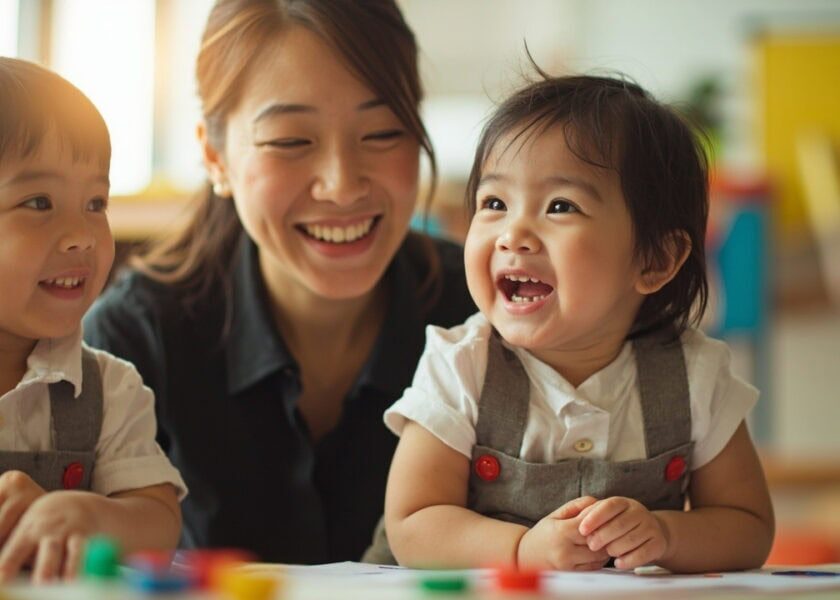
There is a moment that parents describe again and again, a moment that reveals what quality sibling care looks like in practice. It happens at pickup. You arrive at the childcare setting, and you see your children together—not as you left them, not in the separate orbits of your home routine, but in the context they have built together over the hours you were apart.
Your older child is helping the younger one with a puzzle. Or your younger child is laughing at something only your older child finds funny. Or they are sitting together, quiet and content, in a way that tells you they have found something in each other’s company that you could not have engineered if you had tried.
These are the moments that reframe the question. These are the moments when parents realise: I am not choosing between my children. I am giving them to each other.
What Makes Sibling Care Work
Let us be clear about something important. This vision of siblings building each other up is not automatic. It does not happen simply because children share space.
Sibling relationships can be sources of rivalry and resentment just as easily as they can be sources of growth and companionship. What determines the outcome is not the presence of siblings but the quality of the environment in which their relationship unfolds.
When you choose a childcare arrangement, you are choosing the context in which your children will encounter each other. You are choosing who will be present in those formative hours when your children learn how to be siblings. You are choosing the adult voices they will hear, the rhythms they will follow, the standards of interaction they will absorb.
A quality childcare arrangement—one with thoughtful caregiver ratios, with trained and attentive staff, with environments designed for both individual development and peer learning—becomes the setting in which sibling bonds are actively constructed, not merely allowed to happen.
Caregivers who understand sibling dynamics notice when an older child is struggling with the transition to being a big sibling, and they create space for that child to be seen, to be valued, to be reminded that her place in the family has not changed even as the family has grown.
They notice when a younger child is watching an older sibling and they create opportunities for that observation to become learning, for that admiration to become relationship.
The best childcare does not compete with parents for their children’s attention. It cooperates with parents to build the sibling bond that parents, alone, cannot build.
EduNanny’s Approach: Built for Sibling Bonds
EduNanny by BUTLER understands this vision. As a partner in the ECDA Childminding Pilot, EduNanny is built on the conviction that childcare is not a service you purchase for one child at a time. It is a system that shapes your entire family.
The caregivers trained through this programme learn to see children not in isolation but in relationship. They learn to recognise that every child in a family exists in connection to other children, and that their role is to nurture those connections, to protect them, to create the conditions in which siblings can become what they are meant to become.
Structure That Supports Your Family
With ratios that allow each child to be truly known—up to one to three infant ratio in certain arrangements—caregivers have the capacity to observe, to respond, to facilitate sibling interaction in ways that larger settings cannot.
When your children are together in an EduNanny arrangement, they are not competing for the attention of a single overwhelmed caregiver. They are receiving the focused care of someone who has time to notice what is happening between them, to nurture the bond rather than simply manage the room.
Monday to Friday care blocks, with fee structures designed to be accessible within the pilot framework, mean that families can build a sustainable rhythm. CDA and Baby Bonus usability mean that the financial architecture of childcare does not add another layer of stress to an already complex decision.
Transparency and Trust
Parents want transparency. They want to know what happens in the hours when they are not there. EduNanny provides this through clear communication practices and, where deployed, through measures such as CCTV that give parents visibility into their children’s day.
This transparency is not about surveillance. It is about trust—trust between families and caregivers, and trust in the system that holds your children while you are apart.
Questions Every Parent Should Ask
As you consider your childcare options, here are the questions that matter most:
- How does this setting view my children? As individuals only, or as siblings whose relationship deserves nurturing?
- What are the caregiver ratios? Do they allow for observation and facilitation of sibling interaction, or is the environment too crowded for anything beyond supervision?
- How do caregivers handle sibling dynamics? Is there attention given to the firstborn’s transition? Is the younger child’s learning from the older child actively supported?
- What will my children actually experience together? Will they be in the same space, with adults who understand what siblings need from each other?
- Can I see what happens during the day? Is there transparency that allows me to trust the environment I am choosing?
Addressing Common Concerns
Will my firstborn feel replaced? The firstborn’s adjustment to a new sibling is real, and it deserves real attention. In quality sibling care, the firstborn is not competing for attention against a new baby. She is developing a new identity as a guide and protector. The caregiver’s role is to acknowledge her feelings, value her experience, and help her see her expanded role in the family as growth, not loss.
Am I taking something away from my first child? What you are doing is adding a dimension to your family, not subtracting from it. Your firstborn is not losing parental attention in a quality childcare setting—she is gaining a sibling relationship that will serve her for decades. Research on sibling bonds and social intelligence suggests that children who learn to navigate sibling relationships early develop stronger emotional regulation and social confidence.
What if my children don’t get along? Sibling rivalry is real, and it would be dishonest to pretend otherwise. But rivalry is not the only outcome. Quality childcare creates the conditions for sibling bonds to flourish. It does not guarantee that siblings will never conflict—they will, because conflict is part of all relationships. But it gives them the tools to navigate that conflict, to repair, to cooperate, to build.
The Reframe That Changes Everything
What I want you to carry with you, as you make this decision, is a reframing of what you are actually choosing.
You are not choosing between your children. You are not sacrificing your firstborn’s wellbeing for your second child’s development. You are not diluting parental attention into something less than it was.
You are building a relationship that your children will carry for the next seventy years of their lives. You are giving them the gift of each other. You are creating the conditions in which two people will learn, in childhood, how to be companions for a lifetime.
This is not a small thing. This is, perhaps, the most important thing you will ever give your children after the gift of life itself.
The sibling bond does not require constant parental supervision to thrive. It requires the right environment, the right facilitation, the right conditions for growth. It requires caregivers who understand that their role extends beyond the individual child to the web of relationships in which that child exists.
It requires a childcare partner who sees your family as a system, not a collection of separate developmental projects.
You do not have to choose between being present for your first child and being present for your second. You do not have to sacrifice your firstborn’s sense of security to give your second-born the best start. You do not have to feel that every decision you make for one child is a decision you are making against the other.
Quality childcare, chosen thoughtfully and implemented with care, is not a compromise. It is a collaboration. It is the recognition that your family is a living system, and that every part of that system deserves to be seen, valued, and nurtured.
Ready to Explore Your Options?
Your children are building something in the hours you are apart. They are building the relationship they will lean on when you are gone. They are building the companionship that will sustain them through the joys and griefs of a full human life.
They are building each other.
Give them the gift of the right environment, and trust that the bond will grow. Give them caregivers who see them as siblings, not just as individuals. Give them the chance to become what they are meant to become: not rivals for your love, but partners in a relationship that will outlast everything else.
If this vision resonates with you—if you are ready to see your childcare decision not as a choice between your children but as an investment in their relationship—EduNanny by BUTLER welcomes the opportunity to walk this path with you.
As an ECDA Childminding Pilot partner, EduNanny offers the ratios, the training, the philosophy, and the transparency that make quality sibling care possible.
Explore EduNanny’s approach to sibling care or connect with our team to discuss how we can support your family.
You have given them each other.