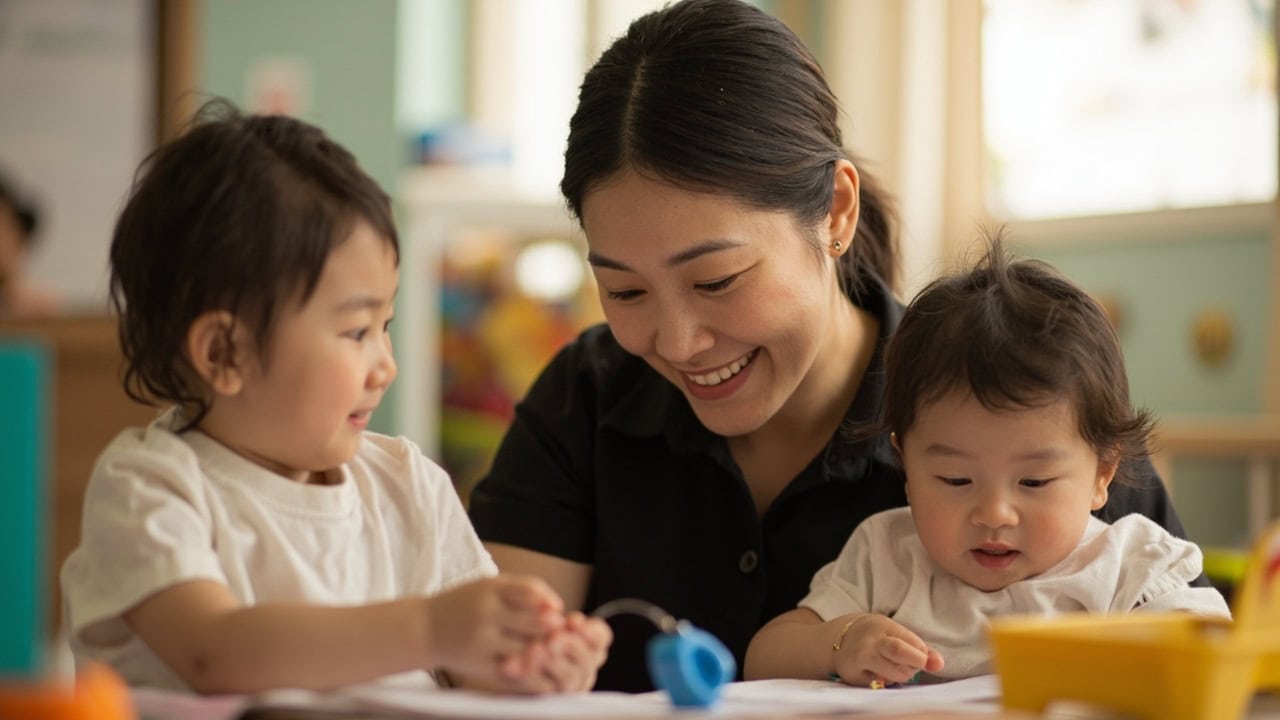
The Quiet Signs Your Child Is Developing Well in Childcare
The Quiet Evidence of Quality Childcare
There is a moment every parent who has chosen quality childcare eventually encounters. It is not dramatic. It does not announce itself. It happens on an ordinary Tuesday evening, or a lazy Sunday morning.
You are watching your child play, or eat, or speak to you, and suddenly you realize that the person in front of you is not the same person who walked into childcare for the first time six months ago. The change is not superficial. Something deeper has shifted. Something has grown.
This is the quiet evidence that confirms you made the right choice — and this is the story of what that evidence looks like, what it means, and why it compounds in ways that matter enormously for your child’s future.
The First Weeks: Building the Foundation
When you first bring your infant to a new care arrangement, there is a period of mutual adjustment that is necessary and healthy. Your child is learning a new environment, new faces, new rhythms. You are learning to read a different kind of communication from your caregiver: the daily reports, the observations, the photographs that arrive on your phone.
Trust is being built on both sides, and trust of this kind takes time. It cannot be rushed. It can only be cultivated through consistent, responsive care.
This is why the first phase of quality childcare is not really about visible growth at all. It is about safety. It is about the establishment of security.
When an infant feels safe — truly safe, in their body, in their environment — they begin to do something remarkable. They begin to explore. They begin to reach outward. They begin to develop.
Trained caregivers understand this instinctively. They know that the first weeks are not about acceleration or achievement. They are about attunement. Your child is learning that this place, these people, this routine — they can be relied upon. That when they reach out, someone will reach back. That when they need comfort, comfort will come.
This is the foundation upon which everything else is built.
From Adjustment to Development: What Growth Actually Looks Like
Here is what most parents do not realize: this foundation is invisible in the short term, but it becomes profoundly visible over months. The child who has been allowed to develop true security in their first care environment does not simply adjust to it. They grow from it. They use it as a launching pad.
There is a difference that matters enormously between a child who has adjusted to childcare and a child who is developing within it.
Adjustment is about familiarity — your child knowing the routine, recognizing the faces, feeling comfortable in the space. Adjustment is necessary and good. But adjustment alone does not tell you that your investment is producing the developmental outcomes you hoped for.
Development is something else. Development is about your child’s expanding capacities — cognitive, social-emotional, motor, linguistic. Development is about your child beginning to show you, in ways that surprise you, what they are becoming.
What This Looks Like Over Time
When development is working well, you will notice it in the months ahead. Not as a single dramatic revelation, but as an accumulating pattern of small but meaningful changes:
- Your infant begins to engage with other children in ways that were not there before
- Your toddler starts to express preferences, to negotiate, to solve problems that would have frustrated them months ago
- Your child begins to narrate their world, to ask questions that reveal new thinking
- They show understanding of concepts — like sharing, waiting, consequences — that simply were not there in their cognitive repertoire a year ago
Consider the infant who entered care at ten months. In the early weeks, that infant might have been primarily focused on the physical environment — the toys, the space, the routines. The caregiver notes the child’s fascination with cause and effect, the emerging interest in other children nearby, the way the infant responds to familiar faces with growing recognition.
Fast-forward three months. That same infant, now thirteen months old, is doing something qualitatively different. The child is actively seeking out peers — not just proximity, but interaction. They are beginning to engage in parallel play, then in simple reciprocal exchange. The child is using words, or approximations of words, to communicate desires and observations. The child is showing frustration when expectations are not met, and then — crucially — beginning to regulate that frustration with increasing success.
Fast-forward again to six months, to nine months. The child who was once primarily physical is now social. The child who once needed constant soothing is now capable of self-regulation in small but meaningful ways. The child who could not yet communicate except through crying now speaks in sentences, negotiates in play, shows empathy, demonstrates understanding of concepts that did not exist in their cognitive repertoire a year ago.
This is what compounding development looks like. It is not a straight line. It is a process that builds upon itself, layer by layer, month by month. And it is most visible, most legible, most meaningful, when the environment in which it occurs is designed to support it.
How Professional Observation Reveals What Parents Might Miss
How do you see it? How do you recognize genuine development when you are not there to witness it all day? How do you trust that the changes are real and meaningful and not just the natural passage of time?
Professional caregivers who have been trained in developmental observation see things that parents, in their love and proximity, sometimes cannot. They have the benefit of perspective. They have seen dozens of children pass through similar stages. They know what typical development looks like, and they know how to recognize when a child is progressing in healthy, age-appropriate ways.
Caregivers maintain detailed observation records. They track your child’s progress across multiple developmental domains — cognitive, social-emotional, motor, language. They notice patterns that emerge over weeks and months. They see your child in interaction with peers, in response to challenges, in moments of frustration and moments of triumph. And then they communicate what they see to you — not in clinical reports, but in thoughtful, specific observations that help you understand your own child better.
This is one of the quiet gifts of quality childcare: it gives you professional eyes on your child. It offers you a trained perspective that complements, not replaces, your parental intuition.
Why Caregiver-to-Child Ratios Matter
The commitment to low ratios in infant care is not simply a regulatory requirement or a marketing point. It is a foundational commitment to the kind of attention that genuine development requires.
When a caregiver can truly attune to a small number of infants, she can observe, respond, support, and document in ways that simply are not possible at higher ratios. She can notice when one child’s frustration is about hunger rather than toys. She can support another child’s emerging language through responsive conversation. She can create the kind of environment in which development — real development — becomes possible.
Your Questions, Answered
Over time, as you receive these observations and begin to see the patterns yourself, your own understanding deepens. You will begin to notice things at home that you would have missed before. You will feel more confident in reading your child’s cues, more secure in interpreting their behavior, more equipped to support their growth in meaningful ways.
You move from uncertainty to informed confidence. You move from wondering whether you made the right choice to knowing, with evidence, that you did.
There is something else the first year reveals: you will become a more observant parent. The caregivers are not just caring for your child. They are teaching you, through their observations and communications, how to see your child more clearly. They are giving you a lens. And as the months pass, you will find that you are reading your child’s cues with greater confidence, that you understand their developmental trajectory in ways that empower rather than cause anxiety.
This is the hidden dividend of quality childcare: it makes you a better parent, not because you are replaced or supplemented, but because you are informed.
Am I making the right choice by putting my child in care?
You chose, perhaps, to work. To contribute to your family, to your career, to your own sense of purpose and identity. And you also chose, alongside that choice, to find care that would support your child’s development in your absence.
That is not a contradiction. That is not a compromise. That is a modern reality, and the question is not whether you should feel guilty about it — you should not — but rather how you can find care that truly serves both the life you are building and the child you are raising.
How will I know if it’s actually working?
The best measure of whether your choice is the right one is not what happens in the first week. It is what happens in the first month, the first quarter, the first year.
The best measure is the quiet evidence.
You will know that quality care is working when your child begins to show you, in ways that accumulate over time, that they are not merely safe but flourishing. When they come home with new words, new skills, new ways of being in the world. When they demonstrate confidence, curiosity, connection. When they show you that they have been somewhere that helped them grow.
What if the changes are just normal development?
Development is not additive. It is multiplicative. And the right environment — the one where your child is truly seen, truly supported, truly challenged at the appropriate level — is the environment where this multiplicative growth can occur most fully.
The growth that happens in the first three months makes the growth in the next three months possible. The security established in the early months enables the exploration and independence that emerge later. Quality care does not create development in isolation — but it does create the conditions that allow each child’s unique developmental potential to unfold more fully than it might otherwise.
What Quality Childcare Looks Like in Practice
EduNanny operates within the ECDA Childminding Pilot, which means it is part of a deliberate, supported effort to provide quality home-based and community-based care pathways for Singapore families. This is not an afterthought. This is a structured, resourced, accountable approach to infant and childminding that reflects both the needs of modern Singapore parents and the developmental science that tells us what young children require to grow well.
For parents, this means that the care your child receives is not isolated. It is part of a system designed for quality. Caregivers are trained, supported, and held to standards. Communication is built into the model — the transparency, the regular updates, the documentation that allows you to see your child’s day even when you are not there.
These are the practical conditions that allow the developmental vision to become real.
What to Look For When Choosing Care
The choice you make now is not a one-time transaction. It is the beginning of a relationship. It is the opening chapter of a story that will unfold over years.
When evaluating care options, consider asking:
- How do caregivers document and communicate developmental observations?
- What is the caregiver-to-child ratio, especially for infants?
- How do caregivers describe the balance between safety, security, and developmental support?
- What does a typical day look like in terms of routine, play, and interaction?
- How are parents involved in understanding their child’s progress?
The right care environment is not just about safety, though safety is non-negotiable. It is not just about supervision, though supervision is essential. It is about the kind of place where your child is known — really known — by the adults who care for them. Where individual differences are noticed and honored. Where each child’s unique trajectory is tracked and supported. Where the caregiver-to-infant ratio is low enough that no child falls through the cracks of attention.
The Evidence Is There
This is the truth that lies beneath the decision so many Singapore parents face: you do not have to choose between work and your child’s development. You do not have to choose between your identity and your parenting. You can have both, and you can have both well, when you find the right care environment.
The first year of quality childcare is not a pause in your child’s life. It is not a holding pattern. It is a launchpad. It is a period of genuine, compounding development that, when it is working well, will surprise and delight and reassure you in ways you did not anticipate.
Your child is growing in ways you did not expect. That is not a hope. That is quiet evidence. And when you see it — when you recognize it, when you name it, when you trust it — you will know that you made the right choice.
Quality infant care and childminding exists to be part of that evidence. To help produce it, document it, and share it with you in ways that deepen your understanding and strengthen your confidence. To walk alongside you through the first year and the years beyond, as your child grows not just in size but in capacity, not just in skills but in personhood.
This is what infant care and childminding, done well, looks like. This is what it is for. And this is why the choice you make matters — not as a source of guilt or anxiety, but as a commitment to the long-term flourishing of the person you love most.
Your child is growing. The evidence is there. And you chose it.
If you would like to explore how EduNanny supports Singapore families through thoughtful, development-oriented childcare, you are welcome to get in touch or learn more about our approach.