What Quality Childcare Nurtures in Your Child’s Inner World
The Question Beneath the Question
There is a moment, familiar to every parent in Singapore, when you hand your child to someone else and walk away. You do it because you must—meetings to attend, responsibilities to carry, a life that continues beyond the walls of your home. But even as you move through your day, part of you remains there. In that classroom, in that home, in that other pair of hands.
You already know your child will be fed and kept safe. You are asking something far more significant: what is happening inside my child right now? Are they content? Are they struggling? Are they discovering something I cannot give them?
And deeper still, a question most parents never fully articulate: is this experience nourishing them in ways I cannot provide myself?
This is not a question about logistics. You are asking about your child’s inner life—their emotional world, their relationships, their sense of self—during the hours when you are not beside them.
What Your Child Builds in Quality Childcare
When your child enters a quality childcare setting, they enter a world organized around their developmental needs—not the compromises of a space designed for other purposes. But the environment is only the beginning. What transforms it into something genuinely meaningful is what happens within it.
New Relationships That Expand Their World
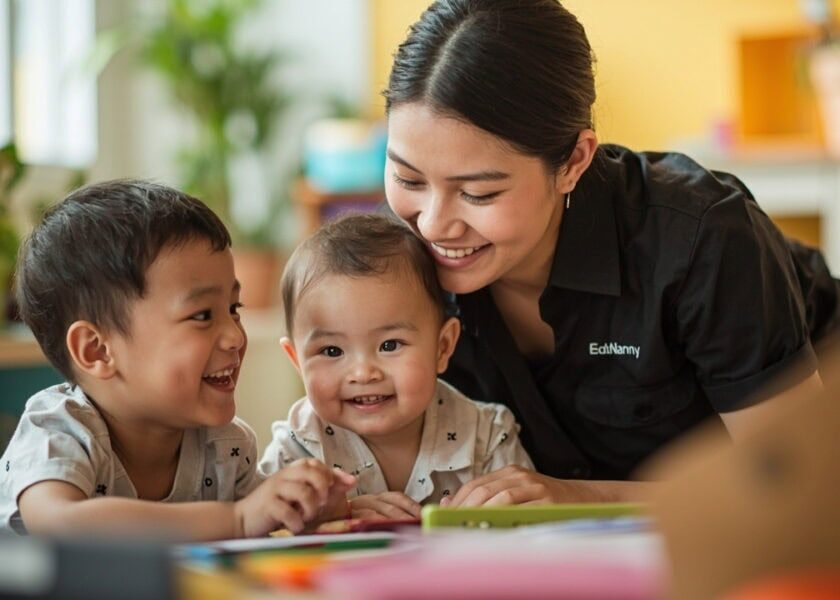
In the morning, there is the moment of arrival. Perhaps there is a flicker of hesitation—then a caregiver who is warm, present, who has been expecting them.
In that small moment, your child begins to learn that the world contains other trustworthy adults. That love is not only at home. That they can move between worlds and be held in each one.
This is not about replacement. Your child is discovering that their capacity to connect extends beyond you—that there are other hands that can be trusted, other voices that bring comfort, other people who will respond to them with care.
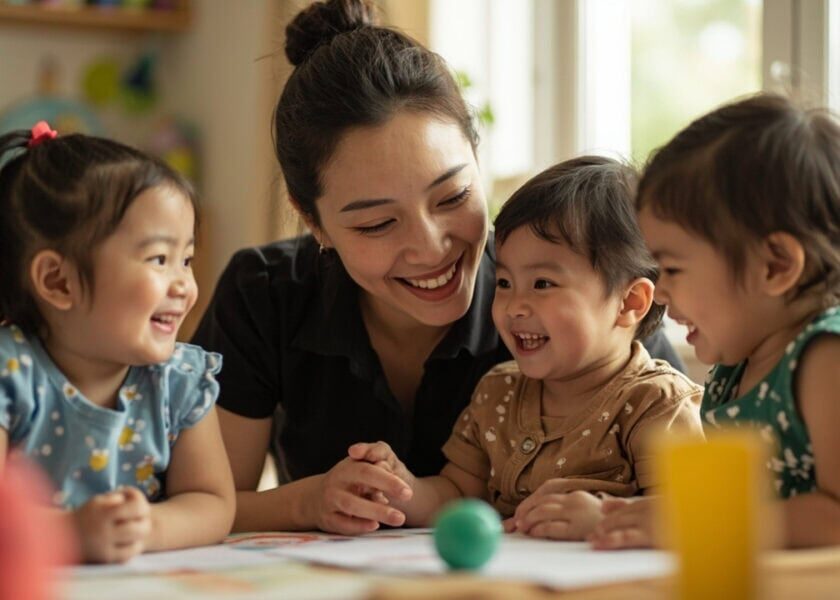
In a quality setting with thoughtful ratios, your child is not lost in a crowd. They are seen. Their small attempts at communication are met with responses. And this shapes something fundamental: it teaches your child that their presence matters, that they are worthy of being truly seen.
Social Navigation With Peers
Consider what happens when your child encounters another child. At home, they may have siblings or playdates. But in childcare, they encounter peers in a sustained, daily way—children their own age, navigating this new world alongside them.
The first friendships are glances across the room, the recognition of another person who moves at a similar pace, who reaches for the same toy. But these moments are not small. Through them, your child begins to understand that there is a world of others—others who are neither caregivers nor family, but peers.
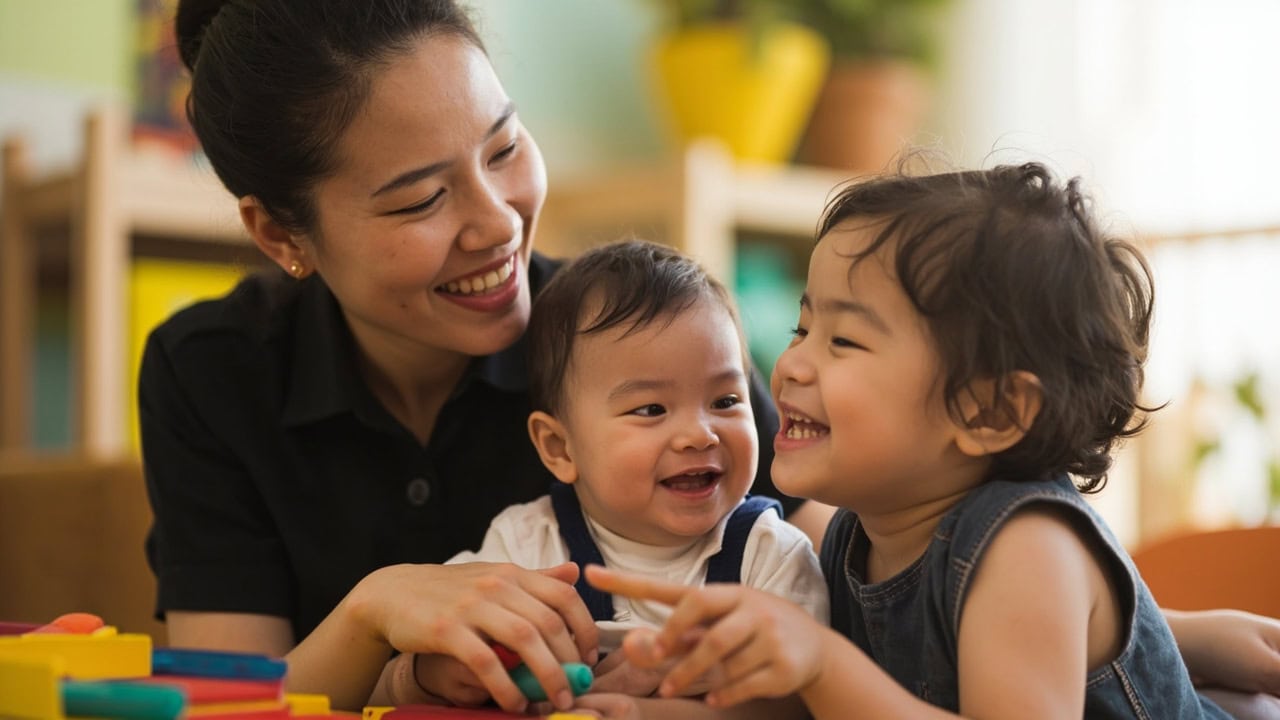
And in learning to be with peers, your child learns what cannot be taught directly: how to share, how to negotiate, how to recover from small frustrations. How to read another child’s face, to sense when someone is upset, to reach out or step back.
These are the foundations of emotional intelligence, built through lived experience—not instruction.
The Emotional Journey of Independence
Perhaps the most underappreciated aspect of quality childcare is the emotional journey of independence.
We speak of independence as a milestone to be achieved. But for a young child, it is not a switch to be flipped. It is a process—an ongoing, emotionally charged process of learning to trust oneself, to feel secure enough to venture away from safety, to know that you can return and find the world still intact.
In quality childcare, this unfolds naturally. Your child learns to tolerate separation—not because they are forced to, but because they discover that goodbyes end well. They learn that when a parent leaves, the parent returns. They learn that they are capable of adaptation, of resilience, of managing their own big feelings.
This is independence as an emotional accomplishment, not a logistical one. And it is built through thousands of small moments—moments of goodbye, of exploration, of return.
Caregivers in quality settings understand that a child’s tears are not just tears. They are the expressions of a heart learning to trust the world. And they respond not with impatience but with warmth, with steadiness, with the quiet confidence that comes from understanding how deeply children’s emotional lives matter.
The Environment as a Teacher
There is another dimension to quality childcare that is easy to overlook: the environment itself, and how it shapes your child’s inner world.
When a space is designed with a child’s developmental needs in mind, the environment begins to support their inner life:
- Soft lighting that reduces visual overstimulation
- Natural, tactile materials that invite exploration without overwhelming
- Arranged spaces that allow movement, retreat, and the discovery of personal rhythm
In many homes, the environment is designed for adults. This is simply reality.
But in a childcare environment that has been thoughtfully prepared, the space itself becomes a kind of teacher. It teaches your child to feel calm, to feel capable, to feel that the world is organized in a way that brings peace.
This is the inner world of the child: not just what happens between people, but what happens within a child as they move through space, as they encounter order and beauty, as they find themselves in an environment that says, without words: this place is for you.
How to Recognize Quality Childcare
For parents in Singapore exploring their options, quality is not defined by flashy facilities. It is defined by how your child is seen and held throughout the day.
Look for these indicators:
- Responsive ratios — Fewer children per caregiver means more individual attention and consistent relationships.
- Trained, reflective caregivers — Those who understand child development and respond with warmth rather than frustration.
- Intentional environment — Spaces arranged for children’s needs: soft lighting, natural materials, areas for movement and retreat.
- Respectful daily rhythm — Routines that honor predictability while allowing flexibility for individual needs.
- Transparent communication — Regular updates that help you feel connected to your child’s day, not just receive logistical notes.
- Partnership with families — A genuine interest in your child’s life at home, and openness to your questions.
Addressing What Parents Really Worry About
Will my child feel abandoned?
In the early days and weeks, some children experience separation anxiety. This is not a sign that childcare is wrong for them—it is a sign of healthy attachment. What matters is how separations are handled: with warmth, with consistency, with the quiet confidence that teaches your child that goodbyes are not endings.
Can anyone really care for my child the way I do?
No. And that is not the goal. The goal is not replacement—it is expansion. Your child is building relationships that add to their world, not subtract from yours. Quality childcare does not compete with your bond; it complements it, giving your child additional secure foundations to grow from.
Is my child thriving, or just surviving?
Look beyond basic needs being met. Is your child developing new ways of expressing themselves? Are they showing increasing comfort with routines and relationships? Do they seem to be building confidence, not just tolerating the day? These are indicators of genuine nourishment.
What if something goes wrong?
This concern is valid, and it points to why choosing quality matters so much. Quality childcare means caregivers trained to notice, respond, and communicate. It means clear protocols and genuine transparency. It means a partnership where you are always informed and always treated as your child’s primary expert.
The EduNanny Approach
EduNanny by BUTLER is built on a recognition of what those hours away from you mean—not as time lost, but as time that belongs to your child’s development.
We are proud to be part of the ECDA Childminding Pilot, reflecting Singapore’s growing understanding of the importance of home-based and community-based pathways for early childhood care. This represents our commitment to a model of care that honors the child’s inner life, not just their physical presence.
Our approach is grounded in the belief that quality care is not a luxury—it is a right for every child, accessible to families across Singapore.
Through the Child Development Account and Baby Bonus schemes, through affordable fee structures within the pilot, through Monday to Friday care blocks designed for working families, we work to remove barriers that might stand between your child and the experience they deserve.
Our caregivers are not just trained professionals—they are people who understand what it means to hold a child’s inner life with care. Our ratios allow for the responsiveness that young children need. Our communication with families is transparent and consistent, because we believe you deserve to know what your child is experiencing, to feel connected even during the hours apart.
And always, at the center of everything we do, is your child—not as a recipient of care, but as a person with their own inner world. A person who deserves to be seen.
When You Walk Away
There is a moment when you hand your child to someone else and walk away. It is never easy—and that is right, because the bond between parent and child should not be easily loosened.
But here is what we want you to know: in that moment, you are not abandoning your child. You are entrusting them to a space that holds their development with intention. A space where they will build relationships that add to their world. A space where they will discover their own capabilities, their own resilience, their own capacity to thrive.
And when you pick them up at the end of the day—when they run to you, or reach for you, or simply look at you with eyes that say I am still yours—know that something else has happened in the hours between.
Your child has grown. Not despite being away from you, but in part because of what they found when they were.
EduNanny by BUTLER holds this time with the care it deserves. We see your child’s inner world. We see who they are becoming. And we are honored, every day, to be part of that becoming.
That is what we offer. That is what we believe in. And that is why, when you walk away from that morning goodbye, you can do so with quiet confidence that your child is exactly where they need to be—not just safe, but truly cared for. Not just supervised, but seen.
Your child’s inner world is in good hands. And so, in a way that matters deeply, are you.
If you are exploring childcare options in Singapore and would like to understand how EduNanny’s childminding approach might support your child’s inner world, we would welcome the conversation. Every child’s story of growing is unique, and we would be honored to be part of yours.