Beyond the Guilt: Building a Village for Your Child
The Science of Attachment: What Research Actually Shows
When researchers first began studying the bond between infants and their caregivers, they noticed something striking: babies form strong attachments. This is not surprising. What was surprising, in the early research, was the finding that these attachments could be healthy and secure even when children had multiple consistent caregivers.
The key word, of course, is consistent. A child who experiences reliable, responsive care from more than one adult does not become confused about who their parent is. They become, in many measurable ways, more capable of connection. They learn that love is not a finite resource that gets divided when shared. They learn that the world can hold them safely, and that the people who love them can also love other people and be loved in return.
In developmental psychology, this is understood through the attachment behavioural system. It describes the internal mechanism that drives children to seek proximity to their caregivers, especially in moments of stress or uncertainty. When this system works well, children develop what is called secure attachment, a deep confidence that their caregivers will be available and responsive.
What quality supplementary care can do, when it is thoughtfully designed and consistently delivered, is reinforce this system. A child who knows they will be well cared for in your absence carries that security with them into the reunion. They do not spend the day anxiously waiting for your return. They play, explore, learn, and rest, secure in the knowledge that the world is reliable.
This is not a compromise. This is emotional education of the highest order.
What Quality Childcare Looks Like and Why It Restores You
Picture a child in a quality care environment, one where the caregiver-to-infant ratio is kept deliberately low, where the same familiar faces appear day after day, where a child’s cues are noticed and responded to with genuine attention.
That child is not simply being kept occupied. They are learning, in real time, what it feels like to be seen. They are building the neural pathways that will allow them, years from now, to be seen and to see others. They are developing what researchers call a secure base, a foundation of emotional safety from which they can explore the world and to which they can always return.
In Singapore, the ECDA Childminding Pilot represents an important step forward for families, offering pathways that bring care into the home and into community settings where children can thrive in small groups with familiar faces. For parents navigating the realities of work and family life, this pilot offers something that has been needed for a long time: an affordable, structured, quality option that treats childcare not as a logistical problem to be solved, but as a relational opportunity to be embraced.
There is a particular kind of exhaustion that parents in Singapore know well. It is the fatigue that goes beyond the physical, the depletion that comes from trying to be everything in every moment.
It is the parent who returns from a full workday, still mentally in meetings, and tries to be fully present for a toddler who has been waiting all day to show them something. It is the parent who loves their child deeply but sometimes feels like they are running on empty, offering presence that feels performative rather than genuine.
This is not a failure of love. This is the reality of trying to pour from a cup that is not being refilled.
What quality childcare can do is refill that cup. A parent who has had a day of focused work, who has been able to think and breathe and function as a whole person rather than a perpetually divided one, returns home with something different to offer. They have their patience intact. They have their attention. They have, perhaps for the first time all day, the emotional reserves to truly listen when their child says something, to really look when their child shows them something.
You cannot give what you do not have. A parent who has been restored, who has had the gift of time and trust and support, can show up in a way that feels like the parent they always wanted to be.
The Evening Reunion: A Sacred Moment
There is a moment that happens every evening in households across Singapore that I have come to think of as sacred. It is the reunion. The child being handed over by the caregiver or being picked up from centre. The moment when parent and child see each other again after hours apart.
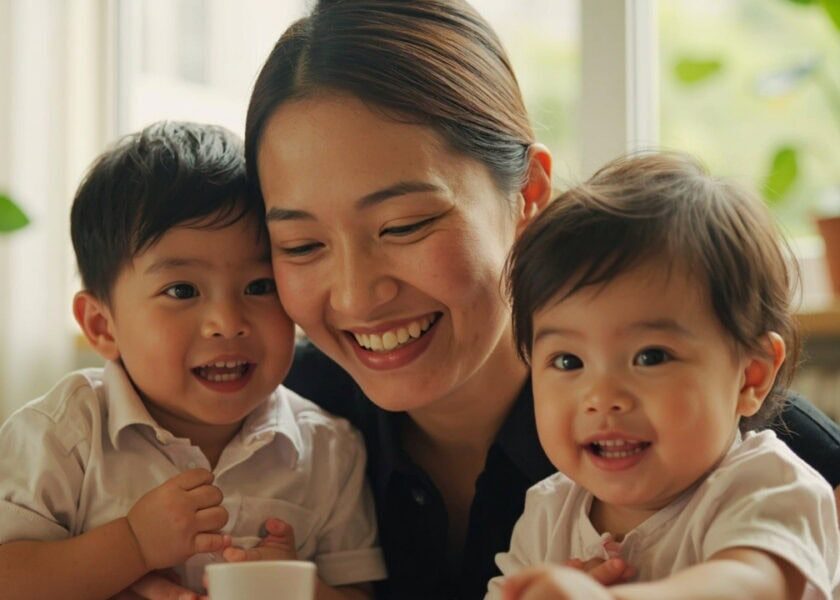
In households where quality care has been in place, this moment tends to look a particular way. The child reaches, sometimes literally stretches their arms out, with a kind of openness and joy that is unmistakable. They have not been pining. They have been living, exploring, being tended to. And now they are delighted to see you.
Not because you are the only person who has ever held them, but because you are the person they love most, and the hours apart have not changed that. If anything, the reunion is made sweeter by the fact that both parties return to each other more whole than they left.
These reunion moments, day after day, accumulate into something profound. They become the texture of your relationship. They become the foundation of a bond that is not fragile, not threatened by distance or time, but resilient and deepening.
Your child learns, through repetition, that leaving and returning is safe. That you always come back. That the people who love them also have lives and responsibilities and needs, and that this does not diminish the love.
Responding to the Doubters
I want to pause here and speak directly to something I know many of you are carrying. It is the weight of other people’s opinions.
The mother-in-law who shakes her head and says young children need their mothers. The colleague who remarks, almost casually, that they could never leave their baby with someone else. The well-meaning friend who asks, with genuine concern in their voice, whether your child cries when you drop them off.
These comments land because they touch the very fear I named at the beginning. And they can make even the most confident parent begin to doubt.
The people who offer these opinions are usually not malicious. They are often coming from a place of love, or at least from a place of the cultural narratives they absorbed when they were becoming parents. But their narratives are not necessarily your narratives. And their fear, however well-intentioned, does not get to define your relationship with your child.
When someone asks you how you can leave your baby, you might try a response that I have found useful over the years:
I am not leaving my baby. I am choosing to build a village. The person caring for my child is not replacing me. They are extending the circle of love and security that my child is growing up inside. And when I come home, I am a better, more present, more connected parent because of the support I have had during the day.
That is not a compromise. That is a choice.
The language we use shapes the way we feel. If you tell yourself every morning that you are abandoning your child, you will feel the weight of that abandonment all day. If you tell yourself that you are stepping into a supportive partnership, one that involves professionals who care about your child’s development as much as you do, you will feel something different. You will feel like what you are doing is what it actually is: loving your child enough to make a hard choice well.
Finding the Right Fit: What to Look For in Infant Care
EduNanny Singapore approaches childminding as a complement to parental care, not a replacement for it. Their model is built on the understanding that children develop best when they experience consistent, responsive relationships, and that parents thrive when they have trusted support. When care is delivered by trained, vetted caregivers in thoughtfully designed environments with low infant ratios, something meaningful shifts. Parents stop feeling like they are giving something away and start feeling like they are receiving something invaluable.
What sets quality childminding apart is not just logistics, though logistics matter. It is the philosophy underneath: a belief that a child’s early years are not just a period to be survived but a foundation to be built. It is the understanding that Singapore parents carry unique pressures, and that the answer is not to do more with less, but to surround families with support that actually works.
Questions to Ask When Choosing Infant Care
- What is the caregiver-to-infant ratio? Lower ratios mean more individual attention, more responsiveness to your child’s cues, more consistency in the relationships formed.
- Are the same caregivers present day after day? Consistency is not just a nice-to-have. It is the foundation on which secure attachment is built.
- How is communication handled? Do you receive regular updates about your child’s day, their discoveries, their moods? This transparency is what allows you to feel connected even when you are apart.
- How does the programme understand and support attachment? Does the approach treat childcare as a logistical arrangement, or as a relational one? Does it see itself as working alongside you, or as a replacement for you?
- What happens at the reunion? Observe how children and parents reconnect. The quality of that moment tells you a great deal about the quality of the care that preceded it.
The Truth You Are Ready to Hear
I want to close by returning to that fear I named at the beginning. Because it deserves to be honoured, not dismissed.
The fear that choosing quality childcare might diminish your bond with your child is not irrational. It comes from love. It comes from understanding that the early years are irreplaceable, that what happens in the first thousand days of life leaves a lasting imprint, that your child needs you in ways that no one else can meet.
All of this is true. And none of it contradicts what I have shared with you today.
Here is the truth that I believe Singapore parents are ready to hear. Your child does not need you to be with them every single moment. They need you to love them consistently, to return to them fully, to show up with your whole self when you are with them. They need you to model for them what a secure, loving relationship looks like.
And sometimes, the most loving thing you can do is step back, trust the village you have built, and give yourself the space to become the parent you are capable of being.
The childcare decision you make is not a referendum on your love. It is an expression of it. When you choose quality care, you are not saying that someone else can do it better. You are saying that you understand your child deserves more than one person who is fully present and emotionally available, and that you are wise enough to build that village.
You are saying that you trust yourself enough to accept help, and that you trust the people you have chosen to be part of your child’s life.
When you choose quality care, you are saying that you want to be the best version of yourself when you are with your child, not a depleted, exhausted version who is running on fumes. You are giving yourself permission to be human, to need support, to have a life beyond parenthood that feeds you and restores you so that you can return to your child ready to play, ready to listen, ready to love.
That is not a compromise. That is not giving up. That is the most courageous and clear-eyed act of love that a parent can choose.
Your child will not remember every moment of every day. But they will remember the feeling of being secure. They will remember that the people who loved them were also loved by other people who treated them well. They will remember that coming home was always a good feeling, because they always came back to someone who was genuinely happy to see them.
That is the bond you are building. Not despite the hours apart, but through them.
You are not giving your child a lesser version of yourself. You are giving them the best version you can be. And that is enough. That has always been enough.
The right childcare does not take anything away from your relationship with your child. It gives something back. It gives you back to yourself, and in doing so, it gives your child back to you, more expressive, more secure, more ready to love you and be loved by you than they might have been otherwise.
That is the truth. And now you know it.
Begin the Conversation
Choosing the right childcare is one of the most personal decisions you will make as a parent. It deserves more than a checklist or a comparison chart. It deserves a thoughtful conversation.
EduNanny Singapore works with families navigating this decision every day. They understand the love and the doubt that sit side by side when you are making this choice. Their team is here to answer your questions, address your concerns, and help you understand what quality childminding looks and feels like when it is built on genuine understanding rather than just logistics.
If you are ready to explore what a trusted, development-focused childminding approach could look like for your family, get in touch. You can also learn more about the ECDA Childminding Pilot and how it supports Singapore families, or read about EduNanny’s approach.