The Observation Advantage: What Professional Eyes Catch That Parents Miss
Will They Really See My Child? The Question Every Singapore Parent Is Afraid to Ask
There is a question that most Singapore parents carry quietly, sometimes even before they enrol their child in any care arrangement. It surfaces at the tour of the centre. During the first meeting with a caregiver. In those uncertain first days when you hand over your infant and watch someone else hold what feels like the most precious thing in your life.
The question is rarely spoken aloud. It is too vulnerable to voice directly. But it is there, and it sounds something like this:
Will they really see my child?
Not just take care of them. Not just keep them safe, fed, and happy. But see them. Understand what makes them tick. Notice the things that matter.
You love your child with a depth that no one else can replicate. You know their moods, their fears, their joys, the particular quality of their laugh. You know the way they need comfort when they are tired versus when they are hungry. You know them because you are their family.
And so there is this quiet, persistent fear—that no matter how warm the caregiver, how lovely the environment, how excellent the programme—professional care will always be, at some fundamental level, surface-level. That the people looking after your child are doing exactly that: looking after them. But not truly knowing them.
This fear is not irrational. It is not the worry of an overprotective parent or the guilt of someone who should not have gone back to work. It is one of the most honest concerns a parent can have.
And it is, in many ways, the right question to ask. Because the truth is: not all childcare is the same. Not all caregivers observe the same way. And the difference between a caregiver who watches and a caregiver who truly sees is not a matter of warmth or love—it is a matter of training.
Observation Is Not the Same as Watching
Let me draw a distinction that matters enormously when you are choosing who will care for your child.
Watching is passive. It is what any of us do when we glance at a child across a room. We register that they are playing, that they seem happy, that they are safe. This is necessary. But it is not enough.
Observation is active. It is deliberate. It is the skill of noticing what matters, understanding why it matters, and recording what you see in a way that reveals patterns over time.
A trained educator has spent years learning how children develop. What typical looks like. What variations mean. How to distinguish between a temporary behaviour and a developmental shift. This is not intuition. It is expertise applied consistently, day after day, to the children in their care.
When you evaluate a childcare arrangement, one of the most important questions you can ask is not “What is your teacher-to-child ratio?” or “What curriculum do you follow?” It is: “How do your educators observe and document what they see?”
The answer will tell you more about whether your child will genuinely be seen than almost any other detail.
What Trained Educators Notice That Parents May Miss
Here is something that might surprise you: a trained observer can often see patterns that parents themselves miss.
This is not because parents do not love their children enough. It is because proximity can blur as much as it illuminates. When you are with your child every day, you adapt to their rhythms. You stop noticing the things that have always been there.
The educator who sees your child for a few hours each day—who has seen hundreds of children pass through her care, who knows the developmental markers and the warning signs and the beautiful variations—that educator notices things you cannot see simply because you are too close.
Consider some concrete examples:
- Laterality preference. Your educator notices that your child is favouring one hand during activities. This may be the early signal of a laterality preference emerging right on schedule. Understanding this helps you support their developing motor skills appropriately.
- Temporary regressions. Your child’s behaviour shifts noticeably for a few weeks. To a parent, this might seem concerning. To a trained observer, it may be linked to a developmental leap that is occupying all of your child’s cognitive energy—a known pattern in early development.
- Temperament patterns. Your child seems shy with other children at first, then becomes fiercely loyal once trust is established. A trained educator recognises this as a temperament pattern, not shyness. This insight gives you language to understand how your child builds friendships—and how to support that process at home.
- Emotional vocabulary needs. Your educator notices that your child often resorts to tears before she can articulate what she needs. Offering emotional words proactively—before frustration builds—may help your child communicate more effectively.
These are the things that trained observation catches. And they are exactly the kind of understanding that accumulates over time when observation is treated as a professional practice, not an afterthought.
By the second week, your educator begins to notice preferences. This child loves the sandpit. That child resists nap time but falls asleep easily after outdoor play. Small patterns emerge.
By the third month, your educator has a map. She knows that this child is energised by outdoor play and needs a quiet transition before nap time. She knows that this child struggles with sudden transitions and responds better to warnings than to surprise changes. She knows that this child has a remarkable vocabulary for emotions and needs to be offered words before she resorts to tears.
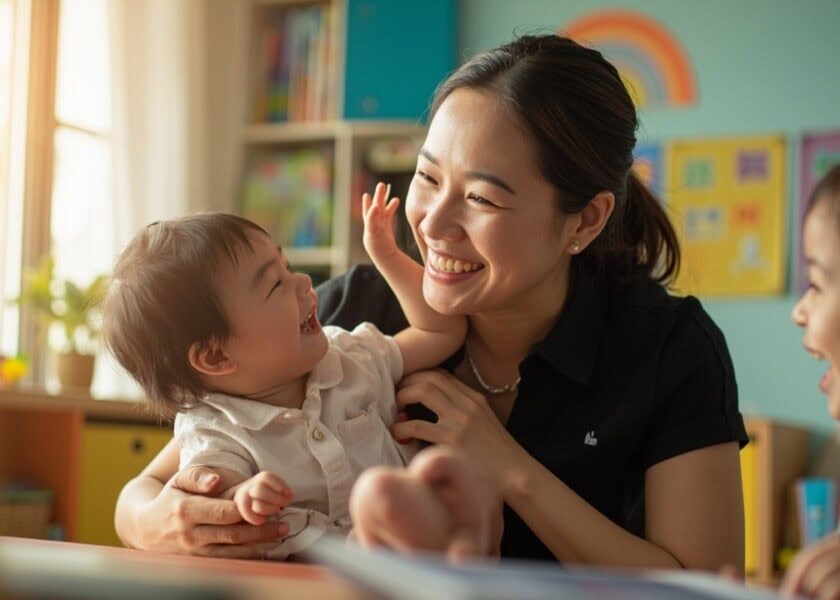
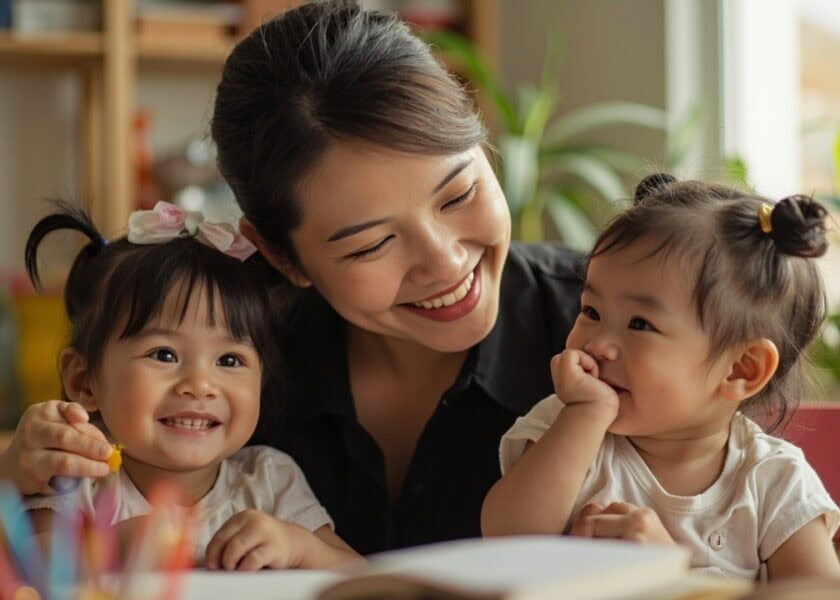
She knows your child. Not instead of you. Not as well as you. But in addition to you. She is a second set of trained eyes on the most important person in your life.
What Quality Childminding Actually Looks Like
In Singapore, the stakes of early development can feel overwhelming. You are balancing careers and family, aspiration and presence, the desire to give your child every advantage and the recognition that childhood is not a race. You are making decisions about childcare not because you want to delegate parenthood, but because life here moves at a pace that does not pause for three years of full-time presence.
So you need the childcare you choose to be more than adequate. You need it to be genuinely good for your child. You need it to understand them.
When you visit a centre or meet with a caregiver, here are the signs that observation is taken seriously:
- Documentation practices. Educators record what they observe in structured ways—not just casual notes, but organised observations that reveal patterns over time.
- Communication depth. Updates go beyond “child had a good day.” You hear about specific moments, developmental observations, and what they suggest about your child’s current needs.
- Low ratios. One educator cannot truly observe and understand twelve children simultaneously. Infant ratios that allow genuine attention matter.
- Consistency. The same educator observes the same children over time. Rotation may be efficient for centres, but it prevents the deep understanding that comes from sustained attention.
- Transparency. Parents are offered meaningful visibility into what happens during care—not just photos, but genuine insight.
And here is the single most revealing question you can ask any provider:
“Can you tell me about a recent observation you made of a child that led to useful insight for the parents?”
A provider who takes observation seriously will have an answer ready. They will describe a specific child, a specific observation, and what it revealed. This is how you know your child will be seen—not by promises, but by practice.
How EduNanny Approaches Professional Observation
EduNanny by BUTLER participates in the ECDA Childminding Pilot, which means our educators are trained in professional observation techniques. They are equipped to notice what matters and to share those observations with you in ways that are meaningful rather than merely procedural.
Depending on the pathway—whether home-based, community, or centre-based—our infant ratios can be as low as one educator to three infants. This is designed to ensure that your child is not one of many. They are one of few. Seen and known and understood.
Choosing EduNanny means:
- Trained observation. Our educators understand child development not as an abstract concept but as a lived practice. They know what to look for and why it matters.
- Honest communication. We share what we see, what it might mean, and what it suggests about your child’s development and needs. No sugar-coating, no vague reassurances—just professional insight offered in partnership with you.
- Visibility where deployed. In arrangements where CCTV measures are in place, we offer transparency as a matter of principle. Trust is built through clarity, not mystery.
- Accessibility. EduNanny operates Monday through Friday, in care blocks designed to fit the rhythm of working families. CDA and Baby Bonus funds are applicable. You should not have to choose between the care your child deserves and the care you can afford.
You may still have questions. That is reasonable.
Will they really understand my child better than I do? No. And that is not what we claim. You know your child in ways no educator ever will. We are not here to replace that knowledge. We are here to add something: the trained, consistent, professional observation of someone who knows what to look for and why it matters. Someone who sees your child from a different angle. Someone who notices what proximity might have obscured.
How do I know the observations are accurate? Over time, as understanding accumulates, you will have opportunities to verify what we observe. You will notice something about your child that surprises you, and you will realise it is true. Your educator will tell you about a developmental leap your child has made, and you will see it at home the next week. You will think: She was right. She was paying attention. She was really seeing him.
What if I disagree with what they observe? We welcome that conversation. You are your child’s expert. When we share an observation, we are offering a perspective, not a verdict. Professional observation is not about the educator knowing best. It is about having an additional trained set of eyes—eyes that notice what matters and share what they see in a spirit of genuine partnership with you.
The Highest Form of Care—and What It Means for You
Observation is the highest form of care.
Not because warmth is unimportant—it is essential, and it is present in every relationship worth having with your child. But because warmth without understanding is incomplete.
A caregiver can love your child and still miss the signal that something is shifting. A caregiver can be kind and attentive and still not see the pattern that, if noticed, would give you a window into your child’s world you did not have before.
But an educator who observes—not just watches, but observes—sees your child with clarity. She sees them with the trained eye that comes from knowing child development, from seeing hundreds of children grow, from understanding what is typical and what is extraordinary and what is simply your child being exactly who they are.
When you are evaluating childcare options, look beyond the surface impressions. Ask about observation practices. Ask to see examples of documentation. Ask the educators about their training and how they apply it. Ask about consistency of care.
And then ask yourself: Do these people notice what matters?
Because that is the skill that separates quality childcare from basic supervision. Not the size of the centre. Not the colour of the walls. Not even the qualifications printed on a certificate.
The skill is observation. The art is noticing.
If you have read this far, you are probably that parent. The one who has asked that quiet question in the tour, in the meeting, in the first uncertain days of care. Will they really see my child?
Here is our answer: Yes. We can see them.
Not instead of you. Not as well as you. But in a way that complements what you know, that adds to it, that gives you insight you cannot get from proximity alone.
We will notice what matters. We will tell you what we see. And over time, as understanding accumulates, you will have something more valuable than a report on your child’s day.
You will have a portrait of who they are becoming.
If you are researching infant care or childminding options in Singapore and want to understand how professional observation works in practice, we invite you to speak with our team.
To learn more about EduNanny and our approach to development-focused childminding, visit our homepage or read about our participation in the ECDA Childminding Pilot.