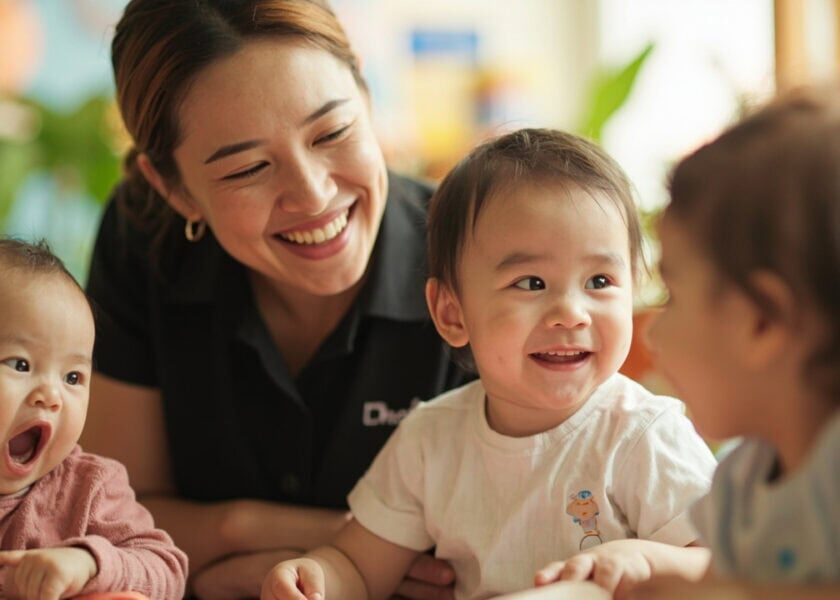
Early Years, Lasting Impact: Choosing Childcare That Builds Brains
What Quality Childcare Actually Builds
When you choose where your infant or toddler spends their early years, you are choosing the environment that helps build their brain.
In the first years of life, your child’s brain is constructing itself at a pace it will never match again. The neural connections that form during these early years establish the pathways through which your child will think, learn, feel, and relate for the rest of their life. This is not a metaphor. It is developmental science.
Developmental researchers call these sensitive periods — windows of time when certain types of development are especially open to being shaped by experience. Emotional regulation, social confidence, the capacity for secure attachment, a disposition toward curiosity rather than fear — these are all being built in the years before your child starts formal school. Not exclusively, but primarily. The foundations are laid early. What is built later is built on those foundations.
The hours your child spends in quality care are not empty hours. They are developmental hours. The question is not whether they matter, but whether the care your child receives is shaping them in the ways you hope.
The Five Competencies That Matter Most
It is easy to say that good childcare is important. But without understanding what it produces, that statement remains abstract. Here is what is actually being constructed during those early years.
Emotional Regulation
The ability to recognize what you are feeling, to tolerate frustration, to recover from disappointment, to self-soothe — this is not an innate trait. It is a skill, learned through experience, through being helped to regulate by responsive caregivers who do not shame a child’s big emotions but sit with them and teach. In quality care, infants and toddlers have repeated opportunities to practice with patient, skilled support. They learn because someone was there, in that moment of distress, and helped them through.
Social Confidence
The capacity to approach other children, to share, to navigate conflict, to read social cues, to cooperate — these require practice in a safe social environment. In quality care, children have daily opportunities to interact with peers under the guidance of caregivers who model and teach social skills. They learn that relationships are rewarding, that other children are interesting, that they can be known and valued by people outside their immediate family.
Curiosity as a Disposition
Not just intelligence, but the willingness to be interested, to ask questions, to explore, to tolerate the uncertainty of not knowing. This is learned in environments that encourage exploration, that treat a child’s questions as worthy of engagement, that do not rush to answers but invite deeper wondering.
Secure Attachment
The capacity to trust that the world is a safe place, that relationships are reliable, that people will respond when you reach out. When an infant cries and someone comes. When a toddler seeks comfort and finds it. When a child learns that their needs will be met. This builds the internal working model of relationships that will shape how they relate to others for the rest of their life.
A Sense of Being Known and Valued
Perhaps the most quietly powerful outcome. Children who grow up in quality care environments where caregivers truly know them — their preferences, their fears, their joys, their particular ways of being — carry that sense of being significant into their future. They learn that they are worth knowing.
Why These Are Not Soft Outcomes
- Emotional regulation allows a child to sit in a classroom and learn rather than being derailed by frustration.
- Social confidence is the foundation for the cooperation, collaboration, and relationship-building that every successful adult needs.
- Curiosity is the engine of lifelong learning.
- Secure attachment is the basis for mental health, for the ability to form healthy relationships, for resilience in the face of difficulty.
- A sense of being known and valued is the wellspring of self-worth.
These are the competencies that determine school readiness, relationship quality, and lifelong well-being. They are being built in the years before school begins — in the years when you are choosing childcare.
The Invisible Work of Development
Most of what I have described happens invisibly. You will not see your child’s emotional regulation developing on any given day. You will not observe their sense of secure attachment forming. You will not witness the growth of their curiosity during the hours they are in care.
This is one of the reasons that choosing childcare can feel so uncertain. You are making a decision with long-term consequences, but you cannot yet see those consequences. You are building something invisible.
What you cannot see is still real. The fact that you cannot observe your child’s secure attachment forming does not mean it is not forming. The fact that you cannot see the neural pathways being built does not mean they are not being built. The early years are architecturally formative whether or not you can see the construction happening.
What you can do is choose an environment where this construction is likely to happen well. You can choose caregivers who understand development, who respond consistently, who create the conditions for these skills to grow. You can choose a setting that values the daily moments as the site of developmental work, not just as hours to be managed.
This is what separates quality care from adequate supervision. Adequate supervision keeps children safe and occupied. Quality care uses time as the medium through which development is shaped — recognizing that every interaction, every response to a child’s distress, every encouragement of exploration, every instance of patient guidance through social conflict, is contributing to the person your child is becoming.
How to Recognize Quality Care
For parents navigating this decision in Singapore, knowing what to look for can make an enormous difference. Here is how you can distinguish quality developmental care from adequate supervision.
Look for responsive, consistent caregivers
The single most important factor in early childhood development is the quality of relationships. Look for caregivers who respond to your child as a person — who notice what your child is feeling, who engage with their interests, who are patient with distress rather than dismissive. Consistency matters too: the same faces, day after day, allow your child to build the relationships that secure attachment requires.
Check the ratios
Ratios matter more than most parents realize. When there are too many children and not enough adults, the kind of attunement I have described becomes impossible. Caregivers cannot truly respond to individual children when they are managing a large group. Ask about caregiver-to-child ratios. This is not a detail — it is the condition that makes everything else possible.
Observe how caregivers handle moments of difficulty
The way a caregiver responds when a child is frustrated, upset, or escalated tells you almost everything you need to know. Do they distract and dismiss? Or do they sit with the child, acknowledge the feeling, and help them through? Ask a prospective caregiver: what do you do when a child has a meltdown? Listen for patience, for developmental understanding, for a philosophy that treats emotional distress as an opportunity rather than a problem.
Notice whether your child is known
In quality care, your child is not one of many. They are a specific person with specific preferences, fears, joys, and ways of being. Ask how caregivers learn about each child. Ask how they document or communicate your child’s development. The best care settings have systems for understanding each child deeply — not just for safety and scheduling, but for the purpose of genuinely supporting who they are becoming.
Ask about the daily philosophy
Quality care is not defined by a curriculum or a set of activities. It is defined by a way of being with children. Ask prospective providers: what do you believe about how children learn and grow? Listen for an answer that goes beyond logistics and safety to something about development, relationship, and the purpose of care.
Trust your observations over promises
Visit more than once, if possible. Observe interactions. Watch how children move through their day. Notice whether the environment feels warm and alive, or institutional and routine-driven. The best providers will welcome your questions and your observations. They will not be defensive about transparency.
The Singapore Context: Navigating Real Pressures
I want to speak honestly about what it is like to navigate this decision as a parent in Singapore, because the pressures here are particular and deserve acknowledgment.
Singapore parents are ambitious. You want the best for your children, and you understand the competitive landscape that awaits them. You are navigating high costs of living, demanding work expectations, and a culture that values educational achievement. You are also navigating the advice of multiple generations, the expectations of extended family, and the noise of a childcare market that offers many options with very different philosophies.
On top of all of that, you may be feeling the particular guilt of the working parent — the sense that time spent away from your child is time lost. I want to name that honestly. It is real, and it is heavy.
Here is the reframe: the hours your child spends in quality care are not lost hours. They are developmental hours. The question is not whether your child needs you — they do, and nothing replaces parental love. The question is whether the environment you choose for the hours you are apart is shaping your child in the ways you hope.
You are not choosing between being a good parent and going back to work. You are choosing how the developmental hours during your working day are spent. That is a choice you can make well, with intention and with confidence.
EduNanny by BUTLER: An Approach Built on Developmental Understanding
This is what we have built at EduNanny by BUTLER. And I want to be specific about what that means, because you deserve to understand what you are choosing — not as a leap of faith, but as an informed decision.
EduNanny operates under the ECDA Childminding Pilot, which reflects a deliberate philosophy of care. Our approach is built on the understanding that infant care is not babysitting with enrichment added. It is developmental work, and it requires the conditions that allow developmental work to happen well.
That begins with ratios. We maintain caregiver-to-child ratios that make genuine responsiveness possible — up to one caregiver for every three infants in our infant care settings. This is not an accident of regulation; it is a design choice that reflects our belief that children develop best when they are truly seen and known.
Our caregivers are trained not just in safety and logistics, but in child development. They understand the milestones, the sensitive periods, the importance of responsive interaction. They are not just keeping your children safe. They are building the competencies I have described — emotional regulation, social confidence, curiosity, secure attachment, a sense of being known.
We offer both home-based and community-based pathways, recognizing that different families have different needs. For some families, care in the child’s own home, with a consistent caregiver who becomes part of the family’s daily life, is the right fit. For others, a community setting where children interact with peers offers important social development. Both pathways are grounded in the same developmental philosophy. Both prioritize the quality of relationship and interaction.
For working parents, logistics matter, and we have designed our scheduling to be practical — Monday to Friday, in structured blocks that give your child the consistency they need. For families navigating cost, we have worked to keep our pilot fees affordable, and we accept CDA and Baby Bonus funds, because we believe that quality developmental care should not be available only to the most affluent families.
And because we know that trust is earned through transparency, we have implemented communication measures, including CCTV in spaces where it supports safety and oversight, so that you can see what your child is experiencing during the hours you are apart.
What You Are Actually Choosing
There will come a day — perhaps at a birthday party, perhaps in a school classroom, perhaps in a moment of conflict with a sibling or a friend — when you will see your child’s confidence and not know where it came from. You will see their curiosity, their social ease, their emotional resilience.
And you will realize that it was built. It was built in the hours when you were not there, in the care of people who understood that every moment was an opportunity to shape the person your child was becoming.
That day, you will understand what you were actually choosing all along. You were not just choosing childcare. You were choosing to participate in building your child’s future.
I want to leave you with that understanding today, before the years have passed and the results are visible. Because the choice you make now — the quality of care you choose, the environment you trust with your child’s early years — will shape what you see years from now.
The early years are the foundation. What you build on that foundation, in these years you cannot get back, matters enormously. Choose carefully. Choose with the long view in mind. Choose care that understands development as its purpose, not a service that keeps your child occupied while you work.
If this understanding of childcare resonates with you — if you believe that the early years are a developmental foundation, not just a logistical solution — we would welcome the opportunity to talk with you about what EduNanny by BUTLER offers.
We know this is not a small decision. We know you are choosing something that matters enormously. We are here to answer your questions, to show you how we work, and to help you understand whether our approach is the right fit for your family.
Because every child in Singapore deserves care that understands what it is building. And every parent deserves to feel confident that their choice is shaping something lasting.
That is what we are here for. That is the work we believe in.
If you would like to learn more about our approach, we welcome you to get in touch or read more about who we are.