The Philosophy of Raising Siblings Who Choose Each Other
“`html
The Gap No One Talks About
Most childcare models begin with a single child in mind. A child who needs routine. Stimulation. School readiness. These are worthy goals, but they leave something unaddressed — the quiet, persistent hope that your children would not just be siblings who share a home, but siblings who share a life.
You hope that somewhere between the squabbling over toys and the whispered secrets before bedtime, a bond would form that no adult could manufacture. A bond that would last long after you are gone.
Singapore parents did not plan for logistics alone. They planned for family — for the sibling who would catch your oldest when they stumble, for the confidante who would sit beside your youngest during their first difficult conversation. They planned for ally.
And yet, childcare options often feel designed for a different family altogether — one child, or siblings expected to slot into the same routine without friction, without individual needs, without the delicate texture of sibling relationship.
What Sibling Care Actually Means
Real sibling care is not childcare that happens to accommodate two children in the same room. It is not the assumption that siblings will simply adjust without intentional support.
It is a philosophy. It begins with understanding that siblings are a unit — a volatile, miraculous unit with its own internal logic, its own rhythms of conflict and reconciliation.
Anyone who has watched two siblings solve a problem together — truly solve it, in a way adults cannot replicate — knows this is development happening in real time. Children learning collaboration, empathy, negotiation, and the profound satisfaction of being known by another person who shares their context.
The Difference That Matters
When childcare providers understand sibling dynamics, they do not merely separate children when they argue. They watch what triggers the argument. They notice if the older child is feeling displaced and needs to be reminded of their role as a mentor. They notice if the younger child is testing boundaries through the older sibling because the safe container of sibling interaction feels like the right place to take a risk.
They intervene not to end the conflict but to guide it — to help children move through friction toward resolution, which is where the real learning happens. This is the difference between childcare that simply works and childcare that matters.
The Singapore Reality
In Singapore, the multi-child household is not a demographic trend — it is a family reality that shapes how parents think about care, about time, about the future. Singapore remains one of the world’s most family-oriented societies, with birth rates that still reflect a widespread belief that children should not grow up alone.
Yet Singapore parents face specific pressures that make quality sibling care not just desirable but necessary:
- Long working hours mean children spend significant portions of their formative hours in care settings
- HDB living creates intimate family spaces where sibling dynamics are amplified
- Cost considerations make affordability a daily calculation, not an abstraction
- Government support through schemes like the Child Development Account and Baby Bonus creates real pathways to accessible care
When parents do not have to worry about whether they can keep their children in the programme, they can focus on what matters: the development of their children, individually and together.
What EduNanny Looks Like: A Morning in Practice
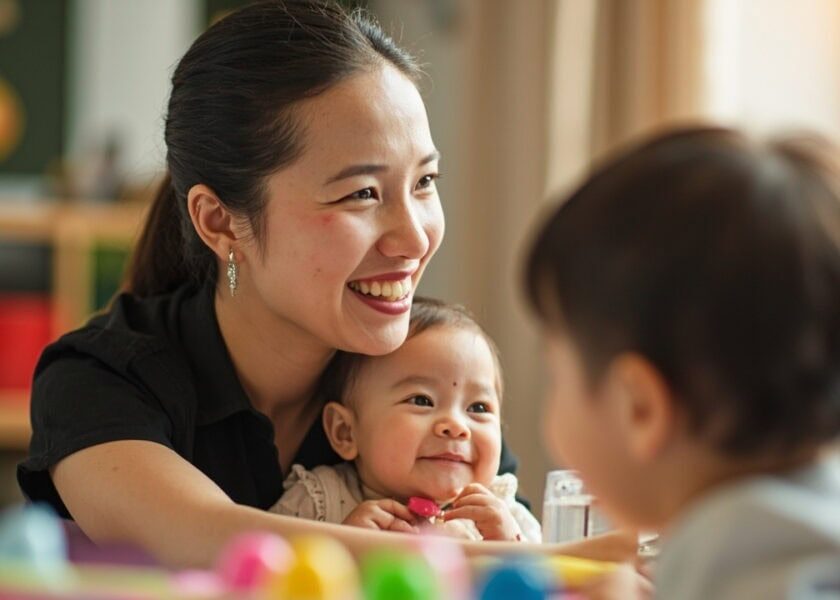
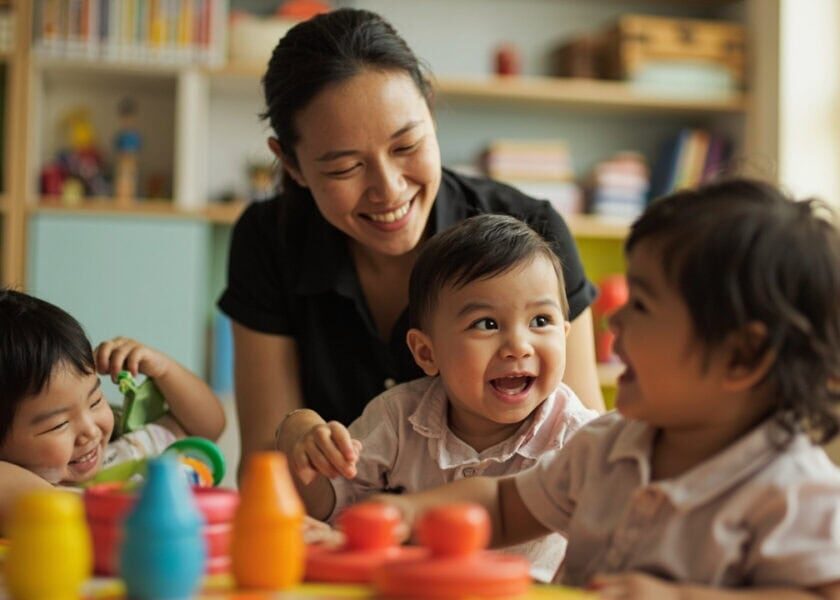
Imagine a morning where your children arrive and the caregiver has already prepared the environment with activities that allow for both individual focus and collaborative play.
Perhaps your older child is working on a drawing while your younger child plays with stacking cups nearby — separate activities, yes, but in the same space, with the same caregiver present, with easy opportunity for the younger child to approach and the older child to invite.
Then, later, a shared project: building a tower with blocks that requires the older child to hand blocks to the younger and the younger child to stack them. The caregiver watches, encourages, steps in only when needed. When the tower inevitably falls, she helps them process the frustration together, asks questions that lead them to problem-solve, and watches as they decide to rebuild.
This decision — to rebuild, to try again together — is not scripted. It is emergent. It arises from the relationship. And it is the exact kind of experience that will shape how your children approach collaboration, resilience, and partnership for the rest of their lives.
The Caregiver’s Role: Reading, Not Just Supervising
When a caregiver-to-child ratio allows for true responsiveness, care shifts from supervision to observation. A caregiver who understands sibling dynamics notices the milestones that belong to each child individually — the first time your daughter stacks three blocks instead of two, the moment your son decides to share his snack without being asked — and the milestones that belong to the sibling relationship itself:
- The first time your children solve a problem without an adult’s intervention
- The first time they defend each other, or comfort each other
- The first time they include each other in a game that neither could have invented alone
These are not small moments. They are the building blocks of a lifelong bond. Morning check-ins address each child’s needs separately and together — understanding how each child slept, how each child ate, whether there are tensions from the night before that need gentle attention. These are not bureaucratic check-ins. They are acts of understanding. And understanding, as any parent knows, is the beginning of peace.
Addressing Your Real Concerns
Will my children receive individual attention?
In quality sibling care, individual attention does not mean isolated attention. It means that each child is seen as a complete person with their own temperament, their own pace of development, their own way of experiencing the world.
Your four-year-old needs to be challenged at her level, not held back by her younger brother’s pace. Your two-year-old needs to be allowed to explore at his pace, not rushed by his older sister’s expectations. Both of them need opportunities to be together, as siblings, in ways that build the bond you hope will outlast your own lifetime.
What about sibling rivalry?
Sibling rivalry is not inevitable — it is often a symptom of unmet needs. When children feel that the system is designed for one child and the other is an afterthought, rivalry flourishes. When each child feels genuinely seen, genuinely valued, and genuinely supported in their individual development, rivalry diminishes.
A caregiver who understands this does not treat conflict as a problem to be eliminated. She treats it as information — asking what this child is needing that they are expressing through frustration, what void they are seeking to fill through conflict.
Is this care affordable?
Affordability is not an abstraction. It is a daily calculation for every family navigating the cost of raising children in Singapore. That is why EduNanny’s pilot fee structures are designed to be accessible — not subsidized to the point of compromise, but genuinely affordable within the framework of what Singapore families can sustain.
We also work with the tools the government has made available: the Child Development Account, the Baby Bonus schemes, and the various subsidies for which eligible families may qualify. These are real mechanisms that can make the difference between care that stretches a family’s budget and care that a family can trust to be sustainable.
How do I know I can trust the care?
Trust is earned, not assumed. Communication is built into every level of our service. Parents receive regular updates — not just perfunctory reports of meals and naps, but meaningful observations about their children’s development, their interactions, their moments of growth and their moments of struggle.
Where CCTV measures are deployed, they are deployed not as surveillance but as accountability — a tool that allows parents to see the environment their children are in. This is not about distrust. It is about the kind of radical transparency that allows parents to relax, to trust, to focus on their own work knowing that their children are in a place where nothing is hidden and everything is intentional.
Questions to Ask When Choosing Childcare for Multiple Children
If you are researching childcare for siblings in Singapore, here are the questions that matter most:
- How does the caregiver approach conflict between siblings? Do they separate children, or do they guide resolution?
- How are individual milestones tracked for each child? Is there documentation that reflects each child’s unique development, not just the pair’s combined activities?
- What is the caregiver-to-child ratio? For infants, a ratio of one to three or better allows for the responsiveness siblings need.
- How are age-appropriate activities designed? Are siblings expected to do the same things, or are there parallel activities that respect developmental differences?
- What does communication with parents look like? Are updates meaningful, or merely procedural?
- How are subsidies and government schemes integrated? Can the provider help you understand what support you are eligible for?
The Long View: Why This Investment Matters
Research in child development consistently shows that sibling relationships are among the most enduring human bonds. The quality of those relationships is shaped, in significant part, by the environments in which children spend their formative hours.
When those hours are spent in a setting that sees each child individually and understands the relationship between them, the conditions for that lifelong bond are established. When those hours are spent in a setting that simply manages two children in the same room, the opportunity is missed. Not lost entirely — siblings are resilient, and the bond is powerful — but missed. An opportunity that might have been seized is allowed to slip away.
You want them to be allies. You want them to have each other when you are old, or far away, or gone. This is not a small hope. It is the hope that drives so many of the decisions you make — the schools you choose, the neighbourhoods you live in, the sacrifices you make to be present at graduations and recitals and ordinary Tuesday dinners.
It is the hope that siblings raised well will become the family your children choose, not just the family they were born into.
EduNanny Singapore: Built for This Hope
EduNanny was founded on a different premise. We believe that when parents bring multiple children into childcare, they are not simply asking for the logistics of supervision to be handled. They are asking for something more profound. They are asking for their children to be understood — individually and together.
We are part of the ECDA Childminding Pilot, which means our approach has been shaped not just by best practices in early childhood development, but by the specific realities of Singapore families. We offer pathways that include home-based care, community-based options, and centre-based support, because we know that families are not monolithic. A family with a newborn and a three-year-old has different needs than a family with twins, or a single parent navigating the school run with a toddler and a kindergartener. Our job is not to fit families into a predetermined model. Our job is to find the model that fits the family.
And because parents do not stop being parents at 6 PM, our AI chatbot Thomas is ready to answer your questions at any hour — about development, about sibling dynamics, about how to support a particular challenge at home. Thomas is not a replacement for human caregiver relationships. He is an extension of them — a resource that is always available, always patient, always ready to point you toward the information or the reassurance you need.
If you would like to talk to someone who understands, we would welcome that conversation. We would like to understand your family — each child, their temperaments, their relationship, the specific dynamics that make your household unique. We would like to share our philosophy and hear your hopes.
We would be honoured, if you let us, to help you build it for your family.
EduNanny is a development-focused childcare and childminding service for Singapore families. Learn more about our approach or our story.
“`