The Attachment Science That Frees Singapore Parents From Childcare Guilt
The Fear You Were Never Told to Name
This fear has a name, though most parents have never heard it called that. It is the single-attachment myth—the deeply held belief that a child’s emotional security depends on a singular, unbroken bond with one primary caregiver. And it is one of the most quietly destructive ideas floating around in Singapore parenting culture.
It persists not because parents are wrong to love their children, but because they have been given an incomplete map of how love actually works.
The single-attachment myth tells you that every hour your child spends with someone else is an hour subtracted from their emotional security. It positions childcare as a zero-sum equation: the caregiver gains what you lose. It suggests that the childcare decision itself is a compromise—a necessary sacrifice—a quiet surrender of something precious.
Here is the problem with this map: it is not accurate. And the guilt it generates is not only undeserved—it is actively counterproductive to the very thing you are trying to protect.
What Attachment Science Actually Tells Us
Let us start where the evidence starts: with John Bowlby, whose foundational work gave us attachment theory. Bowlby described the secure base—the emotional foundation from which a child explores the world and to which they return for comfort when things are uncertain. It is the platform from which they take their first steps away from you, knowing they can come back.
What subsequent research has clarified—particularly in the work of Mary Ainsworth, Mary Belsky, and the growing body of literature on multiple caregiver attachment—is something that rarely reaches parents in plain language:
A child can have more than one secure base. In fact, they should.
Human beings are not wired for single attachment. We are wired for connection. And connection, when it is secure, does not divide. It multiplies.
This is not a theoretical claim. It is decades of longitudinal research, observations across cultures and contexts, and developmental studies that have followed children into adulthood. The evidence is consistent: attachment security is built through consistent, attuned, responsive caregiving. It does not require one person. It requires that the people involved are reliable, that they read the child’s signals, and that they respond with warmth and appropriate timing.
A secure base is not a location. It is a quality of relationship.
When your child reaches for you at the end of a long day and you are there—warm, attuned, present—you are offering a secure base.
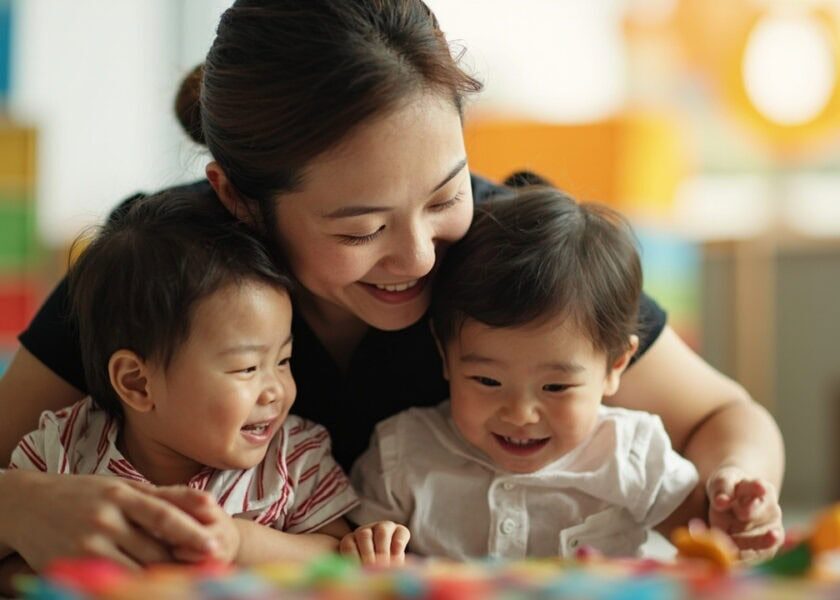
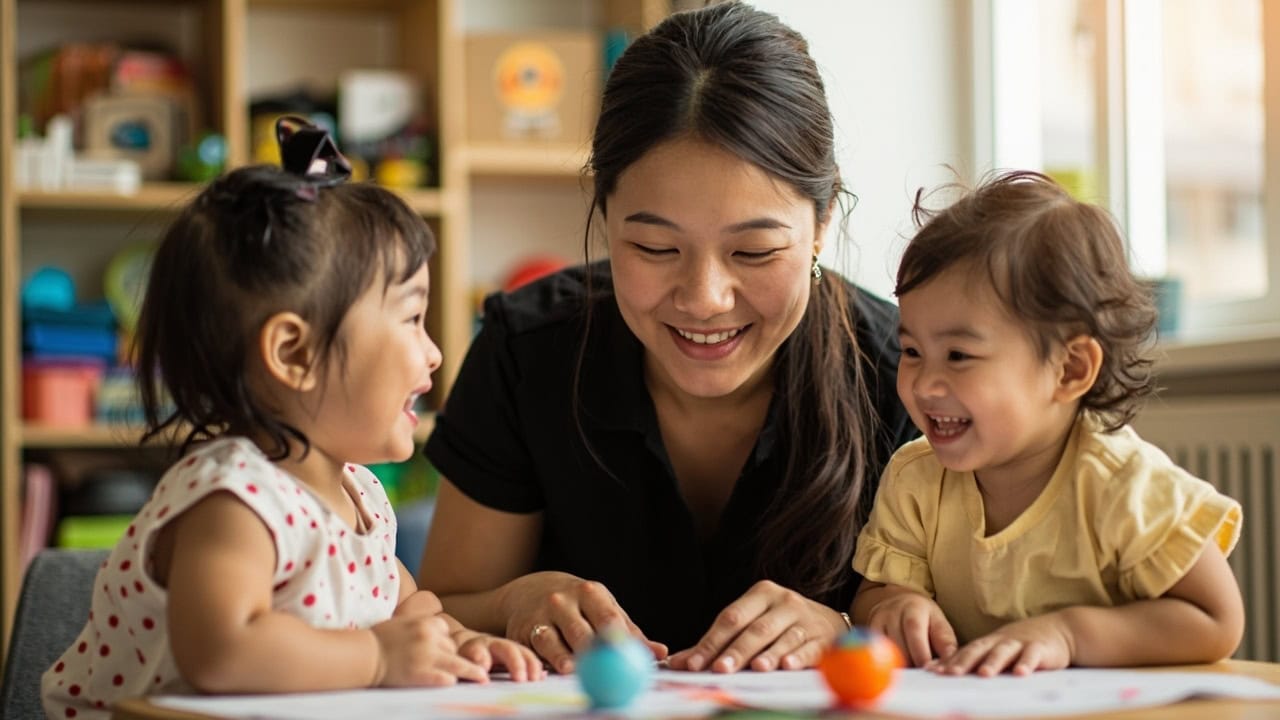
When your child, in the care of a trained professional, reaches for their caregiver and is met with the same quality of attention, the same reading of their cues, the same quiet regulation of their distress—that is also a secure base. Not a competing one. An additional one. One that reinforces the other.
What attachment security predicts is worth being clear about: emotional wellbeing and resilience, the capacity to learn and concentrate, the ability to recover from setbacks, healthy relationship formation throughout life, and a coherent, stable sense of self.
Children who have secure attachment foundations—even if they have experienced multiple caregivers, even if their parents work full-time—do better across virtually every measurable outcome. Not because they had one perfect parent. Because they had relationships that were good enough, consistent enough, attuned enough.
More Love Is Not Less Love
There is a phrase that captures something Singapore parents are rarely told plainly.
More love is not less love.
Your child’s heart is not a finite resource that gets divided up among the adults who care for them. It expands. It develops the capacity to hold multiple important people. The child who knows they are loved at home and who also trusts their caregiver—because trust has been built through consistent, attuned care—is not torn between two worlds. That child lives in a richer world. A world where their secure base has expanded to include more stability, more perspectives, more people who know their name and their preferences and their particular way of smiling when they are proud of themselves.
This is where the single-attachment myth causes so much unnecessary suffering. Parents in Singapore, caught between the demands of a competitive economy, the high cost of living, and the genuine desire to be present for their children, are carrying guilt that is not only undeserved but actively counterproductive.
When parents feel burdened by the childcare decision, when they approach each handover with anxiety they cannot hide, when they come home depleted and struggle to be emotionally available because they have been narrating to themselves all day that they are failing—that is what harms children. Not the childcare. The guilt.
What Quality Childminding Actually Looks Like
You may have heard the word “attunement” used by childcare professionals. It is worth pausing on what this means in practice, because it is not the same as warmth, and the difference matters enormously.
Warmth alone is not enough. A caregiver can love a child dearly and still fail to provide the responsive, consistent attunement that builds secure attachment. The difference is in the quality of attention.
Here is what attunement looks like in a day:
- Before lunch, a caregiver notices that a usually easygoing child is slightly off-color—their energy is different, their play is more tentative. She adjusts the morning routine accordingly, offering more comfort and less stimulation.
- During play, a caregiver reads the difference between a cry of frustration (“I wanted that block”) and a cry of genuine distress (“something startled me”). She responds differently to each.
- At rest time, a caregiver narrates a child’s experience back to them in a way that teaches them their feelings are valid and understandable: “You were so cross when Wei Liang took the red car. That was hard, wasn’t it? You wanted it too.”
- At handover, a caregiver gives a parent a coherent picture of the day—not just “she slept well” but “she was really proud of herself when she stacked all the blocks. She kept looking back at me to see if I saw.”
What is happening in those hours between drop-off and pickup is not a pause in your child’s development. It is development. It is your child learning that the world contains reliable adults who are not their parents but who are nonetheless safe. It is your child practicing separation and reunion—the rhythm that teaches them that people leave and return, that goodbye is not abandonment, that they can tolerate frustration and be soothed.
These are not luxuries. These are the foundational skills that will determine how your child handles starting school, making friends, managing disappointment, and eventually, leaving home.
EduNanny: Built Around This Science
This is why EduNanny enters the picture—not as a replacement for you, but as an extension of the secure base you have already begun to build with your child.
EduNanny by BUTLER operates within the ECDA Childminding Pilot, which reflects a thoughtful, government-supported recognition that Singapore families need real options for professional, home-based childcare. The pilot structure offers pathways that are not one-size-fits-all:
- Home-based arrangements where your child is cared for in a familiar domestic environment
- Centre-based options depending on what fits your family’s rhythm
What all pathways share is a commitment to the ratios and standards that matter: infant care ratios of up to one to three, which means your child is never just a face in a crowd. Monday to Friday care blocks designed around the realities of working parents. Fee structures within the pilot that are intentionally affordable, with CDA and Baby Bonus funds usable where applicable—because security should not be a privilege reserved for families with resources to spare.
Beyond the structures, beyond the logistics, there is something EduNanny understands that separates it from childcare-as-transaction. The work of attunement is not mechanical. It cannot be scheduled or scripted.
It requires caregivers who are trained not just in safety protocols and developmental milestones, but in the subtler art of reading a child’s face, matching their energy, knowing when to comfort and when to let them struggle through something so they can learn they are capable.
Communication matters here too. Parents cannot trust what they cannot see. EduNanny’s approach to transparency—regular updates, open channels, and structured handover notes—means that you are not dropping your child into a black box and hoping for the best. You are partnering with professionals who understand that your child’s day is not separate from your life. It is an extension of it.
Addressing Your Real Concerns
“Will my child feel abandoned at handover?”
Not if the handover is handled with attunement. Short, consistent goodbye rituals—your own version of a hug, a specific phrase, a wave from the same spot—teach your child that leaving and returning are predictable. The anxiety comes from inconsistency, not from the act of separation itself.
“How do I know the caregiver really sees my child?”
Ask about their observation practices. A good caregiver notices patterns, tracks development, and can tell you not just what your child ate but who they played with and what they were proud of. Ask at handover: “Was there anything notable today?” The quality of that answer tells you everything.
“What if I feel guilty every time I drop them off?”
The guilt is a signal, not a verdict. It tells you this matters to you—which it should. But the guilt itself does not serve your child. Children are extraordinarily perceptive. If you walk in carrying guilt like a weight, your child will read that anxiety before they read your love. What helps is owning the decision—not because you have to, but because you have thought carefully about it, and you trust the arrangement you have chosen.
“What if my child cries every morning?”
Some separation distress is normal and actually healthy—it shows your child has formed an attachment worth missing. What matters is how it is handled. A secure handover is one where your child is helped to regulate their distress by a caregiver who is warm and confident, not one where they are soothed by your own extended hesitation. Short, consistent goodbyes that you do not prolong because of your own discomfort—this is the gift you give your child.
What to Look For in Infant Care
When you are visiting childcare options in Singapore, here is what to look for:
- Responsiveness: Watch how caregivers respond to children who are upset, tired, or frustrated. Do they read the cues? Do they adjust?
- Communication: Ask how they share information with parents. Daily updates, handover notes, open channels for questions—these matter.
- Ratio and consistency: Small ratios mean more individual attention. Ask how many children per caregiver, and whether your child will see the same faces each day.
- Tone of interaction: Are caregivers talking to children, not just at them? Are they narrating what is happening? Are they getting down to the child’s level?
- Your own instinct: After a visit, notice how you feel. If you feel uneasy, trust that. If you feel relieved, trust that too.
Questions to ask on a tour:
- What is the caregiver-to-child ratio?
- Will my child have the same primary caregiver each day?
- How do you handle a child who is upset at handover?
- What does a typical day look like for an infant?
- How do you communicate with parents during the day?
- What training do your caregivers receive in child development and attachment?
- Can I see how a typical feeding or nap time is handled?
Your Child’s Second Secure Base
The childcare decision you are sitting with right now—the one keeping you awake, the one you have been second-guessing since the moment you booked the tour—this is not a surrender. This is not a retreat from your parenting.
This is the most thoughtful thing you can do for your child: building a second secure base, finding a caregiver whose training, whose ratios, whose daily rhythms align with what developmental science knows about how children thrive.
When you choose quality care—care that is attuned, consistent, professional, warm—you are not choosing between your career and your child. You are choosing a childcare arrangement that works for your whole family, grounded in what the science actually says about how children develop.
If you are reading this in the quiet hours because the question arrived again, here is what you need to hear:
You are not leaving a gap in your child’s life. You are filling it—with care that is intelligent, consistent, warm, and professionally attuned. You are giving your child more anchors, not fewer. You are building a second secure base that will teach your child that the world is full of reliable, loving adults who know how to read them, comfort them, and help them grow.
Your love for your child is not at risk of running out. It is not a resource that depletes. It is the foundation. Everything else—the caregiver, the routine, the childcare arrangement—is built on top of it, not in spite of it.
The question you asked yourself at three in the morning is not a sign that you are failing. It is a sign that you care enormously. That is exactly the kind of parent your child needs.
Learn More About EduNanny
If you are considering your childcare options and would like to understand more about how EduNanny’s model is built around attachment science and the ECDA Childminding Pilot, we would be glad to speak with you.
This is not a decision you have to make alone. And it is not the compromise you feared it was. It is a choice made by a parent who cares enough to look for the right answer.