How Sibling Bonds Transform Quality Childcare for Growing Families
The Relationship That Shapes Everything
When we think about quality childcare in Singapore, much of the conversation focuses on what happens to the individual child. Is she safe? Reaching her milestones? Is the caregiver attentive and warm?
These are essential questions — and we take them with absolute seriousness. But they are incomplete questions when you are a family with more than one child, or when you are planning to become one.
Because the truth is this: children do not develop in isolation. They develop in relationship. And the most formative relationship many children will ever have is not with their parents — it is with their siblings.
Think about what a sibling actually is to a child. A sibling is someone who is always there. Someone who shares your parents, your home, your history. Someone who remembers the same birthday party, the same holiday, the same unremarkable Sunday morning when nothing special happened except you were together.
A sibling is a witness to your life — and in being a witness, becomes part of who you are.
Most childcare discussions treat siblings as a logistical challenge: two children need pickup, two schedules to manage, two sets of needs to meet. But siblings are not just logistical units. They are a system — an emotional ecosystem that shapes how each child understands themselves, relates to others, and learns what it means to love someone who is not a parent.
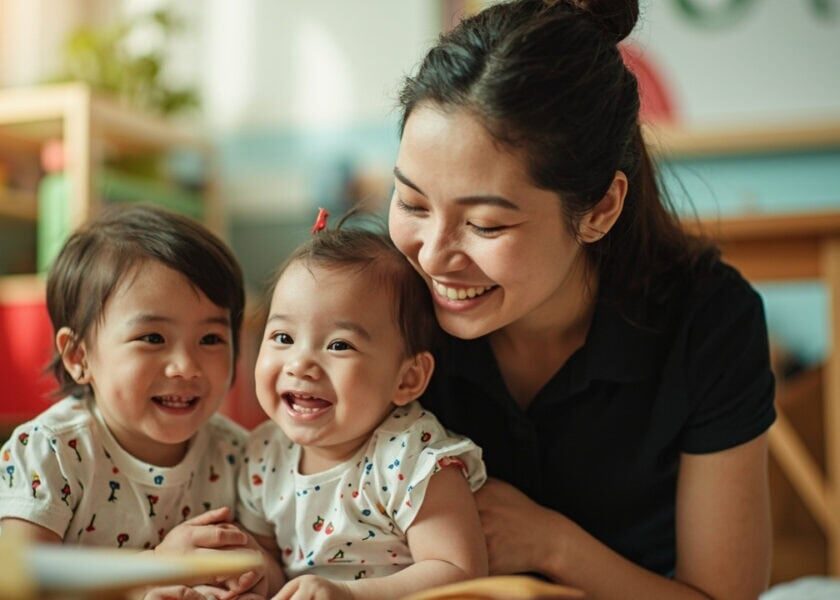
When a second child enters an established childcare arrangement, something significant happens. The first child has already built something there. She knows the rhythms, the rituals, the people. She has learned to trust. And then — suddenly or gradually — a new little person arrives in that space. A person who is related to her. A person who might sleep in the same room, play with the same toys, follow her around with wide eyes trying to figure out how to be like her.
What Quality Childcare Makes Possible for Siblings
This is where EduNanny’s approach becomes something different from simply caring for individual children in the same place at the same time. We think about the sibling system — and what that means in practice is both simple and profound.
There is something quietly powerful about a younger child watching her older sibling navigate the world of the caregiver with confidence. She sees: It is safe here. The caregiver is patient here. This is a place where big people start small and grow.
And there is something equally powerful about the older child having the quiet pride of showing the way. She is the one who knows which song comes after snack time. She is trusted to help. She has something to offer that belongs only to her.
These are not small things. These are the foundations of sibling attachment — the emotional architecture that will outlast any particular caregiver, any particular arrangement, any particular phase of childhood.
Sibling bonds built in quality care are different from sibling bonds built at home alone.
At home, siblings often orbit around the same overwhelmed parent, competing for finite attention. The evening routine becomes a negotiation. The play becomes a battlefield. Not because parents love their children unequally — never that — but because the mathematics of attention and energy do not add up the way children need them to.
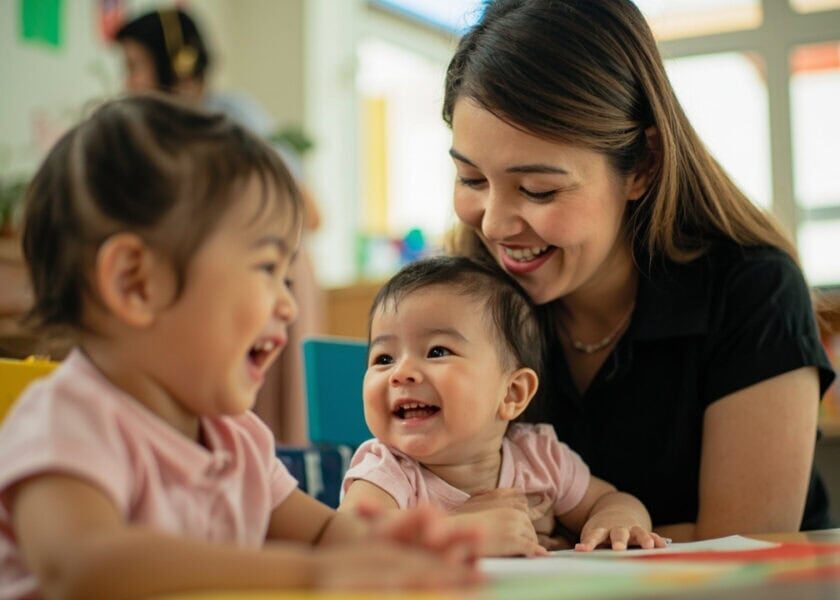
In quality care, with trained caregivers who understand how to support the whole sibling system, children learn to be together differently. They learn cooperation. They learn mutual respect. They learn the particular joy of playing alongside someone who is not your parent — someone who shares your world completely.
When a Second Child Joins Established Care
One of the things parents tell us, again and again, is that they were worried about how their firstborn would respond to the arrival of a new baby in their EduNanny arrangement.
They worried that she would feel displaced. That she would sense the caregiver’s attention divided. That she would experience the arrival of a sibling as a loss rather than a gift.
And then something unexpected happened.
What parents report is that their older child, rather than feeling replaced, felt enhanced. She felt like she had something to offer. She felt like the caregiver still knew her — really knew her — as a distinct person with her own needs, her own temperament, her own ways of expressing joy.
And when the new baby arrived, she was not competing for a caregiver’s love. She was participating in it. She was watching it expand to include someone she already loved, someone who shared her home and her history and, now, her care.
This is not an accident. It is the result of deliberate attention to each child as an individual within the family system. At EduNanny, we do not simply enroll siblings and hope for the best:
- We track each child. Development documentation, behavioral notes, communication with parents — all of it is individualized.
- We understand the older child’s needs. She may need more verbal affirmation, more explicit reassurance that her place in the caregiver’s heart is secure. We provide that.
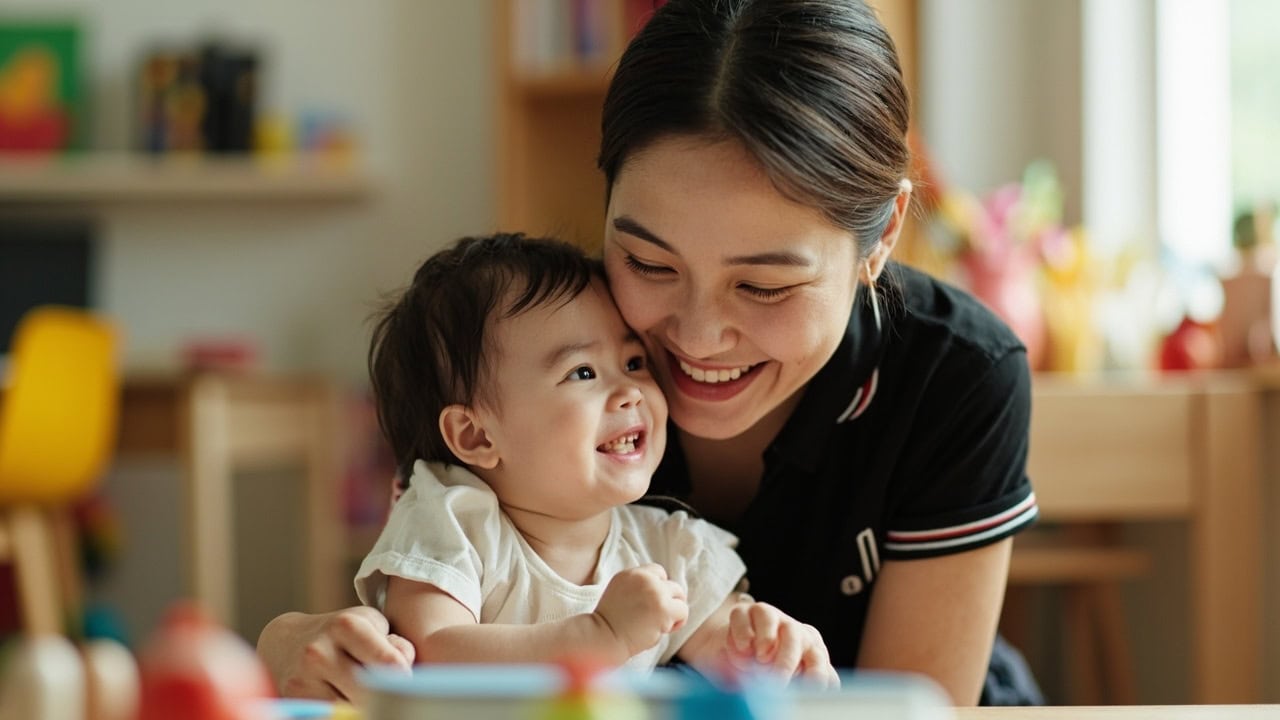
- We understand the younger child’s needs. She may need more physical closeness, more help articulating her needs, more patience as she learns the rhythms of the space. We provide that too.
- We understand the relationship between them. The way they play together, resolve conflicts, comfort each other, learn from each other — this is as important as either child’s individual experience.
What Quality Care Gives Parents
There is another dimension to this that deserves attention, because it is rarely discussed honestly: what happens to parents when professional care is working well for their children.
Parents in Singapore carry a great deal. The cost of living, the demands of dual-income households, the weight of cultural expectations about achievement and opportunity — these are not abstract pressures. They are daily realities that shape how parents move through their days, what they worry about at night, how they relate to their own children.
And when you add another child to the family, the arithmetic of attention and energy becomes even more acute. Parents often describe a kind of depletion — a sense that they are giving pieces of themselves to multiple children and arriving empty at the end of each day.
This is not a failure of love. It is the mathematics of modern parenting.
What quality professional care does — and this is one of its most undervalued gifts — is give families room to breathe.
When you know that your children are with trained caregivers who genuinely know them, who track their development, who communicate with you honestly and transparently, who operate within frameworks that prioritize safety and quality — something shifts. You arrive home not depleted but present.
And this is where siblings become the beneficiaries of professional care in ways that are easy to overlook. When parents are present, siblings are together differently. There is a quality to the play, the conversation, the way siblings move through the evening routine that is simply different when parents are not running on empty.
Siblings who arrive home from quality care together — who have spent the day in a space designed for their development, supervised by caregivers who understand how they grow — carry something with them. They are tired in a good way. They are often already in relationship mode, ready to share and negotiate and laugh together, rather than isolated in parallel play, competing for parental attention.
Continuity as Your Family Grows
One of the great unspoken fears of parents who find a childcare arrangement they love is: what happens when our family changes?
When the baby becomes a toddler and needs different things? When another child arrives? When our lives shift in ways we cannot yet predict?
At EduNanny, we have built our approach to accommodate the reality of family life. Our home-based and community-based pathways are designed to grow with you — to serve your children as they develop, and to serve your family as it grows.
When a second child joins your EduNanny arrangement, we do not start from scratch. We build on what already exists. We understand that continuity is not just about the caregiver’s relationship with your child — it is about your family’s relationship with a system that knows you, that has documentation of your child’s development, that can serve your growing family’s needs without forcing you to search for something new every time your circumstances change.
This matters more than parents often realize until they need it.
There is also something else worth saying, because it is at the heart of why EduNanny exists. Professional childcare, when it is done with integrity and skill and genuine warmth, does something almost paradoxical. It frees family to simply be family.
When grandparents visit, they are not there to fill a childcare gap. They are there because they want to be there — because they can hold the new baby and marvel at her without wondering whether they are doing it right.
When parents come home, they are not scrambling to catch up on what happened during the day. They are receiving thoughtful, transparent communication that helps them understand their children better — and then they are simply present with them, loving them, being a family.
This is not a small thing. This is what childcare should ultimately do. Not replace family, but empower it.
Choosing the Right Childcare for Your Growing Family
If you are a family in Singapore researching infant care and childminding, here are some questions worth asking — not just of potential providers, but of yourself:
- Does this arrangement see my children as individuals, or only as a unit to be managed?
- Does the caregiver understand how siblings develop in relationship, not just proximity?
- Will this arrangement grow with us if our family continues to grow?
- Do I feel confident that my firstborn’s sense of security will be protected when a new child arrives?
- Will this care give me room to be present with my children when we are together?
The right childcare arrangement will not erase the challenges of growing a family. But it can change the quality of what your children carry home with them — and the quality of what you bring to them when the day is done.
Your Growing Family Is Exactly Who We Are Here For
EduNanny Singapore was built for families who take this responsibility seriously. Families who understand that childcare is not a logistical necessity but a developmental choice — one that shapes how children relate to each other, how parents relate to their children, how families relate to the communities around them.
We are part of the ECDA Childminding Pilot. We maintain communication and transparency — honest updates about your child’s day, development tracking that serves not as data collection but as genuine understanding of how each child is growing.
We do these things because we believe they matter. Not as certifications to display, but as commitments to honor.
But above all, we are here because we have seen what is possible when siblings grow up together in the right conditions. We have seen the older child light up when the younger one arrives. We have seen the younger child watch her sibling with something like reverence. We have seen parents arrive home after a day of trust and transparency and simply love their children — not with the frayed, depleted love of overstretched parents, but with the clear, present love of people who know their children are known.
This is why we do what we do. And this is why, if you are a family in Singapore wondering how to care for the children you love — all of them, together — we would welcome the chance to walk this journey with you.
Your growing family is exactly who we are here for.
At EduNanny Singapore, we believe that thoughtful, development-oriented childcare begins with understanding families. Learn more about our approach or get in touch to explore how we can support your family as it grows.