What Your Child Is Really Telling You at Pickup
The Hours Between: Why They Matter More Than You Think
There is a moment, at the end of most ordinary days, when you stand at the gate and hold your child in your arms. You look at their face. You scan for signs. Is this a child who had a good day? Is this a child who is regulated, content, maybe tired but peacefully so? Or is something off — a quality of fussiness you cannot name, a stiffness in their body, a distant look that seems wrong for a four or five or eight o’clock in the evening?
You hold them and you search their face and you wonder.
This is one of the most universal experiences of modern Singapore parenting. The hours in between are hours of imagination. We fill them with worry and curiosity and, sometimes, a kind of helpless speculation. We trust, mostly, that something good happened. But we are not always certain.
This article is about those hours. Not because they are mysterious, but because they do not have to be. Because there is a way of understanding what quality childcare actually looks like in real, ordinary moments — and when you know what to look for, something shifts. The anxiety softens. The guessing stops. And what replaces it is something more valuable: informed trust. The kind of trust that comes not from hoping, but from seeing.
Let me start by naming something that most childcare marketing will not tell you directly. The hours between drop-off and pickup are, in many ways, among the most important hours of your child’s day. Not because what happens in childcare is more important than what happens at home — nothing could replace the intimacy of your own care. But because in those hours, something is happening that most parents have never been invited to fully understand.
When you walk into a quality childcare setting, what you are entering is not a holding facility. What you are entering is a carefully structured world designed around the rhythms that young children need to thrive. And the quality of that world reveals itself, every single day, in the small moments — in how food is offered, in the language that fills the room, in the social world between peers, in the small moments of regulation that shape a child’s nervous system.
Food: More Than Fuel
They need food — but not just food placed in front of them. They need food offered at intervals that match their developing metabolism, in an environment where eating is not rushed, where they are seated comfortably, where the textures and temperatures and social context of mealtimes are all part of what makes eating a positive, grounding experience.
Watch what happens in quality care at lunchtime. A caregiver does not simply set a plate down and move on. They sit with the children. They narrate what is on the menu. They model eating — genuinely enjoying it — so that a hesitant child has something to mirror. When a child pushes a new food away, a quality caregiver does not force. They wait. They try again tomorrow. They make eating a social act, not a task. In Singapore, where mealtimes are already deeply woven into family culture, this approach resonates — because it echoes the care you give at home, extended into the hours you are apart.
Rest: A Non-Negotiable, Not an Afterthought
They need rest — not just sleep scheduled because it is convenient for the programme, but rest woven through the day in ways that respect each child’s individual patterns. A child who is overtired is a child who cannot learn, cannot connect, cannot regulate. A child who is rested is a child who is available for the world.
In practice, this means a dimly lit room, white noise, a consistent routine that signals safety to a developing brain. It means a caregiver who does not rush a child awake because the schedule says nap time is over. It means understanding that some children in Singapore’s equatorial climate need more rest during the heat of midday, and adjusting accordingly. Rest, in quality care, is not downtime between activities. It is a pillar of the day, as important as any learning experience.
Movement: The Work of Childhood
They need movement. Not entertainment, not structured activities imposed upon them, but the kind of movement that a young body craves — crawling, climbing, rolling, exploring. Movement that builds the proprioceptive sense, that develops coordination, that allows a child to feel at home in their own physical self.
Outdoor time in Singapore’s childcare settings is not a bonus. It is a necessity. In quality care, a child is not kept at a table doing worksheets. They are moving. They are climbing, digging in sand, feeling grass under their feet, running in spaces where their bodies can practice what bodies practice. A caregiver in quality care is nearby — attentive, not intrusive — watching a child’s face for cues of overwhelm or delight, ready to scaffold, ready to redirect, but mostly just present and warm and allowing the child to move.
Language: The Invisible Architecture
They need language all day long. Not the language of worksheets or flashcards, but the language of a caregiver who narrates the world, who labels what the child is touching, who responds to a babble as though it were a meaningful contribution to a conversation.
Imagine a caregiver kneeling down as a toddler picks up a yellow wooden block. The caregiver says, quietly: “You’re holding the yellow block. It feels smooth, doesn’t it? Shall we see if the red one feels the same?”
This is not scripted. This is not curriculum. This is the natural, continuous act of a caregiver who understands that language is oxygen for a developing brain, and that every moment is an opportunity to provide it.
What Quality Caregivers Actually Do When You’re Not There
Here is what most parents do not see: the work that happens in a quality childcare environment before, during, and after the hours you are present.
When you drop your child off in the morning, the work has already begun. A quality caregiver has been preparing the environment — not just physically, by arranging the space and laying out materials, but relationally. They have been preparing themselves. They have been thinking about the children in their care as individuals with specific needs, preferences, and developmental trajectories. And when you hand your child over, that caregiver is not just receiving a small person into a room. They are receiving a relationship.
In the ECDA Childminding Pilot, the ratios are intentionally small — up to one to three infants in certain configurations. This is not an accident. This ratio means that a caregiver can actually observe. Can actually notice when a child’s brow furrows before a meltdown, when a child’s hand reaches out not for a toy but for another child, when a child’s body language shifts in ways that indicate hunger or fatigue or the early signs of illness.
These are the moments that matter. These are the moments that a caregiver who is rushed, who is managing too many children, who is distracted by administrative demands — that caregiver will simply miss.
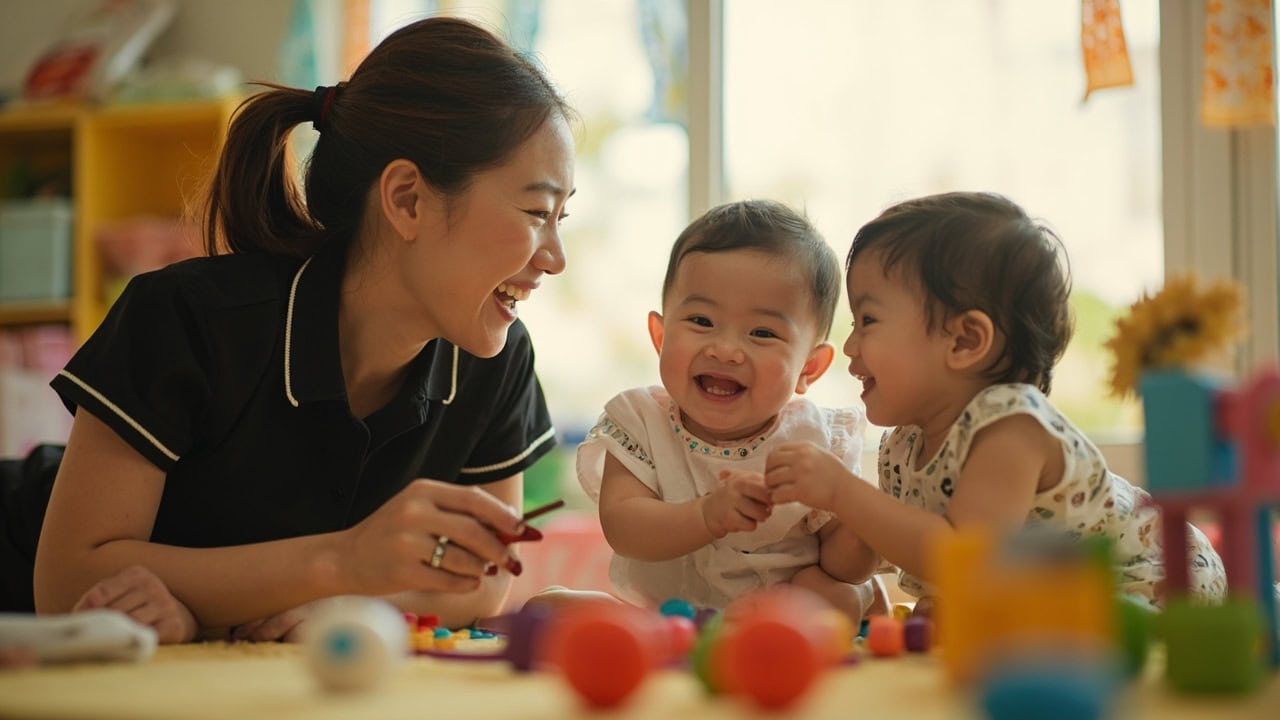
A quality caregiver in the hours you do not see is doing something remarkable. They are holding the emotional temperature of the room. They are reading the social dynamics between children who cannot yet articulate what they feel. They are noticing when one child needs a quiet corner and gently guiding them there without making it a punishment, without making it a thing. They are narrating what is happening for children who are not yet verbal: “I see that you want the red truck. Ethan is using it right now. You can wait, or you can choose the blue one.” They are doing this not once, but dozens of times a day, across every small interaction, every transition, every moment of potential friction.
And here is something that parents rarely get to witness: they are doing it with warmth. Not the performed warmth that you see on a tour, when caregivers smile at you and make eye contact and say all the right things. But the genuine, consistent warmth that comes from professionals who have been trained not just in child development but in self-regulation, who understand that their own nervous system is a model for the children in their care, who know that a calm voice and a patient presence is itself a therapeutic intervention for a toddler who has just dropped their favourite cup and is sobbing as though the world has ended.
When EduNanny talks about the quality of care, this is what they mean. They mean the hours when you are not there. They mean the care that does not need to be marketed because it simply is. They mean the caregiver who notices a child’s hair is damp before the child herself seems to know she is overheating from active play, and who moves that child gently toward water and shade. They mean the caregiver who hears a subtle change in a baby’s cry — not because they have superhuman hearing, but because they have spent weeks learning that this particular baby’s cry at this particular time of day means something specific, and they respond accordingly.
Observation vs. Reporting: The Difference That Changes Everything
There is a difference between observation and reporting, and it matters enormously.
When a caregiver tells you at pickup, “He had a great day,” that is a report. It may be true. But it is not observation. Observation looks like this:
“He was really engaged during music time today — I noticed he was clapping along to the beat, which he hasn’t done consistently before. He ate well at lunch, especially the pasta. And he did seem to get a little frustrated during free play when another child took the car he was using, but I saw him try a different one and settle. He seems like he’s starting to understand that there are other options when things don’t go his way.”
That is observation. That is the kind of detail that tells you what the day actually looked like from your child’s perspective. It names a moment of challenge as well as a moment of growth. It connects a small incident to a larger developmental narrative. It treats your child as a person who is doing things, learning things, progressing through the world in real ways.
When you hear observation like that — when you find a childcare setting where the caregivers are trained to observe and communicate in this way — you will feel the difference. You will feel less like you are receiving a performance and more like you are receiving a window. And windows, it turns out, are what most Singapore parents are hungry for. They do not need to be told their child is fine. They need to see, themselves, that their child is fine. They need to be equipped with the knowledge to understand what they are seeing.
This is why EduNanny has built communication as a core pillar of their approach. Not as an add-on or a selling point, but as a fundamental expression of how they understand quality care. Regular updates, open channels for questions, and in certain deployments, technological measures like CCTV that give parents an additional window into the day — not because technology replaces trust, but because trust and transparency work together. The more you see, the more you understand. And the more you understand, the more your trust becomes informed rather than blind.
The Social World Between Peers: Where Personality Takes Shape
Let me say something now about the social world that forms between children in quality care, because this is something that parents can learn to see, and it matters more than most parents realise.
When your child is in a setting with other children — even just one or two others, in a home-based arrangement — something begins to happen that cannot happen at home with only adults. Your child begins to learn about others. Not as objects, not as convenient playmates, but as people with their own needs, their own preferences, their own emotions.
A toddler in quality peer care learns, in small daily doses, that another child might want the same toy, that another child might feel sad, that another child might be delighted by the same thing that delights them. This is social development at its most foundational. And it is happening in hours you are not there to see.
Here is what you can look for at pickup: signs that this social world is a safe one. Does your child glance at other children with interest or wariness? Does your child emerge from the day showing any signs of having been overwhelmed by peer interaction, or do they emerge with a kind of social ease, a willingness to be near others?
In quality care, peer interaction is carefully managed. It is not a free-for-all. A caregiver is always nearby, not to intervene constantly, but to scaffold. To help a child who is frustrated. To celebrate a moment of sharing. To redirect before a conflict escalates. The social world in quality care is a classroom, but it does not feel like one. It feels like life.
You may notice, at pickup, that your child has a particular way of relating to a peer in the room. They might have a friend, or a comfort figure, or a child they are learning to negotiate with. This is enormously important. This is the earliest formation of social competence. When you learn to recognise it, you can ask about it. You can ask: “Who did Samuel play with today?” And the answer will mean something to you in a way that it did not before.
Learning to Read Your Child at Pickup: A Practical Framework
Now I want to bring this all together around something that I believe is the most practical gift you can give yourself as a Singapore parent navigating childcare decisions: learning to read your child at pickup.
Here is what I want you to carry with you. Your child is communicating to you, every single day, in ways that are quiet but significant. And most parents, in the absence of a framework for understanding what they are seeing, default to one of two responses. They either assume everything is fine — because their child is not crying, because they seem okay, because the caregiver said nothing was wrong. Or they assume the worst — because something feels off, because the child was clingier than usual, because the child asked about a caregiver in a way that felt uncomfortable.
Both responses are forms of guessing. And guessing, I have come to believe, is the great thief of confidence in modern parenting. You deserve better than guessing.
So let me offer you a different approach. At pickup, when you hold your child, take sixty seconds. Just sixty. And look at them as though you are learning to read a new language. Here is what you are looking for.
1. Look at Their Face
Not for a big smile, necessarily. Smile is nice, but it is not the whole story. Look at the quality of their expression. Is it open? Is there a softness around the eyes? Does their face show the kind of relaxation that suggests they have been in an environment where they did not need to be on guard?
A child who has been in chronic stress — not occasional frustration, which is normal, but chronic, unmitigated stress — will often have a facial quality that is subtly different. Their brow may be slightly furrowed even when they are not upset. Their face may have a kind of flatness that is not the same as contentment. You are learning to read calm.
2. Look at Their Body
Is their body loose or stiff? Does your child melt into you when you hold them, or does their body seem braced, held? A child’s body tells the truth. A child who has been held gently and spoken to warmly all day will often have a different quality of physical contact at pickup than a child who has been managed by a series of transitions with insufficient warmth. You are not looking for perfection. You are looking for the general direction of ease.
3. Look at Their Energy
Not just whether they are tired — children in quality care do get tired, because they are engaged and active and learning — but the quality of the tiredness. Is it the kind of tired that comes from a satisfying day, a day full of doing and being? Or is it the kind of tired that comes from a day of managing, of being in an environment that did not quite fit?
4. Look at Their Behaviour in the Hours After Pickup
This is, in some ways, the most informative window of all. A child who has had a good day in quality care will often show a kind of regulated ease in the evening. They may be tired, but they are available. They play. They engage. They are not more irritable than usual, they are not clinging desperately, they are not having the kind of meltdowns that suggest they have been holding themselves together all day.
Of course, all children have hard evenings sometimes — a growth spurt, a missed nap, a virus coming on. But the pattern, over time, is something you can learn to read. If your child consistently comes home dysregulated, distressed, or disconnected, that is data worth taking seriously.
5. Ask Questions That Invite Observation, Not Reassurance
Do not ask, “Did you have a good day?” You will almost always get a yes or no that does not tell you much. Instead, ask:
- “What was your favourite part of the day?”
- “Who did you play with at snack time?”
- “What did Ms. Sarah read this afternoon?”
- “What did you do outside today?”
These questions do two things. They signal to your child that the day matters to you, that you want to know. And they give you, over time, a mosaic of small details that will help you understand whether the picture they are painting matches what you are observing at home.
Learning to read these five signals — face, body, energy, evening behaviour, and the details your child shares — will give you something invaluable. It will give you a language for understanding your child’s experience of childcare. And that, more than any tour or testimonial or marketing material, is what will help you trust what you are seeing.
What Quality Childminding Looks Like in Singapore
Let me be specific about what this looks like in the context of the ECDA Childminding Pilot and EduNanny’s approach, because specifics matter when you are making a decision that affects your child’s daily life.
Small Ratios, Big Impact
EduNanny’s home-based childminding model operates with intentionally small caregiver-to-child ratios. In practice, this means that a caregiver can genuinely know each child — their rhythms, their preferences, their current developmental leaps, their social styles. This is not a luxury. It is a prerequisite for the kind of observation and responsiveness described above. When a caregiver knows your child as an individual, they can tune in to the subtle shifts that indicate a good day or a hard one.
Rhythm and Routine
A quality childcare day in Singapore should feel predictable to a child without feeling rigid. There is a rhythm — greeting, movement, snack, rest, play, outdoor time, lunch, more rest if needed — but within that rhythm, there is flexibility. A child’s needs on a given day might call for more outdoor time or an earlier nap. In quality care, the rhythm serves the child, not the other way around.
Prepared Environment
Quality care means a space that has been thought about. Materials that are appropriate for the ages present. Safety that is assured without being oppressive. Areas for active play and areas for quiet retreat. In a home-based setting, this means a caregiver has considered the space through the eyes of a toddler — what they can reach, what they might put in their mouth, where they might feel unsafe.
Transparent Communication Structures
Within the EduNanny model, there are intentional structures for parent communication. Regular updates that go beyond “they had a great day.” Updates that describe what happened, what was noticed, what was learned. Parents can ask questions. They can raise concerns. They can share what they are seeing at home so that the caregiver can connect the dots. This two-way flow of information is not administrative overhead — it is a hallmark of quality.
Pathways That Fit Real Lives
The pilot offers different arrangements — home-based care and community or centre-based options — so that families across Singapore can access the kind of arrangement that fits their lives. Whether you need full-day care, half-day care, or something in between, there is a configuration that can work. Many families are also able to use CDA funds and Baby Bonus contributions, which removes one layer of financial stress from an already complex decision.
Addressing the Concerns Singapore Parents Carry
Let me speak directly to something I know many parents reading this are feeling. There is a particular kind of vulnerability in leaving your child with someone else. It does not matter how much you trust the setting. It does not matter how well you have vetted the caregiver. There is a residue of uncertainty that clings to those drop-off moments, that makes you pause in the car before you drive away, that sometimes surfaces as a tightness in your chest at pickup before you even see your child’s face.
I want you to know that this is not weakness. This is not a sign that you are doing something wrong by using childcare. This is the normal, appropriate response of a parent who loves their child deeply and wants to make sure that love is being matched by the world when you are not there.
But I also want to tell you something. The uncertainty you feel is not actually about the childcare. It is about the gap — the gap between what you know and what you wish you knew. And that gap is not inevitable. It can be bridged. Not by eliminating all uncertainty, because uncertainty is part of parenting — but by filling it with understanding.
When you learn what quality looks like in ordinary moments, when you learn to read your child at pickup, when you find a programme that is genuinely committed to transparency and communication, something shifts. The anxiety softens into something more like vigilance — and vigilance, unlike anxiety, is useful. Vigilance is the parent who notices, who asks, who stays curious. Vigilance is the parent who is present even in the hours when they are not physically present.
And here is another concern worth naming: the fear that using childcare means you are failing your child, or outsourcing something that only you can provide. This fear is understandable, and it is common, but it is also based on a misconception. What you are doing, when you find quality care, is not replacing what you do at home. You are adding to your child’s world. You are giving them a second set of warm eyes, a carefully prepared environment, a community of peers, and a caregiver who has been trained to notice what you notice — your child’s wonder, your child’s frustration, your child’s enormous capacity to grow.
Making the Decision: What to Look For and What to Ask
If you are a parent in Singapore beginning to research infant care or childminding, here is a practical list of things to look for and questions to ask during your search:
- Observe the environment during a visit. Does it feel calm? Is it clean but not sterile? Are the materials appropriate and accessible? Does the space feel like a place where a child could thrive?
- Ask about ratios. How many children per caregiver? Small ratios are not a luxury — they are a precondition for the kind of individualised attention that makes quality care possible.
- Ask how the daily rhythm is structured. Is there a consistent routine that includes food, rest, movement, and language-rich interaction? Or does the day feel unstructured or overly regimented?
- Ask to see an example of a daily update. What does communication look like between caregivers and parents? Does it feel observational and specific, or general and reassuring?
- Ask about caregiver training. Are they trained in child development, not just in safety protocols? Do they receive ongoing professional development? Are they trained in self-regulation?
- Notice how caregivers interact with children during your visit. Is the warmth genuine and consistent, or performed? Do the children seem at ease? Do the caregivers kneel to children’s level? Do they narrate what is happening?
- Ask about the social environment. How are peer interactions managed? What happens when children conflict over toys or space?
- Ask about CDA and Baby Bonus usage. Can you apply your child’s funds to this programme? What is the fee structure?
- Trust your gut. After a visit, sit with how you feel. If something feels off, take it seriously. If something feels warm and right, take that seriously too.
Moving Forward with Confidence
Here is the part I want you to remember, long after today.
Your child will not remember most of these days. They will not grow up with explicit memories of the songs, the routines, the taste of the snack they loved, the feeling of being held when they were tired. But their body will remember. Their nervous system will remember.
The way they approach other people, the way they regulate their emotions, the way they trust that the world is basically a safe place where warm adults exist and peers can be navigated — all of it is being written in the hours you cannot see. Every moment in quality care — every calm voice in a moment of frustration, every patient hand on a trembling back, every small act of “I see you, I hear you, you are okay” — is building something. It is building the architecture of a human being. And that architecture matters enormously.
This is why the ordinary hours are the most important hours. Not because they are dramatic, but because they are consistent. Because they are warm. Because they are happening day after day after day, and children are built in the repetition of small, good moments.
So when you stand at the gate, and you hold your child, and you do not fully know what happened today — know this. Something happened. Something formative happened. And the reason you are wondering, the reason you are paying attention, the reason you care so much about getting this right — that is exactly the kind of parent your child needs.
Curious. Present. Willing to learn the language of reading your own child. Willing to trust that when you see the signs of a good day — the open face, the relaxed body, the regulated evening, the small stories that spill out in the car — you can believe what you are seeing.
The hours between drop-off and pickup are not a mystery. They are a language. And now, you are learning to read it.
If you are ready to explore childcare arrangements in Singapore that are built on small ratios, genuine communication, and quality care your child deserves, EduNanny by BUTLER, operating through the ECDA Childminding Pilot, may be the right fit for your family. Visit their website to learn more about the pathways available, the fee structures, and how to apply CDA funds. Or reach out directly to speak with a member of their team.
You are not failing your child by using childcare. You are giving them the world. And the world, when it is warm and attentive and full of good ordinary hours — that is exactly what a child needs.