Extending the Foundation: Why Continuity of Care Matters for Your Second Child
The Question That Actually Matters
This is not a question about logistics, though logistics will follow. It is not a question about whether you can manage the schedules and the costs and the arrangements, though those are real and they matter.
It is something more fundamental. It is a question about continuity — about whether the care you worked so carefully to find can expand without fracturing.
Whether the caregiver who learned your child’s rhythms, who understood the particular sound of your child’s cry and what it meant, who became part of the quiet architecture of your family’s daily life — whether that care can hold another child without losing its shape.
Whether your firstborn, who has grown so much in this relationship, will feel the arrival of a sibling as an addition to their world or a diminishment of what was theirs.
These are the questions that most childcare conversations do not touch. Most of what you will read, most of what you will hear from friends and family, will focus on the decision. How to choose. What to look for. What questions to ask at a tour, what red flags to watch for.
These are useful conversations. But they belong to the beginning, when you are choosing for the first time and everything is still ahead of you.
You are not there anymore. You already chose. You already built. And now you are discovering, perhaps for the first time, that its value is deeper than you anticipated.
What You Actually Gave Your First Child
Before we speak about the transition, it is worth pausing to understand what you gave your first child when you chose quality care.
In the first thousand days of life, a child’s brain forms neural connections at an extraordinary rate. This is not a statistic designed to make you anxious. It is simply a reminder of the extraordinary plasticity of these early years, and the correspondingly extraordinary importance of the environments in which that development unfolds.
A child who experiences consistent, responsive, warm caregiving in the first years of life is not simply being kept safe and comfortable. They are building the foundations that will shape how they understand trust, how they form attachments, how they regulate their emotions, how they enter into relationships throughout their lives.
You may not have framed it in exactly those terms when you made your choice. You may simply have wanted your child to be looked after by someone who was warm, attentive, and who treated your child as an individual rather than a task. But beneath that choice was something profound.
You were giving your child something that would outlast infancy — a sense of being known, a felt experience of the world as a place where someone pays attention, where your needs are heard and met, where you are not alone.
What This Looks Like in Practice
- Secure attachment — Your child has learned that when they reach out, someone responds. This becomes the template for all future relationships.
- Emotional regulation — Consistent caregiving helps children learn to identify and manage their emotions over time.
- Exploration and confidence — When the base is secure, children are more willing to explore, try new things, and develop independence.
- Language and cognitive development — Responsive caregivers who talk, listen, and engage support the rapid language development of the early years.
Can Your Second Child Inherit the Same Foundation?
Now you are preparing to give that to another child. And the question is whether you can give them the same inheritance — not a similar one, not something comparable, but the same inheritance.
The same caregiver who already carries the wisdom of knowing your family. The same rhythms and rituals that gave your first child such a sense of security. The same environment that already holds the imprint of your family’s particular way of moving through the world.
Here is what we have learned from the families who have made this transition: it is possible. But it requires something specific from the care arrangement itself. It requires a model of care that is designed not just to serve one child but to hold an entire family as it evolves. It requires caregivers who are genuinely embedded in the life of the family. And it requires a structure that can accommodate the particular ratios, attention, and flexibility that a growing family needs.
Why Home-Based Childminding Makes This Possible
Home-based childminding, as piloted under Singapore’s ECDA framework, offers something that larger centre-based arrangements often cannot: the ability to know each child deeply, to observe and respond to each child’s individual temperament and needs, to maintain the kind of one-to-one and small-group attention that allows a caregiver to truly understand a child rather than simply manage them.
With ratios of up to one to three infants, there is space for the kind of attention that makes continuity real. There is time for the caregiver to learn your second child’s particular cries, to notice the subtle differences in how they seek comfort, to integrate them into the rhythms that your first child already knows and trusts.
What Your Second Child Inherits
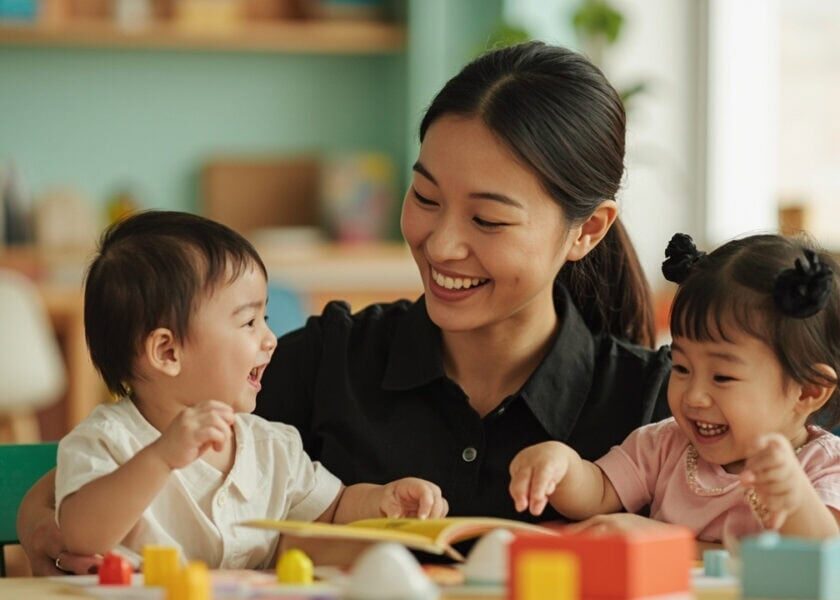
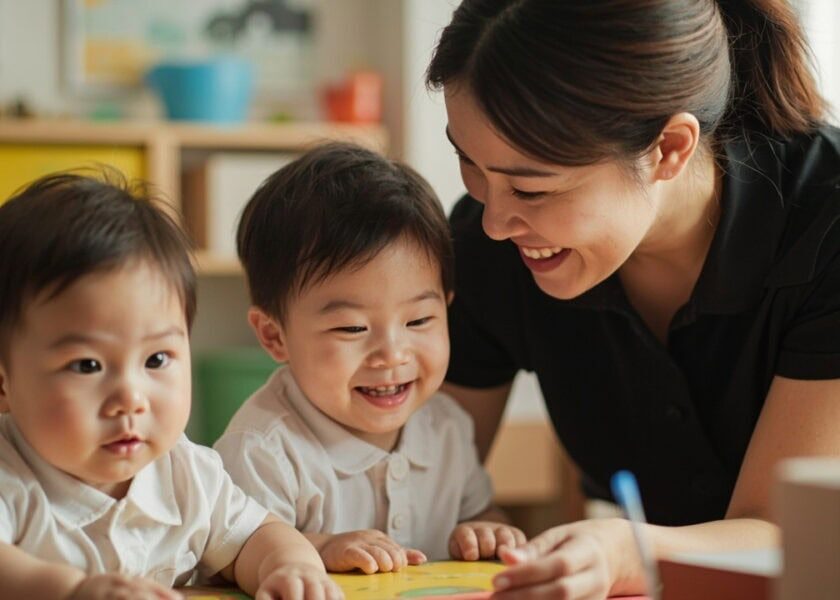
When your second child enters care with a caregiver who already knows your family, they are not starting from zero. They are inheriting a world.
The caregiver who welcomes your second child already understands the tempo of your household, the particular way your family does mornings and afternoons and evenings, the values that shape how you want your children raised. Your second child does not have to spend time learning that this is a safe place, that this person can be trusted, that these routines mean comfort and security. That knowledge is already encoded in the environment itself.
Your second child arrives, in a very real sense, into a home that was already waiting for them.
What Happens to Your Firstborn
When your firstborn has spent two or three years in a quality care environment, learning to trust, learning to explore, learning to be part of a small community of care, they have developed something that cannot be replicated by a new arrangement. They have a history. They have a relationship that has grown alongside them.
And now, when their sibling joins that same space, they get to be part of something significant: they get to be the older child who shows the younger child the ropes, who models what it looks like to be at home in this place, who is not displaced by the arrival of a new family member but is, in a sense, confirmed as a guide and an elder in this small community.
When siblings share a caregiver, they are not simply being cared for in the same location. They are building a shared language of care. They are learning from each other’s experiences, borrowing each other’s security, developing a familial bond that is reinforced daily in an environment that understands and supports family relationships.
Your firstborn does not lose status when their sibling arrives. They gain the opportunity to be a model, a comfort, a companion — and to experience the arrival of a sibling not as a threat to what they have but as an expansion of their world.
Families who have made this transition often describe something unexpected. They expected logistics to be complicated. They expected adjustment periods. They expected some turbulence. What they did not necessarily expect was how quickly the new arrangement would feel like an organic deepening rather than a disruptive expansion.
Because the caregiver already knew how to hold their first child with care and patience and attention, they knew how to make room for a second. Because the environment already had rhythms that worked, those rhythms simply absorbed another small person into their pattern. Because the first child’s relationship with the caregiver was already a source of security and joy, the second child’s arrival was cushioned not just by the caregiver’s skill but by the first child’s own ease and comfort — an ease that communicated, without words, that this place is safe, that this person is good, that there is nothing to fear.
How EduNanny Approaches the Transition
When a family enrolls their second child with EduNanny, we do not treat it as a new onboarding process. We treat it as a continuation.
- Stable caregiver relationships — The caregiver who has built a relationship with your first child is not replaced or rotated. They are the same stable figure who welcomes your second child.
- Consistent communication — The protocols that kept you informed about your first child’s day — daily updates, photographs, transparent sharing of milestones and moments — continue and expand to include both children.
- Maintained environment — The rhythm of the home itself is maintained, not disrupted, as we work with you to integrate your new family member into an environment that is already prepared to receive them.
- Transparent reassurance — Where CCTV measures are deployed, they provide the same peace of mind for your second child’s care as they did for your first.
Built for Singapore Families
We understand that for Singapore families, practical considerations are not separate from emotional ones. The cost of raising children in Singapore is real, and the question of how to manage childcare expenses across multiple children is not trivial.
This is why we have built our pilot fee structures to be affordable and transparent. It is why we work with CDA and Baby Bonus arrangements where applicable, so that the financial architecture of your family’s growth does not become a barrier to the continuity you want for your children.
It is why our care blocks run Monday to Friday, designed around the realities of Singapore working life, because the best care in the world cannot serve your family if it is not accessible at the hours you actually need.
These are not glamorous features. But they are the kind of thing that makes continuity possible in the real world — not just in theory, not just in aspiration, but in the daily, practical lives of Singapore families who need care that can flex and grow without requiring them to start over every time their family changes.
Questions to Ask Before You Decide
If you are evaluating care arrangements for your second child, here are the questions that matter most:
- Who will be the caregiver? Ask specifically whether the caregiver who knows your first child will be the same caregiver for your second. Vague reassurances about “our team approach” may not provide the continuity you are seeking.
- What are the ratios? Understand how many children the caregiver will be responsible for at any given time. Smaller ratios mean more individual attention.
- How will the transition be managed? Ask how they approach integrating a new child into an established environment. The answer will tell you a great deal about whether they understand continuity as a philosophy or simply as a scheduling exercise.
- How does communication work for multiple children? If you have two children in care, how does the caregiver communicate about both? What does a typical daily update look like for families with siblings?
- What happens if our family’s needs change? Life in Singapore involves relocation, career changes, and evolving schedules. Ask how the arrangement accommodates change without requiring you to start over.
- What fees apply for additional children? Understand the full cost structure, including how CDA and Baby Bonus can be applied, and whether there are any hidden costs as your family grows.
Will my second child receive the same quality of attention?
This is a legitimate concern, and it depends entirely on the structure of your care arrangement. In centre-based settings with higher ratios, there may be genuine limits to individual attention. In a well-structured home-based childminding environment with ratios of up to one to three, there is meaningful space for each child to be known and attended to individually.
Will my first child feel displaced or jealous?
The evidence from families who have navigated this transition well suggests that the opposite is more likely when continuity is maintained. Your first child’s existing security, reinforced by a caregiver they trust, becomes a model for how to welcome a sibling. The displacement anxiety tends to arise when the care environment changes entirely — when a child loses the familiar along with gaining a sibling.
What if something changes with the caregiver?
This points to why caregiver stability is not a marketing talking point but a structural necessity. At EduNanny, caregiver retention and relationship continuity are built into how we operate — because home-based models with smaller ratios and embedded caregivers are inherently more sustainable for long-term relationships than large-scale centre operations.
The Quiet Promise We Make
There is a moment, visible in the families we serve, when this becomes clear in a small and quiet way.
It is the moment when your firstborn, now three or four years old, watches their younger sibling being settled by the same caregiver who has known them since infancy. It is the moment when your second child, just months old, falls asleep easily in an environment that holds them with the same attentiveness and warmth that held their sibling before them.
It is the moment when both children, at different stages of their development, carry the same sense of being known — not similarly, but identically in its depth and its quality. It is the moment when you realise that what you gave your first child was not just care. It was an inheritance. And your second child has received it.
This is what continuity means. The architecture of trust you built with your first child does not have to be demolished and rebuilt when your family grows. It can be extended. New rooms can be added. New children can be welcomed in. The foundation holds, and the structure becomes more beautiful for the addition, not despite it.
Somewhere in Singapore, right now, a parent is sitting with the knowledge that their family is about to change again. They may be feeling the weight of that question we began with: can what we built for our first child also hold our second?
We want to say to them, with warmth and with honesty and with the quiet authority that comes from having seen this transition succeed again and again: yes. If the care you chose was built for it, yes.
EduNanny is built for exactly this. Not to solve the logistics alone, though we attend to those with care. Not to offer a convenient service, though we are reliable and accessible. But to hold your family as it grows — to be the stable figure in a changing world, the caregiver who knows your children by name, the relationship that deepens with time, the home that makes room for every child you bring into it.
That is what continuity means in practice. That is what we have always offered. And that is what we will continue to offer, to every family who trusts us with the most important work there is: raising the next generation, one secure child at a time.
If you are expecting another child and want to understand how EduNanny’s home-based childminding model can extend the care foundation you have already built, we invite you to start a conversation with us. We are happy to discuss your family’s situation, answer your questions, and explore whether we are the right fit for where you are now — and where you are going.
Learn more about how EduNanny’s childminding pilot works, or connect with our team to begin.