What Your Child Looks Like at Pickup Reveals Everything
What You See at Pickup Is the Only Answer That Matters
There is a moment that happens every single day in Singapore — in HDB living rooms and condominium apartments, in landed homes and everywhere in between. A door opens. A child looks up. And a parent, still wearing the weight of a full workday, leans down and asks the simplest question in the world.
How was your day?
And the child — in whatever language they have, words or gestures or silence or a sudden, urgent need to be held — begins to answer.
Most parents listen to that answer. But very few have been taught to hear everything it contains. And that is exactly what matters: there is a kind of knowledge sitting right there, in plain sight, that most parents have never been invited to fully trust.
This is not about adding pressure to parenthood. It is about recognising that the child who returns at the end of the day is the most honest, most complete piece of evidence about the quality of care they have received. Not a tour. Not a brochure. Not a review online. The child comes back, and the child is the answer.
You Cannot Be Inside That Room — So Trust What Returns
You cannot be inside that room. You cannot follow your child through every moment of their day and verify that the care is excellent. That is the fundamental condition of working parenthood, and it does not come with a manual for how to know.
So parents do what they can. They ask the caregiver. They read the updates. They look at photos. They take the tour and pay attention to whether the space smells right, whether the children seem calm, whether the walls are bright and the toys look cared for. These things matter. They are not nothing.
But they are indirect signals. And the most direct signal — the one that lives in your arms every evening — is the child themselves.
At the school gate, the infant care centre, or the childminder’s home — wherever your child has spent their day — you see them. Watch carefully. This is not just a child finishing a day. This is a child who has been somewhere, doing something, feeling things, all day long, without you there.
Everything that happened in those hours has gone somewhere inside that small body. It has shaped their posture, their expression, the speed at which they move toward you or away from you. The quality of that return is not incidental. It is data. It is the only data that truly matters.
Most parents in Singapore feel a quiet anxiety about this moment — one they do not always have language for. It is not the anxiety of doubting their child’s physical safety. It is deeper than that. It is the question that sits underneath the surface of every parent who drops their child into someone else’s care for eight or ten hours a day:
Are they okay? Not just safe. Not just fed and changed and put down for a nap. Are they okay? Are they more than okay?
What Genuinely Excellent Care Looks Like
Let us be specific. Because specificity is what transforms a feeling into something you can trust.
Settled, Not Perfectly Behaved
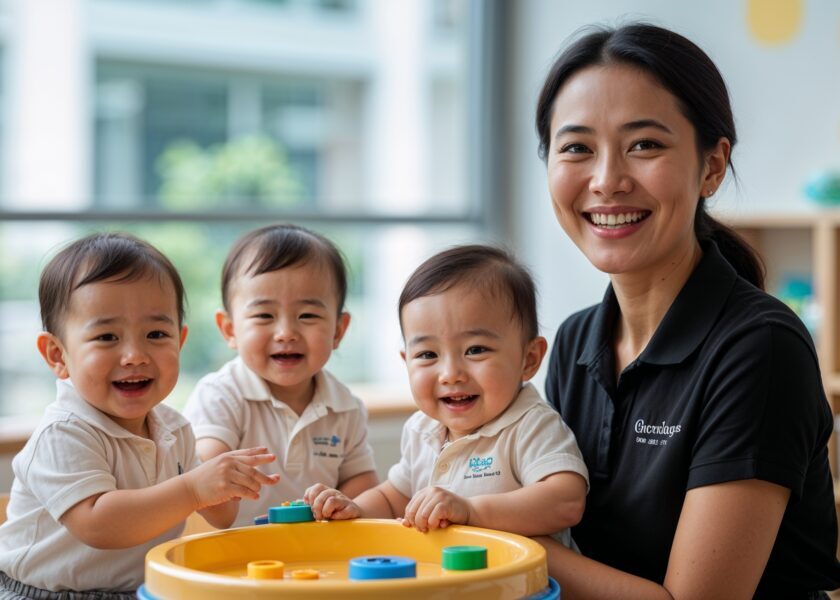
A child in quality care comes back settled. Settled is not a child who is quiet and compliant. Settled is a child whose nervous system has had enough attunement during the day that it can afford to relax.
Settled is a child who may be tired, may be whiny, may be full of big feelings — because children do, because life is full of big feelings — but who can be soothed. Who can come back to themselves after a moment of distress. Who does not arrive home already depleted, already shut down, already running on empty.
Curious, Not Just Supervised
A child in quality care comes back curious. You will see this in the drive home or the walk through the park or the moment they get through the door and notice the cat, or the new book on the shelf, or the way the light is falling differently because it is later than yesterday.
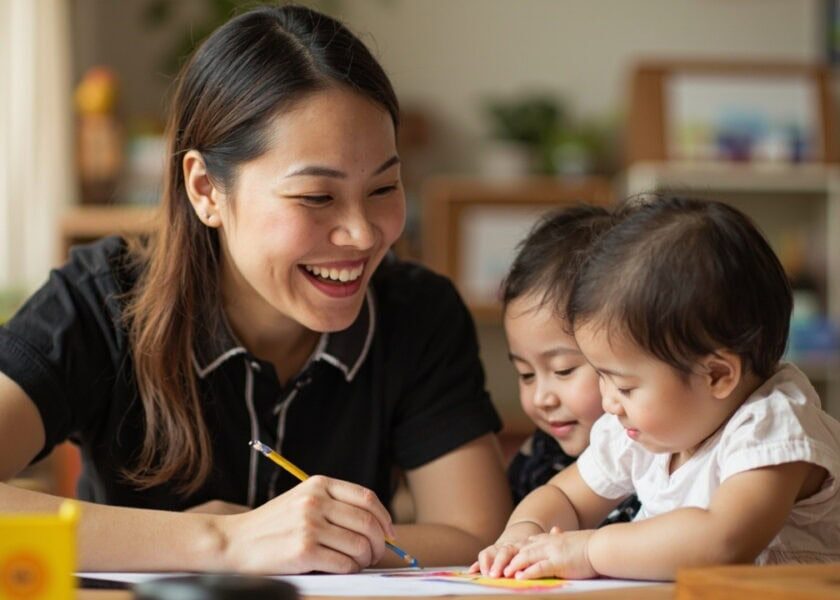
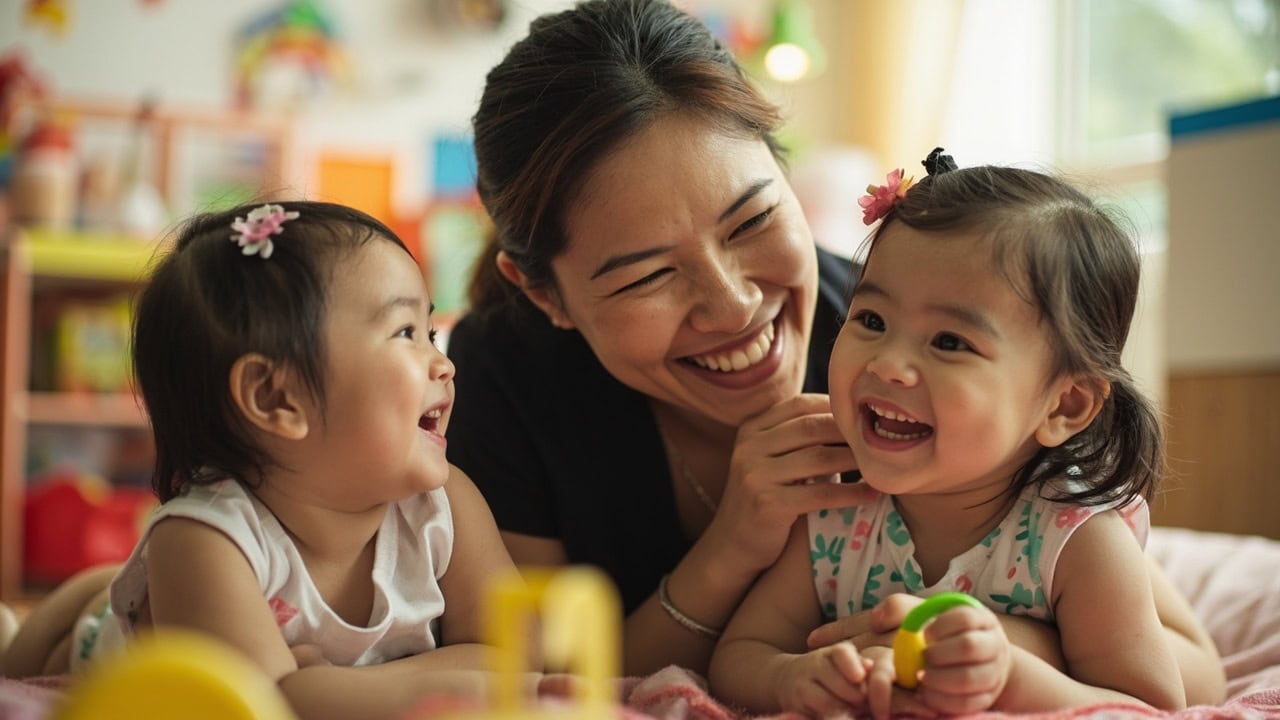
A child who has been genuinely engaged all day — not just supervised, not just kept safe, but engaged — brings that openness home with them. They want to tell you something. They want to show you something. They point. They babble. They reach for you and then immediately reach past you toward something that caught their eye.
That restlessness of genuine curiosity is one of the clearest signs that a child’s mind and heart have been alive all day.
More Themselves, Not Less
This is the point that matters most, and it is the one most often missing from how we talk about childcare quality.
A child in quality care comes back more themselves, not less. The child who walked into care in the morning is the same child who walks out — not diminished, not flattened, not changed into someone who knows how to perform for adults.
The child’s temperament, pace, and particular way of being in the world — all of that is still there, fully intact, maybe even more so. A quiet child does not come back loud because they learned to perform. A spirited child does not come back subdued because they learned to suppress. The child is still the child.
And if the care was genuinely excellent, the child is even more the child — more confident in who they are, more trusting of the world, more willing to show you the real self because the real self has been met with care all day long.
Signs That Deserve Your Attention
Compare this to the child who comes back different in ways that concern you. These are not minor observations. They are the child’s most honest communication, and they deserve to be read with the same seriousness you would give a medical symptom or a school report.
- The child who is unusually flat or disconnected
- The child who falls apart the moment the door closes at home in a way that feels disproportionate to the moment
- The child who does not want to talk about their day — not because they are introverts who need processing time, which is completely valid, but because something has made the day feel unreportable
- The child who flinches when a caregiver’s name comes up
- The older infant who has stopped asking to go, which sometimes happens when the environment has become a source of stress rather than growth
A single difficult pickup does not mean anything is wrong. Children have hard days. Children are tired, hungry, overstimulated, going through developmental leaps, dealing with normal social friction. What matters is the pattern. What matters is what lives inside the child over weeks and months.
Is the general trajectory one of openness and warmth? Does the child regress after a weekend at home and then recover during the week? Or is there a slow, quiet erosion of something that used to be there?
Trust the Flicker
We know this can feel like a lot to put on a parent. You are already carrying enough. You are already wondering if you are doing enough, being enough, giving enough. And now: pay attention to this, too. Read this signal. Carry this knowledge.
We say this not to add to your burden, but to take something away. Because what we are really saying is: you already know more than you think you do.
Your instinct is not just a feeling. Your intuition about your child is a legitimate form of evidence. It is built from thousands of hours of loving observation. It is data. It is pattern recognition at a depth no algorithm can match.
When something feels off — even if you cannot articulate why, even if the caregiver’s report sounds fine, even if the photos look bright and the children look smiling — trust that.
Trust the flicker. The micro-signal. The moment when your child walks through the door and something is just not quite right, and you feel it before you think it. That feeling is not anxiety. That feeling is attunement. And it is one of the most powerful tools a parent has.
Asking the Right Questions
How was your day? is a good start, but it is not always enough. For infants and toddlers, the question often yields silence, or a shrug, or the word “good” — which tells you very little. This is not because your child does not want to share. It is because their capacity to narrate their inner experience is still developing, and the day itself is too abstract and too long for a young mind to organise into a reportable story.
Listen With Your Body First
Before you ask anything, you pick them up and you hold them and you notice. You notice how they rest into you, or how they squirm to get down. You notice whether they reach for you with their whole body or just extend a hand. You notice whether they are floppy or tense.
You notice their smell. Yes, their smell. Because a child who has been in a warm, nurturing environment all day often carries a particular quality of calm in their body. These are not trivial observations. These are a form of listening.
Ask With Shape and Colour
Then ask questions that meet the child where they are. Not “what did you do today?” which is enormous and abstract. But:
- “Did you play with the blocks?”
- “Who was sitting next to you at lunch?”
- “What song did Ms Rachel sing?”
- “What was your snack today?”
- “Who picked you up after nap?”
Questions that have a shape, a colour, a specific thing the child can reach for and hold up to show you. Questions that let the child give you a window into a single, concrete moment of their day.
Watch what happens next. Watch what your child’s face does when you ask the right question. Watch for the moment when recognition lights up — oh yes, the blocks, the blue ones, I knocked them down and Amin knocked them down and we both laughed. That is when you are getting real data. That is when you are inside the child’s experience, even though you were not there.
Notice What Your Child Turns Away From
Watch for the questions your child does not want to answer. The ones they turn away from, or the ones they answer with deflection or a sudden interest in something completely different. These are not failures in your parenting. These are information. They tell you that something lives in that question that the child is not ready to carry into words yet, and that deserves your gentle attention and your patience.
The Child Is the Answer
Every parent already has the capacity to read their child at pickup. You have been doing it since your child was born. You know what your child’s normal looks like. You know the particular way they lean into you when they are tired but happy versus when they are genuinely distressed. You know the sound of their laugh, the way their face changes when they see you across a room, the exact quality of their grip when they reach for you on a good day versus a hard one.
That knowledge is not small. That knowledge is everything.
The child who comes home and says nothing but climbs into your lap and stays there for a while — that child is telling you something.
The child who comes home and talks endlessly, reconstructing the whole day for you in a torrent of language and gesture — that child is telling you something.
The child who comes home and goes immediately to the corner where they keep their favourite toy and sits down and plays, really plays, the way a child plays when their inner world is orderly and full — that child is telling you something.
What we want you to carry forward is not a checklist. It is an invitation to trust what you already know and to pay attention to what your child is already telling you every single day.
And if you have the courage to read those signals honestly, and the humility to act on them when something does not look right, and the patience to trust the pattern over time rather than any single moment — you are being the kind of parent your child needs you to be.
Not a perfect parent. Not a parent who never doubts. A parent who pays attention. A parent who takes the child’s communication seriously. A parent who knows that the child who returns is the answer.
What EduNanny Believes About Infant Care in Singapore
EduNanny was built on a conviction that infant and toddler care in Singapore deserves a different kind of thinking. Not just a better version of what already exists, but a fundamentally reframed approach — one that starts from the child’s experience rather than the parent’s convenience or the institution’s efficiency.
The difference between a child who is safe and a child who is flourishing is the quality of attunement they receive during the hours they are in care.
Safety is the baseline. It is non-negotiable. Every parent deserves to know — truly know — that their child is physically safe, that the environment is clean, that supervision is rigorous, that ratios are appropriate.
But safety alone is not what makes a child come home settled. What makes a child come home settled is a caregiver who is genuinely attuned to them — who notices when a toddler is about to tip over the edge of frustration and steps in before the meltdown, who knows that this particular child needs more processing time before transitions, that this one needs a physical outlet before circle time, that this one is going through a language explosion and needs to be talked to constantly.
Attunement at that level — individual, specific, responsive — is the difference between childcare that merely functions and childcare that genuinely nurtures.
Consistency and Continuity
Monday to Friday. Morning to afternoon. Consistent hours, consistent caregivers, consistent environments.
Infants do not generalise well across settings. A child who has three different caregivers in three different places is expending developmental energy on adaptation rather than growth. The steadiness of a consistent care arrangement is not a minor detail. It is foundational.
Trust and Transparency
Where CCTV measures are deployed, they are not there as surveillance. They are there as a bridge — a way of extending the parent’s visibility into the day, so that the distance between you and your child’s experience feels smaller.
We believe in communication that tells you not just that your child ate and slept, but how they ate, how they slept, what made them laugh, what they reached for first when they woke up. This kind of communication is only possible when ratios are low enough that caregivers have time to notice these things. It is only possible when the culture prioritises transparency as a form of respect for parents, not as a liability management strategy.
Affordability and Access
Singapore parents carry specific pressures — the cost of living, the expectations of the education system, the difficulty of extended family support in a city where grandparents may live in another country or still be working.
The guilt of leaving your infant in someone else’s care, even when you must, even when you know it is good for your child — we do not resolve that guilt for you. We are here to do something more practical: to give you evidence. Real, daily, observable evidence that the care your child is receiving is the kind that produces a child who runs to you at the end of the day and cannot wait to show you the thing they made.
The CDA and Baby Bonus mechanisms are there, and they are usable, and we will help you understand how — not because affordability is a footnote to quality, but because a family that can sustain the care is a family that can sustain the relationship with the caregiver. That continuity is one of the most underappreciated ingredients of excellent infant care.
Our Approach
EduNanny participates in the ECDA Childminding Pilot because we believe that home-based and community-based care pathways offer something that large centre-based environments struggle to replicate: the intimacy of smaller ratios, the warmth of domestic-scale settings, the relational depth that comes from consistent caregivers who know your child the way you know your child.
Our caregivers are not just trained to follow protocols. They are trained to attune. They are trained to read the micro-signals — the same signals we are encouraging you to read at home — and to respond to them in real time, in a way that teaches the child that they are seen, that their feelings matter, that the world is a place where their needs are understood.
That is not a soft aspiration. That is a daily, moment-by-moment practice, and it produces children who come home different in ways you can measure with your own eyes.
From Your Child’s Side of the Door
EduNanny exists because we believe that every Singapore family deserves access to care that makes this moment possible — the moment at the end of the day when your child comes back to you and you can feel, in your bones, that the hours apart were good for them. That they grew. That they were held. That they are more themselves than they were this morning.
We cannot do that alone. The caregiver cannot do that alone. The structures — the centre, the home, the pilot programme — none of these do the work by themselves. The work is relational. It lives in the space between your child and the person who holds them while you are away. And it lives in the space between you and your child, when you pick them up and hold them and ask, quietly, without expectation:
What was your day like?
And the child answers.
Not in words, perhaps. Not always in words. But in the body that relaxes into yours. In the curiosity that reaches toward the evening ahead. In the openness that says: I was safe today, and I was more than safe. I was known.
That is the child we want for every family in Singapore. That is the child who comes back. And that is why EduNanny does what we do — not just to care for your child while you work, but to ensure that when your child returns, you both know, without any doubt, that the day was exactly what it should have been.
That is the promise we hold. That is the evidence we build toward, every single day. And that is the child who walks through the door at the end of every day — ready for dinner, ready for bath, ready for the bedtime story, ready to fall asleep knowing that the world is a good place where people know them and care for them and help them become more themselves.
From your child’s side of the door, it looks like coming home.
If you are exploring infant care or childminding options in Singapore and would like to understand how EduNanny approaches the kind of care that produces a child who comes back settled, curious, and more themselves — we welcome the conversation.