What Your Child Shares When They Come Home
Children Speak. We Simply Have Not Learned to Listen.
This is not a failure of parenting. It is an invitation.
Singapore parents today are navigating something genuinely new in human history: a society where most young children will spend significant time in the care of others before they can speak fluently, before they can narrate their own experience, before they have the words to tell you whether they are happy, whether they feel safe, whether the person caring for them understands them.
The decisions we make about who cares for our children, where, and how, are among the most consequential we will ever make. Yet we make them with incomplete information, because the people we are making them for—the children themselves—cannot yet tell us what they need.
But they are telling us. They are always telling us.
What we need is not a checklist of quality indicators. What we need is a shift in attention, a way of seeing what has always been there. We need to learn the vocabulary our children are already speaking, so that we can hear what they are saying about their days, their relationships, their sense of themselves in the world.
We need to become, in the truest sense, attuned to our children—not because we are supposed to know instinctively what they feel, but because attunement is a skill that deepens with practice, with patience, and with the right kind of guidance.
What Children Actually Communicate
In the earliest years, before language becomes the primary medium of meaning, children are ceaseless storytellers. They tell their stories through the way they enter a room. They tell their stories through the games they choose, the roles they assign to themselves and others, the objects they carry, and the rituals they perform.
A child who spends an entire evening carrying a small cloth, holding it to their cheek, sleeping with it in their arms—this child is telling you something about comfort. About what sustained them in your absence. About the textures of care they encountered.
A child who returns home and immediately recreates a meal-time scene, setting out tiny bowls, distributing portions with careful attention, is showing you something about how they experienced nourishment—not only physical but relational.
A child who is clingy, resistant, barely consolable—that child is also communicating, urgently, about something that did not feel safe or understood.
We are inclined to interpret these behaviors as problems. The clinging child needs to “work through” something. The withdrawn child is “processing.” The irritable child is “overtired.” Sometimes this is true. But sometimes the child is simply reporting. They are giving us the only account they can give, in the only language available to them, of what their day was like inside.
Reading the Transitions
This is especially visible in the transitions—the moments of arrival and departure, the hand-offs that happen morning and evening in childcare settings across Singapore.
Watch a child in those moments. Watch their body, their eyes, the way they move toward or away from the caregiver. Watch the quality of their engagement with you when you arrive:
- Whether they are flooded with relief and need to be held immediately
- Whether they are absorbed in their play and only glancing up
- Whether they hesitate at the threshold, caught between worlds
These are not random fluctuations in temperament. They are data. They are, in a very real sense, a daily report on your child’s inner experience.
What Quality Care Reveals
What do children report, when they are in environments that truly see them?
They report belonging. They report that their preferences are noticed and honored. They report that their needs are met not only physically but emotionally. They report that they are allowed to be fully themselves—to express joy and frustration, to seek closeness and then venture away, to be curious and also to need rest.
In environments where children feel genuinely secure, they do not perform a polished version of themselves. They show up as they are, whole and complicated, and they are met there.
This is what quality looks like from the inside. Not from inspection reports or ratio charts or curriculum frameworks—though these matter too. From the inside, quality is what it feels like to be a child in a particular place. Quality is whether your inner life is seen. Quality is whether you can relax enough to play, explore enough to grow, and return enough to feel safe.
When children come home changed—expanded by new skills and words and ways of being—something has gone right. When they come home contracted, depleted, barely themselves, something has gone wrong. And between these poles lies an entire spectrum of experience that most parents are only beginning to learn to read.
Attunement Is a Skill You Can Develop
Here is what makes this so difficult: you cannot observe your child in care. You are not there. What you have is the evidence that arrives home with them—the residue, the echo, the story told in behavior and mood and the quality of their aliveness.
This evidence is rich, but it requires interpretation. It requires a framework for understanding what you are seeing. This is where attunement becomes essential, and where it becomes learnable.
Attunement is often discussed as though it were an innate instinct, or a vague quality of emotional closeness. But attunement, in the developmental sense, is something more precise: it is the capacity to read another person’s internal states from their external signals, and to respond in ways that validate and meet those states.
It is a skill, not a sentiment. It develops over time. And it can be cultivated.
You Have Already Begun
Consider how you have already begun to learn it. When your infant cried, you learned—through repetition, through attention, through trial and error—to distinguish the cry of hunger from the cry of fatigue, the cry of overstimulation from the cry of pain. You learned to read your baby’s body before they could speak, to understand their signals before you had words for them.
This was attunement in its earliest form. And it was not magic. It was observation, reflection, and the gradual accumulation of understanding.
The same process can continue. As your child grows, their signals become more complex, more layered, more embedded in play and relationship and the textures of daily life.
The child who comes home from childcare and immediately seeks a high point on the couch, clinging to your neck, is communicating something different from the child who comes home and moves straight to the blocks, building alone with concentrated intensity, occasionally glancing at you to make sure you are there.
Both may be in healthy environments. Both may be processing the day. But the signals are distinct, and learning to read them is part of what it means to know your child.
Quality Childminding and What It Looks Like
There is another dimension to this, one that is easy to overlook: the child’s own voice in the matter of care.
Even infants communicate preferences—not only discomforts but satisfactions, not only needs but desires. The child who shows no resistance at drop-off, who settles quickly into play, who returns home energized rather than depleted, is telling you something about whether their preferences are honored.
Consider these questions that quality care answers through behavior, not surveys:
- Are they allowed to finish what they are doing before being moved?
- Are their interests noticed and woven into the day?
- Are they permitted to express displeasure without being immediately corrected?
- Are their rhythms—sleep, hunger, the need for closeness and then for independence—respected?
In quality care, the child’s preferences become part of the curriculum. Not as a matter of permissiveness, but as a matter of respect.
The child who feels that their needs and desires are taken seriously develops a different relationship with the world than the child who learns, early, that their signals go unheeded. One learns that they matter, that their inner life is worthy of attention, that they can trust others to respond to them. The other learns something harder—something that shapes the architecture of future relationships.
The Secure Base in Childcare
This is why EduNanny approaches childminding not as a service delivery but as a developmental partnership. The caregivers are not replacing parents. They are extending the web of secure attachment that your child needs in order to explore.
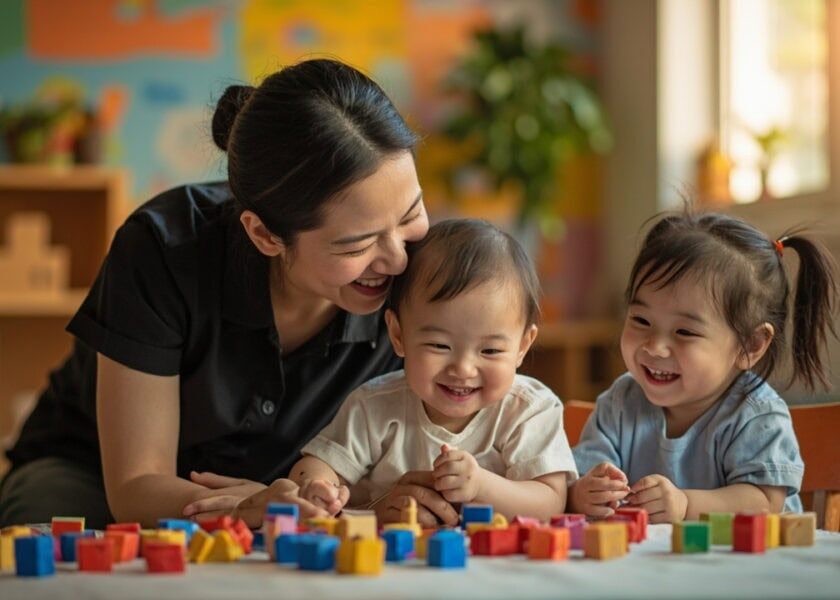
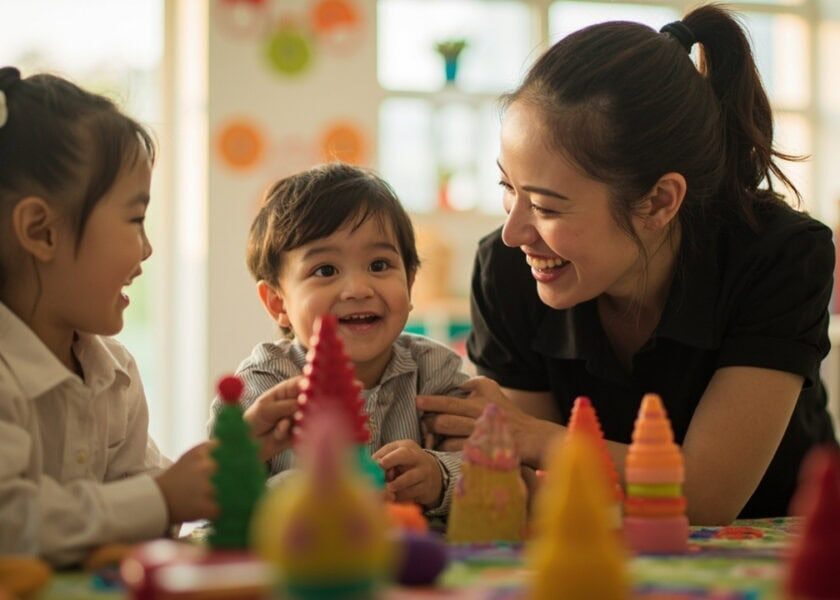
They are providing what psychologists call a secure base—someone who is consistently present, consistently responsive, consistently attuned—so that your child can venture out into the world of play and peers and learning, knowing that they can always return.
When this works, you can see it. Not only in the moments of hand-off, but across time, in the arc of your child’s development. The child who has a secure base in care is more confident in their explorations. They take appropriate risks. They persist at tasks. They form healthy relationships with peers. They know, in their bodies, that they are worthy of attention and care.
And they come home each evening, carrying some of that security with them—ready to share their discoveries, ready to be refilled, ready to rest into the knowledge that the adults who love them are still there.
How EduNanny Singapore Supports This
EduNanny has designed its approach to support not just the care itself, but the parent’s capacity to understand the child who is in care. The EduNanny experience is built on a conviction that parents are not peripheral to the childcare relationship—they are central to it. Their observations, their questions, their growing ability to read their child’s signals are what make the relationship meaningful over time.
This is why EduNanny places such weight on communication, transparency, and trust. Operating within the ECDA Childminding Pilot, parents receive regular updates not as a matter of protocol but as a matter of partnership.
They are not receiving performance reports on a service. They are receiving information that helps them understand their child. When a caregiver notes that your child discovered a new way of stacking cups today, or that they resisted nap time but eventually settled with a particular song, or that they reached for another child during play—this is not administrative detail. This is the raw material of attunement.
The infant ratios in EduNanny’s care settings—up to one to three, depending on the pathway—make this kind of observation possible. In smaller groups, with caregivers who have time to notice, your child’s inner life becomes visible in ways that are harder to sustain in larger settings.
EduNanny operates across Singapore, in home-based settings, community pathways, and centre-based options, making quality care accessible in ways that fit the realities of Singapore family life. The ECDA Childminding Pilot offers structured support within frameworks designed to make childminding a viable, professional, and deeply caring option for parents across the island.
Fees are structured to be affordable within pilot parameters, and payment methods—including CDA and Baby Bonus—can be used where applicable, so that the financial dimensions of care do not add another layer of stress to an already complex decision.
Where deployed, CCTV measures and transparent communication protocols ensure that trust is not assumed but built, maintained, and continuously renewed. These are not mere amenities. They are expressions of a deeper commitment: to the idea that parents deserve to know what is happening with their children, and that children deserve to be in environments where their inner lives are seen.
Reading Your Child: Evening Guidance and Common Concerns
Let us return to that evening window, because it is where so much of the learning happens.
When your child comes home, watch them before you ask them anything. Set down your phone. Pause your thoughts about dinner, about tomorrow, about the day’s unfinished business. Just watch.
Notice:
- The quality of their energy
- Where they go first
- Who they seek out and who they avoid
- The games they choose
- The words they use or do not use
- The texture of their voice
This is not helicopter parenting. This is not anxiety in disguise. This is the practice of attunement—the sustained, patient attention that allows you to hear what your child is saying without words.
Patterns Over Time
Over time, if you keep watching with this kind of curiosity, patterns will emerge. You will begin to see what a good day looks like for your child, and what a difficult one looks like. You will begin to notice the small signals that precede bigger shifts:
- The child who is about to reject food because they are teething
- The child who needs an earlier bedtime because they are in a developmental leap
- The child who needs more closeness this week because something changed in their care environment
This is the knowledge that no checklist can give you. It comes from loving your child enough to pay attention, and from having the right kind of support to make that attention meaningful.
How Do I Know My Child Is Really Okay?
This is the question beneath every decision to place your child in care. And it is not answered by inspection certificates alone. It is answered, day by day, in the evidence that comes home with your child.
When your child runs to you at pickup, not with panic but with the ease of someone who has had a good day and is ready to share it—when they climb into your arms with the particular relaxation of a child who trusts their environment and trusts you to return—when they mention the caregiver’s name with warmth, or show you something they made, or fall asleep easily because their day felt safe and complete.
These are the answers. And when something feels off, when the evening is difficult and the signals are unclear, that is also information—information that invites closer attention, a conversation with the caregiver, a deeper look at what might be happening.
What If I Miss Something Important?
You will. And that is okay. Missing is part of learning. The goal is not to catch everything. The goal is to stay curious, to keep watching, to build the relationship with your child where you become, over time, a fluent reader of their signals.
And when you need support in that reading—when the signals are unclear, when you need another set of trained eyes to help you understand what you are seeing—EduNanny caregivers are there. Not just as care providers, but as partners in observation. They notice what you cannot notice. They see what you cannot see. And they translate it into language you can use.
Can I Really Trust Someone Else With My Baby?
Trust is not a feeling you either have or don’t have. Trust is built through transparency, through consistent observation, through communication that keeps you informed. Trust is built when you can ask questions and receive honest answers. Trust is built when you can visit unexpectedly and see your child content, engaged, known.
EduNanny builds these conditions deliberately. Not because trust should be assumed, but because it should be earned—and then renewed, day by day, through every interaction.
The Invitation
Reading your child is not a means to an end. It is not a way to optimize their development or to catch problems early or to ensure they have every advantage. It is a way of being with your child—a quality of presence that deepens your relationship and enriches both your lives.
The parent who learns to read their child is not a better parent in some moral sense. They are simply a more present one. They are a parent who has accepted the invitation that every child extends: to know me, to really know me, to see past the surface of my behavior into the landscape of my inner experience.
This invitation is always there. Children do not hide their inner lives from us deliberately. They hide them because we have not yet learned to see them. They hide them because the world is too fast, and our attention is too fragmented, and we have not yet developed the skill of slow, sustained observation.
But the invitation remains. It is extended every evening, in the way your child runs to you or holds back, in the way they speak or go silent, in the way they show you what they have become over the hours you were apart.
The early years matter enormously. The decisions you make about care in these years shape the architecture of your child’s future. But they do not do so because of quality frameworks or inspection ratings or ratios on paper. They do so because of what your child experiences, day by day, in the spaces where they are cared for in your absence.
And what your child experiences is written on their body, in their behavior, in the quality of their aliveness when they come home to you.
Learn to read it. Not with anxiety, but with curiosity. Not with fear of getting it wrong, but with the quiet confidence that comes from knowing you are paying attention.
Your child is telling you everything. You have only to listen.
And when you need support in that listening—when the signals are unclear, when the evening is difficult, when you need another set of trained eyes to help you understand what you are seeing—EduNanny will be there. Not as a service provider. As a partner. As a guide in the ongoing, beautiful, never-finished work of knowing your child.
That is what childminding can be, at its best. Not a solution to the challenge of working parenthood, but an extension of the family—warm, attentive, deeply attuned to the child who is at its center.
That is the purpose EduNanny serves, and that is the purpose that matters most.
Your child is speaking. Listen.
Ready to Learn More About EduNanny Singapore?
Explore how EduNanny’s childminding services support both your child’s development and your own journey as an attuned, connected parent. Speak with the EduNanny team about your family’s needs and discover the care option that feels right for you.
Learn more about who EduNanny is and the standards that guide their approach to childcare in Singapore.