The Science Behind Why Your Child’s First Years Matter Most
The Invisible Architecture Being Built Right Now
The science of early childhood development is robust. Decades deep. Peer-reviewed and replicated across cultures and continents. What it tells us is this: the first thousand days of a child’s life are not just a phase to get through. They are the phase in which everything is being decided — not dramatically, not visibly, but quietly, in the architecture forming behind their eyes.
Your child’s brain, in these first years, is building more than one million neural connections every single second. That number is almost impossible to comprehend. We share it not to overwhelm you, but because it means this: every interaction your child has with a responsive, attuned caregiver during these hours is quite literally shaping the kind of thinker, the kind of feeler, the kind of person your child will become.
The quality of care your child receives is not a luxury. It is not a placeholder until they are old enough for “real” school. It is the soil in which the entire garden grows.
Formation, Not Supervision
Here is the part that Singapore parents feel viscerally but rarely hear articulated clearly: when your child is in quality care, something is happening that is not supervision. It is not entertainment. It is not babysitting in any meaningful sense of the word. What is happening is formation.
When a trained, attentive caregiver responds to your infant’s distress with warmth and consistency — not just feeding and changing, but genuinely attuning to what that cry means — your child is building something extraordinary. They are building what developmental psychologists call an internal working model of trust: a set of neural expectations about how the world responds to their needs.
I am worthy of attention. The people around me are reliable. The world is a place where my needs matter.
That belief is not small. That belief is the bedrock on which every relationship, every challenge, every moment of courage in your child’s entire life will be built.
Being Seen Versus Being Processed
Consider what happens in a childcare environment where the ratios are right, where the caregiver is trained and stable, where your child is not one of fifteen but one of two or three. What is built in those hours is something more specific still.
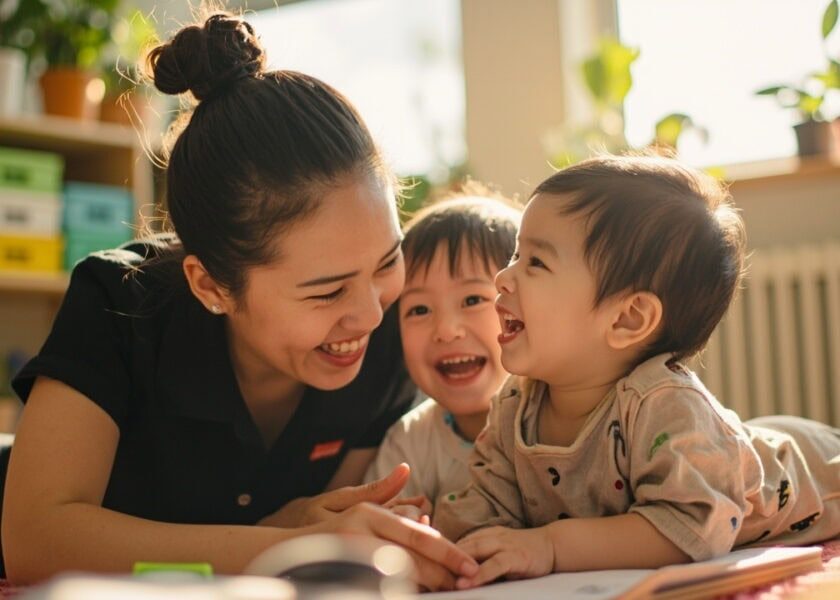
When a caregiver can truly observe your child — can notice the particular quality of their curiosity, the specific things that soothe them, the way they approach other children, the moment when frustration becomes something they are beginning to manage rather than be managed by — your child is being seen. Not managed. Not processed through a routine. Seen. Known.
Children who experience being known in their early care relationships develop better self-regulation. Not because anyone sat them down and taught them to breathe through frustration. But because they were in environments where their emotional states were mirrored back to them, where a caregiver named what they were feeling, where they learned, through hundreds of small moments, that emotions are manageable and that help is available.
What Executive Function Development Actually Means
You may have heard the term executive function and found it clinical or confusing. Let us make it practical.
Executive function is the set of capacities that allows your child, years from now, to:
- Pause before acting
- Focus even when something more interesting is happening
- Adapt when a plan does not work
- Hold information in mind while working on something else
These are the capacities that make school possible. That make friendship possible. That make learning from mistakes possible. And these capacities are not born into a child — they are constructed, day by day, in the interactions between that child and the caring adults around them during these first years.
What You Might Notice at Home
You may see evidence of this at home and not recognize it. You may notice your child, after a day in quality care, is more able to transition between activities without total collapse. More able to express frustration in words rather than through biting or throwing. More able to tolerate a moment of waiting.
More playful. More engaged. More present.
And you might think, well, that is just them getting older. And in part, it is. But it is also the result of what those hours are doing inside them. The quiet developmental work of quality care is accumulating in your child’s mind and heart, and it is showing up in the way they move through the world when they are with you.
That is what you are observing in the evening pickup moment. You are seeing the fruits of formation. You are seeing the evidence of something that cannot be seen while it is happening, because it is happening at a level of the brain and the heart that operates below the surface of behavior.
The Internal Experience Your Child Is Having
Here is a question worth sitting with: What is it like to be your child during those hours?
For an infant, the answer involves sensation and relationship. The temperature of the room. The tone of voice used when they are lifted. Whether the face that appears when they cry looks patient or frustrated. Whether someone notices the particular quality of their fussiness — not just that they are upset, but whether they are tired versus hungry versus overstimulated.
For a toddler, the hours involve discovery and challenge. The excitement of mastering something new. The frustration when mastery does not come easily. The relief of a familiar face. The curiosity about what happens next. The social experiments of playing alongside others.
Your child is not a passive recipient of care. They are an active experiencer, building expectations about the world with every interaction. And the quality of that experience — whether it is one of warmth and attunement or merely adequate supervision — is writing code into their developing nervous system that will run for the rest of their lives.
How Singapore Parents Can Recognize Quality Care
Not all childcare is doing this work. There is a profound difference between an environment where your child is adequately supervised and an environment where they are genuinely understood, where their development is the purpose and not the byproduct of the service.
As a parent, you cannot always see that difference in a tour. The toys will be clean either way. The ratios, on paper, may look similar. What you cannot see is the quality of attention your child receives, the consistency of the caregiver relationship, the pedagogical intentionality that transforms routine care into developmental opportunity, and whether your child’s unique temperament and needs are noticed or flattened into routine.
What to Look For
These indicators go beyond the surface:
- Caregiver stability: Is the same caregiver present day to day, or does your child encounter a rotating cast of faces? Trust is built through consistency.
- Ratios that allow observation: When a caregiver has only two or three children, they can notice the subtle shifts in mood, the emerging interests, the moments when a child needs support versus space.
- Responsive interaction: Do caregivers kneel to a child’s level? Do they narrate what the child is experiencing? Do they name emotions? Or is the environment quiet and efficient?
- Communication about your child’s day: Quality care wants you to know what happened, not just that your child was fed and changed. They should be able to tell you something specific about your child’s experience.
- Questions about your child: A caregiver invested in formation will ask about your child’s preferences, routines at home, and what you are noticing developmentally.
Why Ratios Matter
The research is clear: smaller ratios produce deeper attunement, richer observation, and more meaningful developmental engagement. When a caregiver is responsible for fifteen children instead of three, something essential is lost. The capacity to notice the micro-moments that matter — the slight withdrawal when a child is overwhelmed, the spark of interest when something catches their attention, the frustration building before it becomes a meltdown — requires time and space that is simply impossible in an overextended environment.
How EduNanny Addresses This Question
EduNanny enters this conversation not as another option in a crowded market, but as a deliberate answer to exactly the question Singapore parents are asking. EduNanny was built on a conviction that is simple to state and demanding to deliver: that every child in quality care deserves to be formed, not just watched.
Through the ECDA Childminding Pilot, EduNanny offers Singapore families access to infant care and childminding grounded in this developmental understanding. Whether through home-based pathways where a dedicated caregiver forms a consistent, trusted relationship with your child, or through centre-based settings where trained professionals bring intentional care to every interaction, EduNanny maintains ratios of up to one to three in infant care.
Fee structures within the pilot are designed to be accessible, with several payment pathways — including CDA and Baby Bonus usability — available to ease the logistical weight that Singapore parents carry alongside everything else.
Consistency, Communication, and Trust
Monday to Friday care blocks provide the consistency that developmental science tells us matters enormously. Children do not build trust in fragments. They build it in patterns, in the reliable repetition of responsive care.
When your child knows that the same caregiver will greet them each morning, that the rhythms of the day will feel familiar, that their signals will be recognized by someone who truly knows them — that is when formation becomes possible.
EduNanny understands that you, as a parent, need to feel connected to what is happening during those hours. Communication and transparency are built into their approach, with regular updates and, in applicable settings, CCTV provisions. Not because parents need surveillance, but because trust requires visibility. You cannot relax into the knowledge that your child is thriving if you have no window into their day. You deserve to trust informedly, not blindly.
Common Concerns Addressed
“Will my child form an attachment to their caregiver instead of me?”
Multiple attachments are healthy and developmentally appropriate. Your child can form a secure attachment to their caregiver and to you. The security they build with a consistent, responsive caregiver often supports rather than competes with the attachment they have with you. When your child’s needs are reliably met in your absence, they develop a foundational trust that they bring to all their relationships, including the one with you.
“How do I know quality care is actually happening when I cannot see it?”
You look for the evidence. You observe your child at the evening pickup. You notice what they say, how they play, how they regulate their emotions. You ask the caregiver specific questions about your child’s day and notice whether they have real answers. You watch for signs that your child is comfortable and curious when you arrive, not withdrawn or distressed. The internal work manifests in observable ways.
“Is centre-based or home-based better?”
Either can be excellent, and either can be inadequate. What matters is not the setting but the quality of the relationships, the training of the caregivers, and the ratios that allow for genuine attunement. EduNanny offers both pathways so that families can choose what fits their circumstances, with the confidence that either option is grounded in developmental principles.
Choosing Infant Care in Singapore: A Practical Guide
If you are in the process of researching infant care or childminding in Singapore, this guide will help you make a discerning decision:
- Trust your observation at tours. Watch the caregivers. Do they kneel down? Do they speak warmly? Do they seem present with the children, or distracted? The quality of attention in the room is visible if you look for it.
- Ask about ratios. Not just whether they meet minimum requirements, but what the actual caregiver-to-child ratio is. In infant care, smaller is better.
- Ask about caregiver stability. Will your child have a primary caregiver? How often does turnover happen? How do they handle transitions?
- Notice communication systems. How will you know what happened during the day? Is there daily reporting? Regular check-ins? How do they handle sharing concerns or milestones?
- Observe your child after visits. How does your child respond to the environment? Do they seem interested? Comfortable? Distressed? Your child’s response is important information.
- Ask about training. What is the caregivers’ background in child development? How do they handle common developmental challenges like separation anxiety, biting, or sleep regressions?
- Trust the evening pickup test. After your child has been in care for a few weeks, observe what you notice. Is your child showing signs of the formation we have described — better regulation, more curiosity, growing security? That is evidence worth looking for.
The Foundation Being Built Inside Your Child Right Now
There is one more thing worth leaving you with, and it is the thought that matters most.
When your child is in quality care during these first years, what is being built inside them will outlast the childcare years by decades. The neural pathways that form in responsive, stimulating, emotionally attuned care do not disappear when your child graduates to primary school. They become the substrate on which every subsequent learning, every relationship, every moment of resilience is built.
Your child will carry the internal working model of trust that is being formed right now — this year, in these months — into every classroom, every friendship, every challenge they face as they grow. The internal architecture being constructed in quality childcare is not a phase. It is a foundation. And foundations, once laid, define everything that stands on them.
A Note to Singapore Parents
So when you feel that wondering at the evening pickup — when you notice something different in your child and you cannot quite name what it is — know this: what you are sensing is real. It is the evidence of formation. It is the quiet, extraordinary, invisible work of quality care doing exactly what it is meant to do: building your child from the inside.
You chose this. You chose to look for something beyond supervision. You chose to trust that what happens in those hours matters, because it does.
And you were right.
The work being done inside your child right now is some of the most important work of their entire life. And it is happening, in part, because you made a discerning, thoughtful choice to place them somewhere worthy of that trust.
Next Steps
If you are researching infant care or childminding in Singapore and want to explore an option grounded in developmental understanding, EduNanny welcomes the conversation.
Learn more about EduNanny’s infant care and childminding services within the ECDA Childminding Pilot. Ask questions. Share your concerns. Trust that the team understands the weight of what you are entrusting to them — because they take that seriously.
Your child’s formation is happening. Make sure it is happening somewhere worthy of the trust you are placing.
At EduNanny, we believe that every child deserves to be seen, known, and formed with intention. We invite you to begin a conversation — because the foundations being built right now will last a lifetime.