The Interior Life of Your Child: What Quality Childcare Builds
What Quality Childcare Actually Looks Like
Before we go deeper, here is what research and experience tell us about what your child needs—and what quality care makes possible:
- Security first: Children explore, learn, and connect because they feel safe first. This is not softness—it is the foundation of everything.
- Space to discover capability: When given appropriate challenges and genuine encouragement, children learn that they are agents in their own world.
- Skills for being with others: Peer interaction teaches empathy, patience, and the understanding that other people have feelings too—skills no curriculum can fully replicate.
- Readiness that shows over time: The confidence to try, the resilience to persist, the social ease to belong—these are the real signs that care is working.
The true measure of childcare is what your child is becoming. Not what the programme looks like on paper, but who they are when they walk into a room, when they face a challenge, when they reach for connection. That is the question worth asking. And that is the question we will explore together.
The Foundation: Security and What Your Child Needs First
In those early years, before language has fully opened the door to explanation and reasoning, a child orients to the world through felt experience. They feel whether the environment holds them or lets them fall. They feel whether the person caring for them responds when they reach out, or whether they are left alone with their need.
This is not metaphor. This is biology. A child’s brain is quite literally building itself based on these early experiences of safety and response.
When a child experiences consistent, warm, attuned care—when their cries are met with comfort, when their reaching is answered with holding, when they learn that the world returns them to themselves rather than abandoning them—something remarkable happens. A secure foundation forms. And it is from this foundation that everything else grows.
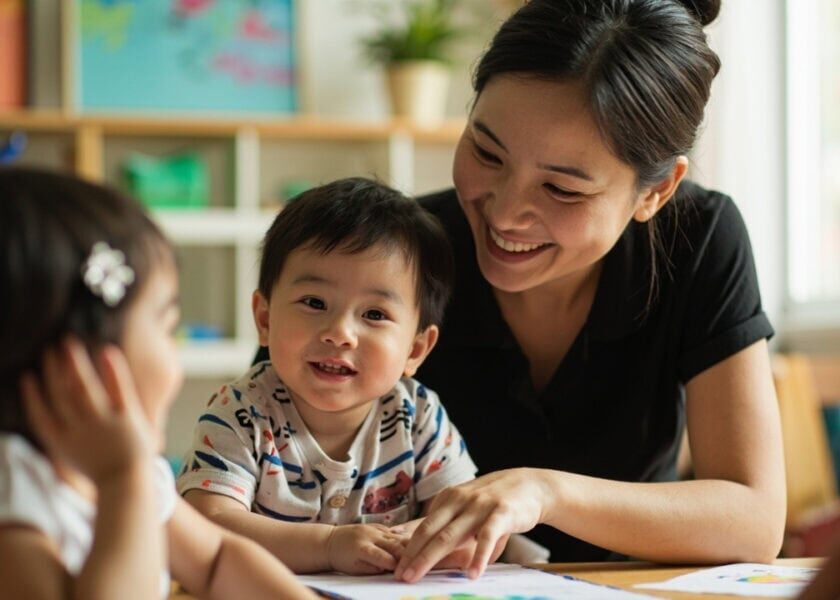
A child who feels secure does something extraordinary: they let go. They turn away from the caregiver. They look at a toy, at another child, at the light coming through the window. They explore. They reach for something just out of grasp, fall, try again. They begin to claim the world as their own.
What Secure Attachment Looks Like in Practice
You see it in the child who runs into the childcare room without looking back—not because they do not love you, but because they trust that you will return. You see it in the child who will, a few minutes later, glance toward the door and smile when you reappear.
That small arc—from distress to exploration to reunion—is the foundation of everything we call readiness. It is the foundation of learning, of cooperation, of the belief that effort leads to reward.
In Singapore, where many families live in high-rise homes and children may not have the same neighbourhood networks that previous generations enjoyed, secure attachment with a consistent caregiver becomes even more important. The childminder or centre-based educator who becomes a reliable, warm presence in your child’s life is not just filling a gap—they are building something irreplaceable.
How Children Grow: Agency, Capability, and Social Development
Consider what happens once that foundation of security is in place. The child begins to discover something about themselves: that they are capable. That their actions have effect. That they can make things happen.
A toddler drops a block, watches it fall, and picks it up again. A baby reaches for a mobile and finds, through their own movement, that they can make it spin. These are not trivial moments. They are the earliest awakenings of agency—the child’s first understanding that they are not just a recipient of care, but an actor in the world, a person with preferences and powers and the capacity to shape their experience.
Nurturing the Child’s Sense of Capability
Quality care pays attention to this. It creates environments where children can encounter appropriate challenges—not overwhelming, but just demanding enough to stretch. It allows for the frustration that comes before mastery, while ensuring that help is present when needed.
It names what the child is doing, mirroring their experience back to them: “You did it. You put the shape in the slot.” This small act of recognition tells the child that their experience matters, that what they are becoming is worth noticing.
Agency is not something that can be given to a child. It can only be enabled. And when it is—when a child has the opportunity to discover their own competence, again and again, in an environment that believes in their capacity—they begin to carry something with them. It shows up later, in small ways:
- The child who tries new foods without fear
- The child who asks for help when they need it, because they have learned that asking is not weakness
- The child who, when faced with a problem, tries one solution, then another, then another
Not because someone taught them persistence, but because they have lived it, felt it, made it their own.
Learning to Be With Others
But there is something else that happens in quality care that is harder to see and more important than we often realize: the child learns to be with others.
Singapore is a small country, and many of our children grow up in households where they are the only child, or one of very few. Without opportunities to be with peers, children miss something vital: the experience of navigating relationships, of learning that other people have wants and feelings that may not match their own, of discovering that conflict is not destruction, and that connection survives disagreement.
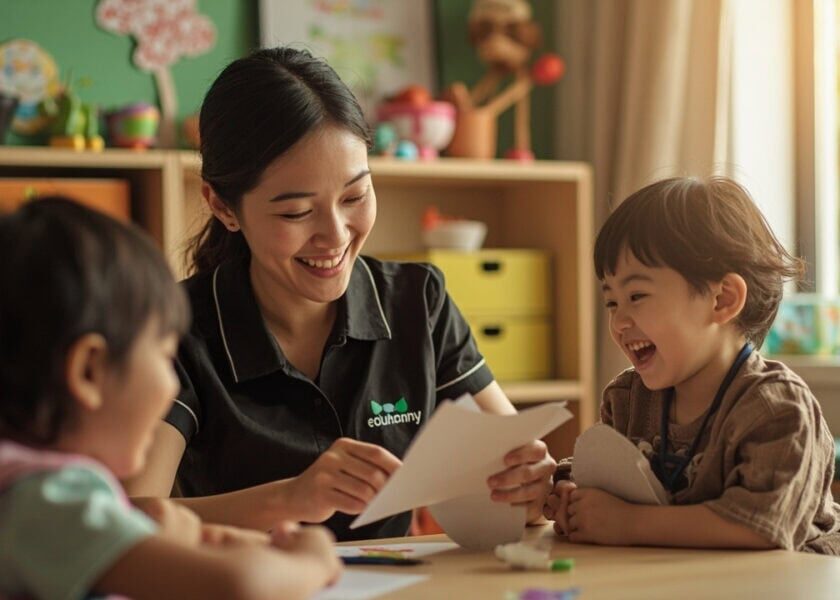
In quality care, children encounter each other. They reach for the same toy. They want the same attention. They discover that someone else has taken the truck they wanted. These are not problems to be eliminated. They are opportunities.
Under the guidance of a trained, observant caregiver, these moments become classrooms without walls:
- A child learns to wait.
- A child learns to notice another’s distress and, with prompting, to offer comfort.
- A child learns that they are part of something larger than themselves—that their actions affect others, and others’ actions affect them.
You may see evidence of this later, in ways that surprise you. The child who shares without being asked. The child who notices when another child is upset and pauses, considers, offers a toy or a touch. The child who enters a new group and reads the room, navigating social complexity with a sureness that seems beyond their years.
What you are seeing is not innate talent. It is the fruit of experiences you could not see—experiences of being with others, in the presence of a caregiver who helped those experiences become lessons, who held the space where social intelligence could take root.
Signs That Development Is on Track
This is what we mean when we speak of the interior life of the child. It is the world inside your child that you cannot directly access—their sense of safety, their emerging confidence, their growing understanding of themselves in relation to others. It is who they are becoming in the moments when you are not there to witness it.
This interior life is not abstract. It has consequences. It leaves marks. It shapes the child you will see emerge over the coming years.
When security is well-established, you will notice:
- A child who is curious without being reckless
- A child who is confident without being dismissive of others
- A child who can separate from you and return to you with ease
When agency has been supported, you will notice:
- A child who approaches challenges with quiet determination
- A child who does not give up easily but also knows how to ask for help
- A child who experiments and tries new things with enthusiasm
When social development has been nurtured, you will notice:
- A child who is comfortable in groups
- A child who can be alone without being lonely
- A child who has the beginnings of genuine friendship
These are not guarantees. Children are complex, and development is never a straight line. But they are signs—real signs, observable signs—that the inner world of your child is developing as it should. And they are the true measure of whether childcare is working. Not the curriculum on paper, not the facilities in photographs, but what your child is becoming.
What to Look For and Ask When Choosing Care
Understanding what your child needs is one thing. Finding care that delivers it is another. Here is what to look for when you are evaluating your options:
What to Observe During a Visit
- How caregivers respond to distress: When a child is upset, do they receive immediate, warm attention? Or are they left to self-soothe for extended periods?
- What the environment invites: Are there materials at different developmental levels, allowing children to choose challenges that stretch them?
- How interactions sound: Do you hear caregivers naming what children are doing, reflecting their experience back to them? Or is most communication directive?
- Whether children seem at ease: Are there smiles? Focused play? Peer interaction? Or is the atmosphere tense, chaotic, or performative?
- The ratio of children to caregivers: Fewer children per adult means more individual attention, more attunement, more space for your child to be known.
Questions Worth Asking
- How do you handle a child who is struggling to settle?
- What does a typical day look like for the children?
- How do you support children when they conflict with each other?
- How will I know what my child is experiencing during the day?
- What training have the caregivers received in child development?
EduNanny by BUTLER: Our Approach
EduNanny by BUTLER was built around a simple conviction: the question every parent carries about their child’s interior life deserves a serious answer. We have built our approach not just around the logistics of care, but around its purpose. Not just that a child is being watched, but that a child is being understood.
EduNanny is part of the ECDA Childminding Pilot, a recognition that Singapore’s families need more than one pathway to quality care. We offer:
- Home-based care: Where a trained childminder comes to your child in the environment they know best—their home. Particularly suitable for infants and toddlers who benefit from continuity and a familiar space.
- Community and centre-based options: Where children benefit from peer interaction in a carefully designed space, building social skills alongside their development.
The ratios we maintain ensure that no child disappears into the crowd, that every child is known, that attention is not a scarce resource but a given one.
Transparency and Trust
We know that trust is not built on promises alone. It is built on transparency. Where deployed, our centres and care arrangements include communication measures that keep you connected to your child’s day, and in some settings, CCTV measures that allow you to see, when you need to see, that all is well.
These are not luxuries. They are acknowledgments of the reality that you carry—the reality of walking away from a closed door and needing, somehow, to trust that what is happening on the other side is good.
Accessibility for Singapore Families
We also know that care must be accessible. Our pilot fee structures are designed to be affordable, and we have made it straightforward to use the tools already available to Singapore families:
- CDA and Baby Bonus can be applied, reducing the financial weight of quality care
- Monday to Friday care blocks are structured around the rhythms of working families
- We are present across Singapore, ready to meet families where they are
The People Behind the Care
But let us be clear about what EduNanny is, at its core. It is not primarily a logistics solution. It is a philosophy of care, made real through the people we select, the training we provide, and the environment we create.
The childminders in our network are not babysitters. They are professionals who understand child development, who know what secure attachment looks like and how to foster it, who can read the cues of a child’s internal state and respond with attunement rather than prescription.
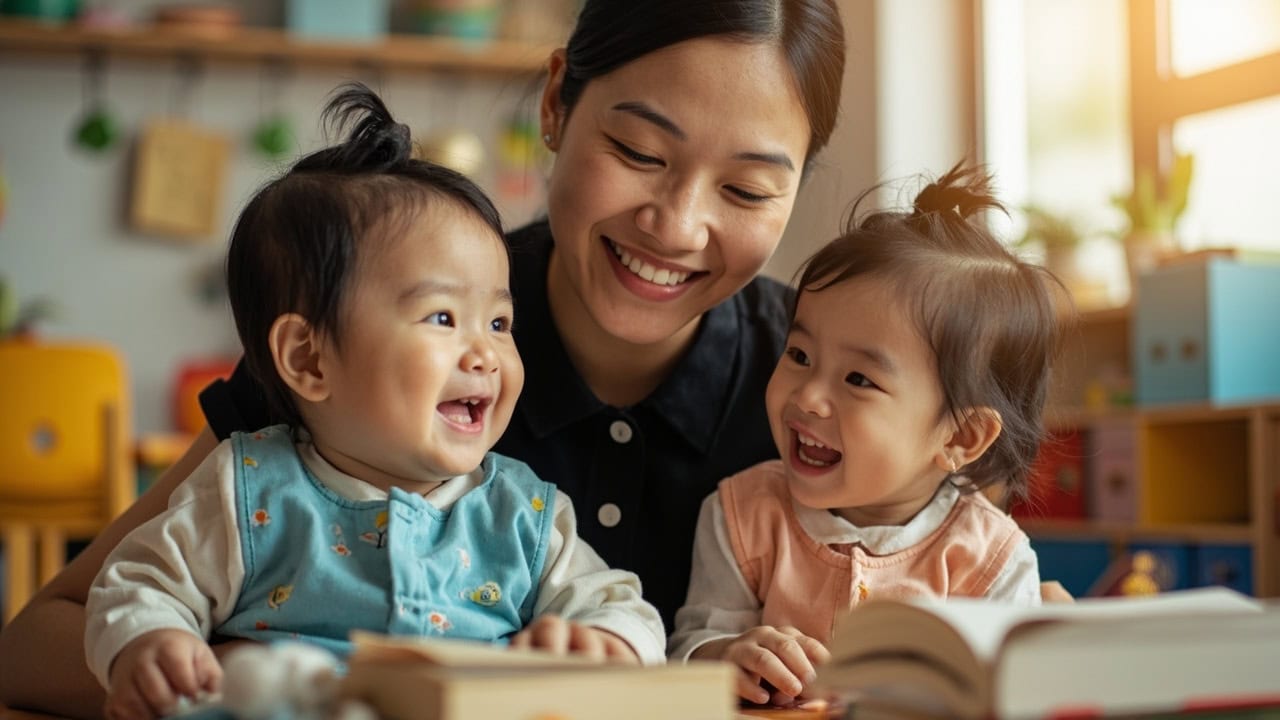
When your child is in EduNanny’s care, they are not simply being fed and changed and kept safe. They are being seen. They are being responded to. They are being given opportunities to explore, to struggle, to master, to connect. They are being held in an environment that believes every moment is an opportunity for growth.
This is what we mean when we say that EduNanny is child-centered. We do not mean it as a marketing phrase. We mean it as a commitment. The child is not an afterthought to our service. The child is the reason for it.
Addressing Your Real Concerns
Will my child feel abandoned when I leave?
This is the question beneath all other questions for many parents. The honest answer is: it depends on what comes before. If your child has experienced consistent, warm, attuned care—even from an early age—they have already begun to build the capacity to trust that you will return.
A skilled caregiver will help your child navigate the transition, offering comfort and presence that allows the goodbye to be hard but not traumatic. Over time, most children move from distress to curiosity, from clinging to exploring. If this transition remains deeply distressing over weeks and months, it is worth investigating whether the care arrangement is the right fit.
Is home-based care as good as centre-based care?
This is not a question with a single answer. It depends on the child, the family, and the quality of the specific arrangement. Home-based care offers continuity, a familiar environment, and individualised attention. Centre-based care offers peer interaction and a structured learning environment. At EduNanny, we believe in both pathways—and in matching families to the arrangement that best fits their child’s needs and temperament.
How do I know if my child is actually thriving?
You know by what you observe over time. Does your child seem curious and engaged? Do they show confidence in familiar settings and gradual comfort in new ones? Do they have moments of persistence alongside the ability to ask for help? Do they show early signs of social awareness—sharing, noticing others’ feelings, navigating groups?
These are the signs that the interior life is developing as it should. Your caregiver’s observations, shared regularly with you, should align with and reinforce what you see at home.
A Decision Worth Taking Seriously
When you drop your child at childcare, you are not just solving a logistical problem. You are not just buying a service to fill the hours while you work. You are making a decision about who your child will become.
Every hour your child spends in quality care is an hour in which their brain is building itself. It is an hour in which they are learning, perhaps for the first time, that they are separate from you but not abandoned, that the world contains others who can be trusted, that their actions have meaning, that learning is possible, that they are competent and capable and worthy of attention.
These are not small things. These are the foundations of everything that comes after:
- The confidence your child will carry into school
- The resilience they will draw on when life becomes difficult
- The relational capacity that will allow them to build genuine connections throughout their lives
- The curiosity that will drive them toward meaning and purpose
You are not just choosing childcare. You are investing in a person.
The question you have been carrying—the question that lives beneath all the logistics and all the lists—is not really about childcare at all. It is about your child. It is about who they are, who they are becoming, whether the experiences they are having when you are not there are shaping them in the ways you hope and dream and cannot quite articulate.
We cannot answer that question for you. No one can. But we can tell you that we have thought about it, lived with it, built our entire approach around it. We can tell you that every decision we make—every ratio we maintain, every training session we require, every communication channel we open—is in service of this one thing: your child’s becoming.
The door will close. The day will begin. And somewhere on the other side of that door, a child will reach for the world.
Our job is to make sure the world reaches back.
If this article has resonated with you, we invite you to take the next step. Schedule a conversation with our team or explore our care options to see quality care in practice.
Every child deserves to be seen. Every parent deserves to trust what happens after the door closes.
EduNanny by BUTLER is here, across Singapore, ready to walk this path with you.