When Your Child Reaches for Someone Else: A New Understanding
The Question Beneath Every Childcare Decision
There is a moment, quiet and unremarkable in every way except the way it matters most, that nearly every parent in Singapore knows by heart. The morning handoff. The small hand releasing yours—not fully, not yet, but enough to let go.
The caregiver kneeling to meet your child’s eyes, speaking words you cannot quite hear, and your child turning back toward you just once, briefly, a question in that glance that you both answer and cannot answer.
And then you leave.
In that exit, in the particular silence of the car or the lift or the corridor after the door closes, something in you settles into a thought you may not have fully formed yet. It sounds something like this:
What does it mean that they are so comfortable with her? What does it mean that they reached for her this morning without hesitation? What does it mean that I could walk away?
This is not a question Singapore parents ask out loud very often. It lives in the margins of conversations with your spouse, in the late-night thoughts that keep you awake, in the particular texture of your silence during those first weeks of childcare when you are both learning—your child and you—how to do this new thing together.
What you are actually asking, beneath all the practical considerations—beneath the logistics and the hours and the proximity to your home or your office—is a question about love. You are asking: If my child forms a real bond with someone else, what happens to the bond we have? You are asking: Is there enough room in my child’s heart for more than one person who matters?
The fear is real, and it is intelligent. The fear comes from a parent’s fierce, protective love, from the understanding that attachment in the early years shapes the architecture of the heart and mind in ways we are only beginning to fully understand. The fear is not irrational. It is a sign of how much you care.
And I want you to know: that fear deserves a real answer.
What Research Tells Us About Multiple Attachments
In the middle of the last century, a British psychologist named John Bowlby began developing what would become one of the most influential frameworks in our understanding of human development. He called it attachment theory. His central insight was this: human beings are born to form deep emotional bonds, and the quality of those bonds—their security, their consistency, their attunement—shapes not only how we feel about relationships but how we feel about ourselves, about the world, about our place in it.
His student, Mary Ainsworth, refined this work through careful observation of infants and their caregivers, and what she found was something profound and, for our purposes, essential. She discovered that children do not form just one attachment. They form multiple attachments, to multiple people, and these attachments can each be genuine, meaningful, and secure.
This is the part that changes everything.
The healthy, well-attached infant is not attached to one person alone. The child who runs to grandmother with delight and reaches for father at the end of the day and settles in the arms of a consistent, loving caregiver—each of these bonds is real. Each contributes to the child’s sense of security. None of them competes with the others.
In fact, the research is remarkably consistent: when children have multiple secure attachment figures, they do not love their parents less. They do not depend on their parents less. They are not confused or conflicted by the presence of other people who matter deeply to them. What they are is more resourced. More capable of exploration, of independence, of the kind of confident curiosity that is the hallmark of healthy development.
A child who trusts that their caregiver will be there, predictably and warmly, when they return from playing, is a child who can afford to venture further. A child who has learned, across multiple relationships, that adults can be relied upon—that the world contains people who will catch them—is building something in themselves that no single relationship could provide alone.
The caregiver becomes, in this framework, what developmental psychologists call a secondary secure base. Not a replacement for the parent, but an expansion of the child’s sense that they are held, that they are safe, that the people who care for them are worthy of trust. The parent remains the primary secure base, the deepest well from which the child draws, but the caregiver adds to that well rather than drawing from it.
Key Findings Parents Should Know
- Multiple attachments are healthy. Children form genuine bonds with multiple caregivers—and each bond can be secure, meaningful, and real.
- Professional attachment does not replace parental attachment. The right caregiver expands your child’s secure base rather than drawing from it.
- The bond you build with your child is not fragile. It is the deepest architecture of your child’s inner life, and it will hold.
- Quality matters. Secure attachments require attunement—sensitive, consistent, emotionally present care over time.
Secure vs. Anxious Attachment: What the Signs Look Like
There is a distinction here that matters enormously. It is the difference between anxious attachment and secure attachment.
Anxious attachment, whether to a parent or a caregiver, happens when the relationship is inconsistent, unpredictable, or characterized by the child’s uncertainty about whether the adult will be available. A child who clings desperately, who cannot be soothed by anyone else, who falls apart at every separation—this child is not securely attached. They are signaling something that needs attention.
A secure attachment is different. A securely attached child can separate and reunion. They can explore and return. They can delight in a caregiver and delight in a parent. They can hold multiple meaningful relationships in their heart without confusion or anxiety, because they have learned that love is not a finite resource, that the people who care for them are reliable, that they themselves are worthy of care.
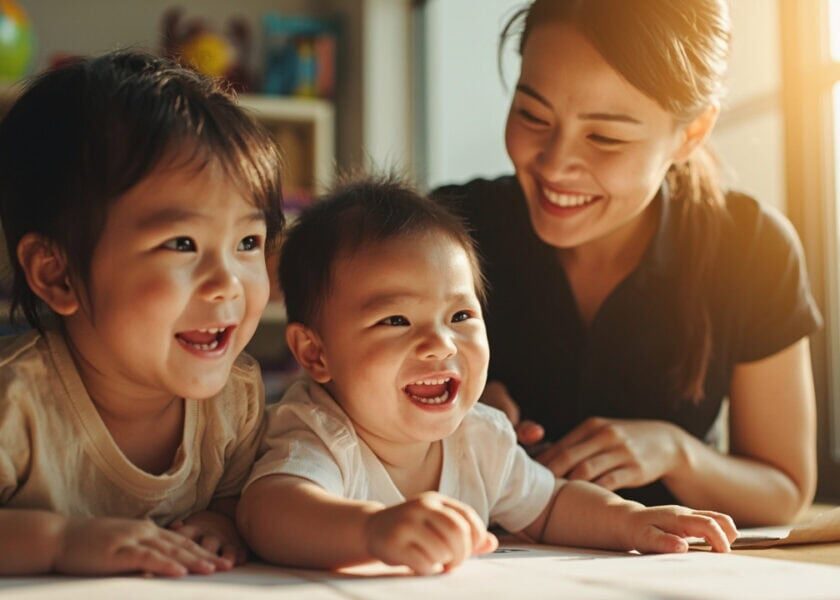
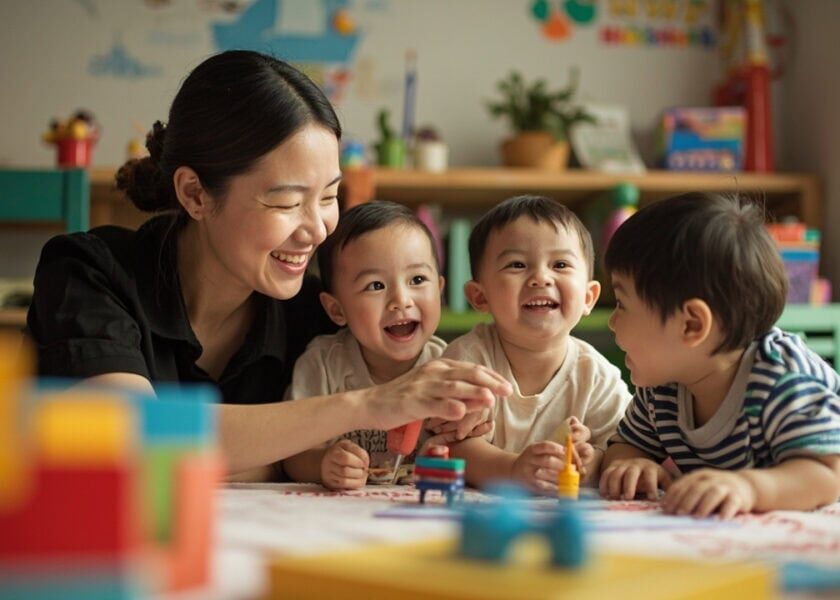
When you see your child reach confidently for their caregiver, settle into the morning routine with visible comfort, and then run to you at pickup with unmistakable joy—this is not a threat to your bond. This is the evidence of it. Your child has learned, through you, how to trust. And that trust, once learned, extends outward.
Signs of Healthy (Secure) Attachment With Your Caregiver
- Your child separates without excessive distress
- Your child can be soothed by the caregiver
- Transitions between home and care get easier over time
- Your child shows genuine warmth toward the caregiver, not just familiarity
- Your child runs to you at pickup with joy, not confusion
Signs That May Need Attention
- Excessive distress that doesn’t reduce over time
- Inability to be soothed by any caregiver
- Clinginess that suggests anxiety rather than healthy connection
- Sudden behavioral changes that persist rather than resolve
What Quality Childminding Actually Looks Like
What makes healthy attachment possible is the quality of the caregiver relationship itself. The research on multiple attachments does not say that just any caregiver bond will do. It says that secure attachments are built through attunement—through the caregiver’s ability to read the child’s cues, to respond sensitively, to be emotionally present in a consistent way over time.
A caregiver who is merely supervising is not building the kind of attachment that expands the child’s secure base. A caregiver who is genuinely attuned, who knows the child’s rhythms and preferences, who responds with warmth and intelligence to the child’s emotional life—this is the caregiver who becomes a true resource for the child and, by extension, for the family.
Markers of Attachment-Informed Care
- Consistent presence: The same caregiver, day after day, so your child can build predictability and trust
- Emotional attunement: The caregiver reads your child’s cues and responds appropriately to their emotional state
- Respect for your child’s pace: Transitions are handled with patience, never rushed
- Transparent communication: Regular updates about your child’s day, their moods, their discoveries
- Support for exploration: The caregiver encourages your child to venture and return, not to cling
Questions to Ask When Choosing Infant Care in Singapore
If you are researching childcare options for your infant or toddler, here are the questions worth asking:
- Who will be caring for my child? Look for consistency—the same caregiver over time, not a rotating cast of strangers.
- What is the caregiver’s understanding of attachment? Do they speak about your child’s emotional world with nuance? Do they understand the difference between anxious and secure attachment?
- What is the ratio? For infants, smaller is better. More individual attention means deeper attunement.
- How will I know what happens during the day? Transparent communication is not optional—it is essential for parents who are building trust with their care arrangement.
- How does this care complement what I am building at home? The best care arrangements feel like a partnership, not a handoff.
Context matters in how children show attachment. Your child may show more overt distress with you because you are their safe base for expressing big emotions. The caregiver may see a more regulated, exploratory child because that is the role caregivers often play in the attachment ecosystem. What matters is that your child can connect warmly with both, can separate and reunion with both, and shows increasing confidence over time.
The Morning Handoff Reframed
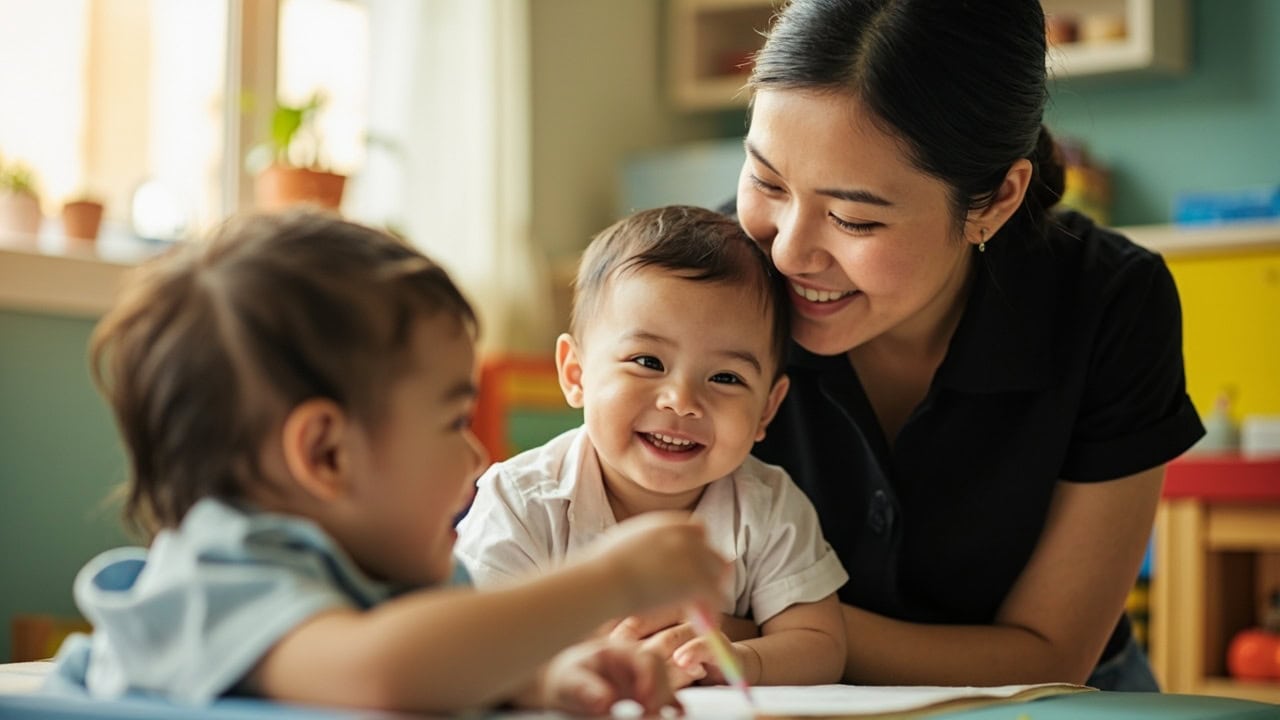
This is the reframe that changes the meaning of the morning handoff. When your child releases your hand and reaches, with trust, for their caregiver, what is happening is not a subtraction from your bond. It is an addition to your child’s resources.
It is your child saying, through behavior that feels bewildering and even painful to witness, that they have learned what love looks like, and they recognize it in another person, and they feel safe enough to let you go because they know you will return, and they know their caregiver will hold them until you do.
You are not diminishing your bond with your child by entrusting them to a caregiver. You are not failing them by needing help, by working, by living in a city where the village is not always geographically close. You are not competing with the person who cares for your child. You are collaborating with them.
Your child’s bond with their caregiver is not a threat to your bond with them. It is an echo of it. It is evidence that you have given your child something so good, so foundational, that they recognise it when they find it elsewhere.
The morning handoff will still be hard. It is supposed to be. That small pang you feel, that reluctance to release your child’s hand, that question that surfaces again and again—these are not signs of failure. They are the cost of loving someone this much. They are the evidence of how much you care about getting this right.
You are getting it right.
EduNanny’s Approach: Secondary Secure Base, Primary Commitment
EduNanny Singapore takes this understanding seriously. The caregivers who work within EduNanny’s framework are trained to understand attachment dynamics, to recognize the signs of secure attachment, to support the child’s emotional development in ways that are complementary to the parent’s own work. They are not substitutes for parents. They are attachment figures—people who have earned the child’s trust through consistent, sensitive care.
Through the ECDA Childminding Pilot, EduNanny by BUTLER provides home-based childminding with carefully considered ratios—up to three infants in care, with attention to the particular demands of infant development. This smaller ratio matters. It allows for the kind of individual attention that builds genuine attunement rather than mere supervision.
For families navigating the cost of quality care, EduNanny has worked to keep arrangements accessible within pilot fee structures. Parents can access support through mechanisms like the Child Development Account and Baby Bonus schemes, making thoughtfully delivered care a realistic option rather than an aspirational one.
Communication is handled with the transparency that parents deserve and that the attachment framework requires. When you understand that the caregiver relationship is genuinely meaningful to your child, you want to know what is happening during the day. EduNanny’s approach includes measures that allow parents to stay connected—knowing what your child is experiencing, how they are settling, what moments of delight or difficulty occurred, what was eaten and how they slept. This transparency is not just a service feature. It is a recognition that you and your child’s caregiver are engaged in a shared endeavour.
Where deployed, additional measures such as CCTV provide an added layer of reassurance—not because trust is absent, but because the realities of modern parenting sometimes require more than good faith. These are practical accommodations to the legitimate needs of families navigating complex lives.
Begin the Conversation
EduNanny exists to be part of that work—not the centre of it, but part of it. To be the secondary secure base when you need one. To be the attuned presence when you cannot be there. To be the communication, the transparency, the reassurance that your child is known and held and loved in your absence.
The village is not a myth. It is a structure, built with intention and care and the kind of respect for parents and children alike that makes it work.
If you are navigating this decision for your family, EduNanny welcomes the conversation. Reach out to learn more about arrangements that may fit your situation—not just logistically, but in your bones.
Because you care too much to settle for less. And your child deserves exactly that kind of thoughtfulness.
You taught your child how to love. You taught your child what trust feels like. You are still teaching them, every day, through the way you show up and the way you choose who else will show up in your place.
That is the work of a secure attachment. That is what it makes possible. And that is what EduNanny is honoured to support.
Learn more about EduNanny’s approach to thoughtful, development-oriented childminding in Singapore, or explore the ECDA Childminding Pilot for eligible families.