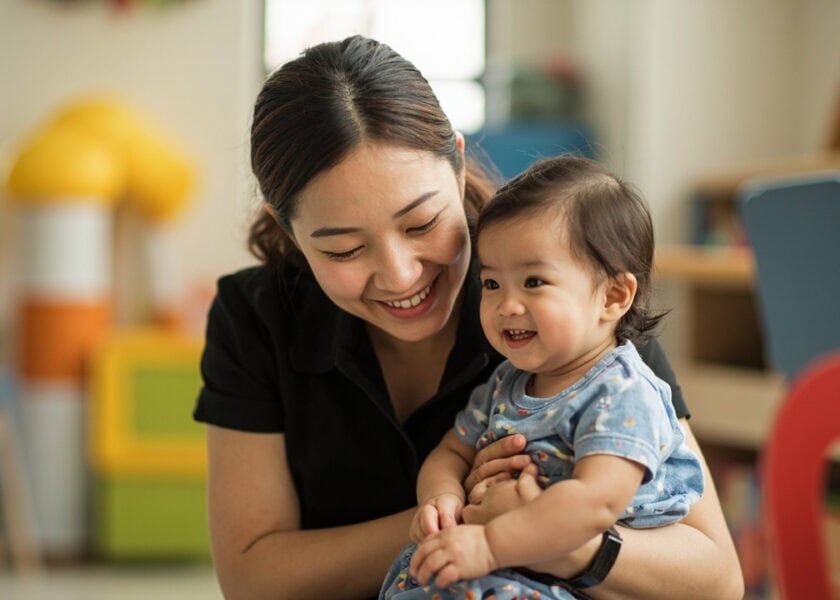
The Guilt After Drop Off Is Not Failure It Is Devotion
The Part of Singapore Parenting Nobody Tells You Is the Most Important
There is a moment, I think, that most Singapore parents know.
It happens after the drop-off. Your child has been handed over — sometimes crying, sometimes not — and you are walking back to the car or standing on the platform waiting for the MRT. The morning is already warm. You have a meeting at nine, or a report due, or simply the accumulated weight of a day that will demand everything you have.
And in that walk, or in that wait, something rises in your chest that you have learned not to name. It is not the relief you expected to feel when someone else took over. It is something quieter than that. Something that sounds like a question you cannot stop asking yourself:
Am I doing enough?
You push it down. You turn on the radio. You check your phone. You keep moving.
But the question is still there. It has been there for a long time.
This is the part of Singapore parenting that nobody puts into words. Not in the pamphlets you were given at the hospital, not in the parenting groups where everyone seems to be managing fine, not in the conversations at the playground where the bravado of modern motherhood and fatherhood holds steady.
The part where you are doing everything right — the best schools, the enrichment classes, the organic milk and the proper sleep routines — and still, in the quiet of your own car, you wonder if it is enough.
This article is not about your child. It is about you.
Here is what you need to hear:
- The guilt you carry after drop-off is not evidence of failure — it is evidence of love
- Choosing childcare with careful thought is itself an act of devotion, not a transfer of responsibility
- Your wellbeing as a parent is inseparable from your child’s development
- The right childcare partnership gives you back emotional capacity — which makes you a better parent
- Quality care sees both your child and you as a family unit that needs support together
The Weight Nobody Names
We live in a city that runs on excellence. Singapore has built its reputation on doing things well — on standards, on precision, on ambition. And somewhere along the way, that same energy has settled into the way we parent.
We plan. We research. We compare. We read the reviews, visit the centres, ask the questions that matter. We are, by any measure, extraordinarily conscientious parents.
But here is what that excellence costs. The mental load of modern Singapore parenting is not small. It is not a minor inconvenience that clever time management can solve. It is a constant, low-grade hum of evaluation:
- Is this food nutritious enough?
- Am I responding to his cry the right way?
- Should she be walking by now?
That hum runs beneath every decision, every interaction, every hour of every day.
The Arithmetic of Absence
For working parents, the arithmetic is especially unforgiving. You leave your child in the morning knowing that you will miss something.
You will miss the nap that only happens with the right person, in the right room, at the right time. You will miss the first time she stacks the blocks just right and looks around for someone to see. You will miss the small, ordinary miracle of being the one who is there.
And so you carry that absence with you through your workday, behind the spreadsheets and the emails and the commute home. You carry it, and you do not always have a place to set it down.
This is not a failure of character. This is not weakness, or a lack of commitment, or proof that you should have made different choices. This is what it means to love someone with your whole heart and to live in a world that requires you to be somewhere else while you do it.
The “Good Enough” Parent
There is a concept in child development psychology that has stayed with me for years. It is the idea of the “good enough parent” — a term coined by the British psychoanalyst Donald Winnicott to describe a parent who is not perfect, who does not anticipate every need before it arises, who does not hover and control and solve every problem before it becomes a problem.
The good enough parent is present, attentive, warm — but also imperfect. And that imperfection, Winnicott argued, is not a flaw. It is what allows a child to develop resilience. It is what teaches a child that the world is survivable even when things do not go perfectly.
In Singapore, we have somehow lost this idea. We have built a culture of parenting that treats every deviation from perfection as a threat. We are so afraid of doing something wrong that we have forgotten to trust what is already inside us:
- The instinct that tells us when our child is hungry
- The reflex that catches them before they fall
- The love that makes us worry this much in the first place
The guilt that Singapore parents carry is not a signal that something is wrong with your parenting. It is a signal that you care deeply. It is the shadow that love casts when it is met with an imperfect world.
The Quiet Voice You Need to Hear
If you have felt this, I want you to hear something clearly:
You are not failing. You are choosing.
And the act of choosing with care, with discernment, with the kind of agonising that most people never see — that is not evidence of your inadequacy. It is evidence of your love.
The parents who worry the most are almost never the parents doing the least. They are the parents who are paying attention. Who are trying. Who are reading this article right now instead of scrolling past, because something in you knows that this matters.
That is not deficiency. That is devotion.
What Quality Care Actually Gives You
Now let me tell you something practical, because the philosophy only matters if it connects to the reality of your life.
You are not just choosing childcare. You are choosing a partnership. You are choosing who will hold your child when you cannot, who will read the signals that tell them they are safe, who will be there for the moments you will only hear about secondhand.
The weight of that choice is real. The research you do, the questions you ask, the sleepless nights spent reading reviews and visiting centres — none of that is wasted. It is the invisible work that nobody sees but that shapes everything.
Why Your Wellbeing Is Not a Luxury
We have spent a long time talking about childcare as a solution for children — as though the only beneficiary of quality care is the child who receives it. And yes, the research on early childhood development is unambiguous. The first years of life matter enormously. Secure attachment in infancy creates the foundation for emotional regulation, for learning, for healthy relationships across a lifetime.
But here is what we have been slower to acknowledge: the quality of care also matters for you.
When your child is in an environment where they are safe, where they are known, where the person caring for them has the capacity to attune to their needs — something shifts in you. You breathe. You unclench. You have a little more to give when you come home at the end of the day.
You are not running on empty. You are not spending every moment at work wondering whether she is crying, whether he is being held, whether the routine you worked so hard to establish is falling apart in your absence.
Parental wellbeing is not a luxury. It is not something you get to after the children are in bed and the dishes are done and the work is finished. It is foundational. It is the thing that determines whether you can be present, patient, warm, and responsive when your child needs you at the end of a long day.
When parents are supported — when their emotional needs are met, when they are not running on guilt and exhaustion and self-doubt — they parent better. Not perfectly. Better.
The quality of your care for your child and the quality of care you receive, for yourself, are not separate things. They are the same thing, wearing different clothes.
The Elements That Change the Drop-Off
Consider what actually happens in the best childcare scenarios:
- Consistency: Your child sees the same caregiver, in the same environment, day after day. They build familiarity. They build trust. And so do you.
- Personalisation: The caregiver knows your child’s rhythms — not just their schedule, but their temperament, their preferences, the particular sound they make when they are tired versus hungry.
- Attunement: With smaller ratios and unhurried attention, your child is not one of many. They are known. They are seen.
- Communication: You know what is happening during the day. Updates, transparency, open channels — these are not luxuries. They are what allow you to let go.
Care Versus Partnership
Care is transactional. It is the minimum standard met, the ratio maintained, the checkbox completed.
Partnership is relational. It is the recognition that your family — your child, yes, but also you — is a unit that needs to be held together. It is the understanding that when you are supported, your child is supported. That when you trust the person holding your child, the weight you carry becomes a little lighter.
EduNanny by BUTLER: Built for the Whole Family
EduNanny grew from a simple but profound observation: Singapore parents were being offered a choice that was not really a choice at all.
The centre-based pathway, with its schedules and ratios and institutional rhythms, or the ad-hoc arrangements, with their uncertainty and inconsistency. What was missing was something in between — a model of care that felt like family, that could adapt to the rhythms of a real family’s life, that saw the child and the parent as a unit that needed support together.
The ECDA Childminding Pilot and What It Means for You
The ECDA Childminding Pilot exists because Singapore recognises that one size does not fit all when it comes to raising the next generation.
Home-based care — whether through a trained childminder in a family setting or within a community or centre-based pathway — offers something that institutional care often cannot: consistency, personalisation, and the kind of unhurried attention that allows a child to feel truly held.
With ratios of up to one to three infants, the kind of attunement that is possible is qualitatively different. The child is not one of fifteen in a room. They are known. They are seen.
What This Looks Like in Practice
- Pilot fee structures are designed to be affordable for working families
- CDA and Baby Bonus can be used — the financial architecture of early childhood care is considered from the beginning, not added as an afterthought
- Monday to Friday care blocks are structured to align with the rhythms of working family life
- Communication and transparency — including CCTV measures where deployed, regular updates, open channels — are part of the philosophy, not add-ons
This Is Not About Outsourcing Love
It is about building a village.
It is about accepting that raising a child in modern Singapore was never meant to be done alone, and that the wisdom to ask for help is not a sign of weakness but of strength.
Addressing the Concerns You Actually Have
“Am I giving up something only I can give?”
No parent can be everything to their child. That is not a failing — it is a reality. What children need is not a parent who is always present, but a parent who is present when present — warm, responsive, attuned. Quality external care does not replace your attachment to your child. It supplements it with consistency and support that allows you to be more present, not less.
“How do I know it is good enough?”
You will never have certainty — and that uncertainty is part of loving someone this much. But you can have confidence. Look for caregivers who are trained and regulated. Look for environments where your child is known as an individual. Look for communication that keeps you connected even when you are apart. And look for a partner who sees your anxiety as reasonable, not as burden.
“I feel guilty even thinking about it.”
That guilt is the tax you pay for loving your child this much. It is not a sign that you are doing something wrong. It is a sign that you take this responsibility seriously. The question is not how to eliminate the guilt — you cannot — but how to hold it alongside the knowledge that you are doing everything you can.
“What if something happens while I am not there?”
This fear is universal and it is real. But it is also a sign of how much you care. Quality care arrangements do not eliminate risk — nothing does. What they do is create environments where your child is safe, known, and held. And they give you back the capacity to be fully present when you are with your child, instead of running on anxiety and exhaustion.
How to Choose Well
If you are in the process of evaluating infant care options in Singapore, here is what matters — not just for your child’s development, but for your own peace of mind.
Questions to Ask Yourself First
- What are my non-negotiables — for my child’s safety, but also for my own peace of mind?
- What routine or rhythm does my child need that I cannot provide alone?
- What would make me feel comfortable enough to let go, even slightly, during the day?
- What kind of communication would help me trust the arrangement?
Questions to Ask Any Caregiver or Centre
- What is the training and background of the primary caregiver?
- What is the ratio of caregivers to children?
- How do you handle feeding, sleeping, and soothing routines?
- What does communication with parents look like on a typical day?
- How do you support families during separation anxiety, illness, or transitions?
Signs You Have Found the Right Partnership
- You feel heard when you express concerns or preferences
- The caregiver knows your child as an individual, not just a schedule
- Communication is proactive, not reactive
- You feel, slowly, over time, that the guilt loosens its grip
- Your child is happy — not just quiet, but genuinely engaged and at ease
You Were Never Meant to Do This Alone
I want to close by speaking directly to you, wherever you are in this journey.
If you are reading this, and you are in the thick of it — the exhaustion, the second shift of worry, the self-questioning that happens when the house is finally quiet — I want you to know that you are seen.
The work you are doing is not invisible. It is not small. It is not less than what another parent would do in your place.
You are not failing. You are carrying something heavy because the person you love is worth carrying it for.
And when you make the choice to seek out quality care — not just any care, but care that you have thought about, worried about, researched and agonised over — that choice is an act of love. Not a transfer of responsibility. Not an admission of defeat.
An act of love that extends beyond your child to include yourself, because you understand, finally, that you cannot pour from an empty cup, and that the parent who is rested, supported, and at peace is the parent your child needs most.
The Quiet Truth
Singapore parents are not failing. You are loving.
And that love, when it is seen and supported and given room to breathe, becomes something extraordinary — for your child, for your family, and for you.
Ready to Find Support That Sees You?
EduNanny by BUTLER exists because we believe that choosing well for your child and choosing well for yourself are the same decision.
We are here not just to care for your infant but to care for your family — to be the kind of partner that gives you back something you did not know you were losing.
If you are ready to explore what that looks like — what it feels like to be truly supported in this, the most important work of your life — we would be honoured to walk this road with you.
Because you were never meant to do this alone. Welcome to EduNanny.
#SingaporeParenting #ChildmindingSG #WorkingParentsSingapore #EduNanny #InfantCareSingapore