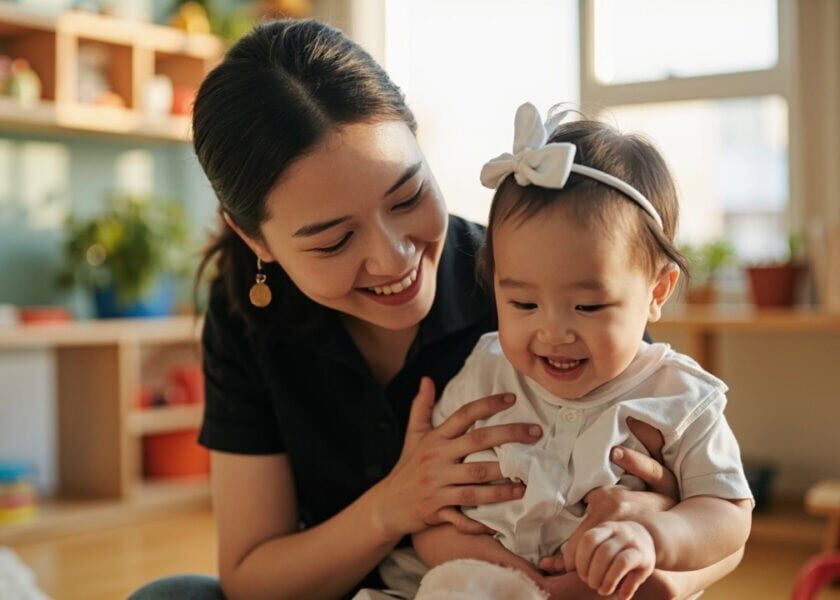
What Singapore Parents Only Understand Years Later
The Moment That Changes Everything
There is a moment that every Singapore parent eventually arrives at, though none of us know to look for it.
It happens at a Primary One orientation, or perhaps during a parent-teacher meeting in those first weeks of formal schooling. Your child walks into a room full of strangers—new faces, new expectations, a new world—and instead of the anxiety you braced yourself for, something else unfolds.
They move toward other children. They try. They adapt. They ask questions. They bounce back when things do not go their way. They look at their teacher with something that resembles trust.
And you find yourself thinking, against all the worry you carried in those early years: where did that come from?
The honest answer is that it came from you. From the choice you made, perhaps years earlier, in a moment of uncertainty and exhaustion and love. A choice made without certainty, without guarantees, and often without the full picture of what you were actually building.
That is the moment this article is about. Not the choosing itself, which comes with enough pressure already. But what comes after. The long view. What Singapore parents only understand years later, when they see their child in that classroom and realize that the qualities they are witnessing did not appear from nowhere.
They were cultivated. Quietly. Consistently. In those earliest years that feel so overwhelming in the moment but reveal their shape only with time.
What the Early Years Actually Build
When we become parents in Singapore, we enter a landscape of choices that can feel both abundant and suffocating. We are told that the early years matter. That the brain develops fastest in the first thousand days. That the attachment we build with our children will shape their futures.
All of this is true—remarkably, overwhelmingly true—but somewhere between the parenting books and the maternity leave timelines and the return-to-work negotiations, we are rarely given the one thing that would help us most: perspective.
We make childcare decisions in a pressure cooker. We choose while we are still recovering from birth, while we are learning the particular rhythm of our own child’s cry, while we are trying to remember what sleep felt like. We choose with our hearts open and our minds scrambled and our hands full in the most literal sense.
We choose without knowing what we are choosing for.
And then, if we are fortunate—if we chose well—we get to watch the years unfold. We get to see our children enter school, enter friendships, enter the world. And only then does the full picture begin to emerge.
I have spoken with many Singapore parents in this position. Parents whose children are now in Primary Three or Primary Four, navigating the demands of a formal education system. Parents who have moved past the fog of early parenthood and can see, with some clarity, what actually happened during those childcare years.
What strikes me consistently is what they notice.
They notice that their child’s ability to sit with frustration did not arrive spontaneously in Primary One. It was built, session by session, interaction by interaction, in the months and years before.
They notice that their child’s ease with other children—the way they can enter a group, share space, read social cues—came from somewhere. They did not simply arrive with this capacity.
They notice that their child approaches new situations with quiet curiosity rather than dread, and they trace that back to early experiences of being in new environments with trusted, attentive caregivers who helped them make sense of the unfamiliar.
What these parents are recognizing is that the qualities we hope to see in our children—resilience, curiosity, emotional steadiness, relational warmth—are not inherited and then simply appear. They are built. And they are built in the environments we create during those formative years, including the childcare environments we choose.
How Executive Function and Social Confidence Develop
Let me share something that parents in Singapore are increasingly recognizing in hindsight: the development of executive function.
Executive function describes the cognitive capacities that allow us to plan, focus, manage impulses, and adapt to changing demands. It is the operating system of self-regulation. Research over recent decades has made increasingly clear that executive function begins developing in infancy and early childhood, not in Primary One.
The capacities that allow a child to wait their turn, to shift attention when asked, to keep working on a task despite frustration—these are not born fully formed. They are cultivated in environments that provide the right kinds of supports and challenges.
When Singapore parents look back at their child’s early childcare experience, many of them begin to recognize this. They remember their child being supported through moments of frustration—not rescued from them, but accompanied through them. They remember caregivers who were attentive to emotional states, who helped children name what they were feeling, who created predictable routines that allowed children to develop a sense of safety and anticipation.
They remember environments that were stimulating but not overwhelming, structured but not rigid.
These are the conditions in which executive function grows. Not through worksheets or formal instruction, but through the ordinary texture of daily care. And when parents see their Primary One child managing transitions, sustaining attention, handling disappointment with equanimity, they begin to understand what was happening all along.
The same principle applies to social confidence. I have heard this from many parents: they were surprised, in those early school weeks, by how easily their child entered peer relationships. How comfortable they seemed in group settings. How their child had, apparently, some native capacity for social ease.
But when these parents look back, they recognize that this was not native at all. It was learned. It was learned in the childcare environment, where children first encountered peers as a consistent social fact. Where they had their first experiences of sharing, of conflict, of negotiation, of repair. Where caregivers facilitated these interactions with skill and intention, helping children develop the social vocabulary they would need.
None of this shows up on a report card. None of it is tested. But it is there, and it matters, and the parents who have lived long enough to see it tend to feel something like awe when they recognize it.
The Caregiver Relationship and the Question of Cost
There is another thing that parents in Singapore often reflect on when they have the distance of years: the quality of the relationship with caregivers.
In the early years, this relationship is the invisible backbone of the whole enterprise. You are trusting someone else with the most precious thing in your life. You are watching your infant form an attachment with another adult, and this can be complicated—beautiful and necessary and also freighted with emotions that are hard to name.
The caregiver is not a surrogate parent, but they are more than a service provider. They are a significant figure in your child’s developmental landscape, and the nature of that relationship matters in ways that are hard to quantify.
When I speak with parents whose children have moved through the childcare years and into school, the ones who speak most warmly are often the ones who remember feeling genuinely partnered. Not just kept informed, but included. The caregivers who shared observations, who noticed things, who communicated with both professionalism and warmth. The ones who treated the parent not as a client to be managed but as a fellow human being who loved this child and wanted to understand them.
This is what the best childcare provides: not just supervision, but attention. Not just safety, but cultivation. Not just a service, but a relationship that becomes part of your child’s early understanding of the world.
Addressing the Cost Question Honestly
I want to address something directly, because Singapore parents deserve this honesty: the question of cost.
We live in a city where the cost of childcare is significant. Where the numbers on the monthly invoice are real, and the calculations about what makes financial sense are not abstract. And in the pressure of those early years, when you are making the decision under uncertainty, it is natural to wonder whether the investment is worth it.
Whether you are paying for something that would happen anyway, or whether the premium you are paying is actually purchasing something that makes a difference.
The answer, from parents who have lived long enough to see the returns, is consistent: the childcare decision is one of the highest-return investments a family makes. Not because of academic metrics or developmental certificates, but because of what you are actually purchasing.
You are purchasing the conditions in which your child’s capacity grows. You are purchasing the environment in which executive function develops, in which social confidence is built, in which curiosity is nurtured and resilience is cultivated. You are purchasing the presence of attentive, trained caregivers who bring skill and intention to the work of caring for your child during the years when the architecture of their mind is being laid down.
Is this always true? No. Not every childcare arrangement is equal. The quality of the environment matters enormously, and choosing well is not simple. But for parents who made thoughtful choices, who found environments that were genuinely good for children, the retrospective evidence is compelling. The investment paid dividends that continue to compound.
This is why reframing helps. If we think of childcare purely as a logistical expense—a cost of working—the numbers will always feel painful. But if we think of it as what it actually is, the earliest and in many ways most consequential educational investment we make in our children’s lives, the frame shifts. The returns do not show up immediately, but they show up. And when they do, the clarity is unmistakable.
The Paradox of the Invisible Years
The most important things that happen in those early years are, by their nature, invisible.
They are invisible in the sense that they cannot be photographed or easily articulated. They are invisible in the sense that they accumulate so gradually that we cannot see them happening. A child who learns, over eighteen months, that their emotions can be named and held and soothed does not arrive at that capacity in a single dramatic moment. They arrive there through hundreds of small experiences, each one unremarkable on its own, all of them together building something profound.
This is the paradox that Singapore parents confront when they look back. The investment they made—the fees they paid, the search they undertook, the trust they extended to caregivers—they cannot see exactly where that investment went. They cannot point to a receipt or a certificate that says: here is the moment your child’s capacity for self-regulation was developed. Here is where their peer confidence was constructed. Here is the record of their executive function taking shape.
And because this work is invisible, it is easy to doubt. Easy to wonder, in the middle of those exhausting early years, whether any of it matters. Whether the decision you made was the right one. Whether the monthly fees are worth it, or whether you are simply paying for babysitting while you work.
These doubts are not failure. They are the natural consequence of investing in something whose returns are long deferred. And they are the reason that the retrospective perspective matters so much—not to make us feel guilty about our past doubts, but to help us recognize, with gratitude, that the investment was real and that it bore fruit.
What Quality Childminding Actually Looks Like
If you are a parent researching childcare options right now, you may be wondering: what should I actually be looking for? How do I evaluate something when the most important outcomes are invisible and long-term?
Here is what the evidence and the retrospective wisdom of experienced parents suggest matters most.
Ratios that allow for real attention
In infant care, the ratio of caregivers to children determines whether attention is possible. When caregivers are stretched too thin, the small moments—the naming of an emotion, the accompaniment through frustration, the celebration of a small triumph—simply cannot happen. Look for arrangements where caregivers can actually see, hear, and respond to your child.
Consistency and continuity
Children build trust and security through predictable relationships. A rotating cast of caregivers undermines the attachment that underlies everything else. Look for environments where your child can form a lasting bond with the people caring for them.
Emotional attunement
The caregivers notice what your child is feeling. They name emotions aloud. They help children find words for what is happening inside them. This work of emotional attunement is not visible in the moment, but it is the foundation of the self-regulation your child will draw on for years to come.
Facilitated peer interaction
Social skills are not learned by osmosis. They are learned through guided experience. Look for environments where caregivers actively facilitate peer interactions—helping children share, negotiate, resolve conflict, and repair relationships. These are the experiences that build social confidence.
Partnership with parents
The best childcare arrangements treat parents as partners, not clients. Caregivers who share observations, who communicate honestly about both triumphs and challenges, who include you in your child’s day rather than keeping you at a distance. This relationship matters for your child, because the consistency between home and childcare environment builds security.
An environment that feels like home
For infants and young children, the physical environment matters. Home-based care can offer warmth, consistency, and a scale that allows for genuine attention. Institutional settings have their advantages, but the intimacy of a home environment often supports the attachment and exploration that young children need.
For Parents Making This Decision Now
If you are making this decision right now, in the fog of early parenthood, without the gift of hindsight, I want to speak to you directly.
The uncertainty you feel is not a sign that you are unprepared. It is a sign that you care deeply. And the care you bring to this choice—the attention, the research, the deliberation—is itself part of what will serve your child well.
Not because you need to be perfect. But because you are paying attention. And paying attention is the beginning of everything.
Here is what I would suggest as you evaluate your options.
Trust your instincts, but verify. Your gut feeling about a caregiver matters. But so does concrete evidence: training, ratios, communication practices, transparency measures. Look for both.
Ask about the small moments. When you visit a potential childcare arrangement, ask them to describe a typical day. Ask how they handle a child who is frustrated. Ask how they facilitate sharing between children. These small answers reveal the philosophy underneath.
Look for partnership, not just service. You want caregivers who see themselves as working with you, not for you. Who communicate not just when there is a problem, but as a matter of course. Who treat you as the expert on your own child.
Consider the long arc. The decision you make now will shape your child’s experience during the most formative years of their development. This deserves more than a checklist of logistics and a comparison of fees. It deserves attention to what you actually want for your child, and who you trust to help you build it.
Remember that doubt is normal. The parents who look back with gratitude also felt doubt in the moment. Doubt does not mean you are making the wrong choice. It means you understand the weight of what you are deciding.
The Truth That Emerges
Let me close by returning to that moment I described at the beginning.
You are at Primary One orientation. Your child is in a room full of new faces. And instead of the anxiety you feared, you see something else.
You see them try. You see them adapt. You see the beginning of a social world that they navigate with something like ease. You see resilience and curiosity and warmth.
And you think: where did that come from?
The answer is that it came from you. From the choice you made. From the years you invested, in money and in trust and in showing up and in allowing others to show up for your child. From the invisible work of early care that you could not see but that was happening anyway, building something that would last.
You did not know, when you made that choice, what you were choosing. None of us do. We choose in the fog, and we hope, and we trust, and we extend ourselves in love without guarantees.
But the parents who have lived long enough to see—they will tell you that the fog lifted. That the investment was real. That the returns were there, even when they could not be seen. That the childcare decision they made years ago was, without exaggeration, one of the most consequential decisions of their parenting lives.
This is what the long view reveals. Not that the choice was easy, but that it was worth it. Not that there were no doubts, but that the doubts did not mean the investment was wrong.
Your child will carry what they learn in these years into every room they enter for the rest of their life. The school classroom, the friendship circle, the workplace, the family they will someday create of their own.
Choose thoughtfully. Choose with attention. And trust that the long view will reveal what the present moment cannot yet show you.
This is the truth that Singapore parents come to understand, years later, when they see their children thrive.
For families seeking a childcare arrangement built on the principles described here—genuine attention, developmental intention, and thoughtful partnership—EduNanny Singapore offers home-based childminding under the ECDA Childminder Pilot, with small ratios, consistent caregiver relationships, and a commitment to transparency that helps parents move forward with confidence. Reach out to learn more about how EduNanny supports families through these formative years.