The Care Ecosystem Every Singapore Family Deserves
The Reality of Singapore Childcare: A Conversation Families Need to Have
There is a moment that every Singapore parent knows, even if no one has ever written a book about it. It happens sometime between six and eight in the morning, usually on a Tuesday, when you are trying to leave for work but your child is crying and your mother-in-law has just texted the family group chat to say she thinks you are dressing the baby too lightly.
Your helper is standing by the door with the diaper bag, but she is not sure if she should offer the bottle now or wait until you leave, because last week you said one thing and your husband said another, and neither of you remembered to tell each other what you had decided.
Your child is watching all of this. Your child has been watching all of this since before they could speak.
This is not a scene from a parenting manual. This is Tuesday morning in a HDB flat in Bedok, in a condo in Bishan, in a landed property in Serangoon. It is Tuesday morning in ten thousand Singapore households, and almost none of us were ever taught how to do this.
We were not taught how to coordinate care across three generations. We were not taught how to translate our values about early childhood into a language that a helper who learned to bottle-feed from a YouTube video can understand. We were not taught how to have a conversation with our own parents about why we want them involved but also differently involved, and why the way they raised us—however lovingly—cannot be exactly the way we want our children raised.
We figured it out as we went. Most of us are still figuring it out. And in the figuring out, we carry something that rarely gets named: the invisible labour of holding a care ecosystem together.
The Gap Between the Old Story and the New Reality
For decades, the conversation about childcare in Singapore has been framed around a single relationship: parent and caregiver. As if the challenge were simply finding someone trustworthy to look after your child while you work. As if the question were answered once you found a good infant care centre or hired a reliable helper.
But anyone who has lived inside this knows that the question does not end there. For Singapore families, childcare is almost never a single relationship. It is a living ecosystem—a complex, interconnected system of people, expectations, physical spaces, and daily rhythms that your child moves through and depends upon.
Consider what this ecosystem actually contains for most Singapore households:
- Grandparents who live nearby and want to be involved, bringing love and generational wisdom but also generational expectations
- Domestic helpers who may have arrived with excellent intentions and some experience, but no framework for the particular pressures of a Singapore household
- Professional caregivers at infant care centres or through services like EduNanny, operating in their own world with their own philosophy
- And underneath all of this, the parents themselves—who are somehow supposed to orchestrate consistency, maintain their careers, preserve their marriages, and still be present enough that their child knows who they are
A Design Challenge, Not a Problem
The difference matters enormously. A problem implies something has gone wrong, something that needs fixing, something to feel guilty about. A design challenge implies something you can build—something you can approach with intention, with principle, with the same rigour you might bring to any other complex system in your life.
When you design a care ecosystem rather than inherit one, you stop reacting and start creating. You stop managing guilt and start building something that works.
The Singapore families who navigate this most successfully are not the ones who have the most help or the most money or the easiest grandparents. They are the ones who figured out—consciously or not—that a childcare ecosystem can be architected. That each person in the system has a role, and that role can be defined. That communication rhythms can be established. That developmental consistency can be maintained even when the physical environments change.
The village your child needs is not a given. It is a creation.
Complicated vs. Complex: Why the Difference Matters
There is a concept that comes up in systems thinking that I find useful here: the difference between a complex system and a complicated one.
A complicated childcare arrangement is a list: grandparent on Mondays, helper on Tuesdays and Wednesdays, infant care centre on Thursday and Friday. The items on the list may not know each other well. They may not communicate. They may be working from different philosophies about what a child needs.
The child experiences a series of somewhat disconnected environments, and someone—the parent, usually—spends enormous energy trying to create consistency from the outside.
An intentional care ecosystem is different. It is designed so that the parts communicate with each other. It is built on shared principles—about language exposure, about discipline, about sleep, about play—that each caregiver understands and reinforces.
The child experiences not a series of disconnected environments but a coherent world, where the same values apply whether they are with their grandmother or their EduNanny caregiver or at the infant care centre. The transition between settings becomes smooth rather than jarring. The child feels held by the system, not bounced between strangers.
Research on early childhood development consistently shows that children develop best when their environments are predictable and responsive—when they know what to expect and when the adults around them are attuned to their needs. A fragmented care system creates cognitive load for the child. This is not catastrophic, but it is unnecessary. With intentional design, it can be avoided.
The People in Your Ecosystem
Grandparents: The Most Emotionally Loaded Relationship
Most Singapore parents want their parents involved. The research on this is consistent across cultures: children benefit from relationships with grandparents, and families benefit from the practical support that grandparents provide. In Singapore’s context, where dual-income households are the norm rather than the exception, and where the cost of living makes professional childcare a significant investment, grandparent involvement is not a luxury. For many families, it is the only way the mathematics works.
And yet. The moment a grandparent becomes a regular caregiver rather than an occasional visitor, something shifts. The grandparent is no longer simply loving a grandchild. They are now doing childcare. And doing childcare means making hundreds of small decisions every day that were once yours to make.
Consider the questions that arise:
- What do you feed the child for snack?
- Do you let them watch television?
- How do you handle a tantrum?
- Do you follow the same sleep routine?
- Do you speak to them in Mandarin or in the accented English they hear from their parents?
These questions are not problems. They are simply the normal friction of any system where multiple people share responsibility for the same child. The families who navigate this most gracefully are not the ones who resolved these questions perfectly. They are the ones who developed a shared language for talking about them.
They learned to separate what matters enormously from what matters a little, and to communicate those distinctions clearly. They found ways to ask a grandparent to adjust a practice without making it feel like a rejection of everything they did right.
This is harder than it sounds. Most of us were raised in a cultural context where questioning our parents’ choices was, if not forbidden, then certainly uncomfortable. And now we are supposed to sit across the dining table from the people who raised us and explain that while we are deeply grateful for their help, we would prefer they not give our eighteen-month-old a biscuit every time she cries.
This requires a kind of emotional courage and diplomatic skill that we were not taught in school. It requires us to hold two truths at once: that our parents love our children, and that love alone does not make someone the best person for every caregiving role.
How Premium Childcare Strengthens Grandparent Relationships
Here is what many families miss: the families who navigate this well have learned to be curious rather than critical. They ask questions before they give instructions. They acknowledge what grandparents do well before they raise concerns. They find the genuine value in the grandparent’s approach—even when it is different from their own—and they build from that foundation rather than tearing it down.
They remember that their child is learning something important from this relationship too: that people can love each other even when they do things differently, and that families can adapt and negotiate and stay together.
When a professional caregiver provides the developmental framework—the intentional language exposure, the sensory-rich activities, the consistent attunement to the child’s emotional world—grandparents are freed from the pressure of having to be everything.
They can simply be grandparents. They can spoil. They can play. They can offer the irreplaceable gift of unconditional love without the burden of also being educators and developmental guides.
A well-designed ecosystem distributes roles so that each person can operate in their zone of greatest strength and greatest joy.
The Helper in the Room
In Singapore, she usually is in the room, and pretending otherwise does no one any good.
Domestic helper is the official term. But in practice, she is often the person who feeds your child breakfast and wipes away the tears at drop-off and gives the evening bath and reads the bedtime story and knows that the baby only sleeps when the white noise is on and the door is closed exactly three-quarters of the way.
In many Singapore households, she is the connective tissue of the entire care system.
And yet. When many of these helpers arrived in Singapore, the training they received for early childhood care ranged from minimal to non-existent. They learned to cook and clean because that was what they were hired to do. The baby was something that happened alongside the household work, something they were expected to figure out.
This is not a criticism. It is a reality. And families who want a genuine care ecosystem rather than a care patchwork need to face this reality honestly.
A helper who means well is a wonderful thing. A helper who is also trained in early childhood development, who understands the milestones and the rhythms and the science of infant brain development—that is something different. That is a professional.
The question is not whether your helper loves your child. Most helpers do. The question is whether your care ecosystem is designed in a way that gives your child the developmental intentionality they need, even in the spaces where trained professionals are not present.
The Invisible Labour Every Singapore Parent Carries
I want to pause here and name something that gets lost in conversations about childcare logistics: the emotional weight that Singapore parents carry.
There is guilt, of course. Most parents feel it in some form—whether they work outside the home or not. The guilt of leaving your infant with someone else. The guilt of not being present enough. The guilt of asking too much from aging parents or of feeling trapped by their involvement. The guilt of not being grateful enough for help that you also did not choose.
But there is something beneath the guilt that is less often named, and I think it is even more significant.
It is the loneliness of being the only person who sees the whole picture. The person who knows what the child ate for breakfast and when they last napped and what words they are starting to say and which children at playgroup they gravitate toward and what makes them laugh and what makes them sad.
The person whose mind is running calculations all day long about transitions and timing and who needs to know what. The person who holds the memory of the child’s birth and also the grocery list and also the reminder to call the pediatrician and also the knowledge that you have not had a real conversation with your spouse in weeks.
This is the invisible labour. It does not show up on any chore chart. It is not compensated. It is not always acknowledged, even by the people doing it.
And it is a significant contributor to why Singapore parents—so many of them capable, accomplished, resource-rich—feel so overwhelmed.
What Intentional Design Actually Offers
A well-designed care ecosystem does not eliminate this labour entirely. But it distributes it differently.
When grandparents, helpers, and professional caregivers are aligned around shared principles, the parent is no longer the only one holding the system together. The parent becomes a member of the team rather than the team manager.
The cognitive load lightens. The loneliness lifts, because there are now other people who understand what you are building and why.
This is one of the most powerful gifts that intentional design can give. Not more time, because we cannot manufacture hours that do not exist. But more shared understanding. More team. More village.
Building Your Care Ecosystem: A Practical Framework
The question is how. How do you build a genuine ecosystem rather than a patchwork? How do you create the conditions for coherence when you cannot control every interaction?
The answer is not perfection. It is principle.
Start With Your Own Clarity
You start by being very clear, internally, about what you believe your child needs and why.
- What is non-negotiable for you?
- What are you willing to be flexible about?
- What does developmental consistency actually mean in your family’s context—with your child’s temperament, your cultural background, your own upbringing?
Communicate as Shared Understanding
Once you know your principles, you can communicate them. Not as a list of rules to be followed, but as a shared understanding of what you are all building together.
The grandparent who knows that intentional language exposure matters to you—and understands why—will make different choices than one who simply received a memo that said “speak more Mandarin.”
The helper who understands that your child’s fussiness in the late afternoon is connected to overstimulation rather than hunger will respond differently than one who just sees a crying baby and reaches for a biscuit.
Build Over Time
This kind of communication is not easy. It requires trust, which takes time to build. It requires ongoing conversation, which takes energy you may not feel you have.
But it is the work that makes the ecosystem function. It is the work that transforms a collection of well-meaning people into a team.
What Quality Childminding Actually Looks Like
Before you can build your ecosystem, you need to know what you are building toward. Quality childminding is not just supervision. It is not merely keeping your child safe and fed while you are at work. It is the active, intentional cultivation of your child’s developmental environment.
Here is what this looks like in practice:
- Language-rich interaction: Your caregiver talks to your child throughout the day—not just commands, but commentary. Describing what you are doing, naming what you see, responding to what your child expresses. This is not chatter. This is the raw material of language development.
- Responsive attunement: Your caregiver notices the cues—fatigue before the crash, hunger before the meltdown, overstimulation before the tantrum. She responds to the need, not just the behaviour.
- Sensory-rich environments: Play that engages multiple senses, materials that invite exploration, space that allows for movement and discovery.
- Emotional warmth: A relationship where your child feels genuinely known and held—not just watched, but attuned to.
- Consistent routines: Predictable rhythms that help your child feel secure and regulate their own bodies.
EduNanny: Your Ecosystem’s Professional Anchor
EduNanny operates within the ECDA Childminding Pilot—a government-supported initiative that expands the pathways available to Singapore families for infant and toddler care. The pilot makes professional childminding more accessible, with fee structures designed to be affordable for families across a range of circumstances.
For families with a Child Development Account, CDA funds can be used, and Baby Bonus provisions apply where eligible. Care is available Monday through Friday, with coverage across Singapore.
The EduNanny Model: Home-Based, Professional, Intentional
The EduNanny model is home-based. A trained caregiver comes to you—into the environment your child knows best—and provides attentive, intentional care at ratios of up to one to three infants.
This ratio differs from what most infant care centres can offer, where the demands of group care mean that individual attention is structurally limited. The EduNanny model combines the intimacy and personalisation of in-home care with the training, vetting, and professional standards families expect from a premium service.
More Than a Caregiver: A Model and a Teacher
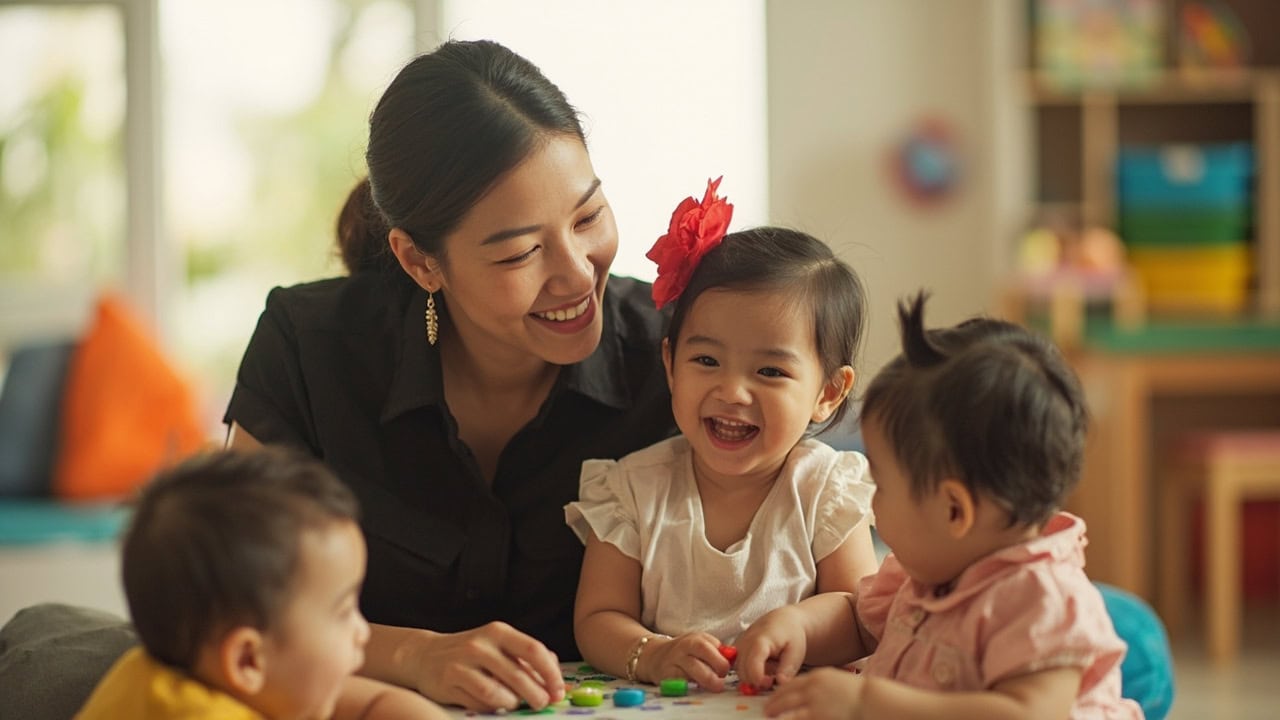
When EduNanny caregivers are present, they do more than attend to your child’s immediate needs. They demonstrate what intentional care looks like—the language-rich commentary, the responsive rather than reactive attunement, the sensory-rich play environments, the respectful and warm approach to a child’s emotional world.
Over time, this approach ripples outward. Your helper learns. Your grandparent observes. The standard of care across your ecosystem rises, because everyone is now operating within a framework they can see and understand.
EduNanny is not positioned as a replacement for your family. It is positioned as the professional anchor within your family’s village—the component that brings developmental intentionality and quality assurance to a system that, without it, might be excellent in some dimensions and absent in others.
Transparency, Trust, and Support Beyond the Physical
For families navigating complex care arrangements, knowing what happens when you are not in the room is not a luxury—it is a necessity. EduNanny implements communication and transparency measures, including CCTV protocols where deployed, so that parents can stay connected to their child’s day even when they are physically apart.
This is not about surveillance. It is about the confidence that comes from knowing your child is in good hands—and the peace of mind that lets you be present in your own life.
EduNanny has also introduced the Thomas AI Chatbot—a conversational tool that helps parents navigate the practical and emotional complexity of childcare coordination. Whether you have questions about developmental milestones, need advice on managing grandparent dynamics, or are simply looking for resources to support your ecosystem, Thomas is available to help.
Addressing Your Real Concerns
“Will premium childcare threaten my relationship with my helper?”
No. The most misunderstood aspect of professional childcare is that it is not about replacement. It is about architecture.
You are not firing your mother-in-law. You are not telling your helper she is not good enough. You are building a system where each component has a defined role, where professional quality provides the framework, and where everyone—grandparent, helper, professional caregiver, and parent—knows what they are contributing and why.
When a trained caregiver enters your home, your helper gains a colleague, not a competitor. She gains someone who can model best practices, who can explain the why behind certain approaches, who can share the cognitive load of understanding your child’s development. The relationship deepens into partnership.
“I feel guilty about asking my parents to step back.”
That guilt makes sense. You love your parents. You are grateful for their help. And yet you also know that something about the current arrangement is not quite right for your child—or for you.
A well-designed ecosystem often means your parents can be more involved, not less. When professional care handles the developmental intentionality, your parents are freed to simply love your child as grandparents. The Sunday lunches become visits, not shift changes. The relationship can return to what it was always meant to be.
“Can we actually afford this?”
The ECDA Childminding Pilot is designed to make professional childminding accessible to families across Singapore. CDA funds can be used, and Baby Bonus provisions apply where eligible. For many families, the cost is comparable to quality infant care centres—and the home-based model offers developmental advantages that group care cannot.
But here is the question worth asking: can you afford not to invest in intentional care? The first years of your child’s life are when the architecture of their brain, their emotional regulation, their language capacity, and their sense of security are being built. This is not the time for patchwork.
The Village Worth Building
The work of building a care ecosystem is not a problem to solve. It is a design challenge to embrace. And the families who embrace it—who approach their village with intention rather than accepting whatever patchwork falls into place—are not just surviving Singapore parenthood. They are building something remarkable.
They are building a child who feels held. A child who moves through multiple environments and finds consistency in each of them. A child who learns that love can take many forms and that families are not static but dynamic, not perfect but purposeful. A child who develops the security that comes from knowing, at a deep and wordless level, that the adults in their life are coordinated, are communicating, are aligned in their care.
They are building relationships with grandparents that are preserved rather than strained—the kind of relationships that deepen over years because the tensions were named and managed rather than allowed to fester.
They are building helper relationships that become partnerships, where the person caring for your child all day feels respected and supported and part of something meaningful.
They are building marriages that survive the early years because the system around them is working rather than collapsing. Because they are not constantly firefighting. Because the village is holding.
And they are building themselves back. The parent who enters a well-designed ecosystem begins to breathe again. The invisible labour becomes visible, shared, distributed. The loneliness lifts. The guilt, which was never really about childcare at all but about the impossible standard we set for ourselves, begins to soften.
This is what intentional design offers. Not perfection, because no system is perfect and no child will be raised in a perfect environment and no grandparent or helper or professional caregiver will ever do everything exactly as you would. But coherence. But alignment. But the assurance that you have done the work, that you have built something on purpose rather than accident, that the village your child lives in was designed with them at the centre.
EduNanny is proud to be part of that design. Not the whole thing—nothing can replace the irreplaceable roles of family—but a crucial component. The professional anchor. The quality standard. The trained, vetted, deeply attentive presence that brings developmental intentionality into your home and models what your child’s ecosystem can become.
Singapore has always been a place of families. Three generations living in proximity, sharing meals and responsibilities and the joy of watching children grow. We have the helpers who came from distant lands to become part of our households. We have the childcare centres and the infant care options and the after-school programmes. We have more moving parts than almost any other childcare context I can imagine.
And we have the opportunity, if we choose to take it, to approach all of this not as a burden to bear but as an architecture to build. To stop reacting and start creating. To design the village our children deserve, one intentional decision at a time.
The group chat will still exist. The Tuesday morning negotiations will continue. Someone’s grandmother will still worry about whether the baby is dressed warmly enough. This is Singapore. This is family. This is what it looks like to love people across generations and across expectations and across all the ways we sometimes fail to understand each other.
But the families who thrive in this context are not the ones who had it easier. They are the ones who built something—deliberately, lovingly, and with the kind of care they wanted their children to feel every single day.
That is the village worth building. And we are here, ready to be part of yours.
If you are ready to explore how EduNanny can serve as the professional anchor in your family’s care ecosystem, we invite you to start a conversation with us. Your village is waiting to be built.